Annual Sales Meeting Agenda: The 2026 Planning Playbook
A copy-ready annual sales meeting agenda for 2026 — hour-by-hour structure, a sample timeline table, and the prep that turns a kickoff into pipeline.
Your annual sales meeting is the single most expensive hour-block your revenue team will spend all year. Pull 40 reps off the phones for two days and you have burned a six-figure chunk of selling time before anyone touches a slide. The difference between a kickoff that pays for itself and one that everyone forgets by February is almost entirely the agenda.
This is the working playbook: a full annual sales meeting agenda you can copy, the timing that keeps energy up, the prep that makes it real, and the follow-up that stops it from evaporating.
TL;DR#
- An effective annual sales meeting agenda balances four blocks: look back (results), look forward (strategy and number), skill-building (enablement), and culture (recognition and connection).
- Cap any single sit-and-listen session at 45–60 minutes. Attention dies after that, and your most expensive audience tunes out.
- Anchor every session to a decision or an action — "what will reps do differently Monday?" — not just information transfer.
- Build the territory, quota, and account data before the meeting so reps walk out with assigned pipeline, not homework.
- Schedule the follow-up cadence (30/60/90-day check-ins) inside the agenda itself, or the energy decays within two weeks.
What is an annual sales meeting agenda actually for?#
An annual sales meeting agenda is the hour-by-hour plan that turns a company-wide gathering into aligned action on next year's number. Think of it like a flight plan: the destination (the annual target) is fixed, but the agenda is the route, the fuel stops, and the checklist that gets everyone there without circling the airport.
Most agendas fail in one of two predictable ways. They are either a parade of leadership status decks — quarter-by-quarter results no rep will remember — or they are a loose "team-building" retreat with no connection to pipeline. The fix is to treat the agenda as a product with a job to do: every block must change what a rep believes, knows, or does.
That job splits cleanly into four blocks. Get the proportions right and the rest is logistics.
What are the four blocks of a winning agenda?#
Block 1 — Look back (results and lessons)#
Open with honesty about last year, but keep it tight. Reps do not need a 30-slide regional breakdown; they need the three numbers that matter (attainment, win rate, average deal size) and the two lessons leadership is acting on. The goal is credibility: show that you read the data and changed something because of it. A useful frame is the team win rate trend — where did deals slip, and what is the plan to fix it?
Block 2 — Look forward (strategy, number, and territories)#
This is the spine of the meeting. Present the annual target, the segment strategy, and — critically — the individual quotas and territories. The single biggest predictor of a meeting that "sticks" is whether reps leave knowing exactly what they own. If territory and account assignments are still being negotiated on stage, you have moved planning work into your most expensive room.
Block 3 — Build skills (enablement)#
Pick one or two skills, not ten. A 90-minute workshop on a single motion — discovery, multithreading, or a new outbound sales strategy — beats a firehose of "10 tips." Make it hands-on: role-play, live call reviews, or a build-your-sequence lab. Skills taught passively from a slide do not transfer.
Block 4 — Connect (recognition and culture)#
Recognition is not filler. Public acknowledgment of top performers and "most improved" reps is one of the cheapest retention levers you have. Reserve real time for it, and protect unstructured connection time — dinners, small-group breakouts — because that is where cross-team trust actually forms.
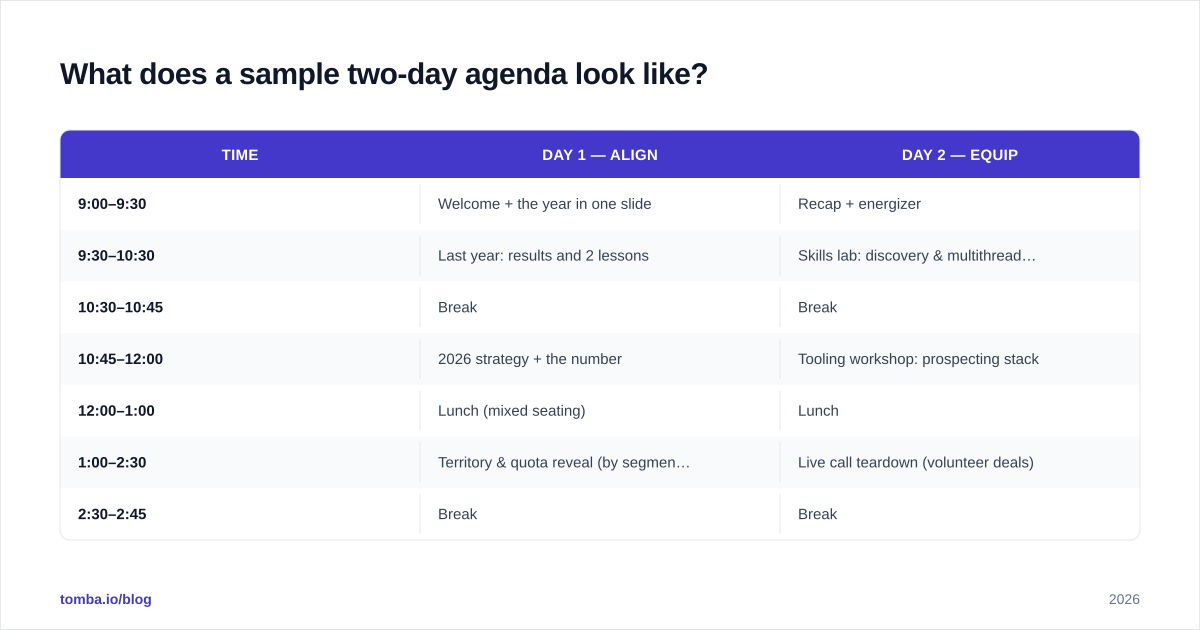
What does a sample two-day agenda look like?#
Here is a concrete annual sales meeting agenda you can adapt. It assumes a mid-size team (20–60 reps), an in-person format, and a 9-to-5 day with real breaks.
| Time | Day 1 — Align | Day 2 — Equip |
|---|---|---|
| 9:00–9:30 | Welcome + the year in one slide | Recap + energizer |
| 9:30–10:30 | Last year: results and 2 lessons | Skills lab: discovery & multithreading |
| 10:30–10:45 | Break | Break |
| 10:45–12:00 | 2026 strategy + the number | Tooling workshop: prospecting stack |
| 12:00–1:00 | Lunch (mixed seating) | Lunch |
| 1:00–2:30 | Territory & quota reveal (by segment) | Live call teardown (volunteer deals) |
| 2:30–2:45 | Break | Break |
| 2:45–3:45 | Product roadmap + competitive update | 30/60/90-day commitments (written) |
| 3:45–4:45 | Top-performer recognition | Q&A with leadership |
| 4:45–5:00 | Day 1 close + dinner logistics | Close + single call-to-action |
| Evening | Team dinner / awards | — |
Notice what is missing: no three-hour leadership monologue, and no single block longer than 90 minutes. The afternoon "reveal" and "commitments" sessions are where information becomes ownership.
How long should each session be?#
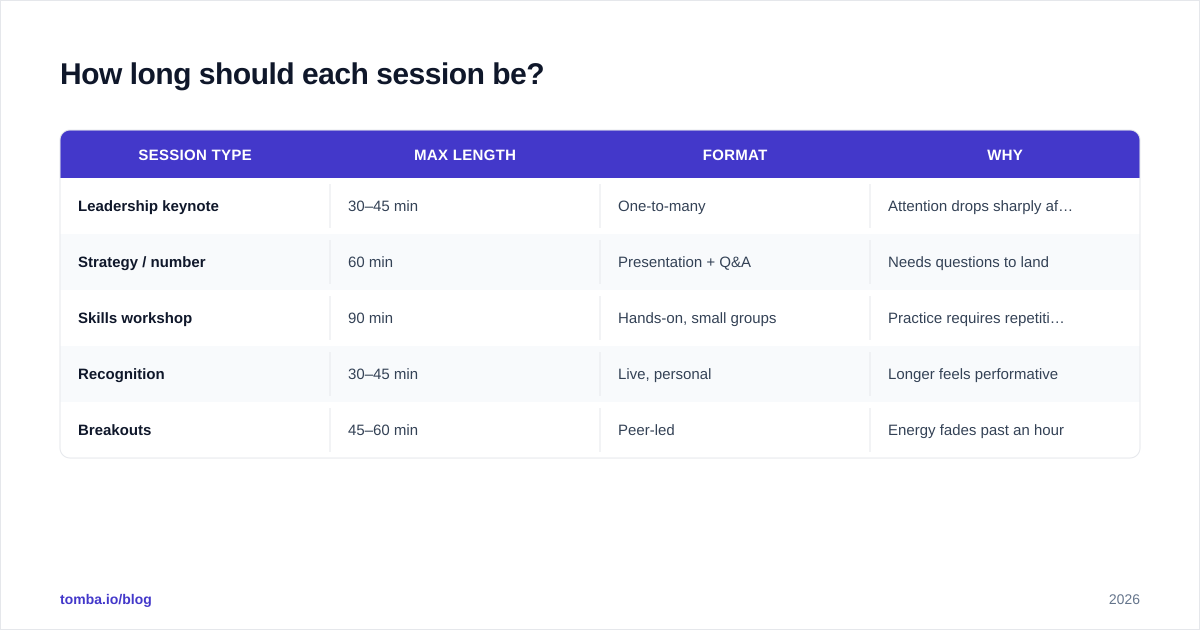
Match the format to the cognitive load. A passive listen-only keynote and an interactive workshop have very different shelf lives.
| Session type | Max length | Format | Why |
|---|---|---|---|
| Leadership keynote | 30–45 min | One-to-many | Attention drops sharply after 45 min |
| Strategy / number | 60 min | Presentation + Q&A | Needs questions to land |
| Skills workshop | 90 min | Hands-on, small groups | Practice requires repetition |
| Recognition | 30–45 min | Live, personal | Longer feels performative |
| Breakouts | 45–60 min | Peer-led | Energy fades past an hour |
The rule of thumb: if reps are only listening, cap it at 45 minutes. If they are doing something, you can stretch to 90. Anything beyond that and you are paying for daydreaming.
How do you prepare so the meeting drives pipeline?#
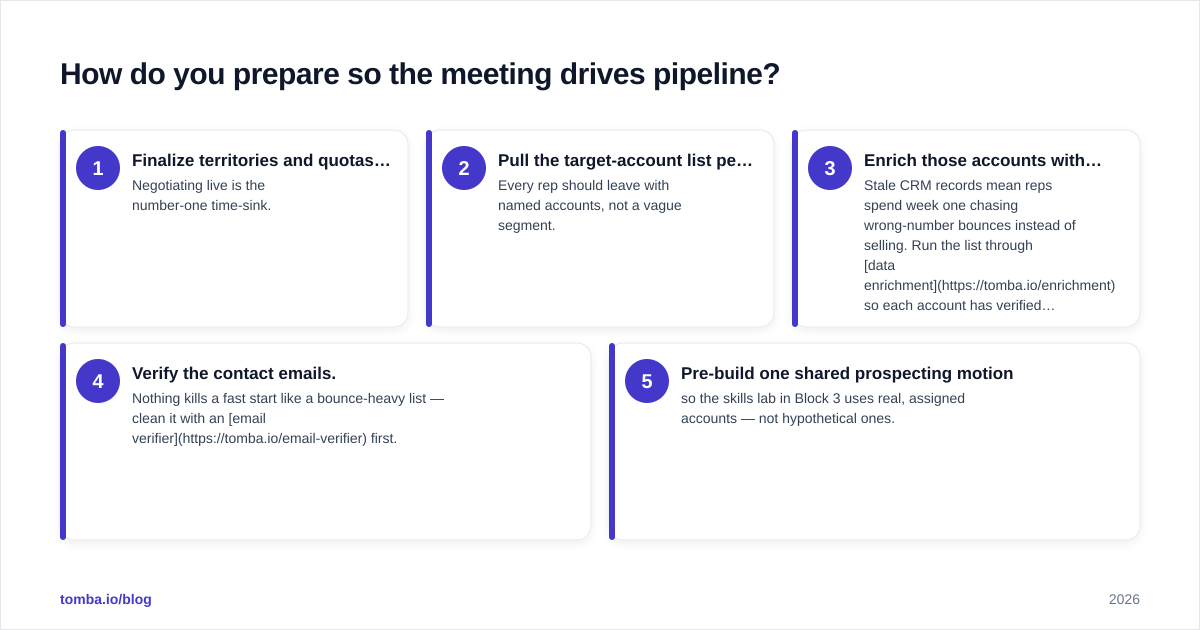
The meeting is the visible 5%. The 95% that determines ROI happens in the three weeks before. The most common failure is walking reps into a strategy session without the data they need to act — so they leave with "follow-ups" instead of assigned, enriched pipeline.
Your prep checklist:
- Finalize territories and quotas before the room is booked. Negotiating live is the number-one time-sink.
- Pull the target-account list per rep. Every rep should leave with named accounts, not a vague segment.
- Enrich those accounts with current contact data. Stale CRM records mean reps spend week one chasing wrong-number bounces instead of selling. Run the list through data enrichment so each account has verified decision-maker contacts before the meeting.
- Verify the contact emails. Nothing kills a fast start like a bounce-heavy list — clean it with an email verifier first.
- Pre-build one shared prospecting motion so the skills lab in Block 3 uses real, assigned accounts — not hypothetical ones.
When reps walk out of the territory reveal and immediately open a list of verified, enriched accounts they own, the meeting stops being theater and becomes the first day of execution.
)
What turns a kickoff into a new prospecting motion?#
A great agenda often introduces one new way of working — and the annual meeting is the right moment to standardize it because everyone is in the room. The classic candidate is how reps build their target lists.
If half your team scrapes LinkedIn by hand and the other half buys stale lists, you have no shared motion to coach. Standardizing on a single workflow — find the company, pull the right contacts, verify, sequence — means your Block 3 skills lab and your Block 2 territory assignments speak the same language. Tools like a domain search to map every contact at a target account, paired with a bulk email finder for assigned lists, give the whole team one repeatable starting point instead of forty improvised ones.
For deeper benchmarks on how teams structure outbound, vendor research from G2 and HubSpot's sales blog are useful neutral references when you want outside validation for the motion you choose.
How do you keep the energy from dying after the meeting?#
Conclusion first: schedule the follow-up inside the agenda, or it will not happen. The 30/60/90-day commitments block on Day 2 is not optional — it is the mechanism that converts inspiration into a tracked habit.
Three practices that hold the line:
- Written commitments. Each rep writes one specific, measurable change ("add a second contact to every open opp"). Manager keeps the copy.
- Booked check-ins. Put the 30/60/90 reviews on calendars before anyone leaves the room. Unscheduled follow-up is the same as no follow-up.
- A single call-to-action. Close with one thing the whole team does Monday. Ten priorities is zero priorities.
Reinforce it with a clear measurement plan tied to your revenue operations dashboards, so the behaviors you taught show up in the pipeline numbers within a quarter.
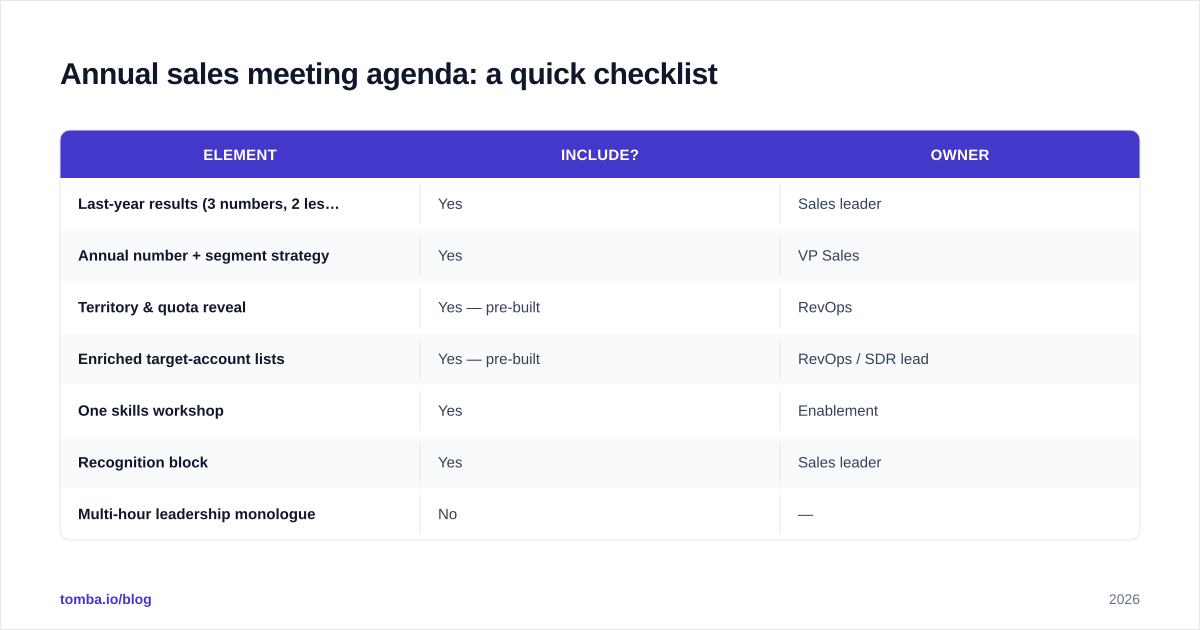
Annual sales meeting agenda: a quick checklist#
| Element | Include? | Owner |
|---|---|---|
| Last-year results (3 numbers, 2 lessons) | Yes | Sales leader |
| Annual number + segment strategy | Yes | VP Sales |
| Territory & quota reveal | Yes — pre-built | RevOps |
| Enriched target-account lists | Yes — pre-built | RevOps / SDR lead |
| One skills workshop | Yes | Enablement |
| Recognition block | Yes | Sales leader |
| Multi-hour leadership monologue | No | — |
| Unstructured connection time | Yes | Everyone |
| 30/60/90 commitments + booked reviews | Yes | Managers |
If every "yes" row is genuinely planned and the prep is done in advance, you have an agenda that earns back the selling time it costs.
Get your team's target accounts ready before kickoff#
The fastest way to make next year's meeting pay off is to walk every rep into the room with verified, enriched accounts they already own. Tomba's Email Finder lets you build those lists by domain, name, or company and verify them before the territory reveal — so Block 3's skills lab runs on real pipeline, not hypotheticals. Start on the free tier (25 searches/month), and scale to Starter at $49/mo once your reps are building lists at kickoff speed. Prepare the data once, and your annual sales meeting agenda turns from a status update into the first day of the quarter.
// get started
Find, verify and enrich your first contacts today
Start on the free plan with 25 searches a month, then scale when your team is ready.
Free plan · No credit card required · GDPR & CCPA
// about the author