Anonymous Visitor Identification: The 2026 B2B Playbook
Up to 98% of B2B website visitors leave without filling out a form. Anonymous visitor identification reveals the companies behind that traffic—here's how to turn silent sessions into real pipeline in 2026.
TL;DR
- Anonymous visitor identification reverse-resolves your website traffic into companies (and sometimes individual contacts) so you can act on intent before a form is ever filled.
- Roughly 95–98% of B2B visitors never convert on-site; identification recovers a slice of that lost demand instead of letting it bounce.
- Company-level reveal (IP-to-firmographic) is privacy-safe and broadly legal; person-level reveal is powerful but carries real consent and compliance weight.
- Accuracy, match rate, and data freshness vary wildly between vendors—benchmark them on your traffic before committing.
- Identification is only step one. The ROI comes from enriching the company, finding the right contact, and routing it into outbound fast.
What is anonymous visitor identification?#
Anonymous visitor identification is the practice of turning unknown website traffic into named accounts. Think of it like a doorman at a members-only club who recognizes the company logo on someone's jacket even though they never signed the guest book—you learn who showed up without them announcing themselves.
Technically, it works by capturing signals a visitor's browser already broadcasts—primarily the IP address, plus cookies, device fingerprints, and reverse-DNS data—and matching them against a database of company networks and B2B contact records. When a visitor from 34.x.x.x lands on your pricing page, an identification platform can resolve that IP to "Acme Corp, 500 employees, SaaS, San Francisco" in milliseconds.
There are two distinct tiers, and conflating them is the most common mistake teams make:
- Company-level identification — resolves traffic to an organization. Privacy-safe, GDPR-friendly in most cases, and the backbone of account-based marketing.
- Person-level identification — resolves traffic to an individual via cookie graphs and identity networks. Far higher value, far higher compliance risk.
Why does anonymous visitor identification matter in 2026?#
The conclusion first: because your form is leaking demand, and you're paying to acquire traffic you never act on.
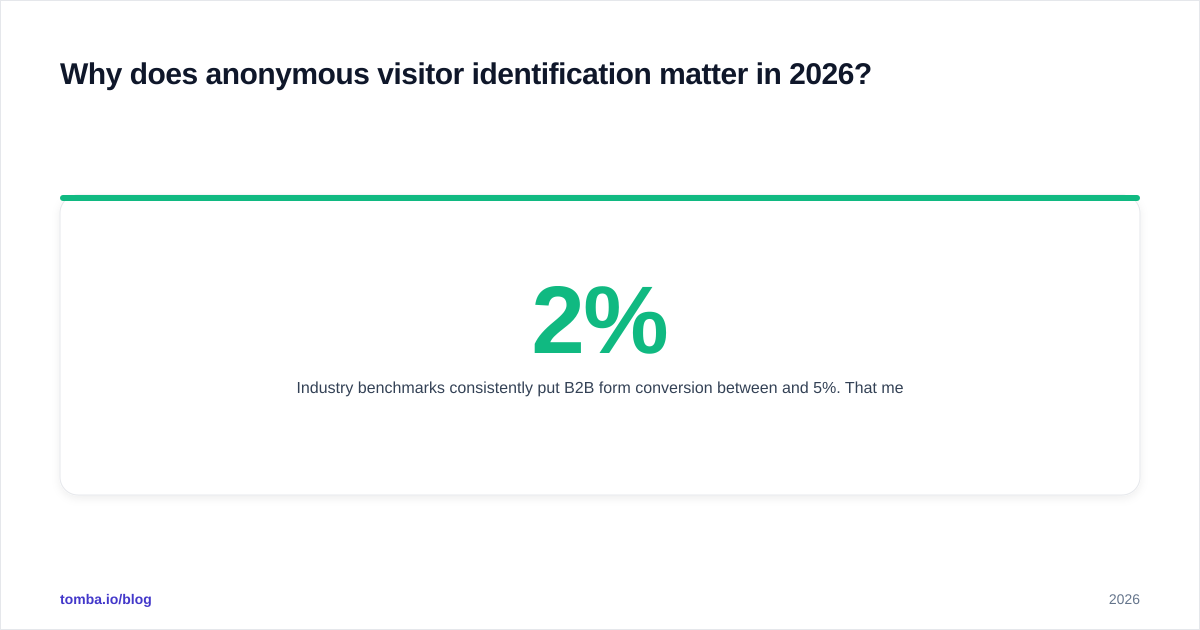
Industry benchmarks consistently put B2B form conversion between 2% and 5%. That means 95–98% of the people you spent money to attract—through ads, SEO, events, and content—leave no trace your sales team can use. They read your case study, compared your pricing, and left. The intent was real; the capture was zero.
Three shifts made identification a 2026 priority rather than a nice-to-have:
- Third-party cookie deprecation pushed marketers toward first-party signals they actually own, and your own server logs are the most first-party signal there is.
- Buying committees got bigger and quieter. Gartner has long noted that B2B purchases involve 6–10 stakeholders who do most of their research anonymously before ever talking to sales.
- Outbound got more expensive and more regulated, so warming an account that already visited beats cold-emailing a list that never heard of you.
Pairing identification with data enrichment means a single anonymous pricing-page session can become a fully-built account record with the right contact attached—ready for a relevant, timely touch instead of a generic blast.
How does anonymous visitor identification work?#
The pipeline has five stages, and understanding each helps you diagnose where a vendor is weak.
- Capture — A lightweight JavaScript tag (or server-side log) records the session: IP, pages viewed, referrer, time-on-page, UTM parameters.
- Resolve — The platform matches the IP/fingerprint against firmographic and identity databases. This is where match-rate differences come from.
- Enrich — The matched company is expanded with employee count, industry, revenue, tech stack, and location. Person-level platforms add a name, role, and email.
- Score — Behavior plus firmographics produce an intent signal: a 12-minute pricing-page session from an ICP-fit company outranks a 9-second bounce from a student.
- Route — High-fit, high-intent accounts flow into your CRM, Slack, or sequencing tool for action while the interest is hot.
The weak link is almost always stage 2. Vendors quote a single "match rate," but the number that matters is match rate on traffic that looks like your customers. A tool that nails US enterprise IPs may whiff on EU SMBs or remote workers on residential connections.
Company-level vs. person-level: a side-by-side#
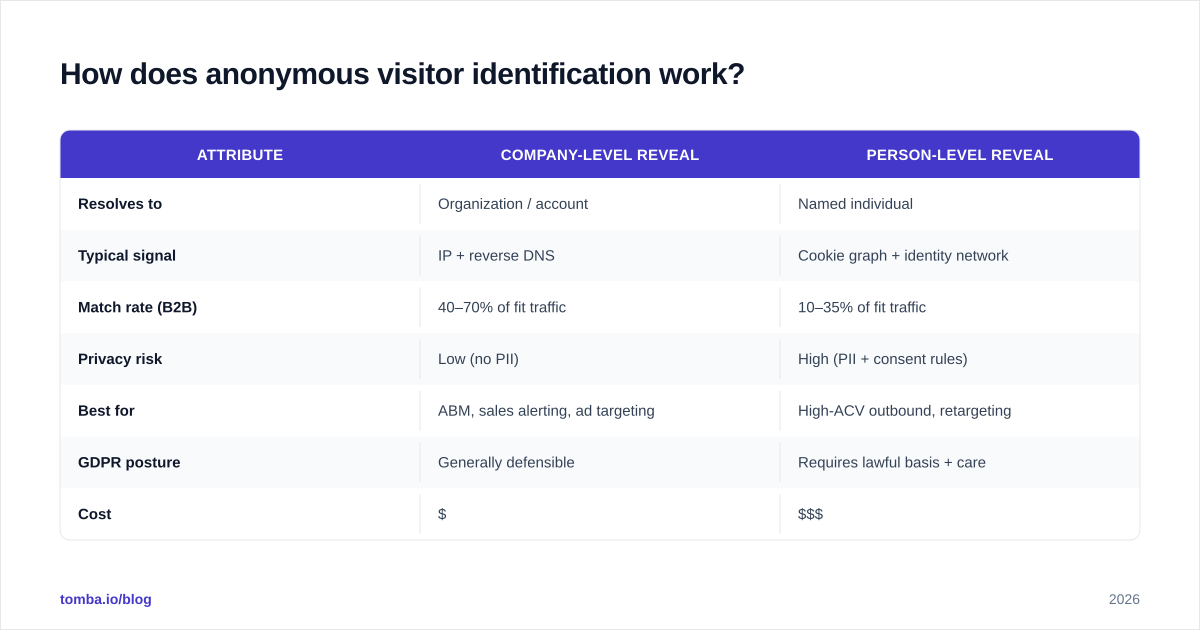
| Attribute | Company-level reveal | Person-level reveal |
|---|---|---|
| Resolves to | Organization / account | Named individual |
| Typical signal | IP + reverse DNS | Cookie graph + identity network |
| Match rate (B2B) | 40–70% of fit traffic | 10–35% of fit traffic |
| Privacy risk | Low (no PII) | High (PII + consent rules) |
| Best for | ABM, sales alerting, ad targeting | High-ACV outbound, retargeting |
| GDPR posture | Generally defensible | Requires lawful basis + care |
| Cost | $ | $$$ |
The honest takeaway: most teams should start with company-level identification, prove the workflow, and only graduate to person-level reveal where deal sizes justify the compliance overhead.
Is anonymous visitor identification legal?#
Short answer: company-level identification is broadly legal; person-level identification is conditional and jurisdiction-dependent. This is not legal advice—run your specific setup past counsel.
The distinction that regulators care about is personal data. An IP address resolved to "a company in Boston" generally isn't treated as PII. The same IP resolved to "Jane Doe, VP of Ops, jane@acme.com" absolutely is, and that pulls you into GDPR, ePrivacy, CCPA/CPRA, and similar frameworks.
Practical guardrails for 2026:
- Disclose identification in your privacy policy and cookie banner.
- Honor consent signals—don't person-resolve EU visitors who declined tracking.
- Prefer company-level for cold prospecting; reserve person-level for visitors with an existing relationship or lawful basis.
- Document your lawful basis (legitimate interest assessments) before turning on person-level reveal.
The U.S. Federal Trade Commission and EU data authorities have both signaled growing scrutiny of identity resolution, so treat compliance as a feature, not a footnote.
What should you look for in a visitor identification tool?#
Five criteria separate a tool that builds pipeline from one that floods your CRM with junk:
- Match rate on your geography and segment — Test it, don't trust the marketing page.
- Data freshness — Stale firmographics route the wrong accounts to the wrong reps.
- Enrichment depth — Company name alone is a lead; company plus the right contact plus an email is a meeting.
- Routing and integrations — Native HubSpot and Salesforce connectors beat CSV exports every time.
- Transparent, predictable pricing — Per-identified-account or flat tiers; avoid opaque "contact us" walls when you're starting out.

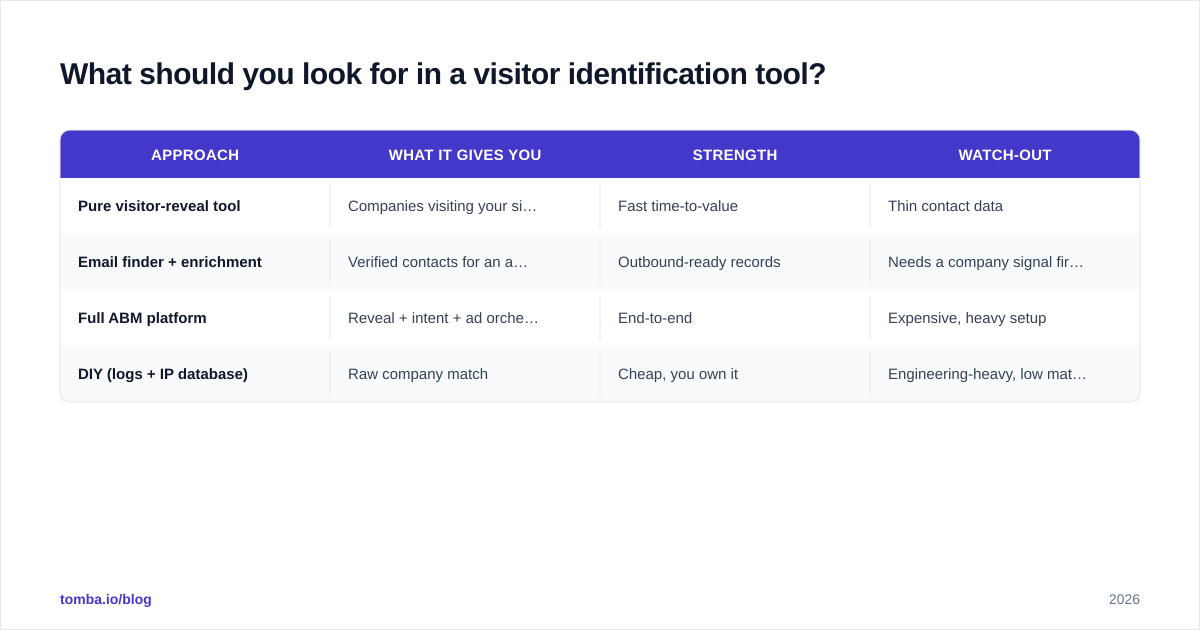
How the main approaches compare#
| Approach | What it gives you | Strength | Watch-out |
|---|---|---|---|
| Pure visitor-reveal tool | Companies visiting your site | Fast time-to-value | Thin contact data |
| Email finder + enrichment | Verified contacts for an account | Outbound-ready records | Needs a company signal first |
| Full ABM platform | Reveal + intent + ad orchestration | End-to-end | Expensive, heavy setup |
| DIY (logs + IP database) | Raw company match | Cheap, you own it | Engineering-heavy, low match rate |
The combination most lean teams land on: a reveal layer to surface the account, then an email finder and verifier to build the contact, then a sequencer to act. You don't need a six-figure ABM suite to get 80% of the value.
How do you turn identified visitors into pipeline?#
Identification without a workflow is just a prettier analytics dashboard. Here's the operational loop that converts reveals into revenue.
1. Filter to fit. Don't act on every reveal. Define your ICP—size, industry, region—and ignore the rest. A reveal that doesn't match ICP is noise that erodes rep trust in the system.
2. Score on behavior. Weight pricing, demo, and product pages heavily; weight careers and blog pages lightly. A repeat visitor to /pricing is a buying signal; a one-time blog reader is not.
3. Find the right human. Company-level reveal tells you Acme is in-market. It doesn't tell you to email the intern. Use domain search to pull the relevant department's contacts, then verify before sending so your deliverability survives.
4. Route fast. Speed-to-lead research is brutal: act within an hour, not a day. Push high-fit reveals straight into Slack and your sequencer so a rep can reach out while the tab is still open.
5. Personalize on the visit. "Saw you were comparing options on our pricing page" outperforms "I hope this finds you well" by a wide margin—because it's true and specific.
6. Measure and prune. Track reveal-to-meeting and reveal-to-opportunity rates. If a source of reveals never converts, stop routing it.
This loop is where most of the ROI lives. The reveal is the cheap part; disciplined routing and a relevant first touch are what compound. Tomba's website visitor reveal sits at the front of this exact pipeline, handing identified companies to enrichment and contact discovery so the workflow stays in one stack.
What does anonymous visitor identification cost?#
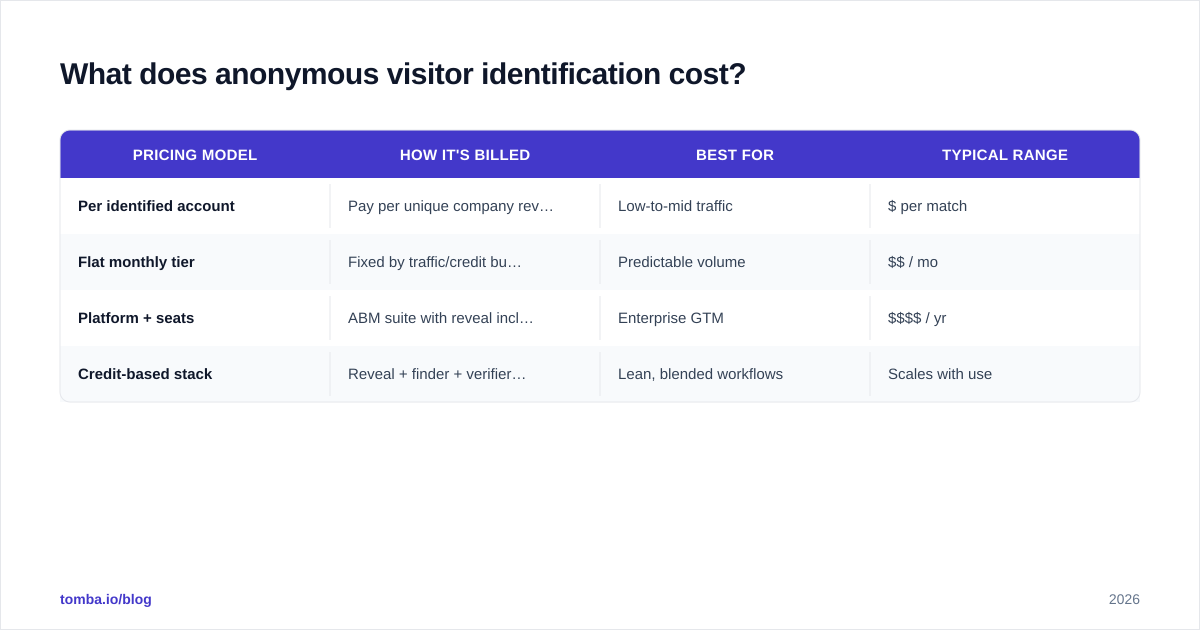
Pricing models cluster into three shapes, and the right one depends on your traffic volume:
| Pricing model | How it's billed | Best for | Typical range |
|---|---|---|---|
| Per identified account | Pay per unique company revealed | Low-to-mid traffic | $ per match |
| Flat monthly tier | Fixed by traffic/credit bucket | Predictable volume | $$ / mo |
| Platform + seats | ABM suite with reveal included | Enterprise GTM | $$$$ / yr |
| Credit-based stack | Reveal + finder + verifier credits | Lean, blended workflows | Scales with use |
For most teams that already do outbound, the credit-based blended stack is the efficient path: you pay for reveals and the contact-finding that turns them into action, rather than buying a standalone reveal tool and a separate data tool. Tomba's pricing follows this shape—Free (25 searches/mo) to start, Starter at $49/mo, Growth at $99/mo, and Pro at $249/mo—so you can validate the workflow on the free tier before scaling credits.
You can sanity-check any vendor's claims against third-party reviews on G2 before you commit budget; reported match rates and support quality vary far more than pricing pages suggest.
Common mistakes to avoid#
- Treating every reveal as a lead. Filter to ICP first or you'll bury reps in noise.
- Skipping verification. Reveal gives you a company; emailing unverified guesses torches your sender reputation. Verify before you send.
- Ignoring privacy posture. Turning on person-level reveal for EU traffic without a lawful basis is a fast way to a complaint.
- Buying the suite before proving the loop. Start small, prove reveal-to-meeting, then scale.
- Acting slowly. A reveal three days old is a cold lead again. Route in minutes.
Frequently asked questions#
Is anonymous visitor identification the same as Google Analytics? No. Analytics tells you that traffic happened in aggregate; identification tells you which company it was so you can act on it. They're complementary—analytics for trends, identification for pipeline.
What match rate is realistic? For company-level reveal on fit B2B traffic, 40–70% is a reasonable band. Anyone promising near-100% is selling. Always benchmark on your own traffic.
Can I identify individual visitors? Technically yes, via person-level identity networks—but only do it with a documented lawful basis and consent. For cold prospecting, company-level reveal plus a compliant contact lookup is the safer, more durable approach.
Do I still need an email finder if I have a reveal tool? Usually yes. Reveal surfaces the account; an email finder and verifier turn that account into a contactable person. The two are sequential, not redundant.
Turn silent traffic into named pipeline#
You're already paying to bring visitors to your site. Anonymous visitor identification is how you stop letting 95% of them leave without a trace. Start company-level, stay compliant, and—most importantly—wire reveals into a fast, ICP-filtered workflow that ends in a relevant first touch.
The reveal is only worth as much as the contact you can act on. Use the Tomba Email Finder to convert every identified company into a verified, outbound-ready contact—then route it before the visitor's interest cools. Spin it up on the free tier, point it at your highest-intent reveals, and measure reveal-to-meeting from day one.
// get started
Find, verify and enrich your first contacts today
Start on the free plan with 25 searches a month, then scale when your team is ready.
Free plan · No credit card required · GDPR & CCPA
// about the author