Anonymous Website Visitor Tracking: 2026 Guide
Most of your website traffic leaves without filling a form. Learn how anonymous website visitor tracking turns that lost traffic into named accounts and pipeline in 2026.
TL;DR
- Roughly 97–98% of B2B website visitors leave without filling a form, so form-only lead capture misses the bulk of your buying interest.
- Anonymous website visitor tracking matches visitor signals (IP, reverse-IP firmographics, and first-party identity resolution) to companies — and sometimes individuals — so you can act on intent you'd otherwise never see.
- Company-level reveal is mature and widely legal; person-level reveal is possible but carries real GDPR/CCPA exposure, so consent and data minimization matter.
- Accuracy varies a lot: reverse-IP works for office traffic but degrades on remote, mobile, and VPN traffic. Treat match rates of 25–50% on B2B traffic as realistic, not the 99% some vendors imply.
- The real ROI comes after the reveal — routing identified accounts into enrichment, outbound, and CRM workflows fast enough to matter.
What is anonymous website visitor tracking?#
Anonymous website visitor tracking is the practice of identifying the companies — and in some cases the people — behind website sessions that never submit a form or log in. Think of it like a doorbell camera for your funnel: plenty of people walk up, look around, and leave, and without a camera you'd never know they came. A reveal tool gives you that footage.
It works by capturing signals the browser already sends, then matching them against a database. The most common signal is the visitor's IP address, which gets run through reverse-IP lookup to find the registering organization. Layered on top, identity-resolution networks use cookies, hashed emails from prior form fills, and partner data to connect returning or known visitors to a profile.
The payoff is straightforward: instead of waiting for 2–3% of traffic to convert on a form, your sales and marketing teams get a list of accounts showing real interest — which pages they read, how often they return, and how engaged they are. That's intent you can route, score, and act on.
How does visitor identification actually work?#
There are three mechanisms stacked underneath most tools, and knowing which one is firing tells you how much to trust the result.
1. Reverse-IP company lookup. When a visitor loads your page, their public IP is logged. Tools match that IP to a business using registries (like ARIN/RIPE) and proprietary mappings of IP ranges to companies. This is how you get "Acme Corp viewed your pricing page." It's strong for traffic from corporate offices with dedicated IP blocks and weak for everything else.
2. First-party identity resolution. If a visitor previously filled a form, clicked a tracked email, or logged in, you can drop a first-party cookie and tie future anonymous sessions back to that known person. This is fully first-party and the cleanest from a privacy standpoint.
3. Third-party identity networks (person-level). Some vendors maintain large cookie/device graphs built from publisher partnerships and data co-ops. These can resolve an anonymous visitor to a named individual with an email. This is the most powerful and the most legally fraught — especially in the EU.
Once a visitor is matched, the record is usually pushed through data enrichment to append firmographics (industry, size, revenue) and contact data so the lead is actionable rather than just a company name.
Why bother — isn't form capture enough?#
No, and the math is the whole argument. If 97% of your traffic never fills a form, then your entire demand-gen apparatus is optimizing the bottom 3%. According to widely cited B2B benchmarks reported by vendors like HubSpot, average B2B landing page conversion rates sit in the low single digits. Everything above that line is invisible without reveal.
Here's what tracking the anonymous portion unlocks:
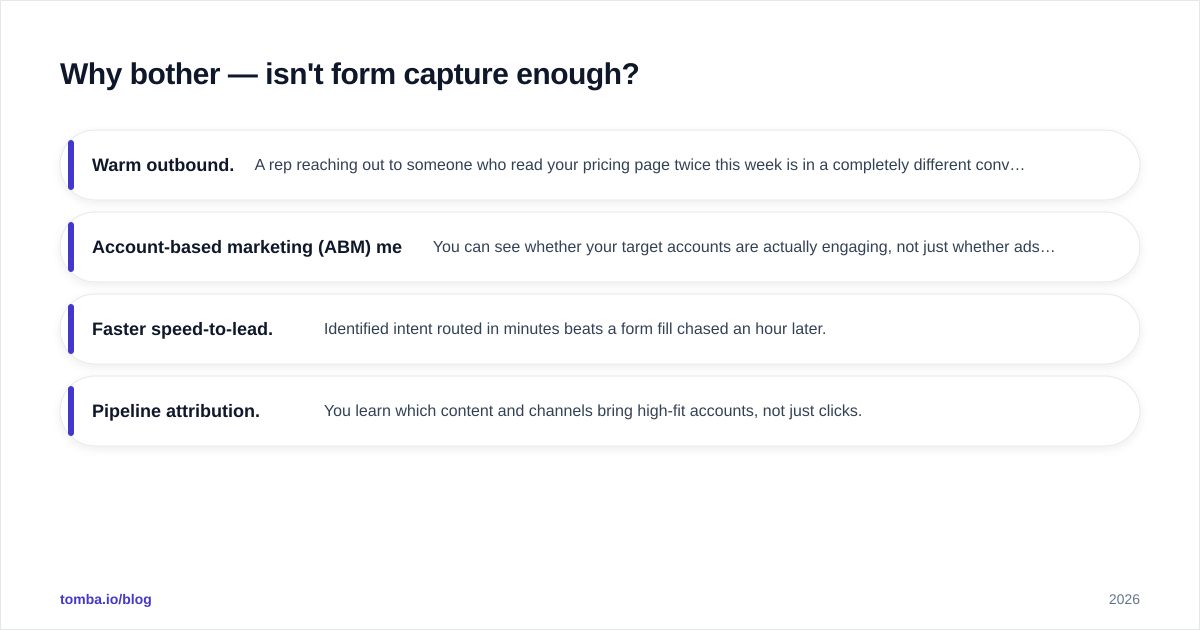
- Warm outbound. A rep reaching out to someone who read your pricing page twice this week is in a completely different conversation than a cold list.
- Account-based marketing (ABM) measurement. You can see whether your target accounts are actually engaging, not just whether ads served.
- Faster speed-to-lead. Identified intent routed in minutes beats a form fill chased an hour later.
- Pipeline attribution. You learn which content and channels bring high-fit accounts, not just clicks.
The catch is that a reveal without a workflow is just a longer report nobody reads. The value is in what happens next — scoring the account, finding the right contact, and getting a human or sequence on it quickly.
Is anonymous website visitor tracking legal (GDPR / CCPA)?#
Short answer: company-level tracking is generally low-risk; person-level identification of EU residents without a lawful basis is high-risk. This is not legal advice, but the distinction is well established.
Reverse-IP that returns "a visitor from Acme Corp" identifies an organization, not a person, so it sits on safer ground. The moment a tool returns a named individual and their email, you are processing personal data, and under GDPR you need a lawful basis (typically legitimate interest with a balancing test, or consent) plus transparency in your privacy policy. The GDPR overview on Wikipedia is a reasonable primer on the principles involved.
Practical guardrails:
- Disclose visitor identification in your privacy policy and cookie banner.
- Prefer company-level reveal for EU traffic; gate person-level reveal behind consent.
- Honor opt-outs and Do Not Track signals; apply data minimization.
- Vet your vendor's data sourcing — "where the data comes from" is a real diligence question, the same way you'd scrutinize any contact provider's data sources.
When in doubt, default to company-level intelligence and use a verified email finder to source a compliant contact for the right role, rather than relying on a scraped person-level match of unknown provenance.
How accurate is it, really?#
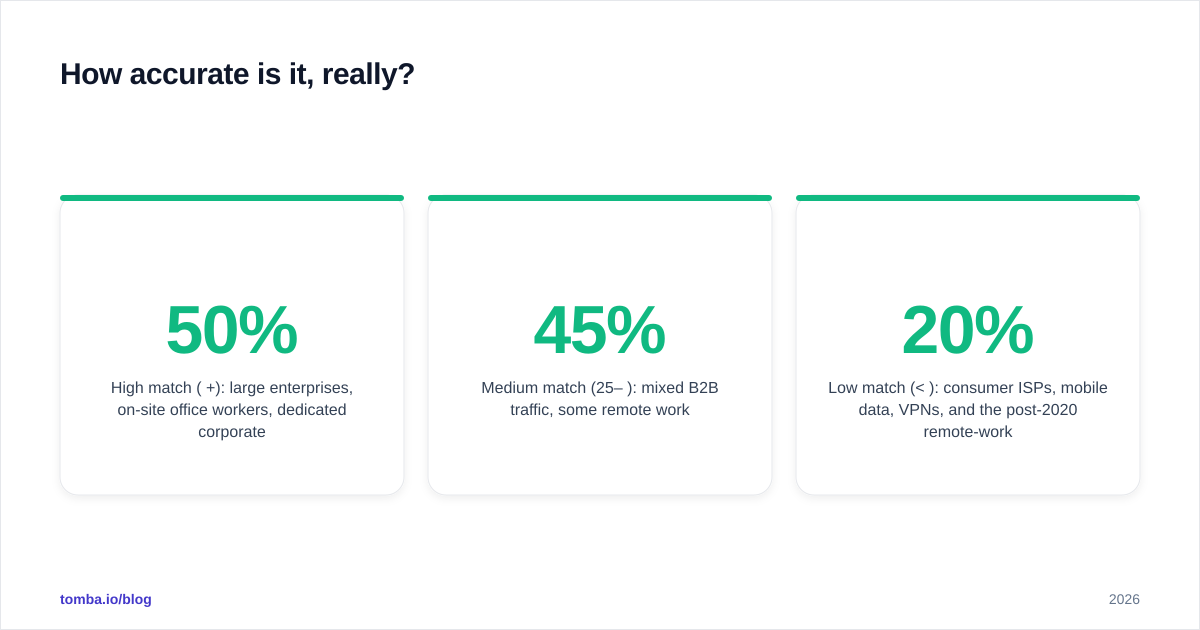
Accuracy is the single most oversold dimension in this category, so set expectations correctly. Reverse-IP match rates depend entirely on your traffic mix:
- High match (50%+): large enterprises, on-site office workers, dedicated corporate IP ranges.
- Medium match (25–45%): mixed B2B traffic, some remote work.
- Low match (<20%): consumer ISPs, mobile data, VPNs, and the post-2020 remote-work reality where employees browse from home on residential IPs.
Person-level networks can lift the identified share, but with a tradeoff in confidence and compliance. A healthy way to think about it: company-level reveal is high-precision, lower-recall; person-level reveal is higher-recall, lower-precision. Independent reviews on G2 and Capterra are useful because users routinely report real-world match rates that differ from marketing claims.
The fix for low match rates isn't a better magic database — it's enriching what you do match and verifying contacts before outreach. A revealed company plus an email verifier pass beats a high "identified" number full of bounces.
What tools handle anonymous visitor tracking in 2026?#
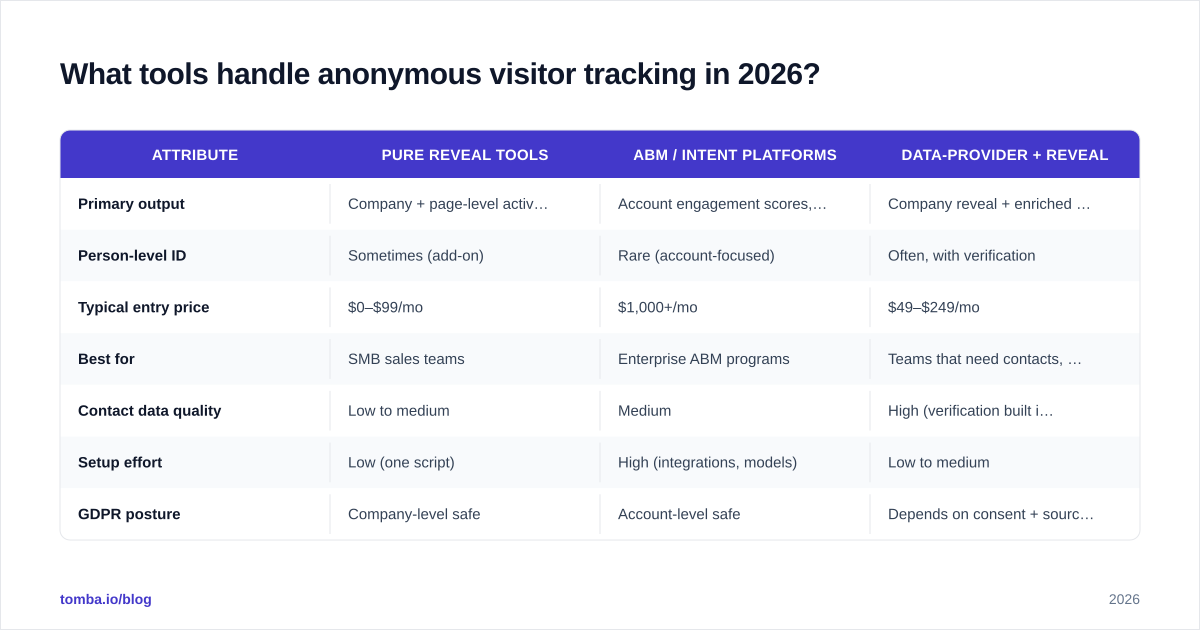
The market splits into pure visitor-ID tools, full ABM/intent platforms, and data providers that add reveal as a feature. Here's how the main approaches compare on the attributes that actually drive a buying decision.
| Attribute | Pure reveal tools | ABM / intent platforms | Data-provider + reveal |
|---|---|---|---|
| Primary output | Company + page-level activity | Account engagement scores, intent | Company reveal + enriched contacts |
| Person-level ID | Sometimes (add-on) | Rare (account-focused) | Often, with verification |
| Typical entry price | $0–$99/mo | $1,000+/mo | $49–$249/mo |
| Best for | SMB sales teams | Enterprise ABM programs | Teams that need contacts, not just names |
| Contact data quality | Low to medium | Medium | High (verification built in) |
| Setup effort | Low (one script) | High (integrations, models) | Low to medium |
| GDPR posture | Company-level safe | Account-level safe | Depends on consent + sourcing |
A few buying notes. If you only need "which companies visited," a lightweight reveal script is enough and often cheap. If you run a structured ABM motion at the enterprise level, an intent platform earns its price through scoring and orchestration. But most teams actually want the third column — they don't just want a company name, they want the right person's verified email so a rep can act today. That's where pairing a reveal source with an email-finding and enrichment stack pays off.

How do you turn a revealed visitor into pipeline?#
The reveal is step one of seven, not the finish line. Here's a workflow that consistently converts anonymous traffic into booked meetings.
- Capture and filter. Install the tracking script and immediately filter noise — bots, your own team, existing customers, and irrelevant geographies.
- Score for fit and intent. Combine firmographic fit (is this an ICP account?) with behavior (visited pricing, returned 3x, read a bottom-funnel page).
- Resolve the right contact. A company name isn't actionable. Use a domain search to find the relevant roles at the revealed company, then pull the decision-maker's address with an email finder.
- Verify before you send. Run new addresses through verification to protect your sender reputation; bounces from speculative contacts will wreck deliverability.
- Enrich the record. Append title, seniority, LinkedIn, and company data so personalization is fast and credible.
- Route in real time. Push high-fit, high-intent accounts straight into your CRM and alert the owning rep via your existing integrations — speed is the whole point.
- Measure and feed back. Track which revealed-then-contacted accounts convert, and feed that back into scoring.
Notice that four of the seven steps are about what happens after the reveal. Tools that only show you company names leave you to bolt on contact discovery, verification, and routing yourself. Building those steps into one motion is what separates a curiosity dashboard from a pipeline engine. If you're standing up this stack, Tomba's website visitor reveal plus its finder and verifier sit in the same toolchain, and the pricing tiers are transparent — see the full Tomba pricing breakdown (Free at 25 searches/mo, Starter $49/mo, Growth $99/mo, Pro $249/mo).
What mistakes should you avoid?#
- Treating match rate as a vanity metric. A 60% "identified" rate full of unverifiable person-level guesses is worse than 30% solid company matches you can act on.
- Ignoring compliance until legal asks. Add the privacy-policy language and consent gating on day one; retrofitting is painful.
- No routing SLA. If a revealed pricing-page visitor sits in a report for three days, you've recreated the latency you were trying to fix.
- Skipping verification. Pushing speculative emails into sequences spikes bounces and damages sender reputation. Always verify first.
- Buying intent platform pricing for an SMB problem. If you don't have an ABM team to operate scoring models, a simpler reveal-plus-enrichment stack delivers more for less.
The bottom line#
Anonymous website visitor tracking fixes the most expensive blind spot in B2B: the 97% of demand that never raises its hand. Done right, it's not surveillance theater — it's company-level intelligence, resolved to a verified contact, routed to a rep while interest is still warm. Do it carefully on the compliance side, set honest accuracy expectations, and invest most of your effort in the post-reveal workflow.
Ready to act on the traffic you're already paying to attract? Start by turning revealed companies into reachable people: use the Tomba Email Finder to source the right decision-maker's verified email from any domain, then enrich and route it into your CRM. It's free to try at 25 searches/month, and it slots directly into the seven-step workflow above so your anonymous visitors stop being anonymous — and start being pipeline.
// get started
Find, verify and enrich your first contacts today
Start on the free plan with 25 searches a month, then scale when your team is ready.
Free plan · No credit card required · GDPR & CCPA
Get the Tomba newsletter
Product and data updates
// about the author