Antideo vs Cufinder 2026: Email & Data Tool Comparison
Antideo vs Cufinder in 2026: one is a lightweight verification API, the other a full lead-data engine. See which fits your prospecting stack — and where a third option beats both.
You are comparing two tools that look similar on a feature grid but solve different problems. Antideo is a lightweight validation API. Cufinder is a lead-data and email-finding engine. Picking the wrong one means either paying for data you don't need or shipping with a tool that can't actually find the contacts you want.
TL;DR — Antideo vs Cufinder at a glance#
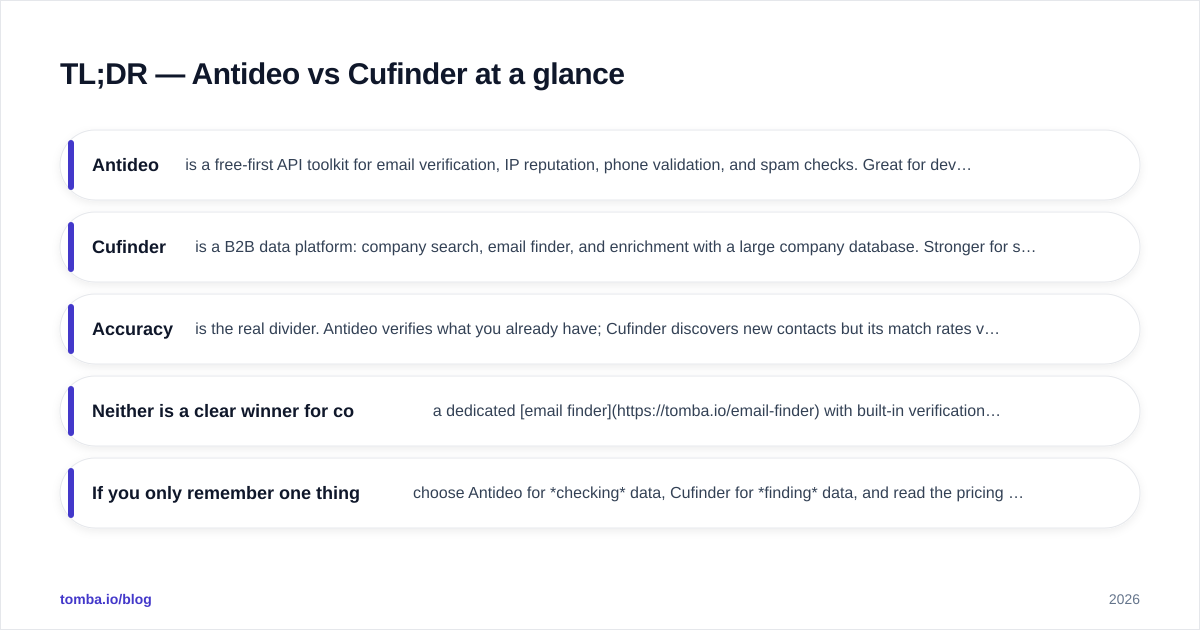
- Antideo is a free-first API toolkit for email verification, IP reputation, phone validation, and spam checks. Great for developers bolting validation onto a signup form. Weak as a prospecting engine.
- Cufinder is a B2B data platform: company search, email finder, and enrichment with a large company database. Stronger for sales teams building lead lists, heavier on price.
- Accuracy is the real divider. Antideo verifies what you already have; Cufinder discovers new contacts but its match rates vary by region and seniority.
- Neither is a clear winner for cold outreach — a dedicated email finder with built-in verification usually beats running two partial tools.
- If you only remember one thing: choose Antideo for checking data, Cufinder for finding data, and read the pricing section before you commit.
What is Antideo?#
Antideo is an API-first data hygiene service. Its core jobs are email validation, IP address reputation lookups, phone number validation, and content/profanity checks. The pitch is simple: a free tier that developers can wire into a form to block disposable emails, fake signups, and risky IPs before they pollute your database.
Where Antideo shines is at the boundary of your app. Think of it like the bouncer at a club door — it decides who gets in, but it does not go out and recruit guests. You send it an email address or IP, it tells you whether the address is deliverable, disposable, or suspicious. It does not hand you a list of new prospects.
That focus keeps Antideo cheap and fast, but it also caps what you can do with it. There is no company database, no name-to-email discovery, and no enrichment that turns a domain into a roster of decision-makers.
What is Cufinder?#
Cufinder is a B2B prospecting and enrichment platform. It combines a company database, an email finder, phone discovery, and a Chrome extension. You start from a company name, domain, or LinkedIn profile and Cufinder returns contact and firmographic data — the opposite direction of Antideo.
If Antideo is the bouncer, Cufinder is the recruiter walking the street handing out invitations. It is built for sales and marketing teams who need to generate lists, not just clean them. Cufinder also markets enrichment APIs so you can append company size, industry, and revenue to records you already hold.
The trade-off is cost and accuracy variance. Discovery tools have to guess and pattern-match across millions of records, so match rates swing depending on company size, region, and how senior the contact is. A VP at a 5,000-person US firm is easy; a founder at a 12-person agency in a smaller market is not.
Antideo vs Cufinder: how do they actually compare?#
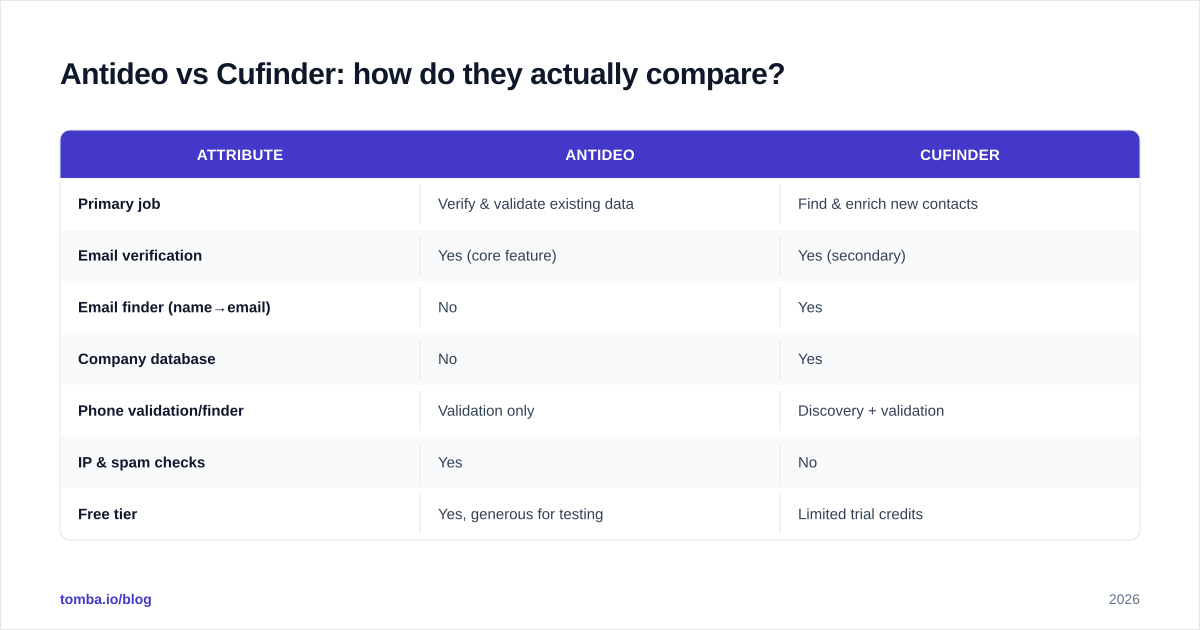
Here is the side-by-side that matters. The two tools overlap on the word "email," and almost nowhere else.
| Attribute | Antideo | Cufinder |
|---|---|---|
| Primary job | Verify & validate existing data | Find & enrich new contacts |
| Email verification | Yes (core feature) | Yes (secondary) |
| Email finder (name→email) | No | Yes |
| Company database | No | Yes |
| Phone validation/finder | Validation only | Discovery + validation |
| IP & spam checks | Yes | No |
| Free tier | Yes, generous for testing | Limited trial credits |
| Best for | Developers, form hygiene | Sales & lead-gen teams |
| API-first | Yes | Yes (plus UI + extension) |
The pattern is clear: Antideo cleans, Cufinder collects. If your problem is "too many junk signups," Antideo is the lighter, cheaper fix. If your problem is "I need 500 verified CMO emails by Friday," Antideo cannot help and Cufinder becomes the contender.

Which tool is more accurate?#
Accuracy means two different things here, so compare like for like.
For verification accuracy — does this address exist and accept mail? — Antideo performs well because that is its single focus. It runs syntax checks, MX record lookups, disposable-domain detection, and SMTP probing. Cufinder also verifies, but verification is downstream of discovery, so the depth is shallower.
For discovery accuracy — can the tool find a correct email from just a name and company? — only Cufinder competes, and the honest answer is "it depends." Independent reviews on G2 show data tools in this category landing anywhere from 60% to 90% valid emails depending on the segment. Catch-all domains are the usual culprit; a guessed address on a catch-all server looks deliverable but bounces or never reaches a human.
This is why serious teams pair discovery with a real email verifier and a catch-all verifier rather than trusting a single "found" status. Neither Antideo nor Cufinder fully closes that loop on its own — Antideo can't find, and Cufinder's verification layer is thinner than a dedicated checker.

Where a tool sources its data also drives accuracy. Tools that blend public web crawling, partner data, and continuous re-verification tend to outperform single-source databases. If you want to see how that works in practice, Tomba documents its data sources openly — a useful benchmark when you evaluate any vendor's accuracy claims.
What does each tool cost in 2026?#
Pricing is where the two tools diverge most sharply, and where buyers most often regret a fast decision.
Antideo leans on a free tier that covers low-volume validation, with paid plans scaling by request volume. For a developer adding signup hygiene, you may never leave the free or entry tier. That makes Antideo extremely cost-efficient for its narrow job.
Cufinder prices like a sales platform: credit-based plans that climb as you need more lookups, enrichment, and exports. The value is higher because the output is higher (new leads, not just checks), but so is the bill. Heavy prospecting on Cufinder can run into hundreds per month.
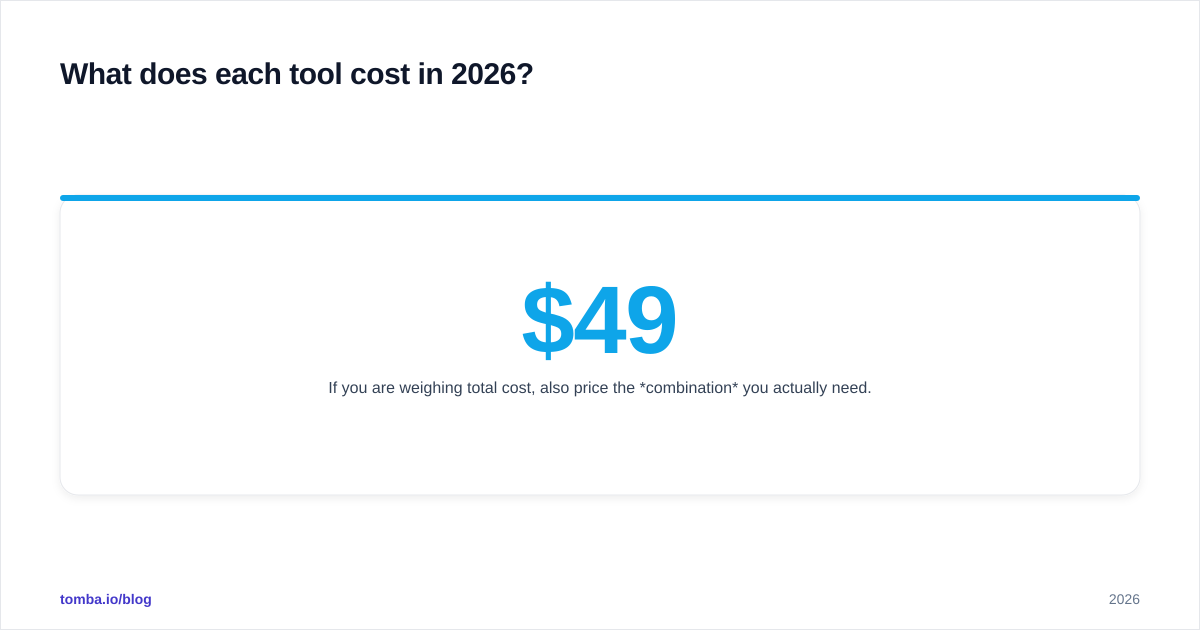
If you are weighing total cost, also price the combination you actually need. A finder plus a verifier plus enrichment from one vendor is often cheaper than stitching a discovery tool to a separate validation API. For reference, Tomba pricing bundles finding, verification, domain search, and data enrichment into one plan — Free (25 searches/mo), Starter $49/mo, Growth $99/mo, Pro $249/mo, and Enterprise custom — so you are not paying two vendors for one workflow.
When should you choose Antideo?#
Pick Antideo when validation is the whole job. Concrete cases:
- You run a SaaS signup or waitlist and want to block disposable and role-based emails at the door.
- You need IP reputation or spam checks alongside email validation in one API.
- You are a developer who wants a free, no-frills endpoint and you already have the addresses to check.
- Your volume is low to moderate and budget is the priority.
Antideo is a poor choice the moment your task shifts from "is this clean?" to "who should I contact?" It has no discovery engine, so it cannot build a prospect list from a target account.
When should you choose Cufinder?#
Pick Cufinder when you need to generate net-new contacts and firmographics:
- You are building outbound lists from a set of target companies or industries.
- You want company-level enrichment (size, industry, revenue) appended to a CRM.
- You prefer a UI plus a Chrome extension over a pure API.
- You can absorb credit-based pricing in exchange for discovery.
Cufinder is overkill if all you do is sanitize a form, and underwhelming if your prospecting hinges on hard-to-find SMB contacts where match rates dip.
What is the smarter decision framework?#
Conclusion first: match the tool to the direction of data flow, then layer verification regardless of which you pick.
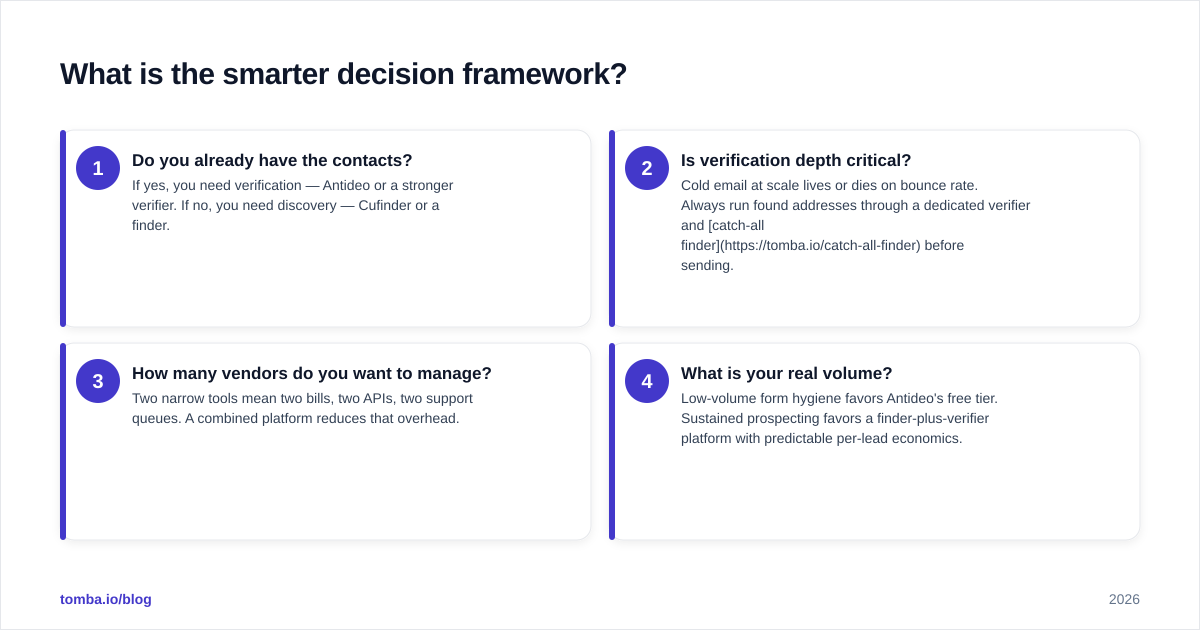
- Do you already have the contacts? If yes, you need verification — Antideo or a stronger verifier. If no, you need discovery — Cufinder or a finder.
- Is verification depth critical? Cold email at scale lives or dies on bounce rate. Always run found addresses through a dedicated verifier and catch-all finder before sending.
- How many vendors do you want to manage? Two narrow tools mean two bills, two APIs, two support queues. A combined platform reduces that overhead.
- What is your real volume? Low-volume form hygiene favors Antideo's free tier. Sustained prospecting favors a finder-plus-verifier platform with predictable per-lead economics.
The framework exposes the gap both tools share: neither was built to be a complete cold-outreach data stack. Antideo verifies but can't find. Cufinder finds but verifies lightly. For most outbound teams, that gap is the whole game.
Is there a better all-in-one alternative?#
For teams whose actual goal is verified outbound contacts, a single platform that finds and rigorously verifies usually beats running Antideo and Cufinder side by side. That is the niche Tomba fills.
Tomba's email finder discovers professional addresses by name, domain, or company — Cufinder's strength — while its email verifier, catch-all verification, and transparent data sources cover the validation depth Antideo is known for. You also get domain search, a phone finder, and bulk lead generation in the same plan, plus a Tomba API for the developers who liked Antideo's API-first model.

You can validate the comparison yourself: read Antideo's docs at antideo.com and Cufinder's at cufinder.io to confirm the feature boundaries described above before you buy.
Final verdict: Antideo or Cufinder?#
Buy Antideo if you want a cheap, focused validation and IP-hygiene API and you already own your contact data. Buy Cufinder if you need a discovery-and-enrichment engine and can fund credit-based pricing. They are not really rivals — they are tools for opposite halves of the data lifecycle, and many teams that try one eventually realize they need both jobs done.
If that describes you, skip the two-vendor tax. Start with the Tomba Email Finder — find verified professional emails by domain, name, or company in one workflow, with a free tier to test accuracy before you commit. It is the closest thing to "Antideo's verification plus Cufinder's discovery" in a single, transparent platform — and it lets you stop guessing whether the address you found will actually land.
Ready to find emails that actually work?
Join 150,000+ professionals who stopped guessing and started sending. Free credits on signup — no credit card required.
Get the Tomba newsletter
Practical outbound tactics and product updates — once every two weeks.
About the author