ANUM Framework: A Smarter Lead Qualification Method (2026)
ANUM puts Authority before Budget to qualify leads faster than BANT. Here's how the framework works, when to use it, and how it stacks up against MEDDIC and CHAMP.
TL;DR
- The ANUM framework is a B2B lead-qualification method that stands for Authority, Need, Urgency, Money — a reorder of the classic BANT checklist that puts decision-making authority first.
- It exists because most deals stall when reps spend early calls talking to people who can't say "yes." ANUM forces you to confirm you're talking to a real decision-maker before you invest time.
- ANUM works best for fast-moving, mid-market outbound motions; MEDDIC fits complex enterprise deals; BANT still suits inbound triage.
- You can score leads with ANUM in under five minutes per prospect using four discovery questions, and you can pre-fill the Authority signal with accurate contact data before you ever pick up the phone.
- This guide gives you the four ANUM questions, a scoring rubric, a comparison table against BANT/CHAMP/MEDDIC, and a practical workflow.
What is the ANUM framework?#
The ANUM framework is a sales qualification method that ranks four buying signals in priority order: Authority, Need, Urgency, and Money. It was popularized by Ken Krogue of InsideSales as a reaction to BANT (Budget, Authority, Need, Timeline), which had a structural flaw — it asked about budget before confirming you were even talking to the right person.
The reorder is the whole point. ANUM says: don't waste a discovery call uncovering pain and quantifying budget with someone who has zero say in the purchase. First confirm authority. Then surface need, gauge urgency, and only then talk money.
Think of it like a bouncer at a venue. BANT checks your wallet at the door before asking whether you're even on the list. ANUM checks the guest list first — because if your name isn't there, the size of your wallet is irrelevant. Technically, ANUM front-loads the disqualifier most likely to kill a deal late, so you spend your hours on the prospects who can actually transact.
What does each letter in ANUM stand for?#
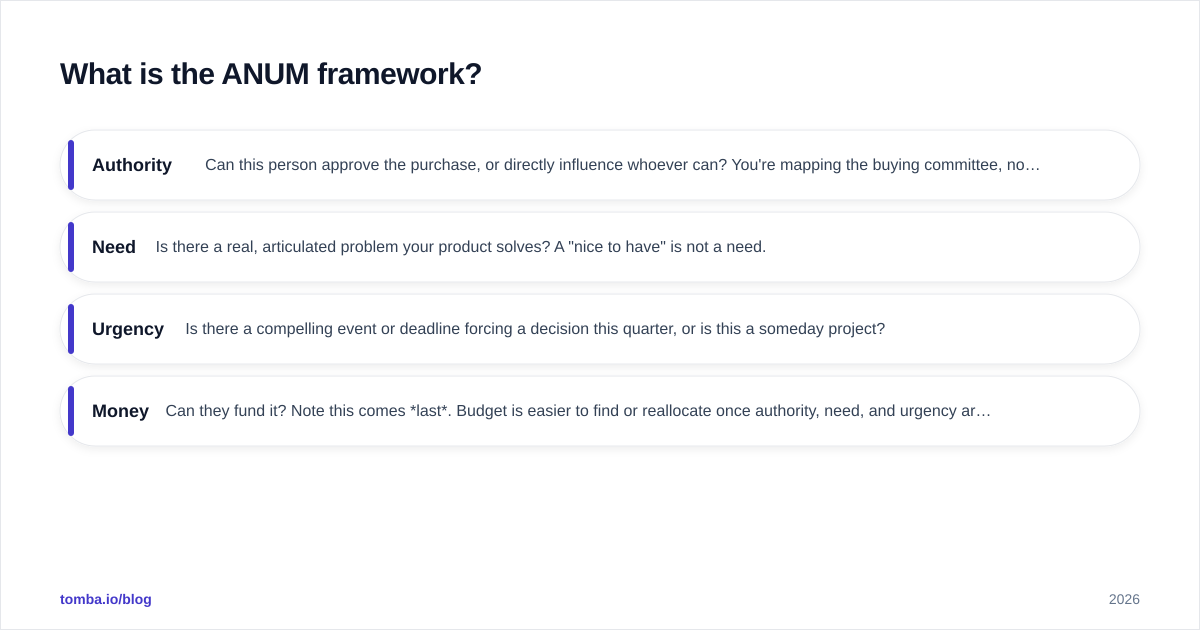
- Authority — Can this person approve the purchase, or directly influence whoever can? You're mapping the buying committee, not just collecting a job title.
- Need — Is there a real, articulated problem your product solves? A "nice to have" is not a need.
- Urgency — Is there a compelling event or deadline forcing a decision this quarter, or is this a someday project?
- Money — Can they fund it? Note this comes last. Budget is easier to find or reallocate once authority, need, and urgency are confirmed.
Why did ANUM replace BANT for many sales teams?#
BANT was created by IBM decades ago for a world of large, slow, budget-cycle-driven purchases. It works when budgets are fixed annually and the salesperson's job is to slot into an existing line item. You can read HubSpot's breakdown of BANT to see how the original sequence assumes budget is the gating factor.
Modern B2B SaaS buying broke that assumption. Budgets are fluid, buying committees average six to ten people, and the person who picks up your cold call is often not the economic buyer. When a rep leads with "What's your budget for this?" two things go wrong: the prospect gets defensive, and the rep may be qualifying someone who can't sign anything.
ANUM fixes the sequence. By validating authority first, your reps stop pouring discovery effort into dead-end contacts. The downstream effect is a cleaner pipeline and a healthier sales win rate, because the opportunities that advance are the ones with a real decision-maker attached from day one.
There's a data-quality angle too. ANUM is only as good as your ability to identify the right person. If your CRM is full of generic info@ addresses and gatekeeper contacts, you can't run the "A" step. Front-loading authority means front-loading good contact data — which is why accurate prospecting tooling and ANUM go hand in hand.
How do you qualify a lead with ANUM? (the four questions)#
Run these four discovery threads, in order. Each maps to one letter.
1. Authority. "Walk me through how a decision like this gets made on your team — who else weighs in?" You're not bluntly asking "Are you the decision-maker?" (people inflate their own authority). You're mapping the committee. If your contact is a champion but not the buyer, your goal becomes a warm intro upward.
2. Need. "What's prompting you to look at this now? What does it cost you to leave it unsolved?" A quantified pain ("we lose ~15 hours a week to manual data entry") is a strong need. A vague "we're just exploring" is weak.
3. Urgency. "Is there a date or event driving a decision — a renewal, a board target, a launch?" No compelling event usually means no deal this quarter, regardless of interest.
4. Money. "Projects like this typically land between $X and $Y. Is that workable, or should we scope differently?" Now that authority, need, and urgency are confirmed, budget is a scoping conversation, not a gate.
A simple ANUM scoring rubric#
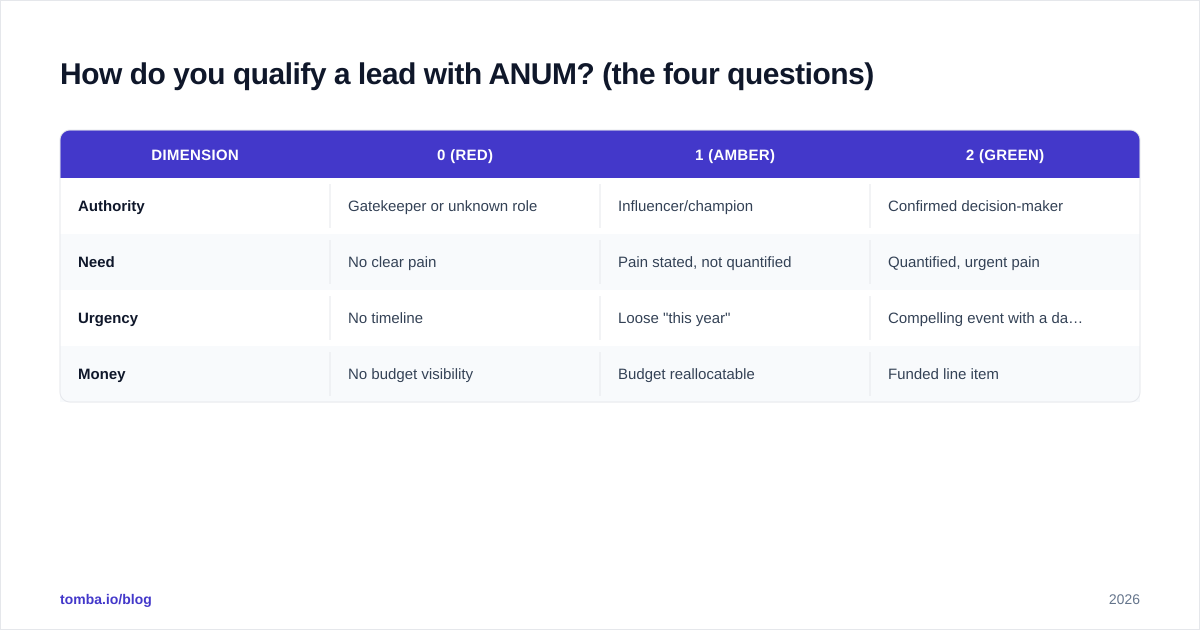
Score each dimension 0–2 and add them up. A prospect scoring 6+ is sales-ready; 3–5 needs nurturing; below 3 is a recycle or disqualify.
| Dimension | 0 (Red) | 1 (Amber) | 2 (Green) |
|---|---|---|---|
| Authority | Gatekeeper or unknown role | Influencer/champion | Confirmed decision-maker |
| Need | No clear pain | Pain stated, not quantified | Quantified, urgent pain |
| Urgency | No timeline | Loose "this year" | Compelling event with a date |
| Money | No budget visibility | Budget reallocatable | Funded line item |
This rubric plugs directly into a marketing qualified lead handoff: marketing passes the lead, sales runs ANUM, and only 6+ scores get full pipeline treatment. It keeps your CRM honest about what "qualified" actually means.
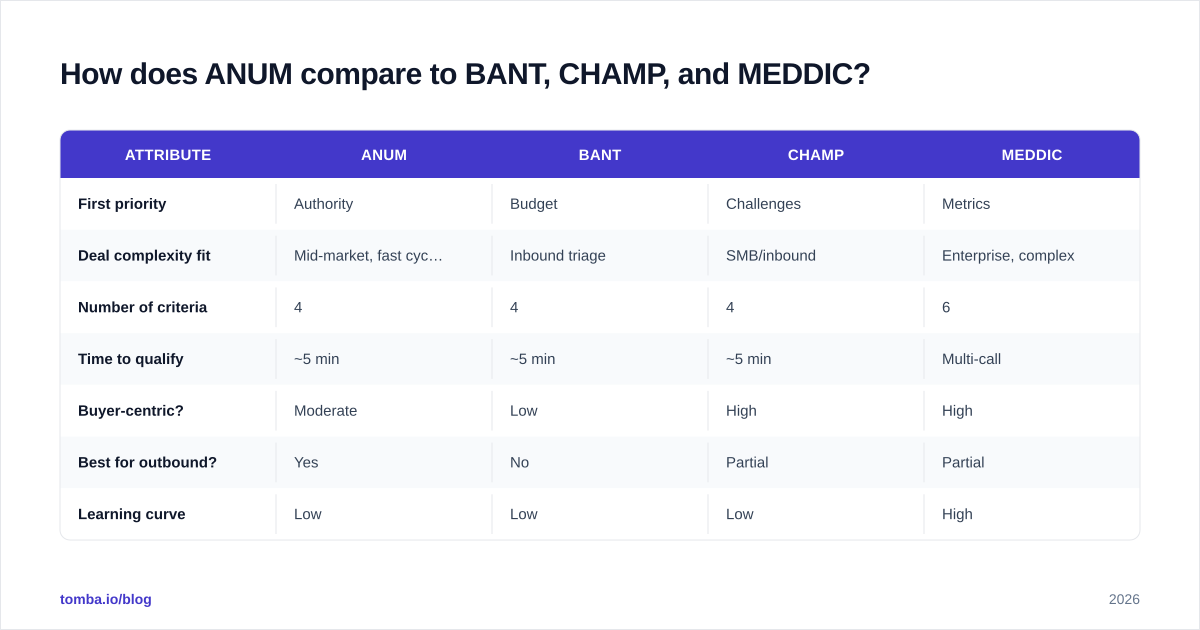
How does ANUM compare to BANT, CHAMP, and MEDDIC?#
ANUM isn't the only framework, and it isn't always the right one. Here's how the four most common qualification methods stack up.
| Attribute | ANUM | BANT | CHAMP | MEDDIC |
|---|---|---|---|---|
| First priority | Authority | Budget | Challenges | Metrics |
| Deal complexity fit | Mid-market, fast cycles | Inbound triage | SMB/inbound | Enterprise, complex |
| Number of criteria | 4 | 4 | 4 | 6 |
| Time to qualify | ~5 min | ~5 min | ~5 min | Multi-call |
| Buyer-centric? | Moderate | Low | High | High |
| Best for outbound? | Yes | No | Partial | Partial |
| Learning curve | Low | Low | Low | High |
A few takeaways:
- ANUM vs BANT: Same four-ish ingredients, different order. ANUM is the better default for outbound because it disqualifies non-buyers fastest. Salesforce's qualification guidance leans toward authority- and need-first thinking for exactly this reason.
- ANUM vs CHAMP: CHAMP leads with Challenges (need), which is more buyer-empathetic, but it can let you sink time into well-articulated pain with no decision-maker attached. ANUM guards against that.
- ANUM vs MEDDIC: MEDDIC is heavier — six criteria including Metrics, Economic buyer, Decision criteria, Decision process, Identify pain, and Champion. It's overkill for a $5K/year deal but essential for six-figure enterprise sales. If your average contract value is high and cycles run months, graduate from ANUM to MEDDIC.
You don't have to pick one forever. Many teams run ANUM at the top of funnel for speed and switch to MEDDIC once a deal crosses a value threshold. Reviewers on G2 frequently note that the framework matters less than consistent application across the team.

When should you NOT use ANUM?#
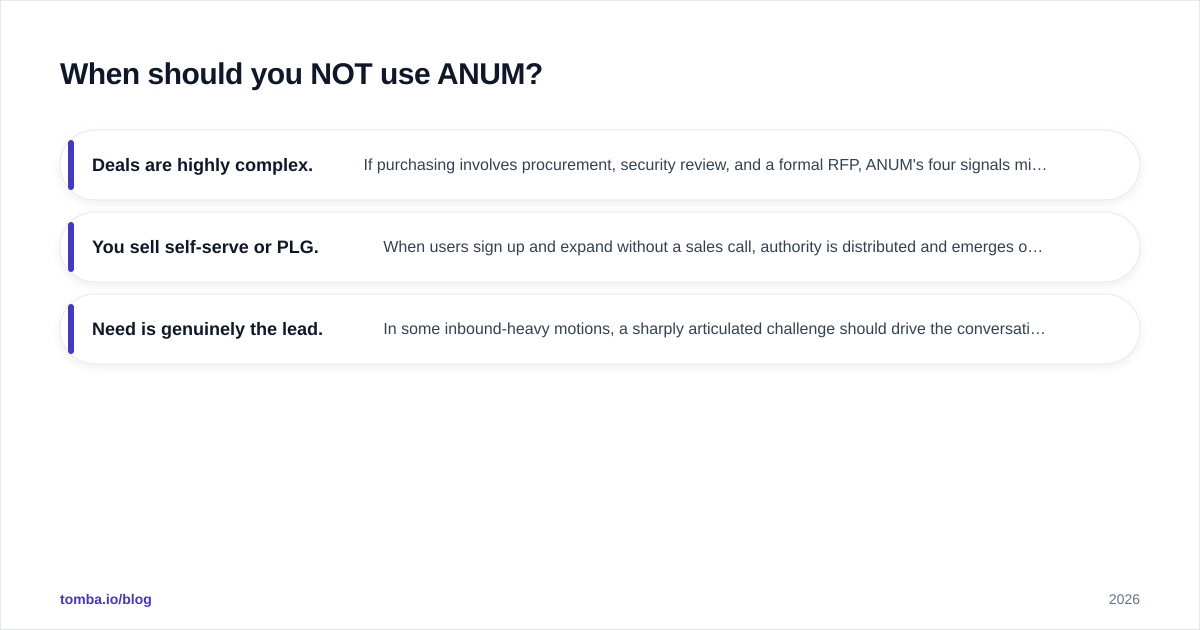
ANUM has blind spots. Skip it or supplement it when:
- Deals are highly complex. If purchasing involves procurement, security review, and a formal RFP, ANUM's four signals miss the decision process. Use MEDDIC.
- You sell self-serve or PLG. When users sign up and expand without a sales call, authority is distributed and emerges over time. Product usage signals beat a discovery rubric here.
- Need is genuinely the lead. In some inbound-heavy motions, a sharply articulated challenge should drive the conversation. CHAMP's challenge-first order may convert better.
The honest framing: ANUM is a triage tool, not a deal-closing methodology. It tells you who deserves your time, not how to win. Pair it with a strong discovery process and a clean sales pipeline and it earns its keep.
How do you operationalize ANUM in your pipeline?#
A framework only works if it's wired into the daily workflow. Here's a practical sequence.
Step 1 — Pre-qualify Authority before outreach. This is where most teams lose ANUM's advantage. You can't qualify authority on a call if you never reach a decision-maker. Build your prospect lists around real roles and verified contacts, not scraped guesses. Use data enrichment to append job title, seniority, and department so your "A" score starts from facts.
Step 2 — Reach the right person directly. A decision-maker's direct line or verified work email beats the main switchboard every time. Pairing a verified email with a B2B phone number gives your reps two channels to reach authority without a gatekeeper.
Step 3 — Score during discovery. Use the 0–2 rubric above on the first call. Log it as a custom field in your CRM so pipeline reviews can filter by ANUM score.
Step 4 — Route by score. 6+ goes to active pipeline. 3–5 enters a nurture sequence with a re-qualification trigger. Below 3 recycles to marketing or closes-lost with a reason code.
Step 5 — Inspect and coach. In weekly reviews, look at deals that advanced with a low Authority score — they're your future slipped deals. Coaching to the "A" is where managers get the most leverage.
The throughline: ANUM rewards teams that know exactly who they're talking to. That's a contact-data problem before it's a sales-skill problem.
Frequently asked questions about ANUM#
Is ANUM better than BANT? For outbound and mid-market motions, usually yes — it disqualifies non-buyers earlier. For inbound triage where budget is the real gate, BANT can be faster. Many teams keep both.
Who created the ANUM framework? It's widely attributed to Ken Krogue, co-founder of InsideSales.com, who promoted reordering BANT to lead with authority.
Can ANUM and MEDDIC coexist? Yes. Use ANUM for fast top-of-funnel triage and escalate qualifying deals to MEDDIC once they cross a value or complexity threshold.
How long does ANUM qualification take? About five minutes of focused discovery per prospect once you've already identified and reached the right contact.
Where does Tomba fit?#
ANUM lives or dies on the "A." If your reps can't get a decision-maker on the line, the rest of the framework is theory. That's the gap Tomba's Email Finder closes — give it a name and a company domain and it returns the verified professional email of the exact person who can say yes, so your reps start every ANUM call already talking to authority.
Tomba's Free tier covers 25 searches a month, with Starter at $49/mo and Growth at $99/mo when you scale outbound. Feed those verified contacts into your scoring rubric, route by ANUM score, and watch your discovery hours land on the deals that actually move. Start with the Email Finder, confirm authority before you dial, and let the framework do the rest.
// get started
Find, verify and enrich your first contacts today
Start on the free plan with 25 searches a month, then scale when your team is ready.
Free plan · No credit card required · GDPR & CCPA
// about the author