Anymail Finder vs Apollo.io: Email Finder Showdown 2026
Anymail Finder charges only for verified emails; Apollo.io bundles a 275M-contact database with sequencing. Here's which one actually fits your 2026 outbound stack.
You came here to settle one question: when you put Anymail Finder vs Apollo.io side by side, which tool actually gets verified emails into your sequences without burning budget? The short answer is that they solve different problems. Anymail Finder is a focused email-discovery engine that only charges you for results it can verify. Apollo.io is a full go-to-market platform — a 275M+ contact database bolted to a sequencer, a dialer, and a CRM. Picking the "winner" depends entirely on whether you want a precise scalpel or a Swiss Army knife.
TL;DR#
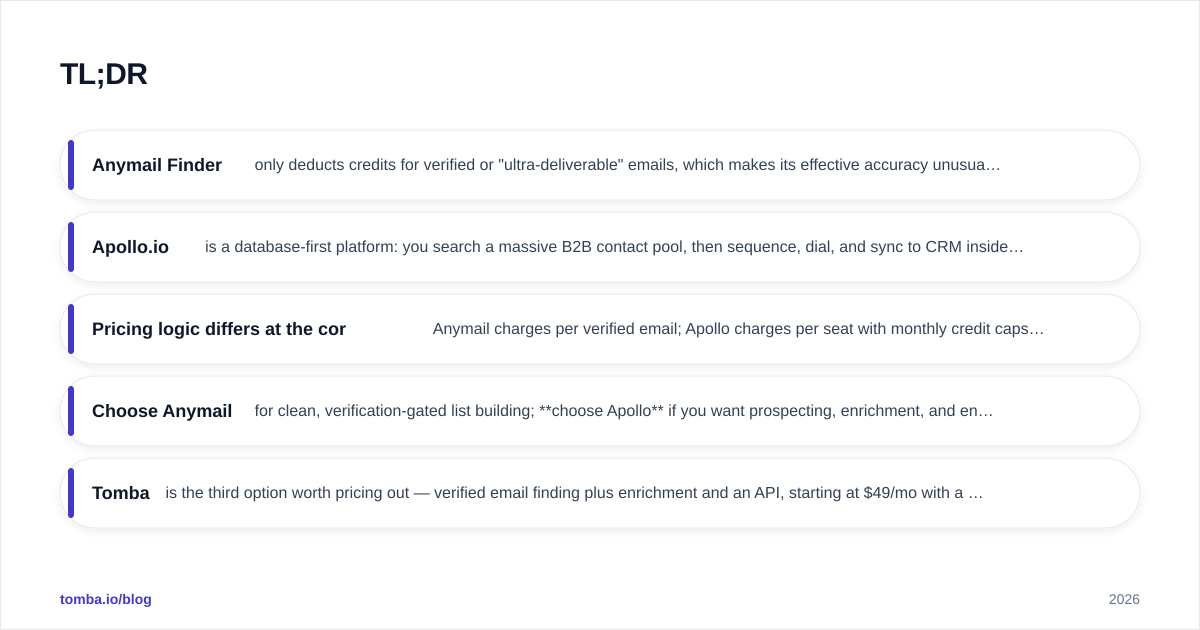
- Anymail Finder only deducts credits for verified or "ultra-deliverable" emails, which makes its effective accuracy unusually predictable for cold outreach.
- Apollo.io is a database-first platform: you search a massive B2B contact pool, then sequence, dial, and sync to CRM inside one tool.
- Pricing logic differs at the core — Anymail charges per verified email; Apollo charges per seat with monthly credit caps that throttle exports.
- Choose Anymail for clean, verification-gated list building; choose Apollo if you want prospecting, enrichment, and engagement bundled together.
- Tomba is the third option worth pricing out — verified email finding plus enrichment and an API, starting at $49/mo with a free tier.
What is Anymail Finder?#
Anymail Finder is a single-purpose email-finder. You feed it a full name plus a company domain (or a company name, or a LinkedIn profile, or a CSV for bulk runs), and it returns a business email address with a confidence status. Its defining feature is the billing model: you are only charged when it returns an email it has marked verified. Guessed or unverifiable results don't cost a credit.
That sounds like a small detail. In practice it reshapes how you budget. Most finders charge per search regardless of whether the result is usable, so a 40% hit rate quietly means you paid 2.5x the sticker price per real email. Anymail's verified-only deduction pushes that risk back onto the vendor, which is why deliverability-conscious teams like it for cold email where a single spam trap can dent your sender reputation.
What it is not: a prospecting database. Anymail doesn't hand you a "show me all VPs of Marketing in fintech" list. You bring the names; it finds the addresses.
What is Apollo.io?#
Apollo.io is a sales intelligence and engagement platform. Its anchor asset is a contact database the company reports at 275M+ contacts and 73M+ companies, filterable by title, industry, headcount, technology, intent signals, and dozens of other attributes. On top of that database it stacks email sequencing, a phone dialer, deal management, and native CRM sync.
The mental model is different from Anymail's. With Apollo you start from zero names and discover prospects through filters, then act on them without leaving the app. It's closer to a ZoomInfo or Apollo alternative category competitor than to a pure finder. That breadth is the selling point and the catch: you're buying a platform, and you pay platform prices and accept platform data-freshness trade-offs.
How do Anymail Finder and Apollo.io compare at a glance?#
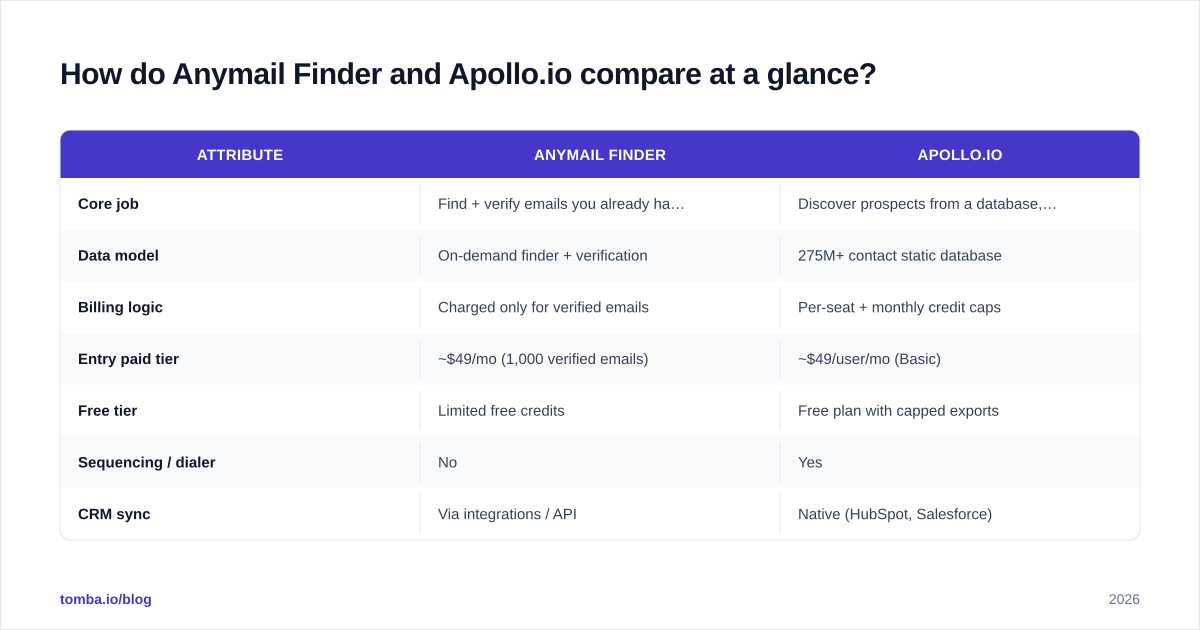
Here's the head-to-head on the attributes that actually change your workflow and your invoice.
| Attribute | Anymail Finder | Apollo.io |
|---|---|---|
| Core job | Find + verify emails you already have names for | Discover prospects from a database, then engage |
| Data model | On-demand finder + verification | 275M+ contact static database |
| Billing logic | Charged only for verified emails | Per-seat + monthly credit caps |
| Entry paid tier | ~$49/mo (1,000 verified emails) | ~$49/user/mo (Basic) |
| Free tier | Limited free credits | Free plan with capped exports |
| Sequencing / dialer | No | Yes |
| CRM sync | Via integrations / API | Native (HubSpot, Salesforce) |
| Best for | Clean list building, deliverability | All-in-one outbound motion |
The pattern: Anymail wins on purity of the finding job, Apollo wins on breadth of the surrounding motion. Neither is strictly better — they answer different questions.
Which tool is more accurate?#
Accuracy is the question everyone asks and almost nobody measures correctly, because "accuracy" splits into two numbers: hit rate (did you get an email?) and deliverability (does it bounce?).
Anymail Finder optimizes the second number by design. Because it only bills for verified results, its incentive is to be conservative — it would rather return "not found" than charge you for a risky guess. That tends to produce lower raw hit rates but very clean bounce rates, which is what you want when email deliverability is the constraint.
Apollo's accuracy is database-dependent. When a contact record is fresh, you get an instant, high-confidence email. When the record is stale — and at 275M contacts, a meaningful slice always is — you get an address that may belong to someone who left the company two roles ago. Apollo does run verification, but a static database inherently decays between refreshes in a way an on-demand finder doesn't.

The honest takeaway: for a name-and-domain you already have, a verification-gated finder usually beats a database lookup on deliverability. For discovering names you don't have yet, the database wins because the finder simply can't do that job. This is also why many teams run both — or run a finder like the Tomba Email Finder alongside their database tool to re-verify exports before sending.

How does pricing really work?#
This is where the two tools diverge most, and where buyers get surprised.
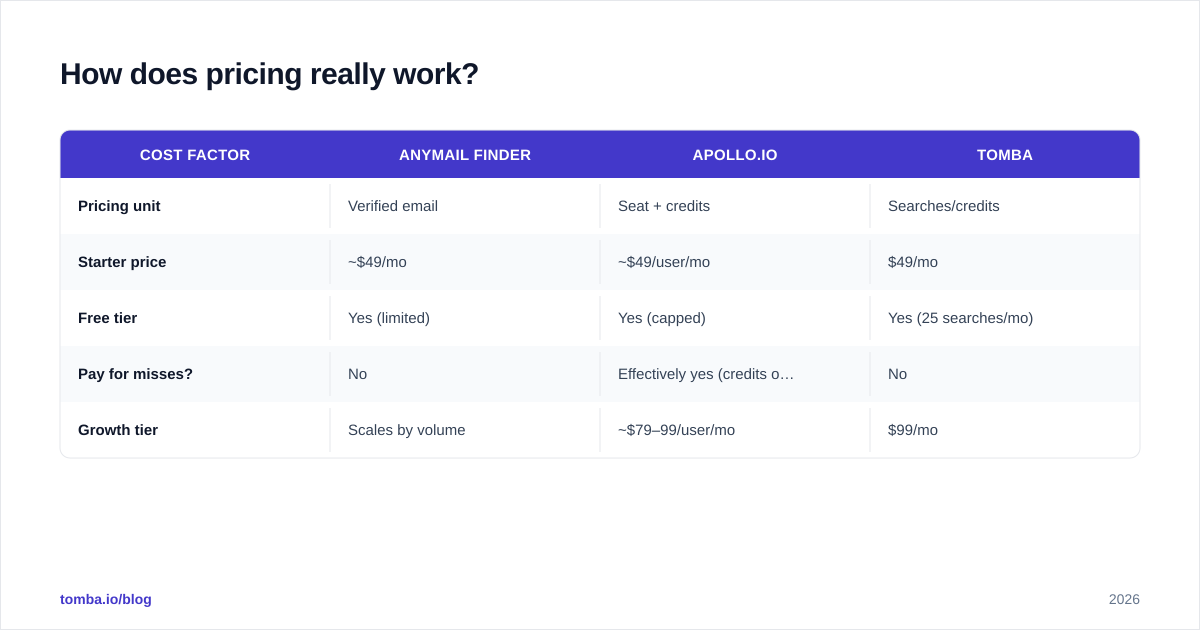
Anymail Finder prices around the verified-email unit. Plans scale by how many verified emails you need per month, with the entry paid tier landing near $49/mo for roughly 1,000 verified emails. The key word is verified: a search that returns nothing doesn't decrement your balance, so your real cost-per-usable-email is close to the sticker number.
Apollo.io prices per seat, then layers monthly credit caps on top. The Basic tier starts around $49/user/mo, but exports and certain enrichment actions draw down a credit pool that resets monthly. Heavy list-builders routinely hit those caps mid-month and either wait or upgrade. The platform value is real, but the "unlimited" feeling evaporates once you scale extraction.
| Cost factor | Anymail Finder | Apollo.io | Tomba |
|---|---|---|---|
| Pricing unit | Verified email | Seat + credits | Searches/credits |
| Starter price | ~$49/mo | ~$49/user/mo | $49/mo |
| Free tier | Yes (limited) | Yes (capped) | Yes (25 searches/mo) |
| Pay for misses? | No | Effectively yes (credits on attempts) | No |
| Growth tier | Scales by volume | ~$79–99/user/mo | $99/mo |
For a precise breakdown of how a verified-only model compares on total cost, the Tomba pricing page lays out tiers from Free through Pro ($249/mo) without per-seat multipliers — useful as a third reference point when you're modeling spend.
When should you choose Anymail Finder?#
Pick Anymail Finder when your job is converting a known list of people into clean, sendable emails. Concretely:
- You already have target names and companies (from events, LinkedIn exports, a partner list, or your CRM).
- Deliverability is non-negotiable because you're protecting a warm sending domain.
- You want predictable billing where the number on the invoice maps to usable results.
- You don't need a dialer, sequencer, or built-in CRM — you have those already.
Anymail is the tool that says "no" gracefully. If it can't verify an address, it tells you and doesn't charge you. For lean teams running tight cold-email programs, that discipline is worth more than a bigger database they'd have to clean anyway. If your bottleneck is the cleaning step, pairing any finder with a dedicated email verifier closes the loop before you hit send.
When should you choose Apollo.io?#
Pick Apollo.io when your job is building an outbound motion from scratch inside one tool. Concretely:
- You don't yet have a target list and need to discover total addressable accounts and contacts by filter.
- You want sequencing, email tracking, and a dialer in the same login as your data.
- You value native CRM sync and are running a HubSpot or Salesforce-centric revenue operations stack.
- You can live with database decay and credit caps in exchange for breadth.
Apollo is genuinely strong as a consolidation play. For an early-stage SDR team that doesn't want to stitch five tools together, "one platform, one bill, one onboarding" is a legitimate advantage even if each individual module is beaten by a specialist. The risk is lock-in and the slow realization that the engagement features push you toward higher per-seat tiers as you grow.

What about data freshness and compliance?#
Two under-discussed factors decide long-term satisfaction with either tool.
Freshness. An on-demand finder queries against live signals at the moment you ask, so it reflects reality closer to now. A static database is a snapshot that's only as good as its last refresh cycle. If you sell into high-churn segments (startups, agencies, anything where people change jobs fast), favor the finder model or re-verify Apollo exports before every send. You can read how a finder sources and refreshes its results on Tomba's data sources page for a sense of what "live" actually means.
Compliance. Both tools operate in B2B contexts governed by GDPR and CAN-SPAM. The practical difference: a finder returns addresses you request one at a time with a clear basis, while a bulk database export tempts teams into spray-and-pray sends that draw complaints. Whichever you choose, document your lawful basis and honor opt-outs — the G2 category pages for both products are full of reviews flagging where careless bulk sending went wrong.
How do they fit a real outbound stack?#
Most teams I see don't pick one and discard the other — they assign each a lane:
- Discovery lane (Apollo or a database): find net-new accounts and contacts you didn't know existed.
- Verification lane (Anymail / Tomba): re-verify every address before it enters a sequence, because exported database emails decay.
- Enrichment lane: fill missing fields — phone, role, social — via data enrichment so your personalization has fuel.
In that architecture, Apollo and Anymail aren't rivals; they're stages. The mistake is paying Apollo's platform premium and sending its raw exports without a verification pass — that's how good domains end up on blocklists. Run the cheap verification step and your reply rates and your response rate both hold up.
Is there a better-value third option?#
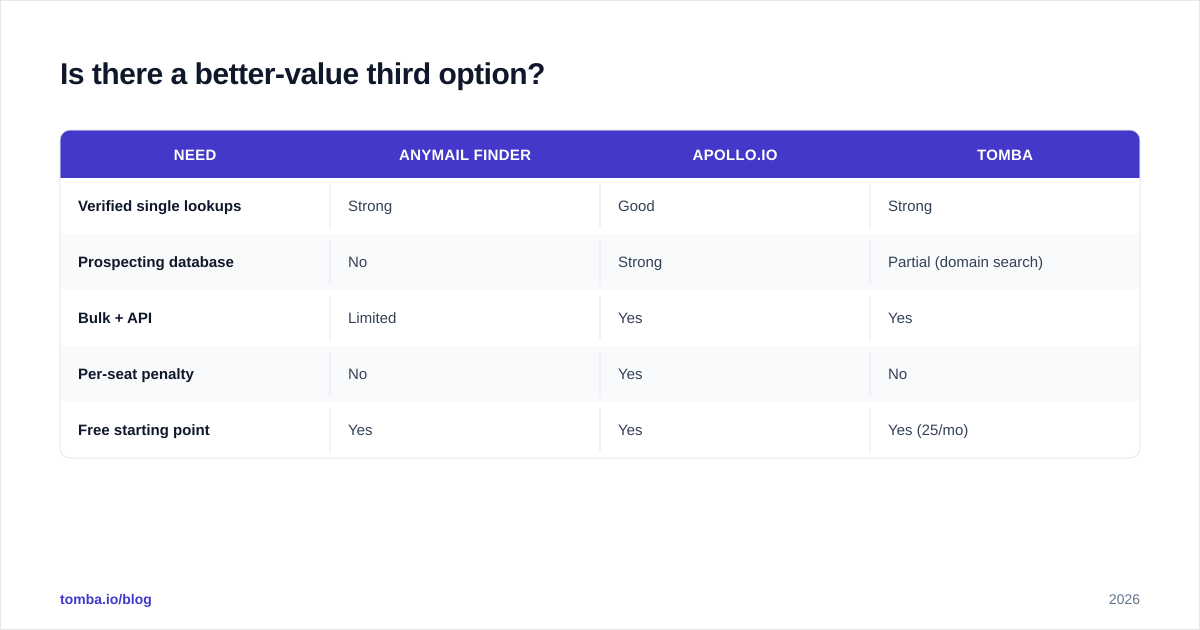
Yes — and ignoring it would make this comparison dishonest. Tomba sits between the two: it's a verification-gated email finder like Anymail, but it also ships domain search, bulk processing, enrichment, and a developer-grade Tomba API — closing part of the gap toward Apollo's breadth without the per-seat pricing.
| Need | Anymail Finder | Apollo.io | Tomba |
|---|---|---|---|
| Verified single lookups | Strong | Good | Strong |
| Prospecting database | No | Strong | Partial (domain search) |
| Bulk + API | Limited | Yes | Yes |
| Per-seat penalty | No | Yes | No |
| Free starting point | Yes | Yes | Yes (25/mo) |
If your priority is verified emails at a transparent price with an API you can actually build on, Tomba is the value pick. If you need a full engagement platform, Apollo earns its keep. If you want the leanest possible finder and nothing else, Anymail does exactly that.
The bottom line: which should you pick?#
Decide by your starting point. If you already have names and need clean emails, Anymail Finder's verified-only billing is the lower-risk, lower-surprise choice. If you're starting from nothing and want discovery plus engagement in one platform, Apollo.io is the broader buy — just budget for credit caps and re-verify before you send. And if you want most of the finding power of a specialist with the bulk and API muscle to scale, price out Tomba before you commit.
Whichever lane you're in, the finding step is the foundation everything else sits on. Start with the Tomba Email Finder — find professional email addresses by name, domain, or company, verify them in the same workflow, and keep your sending reputation intact. The free tier gives you 25 searches a month to benchmark accuracy against your current tool before you move a dollar of budget. Run the same 50 contacts through all three and let the bounce rate pick the winner.
// get started
Find, verify and enrich your first contacts today
Start on the free plan with 25 searches a month, then scale when your team is ready.
Free plan · No credit card required · GDPR & CCPA
// about the author