Top 7 Aomni Alternatives for AI Sales Research in 2026
Aomni's AI research agent is powerful, but it isn't the only option. Here are 7 Aomni alternatives compared on data depth, pricing, and workflow fit for 2026.
Aomni made a name for itself by handing reps an AI agent that researches accounts while they sleep. But "AI does my account research" is now a crowded category, and Aomni is not automatically the right fit for every team, budget, or data need. If you are evaluating Aomni alternatives in 2026, this guide compares the seven strongest options on what actually matters: research depth, data accuracy, workflow integration, and price.
TL;DR#
- Aomni is strong for deep, agent-driven account research, but pricing and data coverage push many teams to look elsewhere.
- The best Aomni alternatives split into three buckets: AI research agents, account-intelligence platforms, and data-and-enrichment engines that feed your own workflow.
- If your bottleneck is contact data (emails, phones, firmographics) rather than narrative research, a dedicated finder like Tomba is far cheaper and more accurate per lookup.
- For full-funnel intent and account scoring, 6sense and Clay sit at the heavier, pricier end.
- Match the tool to your real gap: research narrative, intent signals, or verified contact data. Most teams overpay for the first when they actually need the third.
What does Aomni actually do?#
Aomni is an AI-powered sales research platform. You point it at an account, and an autonomous agent crawls public sources — company sites, news, filings, social — then synthesizes a briefing: account overview, likely pain points, stakeholders, and talking points for outreach. The pitch is simple: replace the 30–45 minutes a rep spends researching each account with a few minutes of AI-generated prep.
That is genuinely useful for account executives running complex, considered deals. Where it gets weaker is at scale (researching 500 accounts is a different problem than researching 5), on contact-level data accuracy, and on price transparency for smaller teams. Those three gaps are exactly why people search for alternatives.
How should you categorize Aomni alternatives?#
Before comparing tools head-to-head, sort them by the job you are hiring them for. Most "Aomni vs X" confusion comes from comparing tools that solve different problems.
- AI research agents — generate narrative briefings and talking points (Aomni, Clay's research workflows, Perplexity-style agents).
- Account intelligence + intent — score accounts, surface buying signals, prioritize territory (6sense,
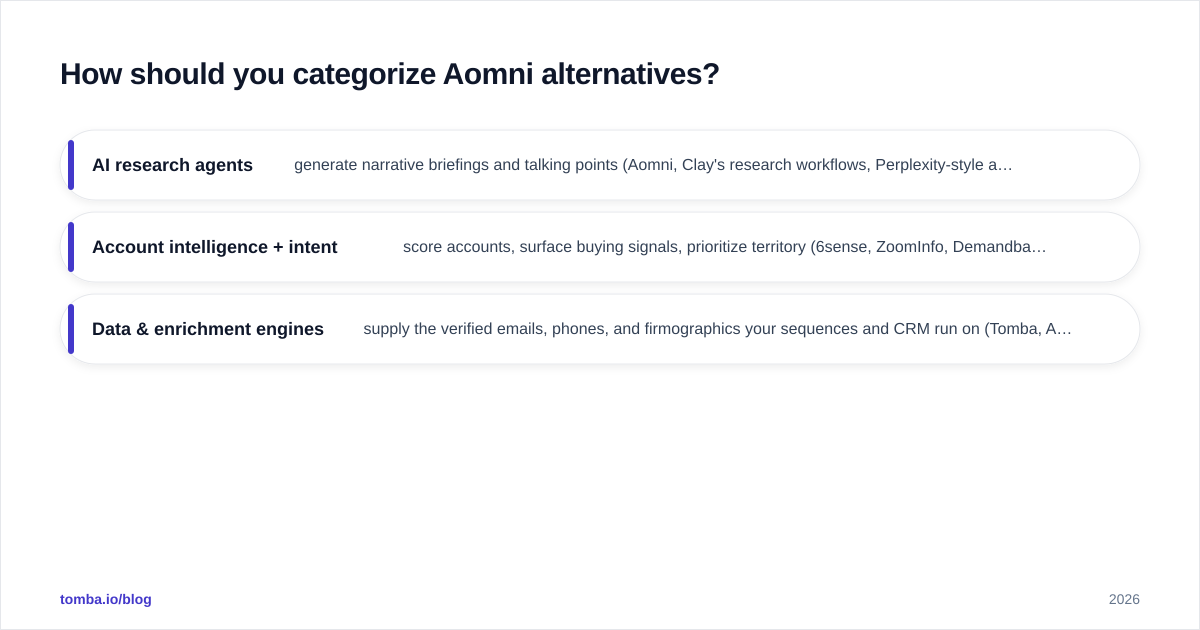
ZoomInfo, Demandbase).
- Data & enrichment engines — supply the verified emails, phones, and firmographics your sequences and CRM run on (Tomba, Apollo, Clearbit).
A team that says "Aomni is too expensive" often discovers their real need was the third bucket. You do not need an AI to write you a paragraph about Acme Corp; you need 200 verified decision-maker emails. Be honest about which gap you are filling.
What are the 7 best Aomni alternatives in 2026?#
1. Clay#
Clay is the spreadsheet-meets-automation platform that has eaten a huge slice of the AI-research market. You build tables, plug in 100+ data providers, and chain AI prompts to enrich, research, and personalize at scale. It is more flexible than Aomni and far more powerful for batch research — but it has a real learning curve and credits add up fast.
Best for: ops-minded teams who want to build custom research and enrichment workflows.
2. 6sense#
6sense is account intelligence and intent at the enterprise tier. Instead of researching one account at a time, it tells you which accounts are in-market right now based on anonymous intent signals, then orchestrates plays around them. It overlaps with Aomni only loosely — this is prioritization, not briefing-writing. Expect enterprise pricing and a real implementation. (See our 6sense alternative breakdown if budget is the blocker.)
Best for: larger GTM teams that need pipeline prioritization, not just account prep.
3. Apollo#
Apollo bundles a B2B database, sequences, and basic AI research into one tool. It is the "good enough at everything" option and a common Aomni alternative for teams that want contact data and light research in a single seat. Data accuracy is decent but variable, and the all-in-one model means you compromise on each individual feature. Compare it as an Apollo alternative when data quality is your priority.
Best for: SMB teams wanting database + outreach + light research in one place.
4. ZoomInfo#
The incumbent. ZoomInfo offers deep firmographic and contact data plus Copilot, its AI layer for signals and account summaries. It is comprehensive and expensive, with annual contracts that lock you in. If you need enterprise-grade coverage and have the budget, it competes directly with Aomni's research on breadth.
Best for: enterprises that need maximum data coverage and can absorb the contract.
5. Perplexity / general AI agents#
A growing number of teams skip purpose-built tools and run account research through general AI agents with web access. It is cheap and flexible, but you get no structured data, no CRM sync, and no verified contacts. Good as a supplement, weak as a system of record.
Best for: individual reps doing ad-hoc research on a tight budget.
6. Demandbase#
Demandbase is 6sense's main rival in account-based intent and advertising. Like 6sense, it is about targeting and orchestration more than narrative research. Strong for ABM-led orgs. See the Demandbase alternative comparison for the trade-offs.
Best for: ABM teams running coordinated ads + sales plays.
7. Tomba#
Tomba comes at the problem from the data side. Rather than writing you a research narrative, it gives you the verified contact layer that every research workflow eventually needs: emails, phones, firmographics, and enrichment by domain or name. If your honest bottleneck is "I have the accounts, I need to reach the right people," a dedicated email finder plus data enrichment solves it for a fraction of an AI-research subscription — and you can wire it into your own AI prompts via the Tomba API.
Best for: teams whose real gap is verified contact data, not generated briefings.
How do the Aomni alternatives compare?#
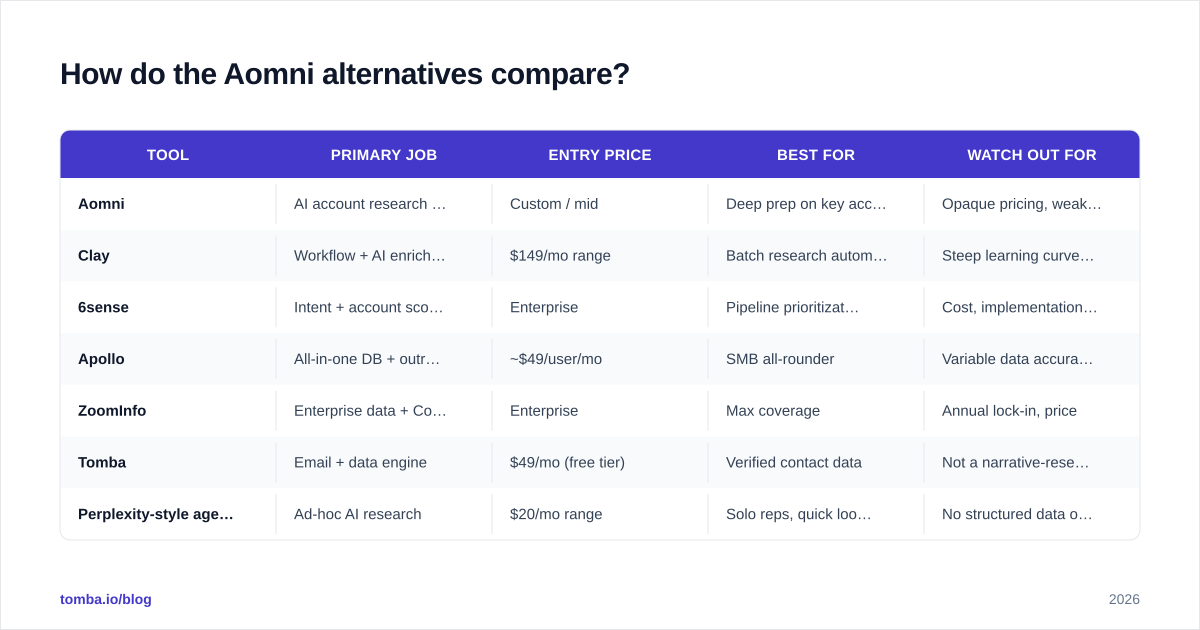
The table below maps each tool to its primary job, starting price posture, and where it wins. Prices change often — confirm current numbers on each vendor's site (and review Tomba pricing directly).
| Tool | Primary job | Entry price | Best for | Watch out for |
|---|---|---|---|---|
| Aomni | AI account research agent | Custom / mid | Deep prep on key accounts | Opaque pricing, weak at scale |
| Clay | Workflow + AI enrichment | $149/mo range | Batch research automation | Steep learning curve, credit burn |
| 6sense | Intent + account scoring | Enterprise | Pipeline prioritization | Cost, implementation time |
| Apollo | All-in-one DB + outreach | ~$49/user/mo | SMB all-rounder | Variable data accuracy |
| ZoomInfo | Enterprise data + Copilot | Enterprise | Max coverage | Annual lock-in, price |
| Tomba | Email + data engine | $49/mo (free tier) | Verified contact data | Not a narrative-research tool |
| Perplexity-style agents | Ad-hoc AI research | $20/mo range | Solo reps, quick lookups | No structured data or CRM sync |
Is Aomni worth it, or should you switch?#
Keep Aomni if your motion is low-volume, high-value enterprise selling where a rep genuinely benefits from a polished briefing per account and your budget supports it. The narrative quality is its core strength.
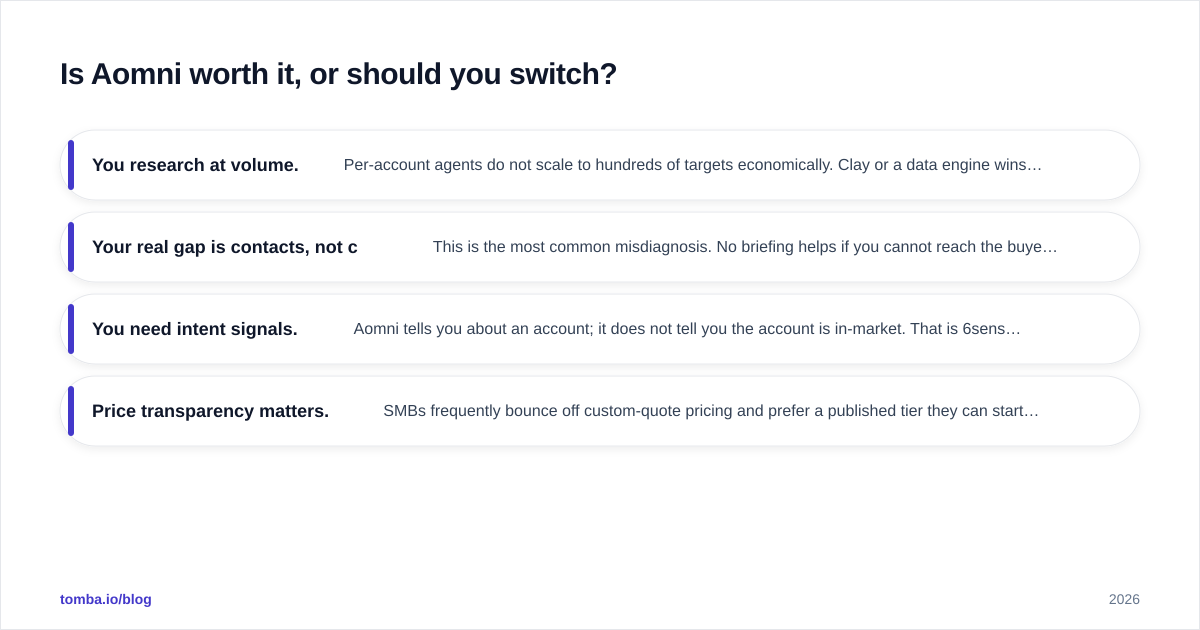
Switch — or supplement — if any of these are true:
- You research at volume. Per-account agents do not scale to hundreds of targets economically. Clay or a data engine wins here.
- Your real gap is contacts, not context. This is the most common misdiagnosis. No briefing helps if you cannot reach the buyer. A domain search that returns every verified email at a company moves more pipeline than another paragraph of "talking points."
- You need intent signals. Aomni tells you about an account; it does not tell you the account is in-market. That is 6sense/Demandbase territory.
- Price transparency matters. SMBs frequently bounce off custom-quote pricing and prefer a published tier they can start on today.
How accurate is the underlying data?#
This is the question that decides ROI, and it is where AI-research tools quietly struggle. An agent can write a fluent account summary, but if the contact it surfaces bounces, the whole workflow leaks at the last step. Independent reviews on G2 and analyst coverage from firms like Gartner consistently show wide accuracy gaps between vendors — "AI-powered" says nothing about data freshness.
Two practical rules:
- Separate research quality from contact-data quality. They are different capabilities and rarely both best-in-class in one tool.
- Verify before you send. Whatever surfaces a contact, run it through an email verifier and a catch-all verifier before it touches a sequence. Bounces wreck sender reputation faster than any tool earns it back.
Tomba publishes its data sources openly, which is the kind of transparency you should demand from any vendor before trusting their numbers — including Aomni itself, whose homepage is aomni.com.
What's the smartest stack in 2026?#
You rarely need to replace Aomni with a single tool — you need the right two-layer stack:
- Layer 1 — Targeting & research: pick one of Aomni, Clay, or an intent platform based on whether you optimize for narrative, automation, or signals.
- Layer 2 — Contact data & verification: a dedicated finder/verifier that feeds verified emails and phones into your CRM and sequences.
Teams that try to make one tool do both usually overpay for the half they need less. The leanest setup is a focused research layer plus a high-accuracy data layer wired together through APIs.
How do you choose your Aomni alternative?#
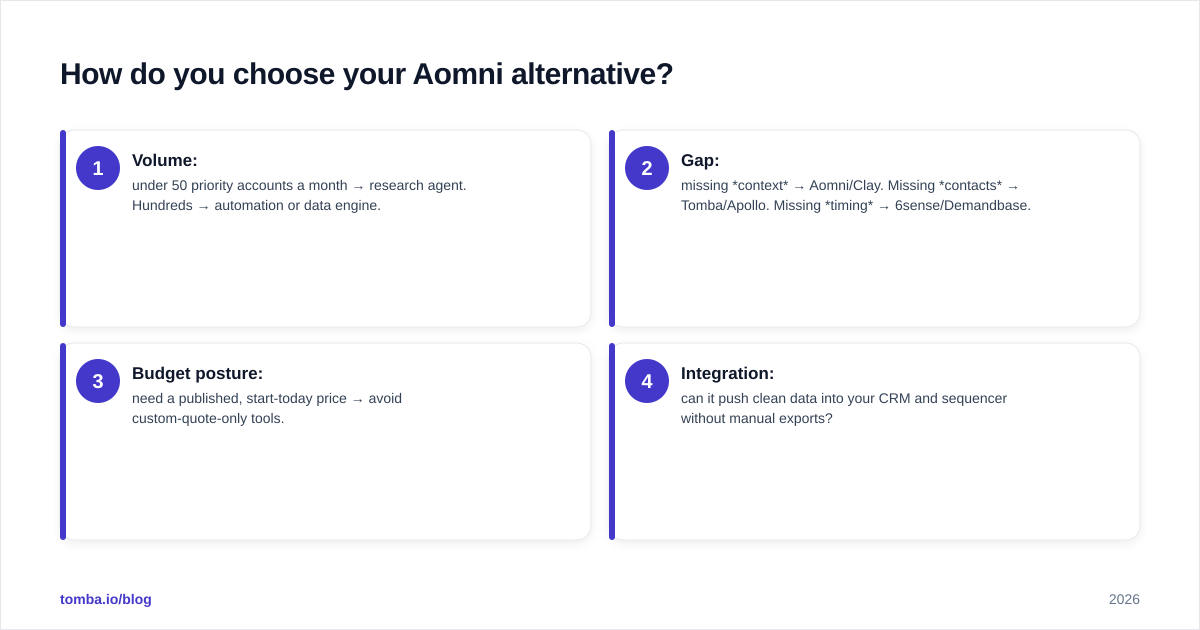
Run this quick diagnostic before you buy anything:
- Volume: under 50 priority accounts a month → research agent. Hundreds → automation or data engine.
- Gap: missing context → Aomni/Clay. Missing contacts → Tomba/Apollo. Missing timing → 6sense/Demandbase.
- Budget posture: need a published, start-today price → avoid custom-quote-only tools.
- Integration: can it push clean data into your CRM and sequencer without manual exports?
Answer those four and the shortlist usually collapses to one or two options.
The bottom line#
Aomni is a capable AI research agent, but "best Aomni alternative" depends entirely on which job you are actually hiring for. If you need richer narrative or scaled automation, look at Clay; if you need intent and prioritization, look at 6sense or Demandbase; if — as is most common — your pipeline is really starved for verified contact data, a dedicated data engine is the higher-ROI move.
That is where Tomba fits. Instead of paying premium rates for generated briefings, use the Tomba Email Finder to turn the accounts you already know into verified, ready-to-contact decision-makers — by domain, name, or company — starting on a free tier and scaling through an API your AI workflows can call directly. Research tells you who to chase; Tomba makes sure you can actually reach them.
// get started
Find, verify and enrich your first contacts today
Start on the free plan with 25 searches a month, then scale when your team is ready.
Free plan · No credit card required · GDPR & CCPA
// about the author