Aomni Pricing, Reviews, Pros and Cons: 2026 Buyer's Guide
A neutral breakdown of Aomni's pricing, real user reviews, and the honest pros and cons — plus where an AI account-research agent fits in your 2026 GTM stack.
TL;DR
- Aomni is an AI account-research agent that compiles deep prospect and account intelligence so reps walk into calls already briefed — its value is research speed, not contact data.
- Aomni pricing is mostly quote-based in 2026: a limited free/trial entry point, a self-serve paid tier, and custom enterprise contracts. There is no public flat "$X seat" sticker for teams.
- Reviews are strong on research depth and time saved, weaker on price transparency, occasional stale data, and a learning curve for prompt-style workflows.
- The biggest pro is hours saved per account; the biggest con is that you still need a separate source for verified emails and phone numbers.
- Pair Aomni-style research with a dedicated email finder and data enrichment layer, because account intelligence and contact accuracy are two different jobs.
Aomni pricing, reviews, pros and cons: the short version#
If you are weighing Aomni for 2026, here is the honest take. This guide on Aomni pricing, reviews, pros and cons covers what you actually pay. It also covers what real users praise, what they complain about, and where the tool fits in a modern outbound stack.
What is Aomni and who is it for?#
Aomni is an AI sales-research platform. You point it at an account. It then gathers public signals on its own — company news, tech stack, org structure, strategic priorities, and competitor context. From those signals, it builds a briefing your reps can read before a discovery call. Think of it as a research analyst that never sleeps. A rep might spend 45 minutes Googling a prospect. The agent builds a structured dossier in minutes.
It is built for revenue teams running complex, considered B2B sales — mid-market and enterprise motions where deal sizes justify per-account research. A transactional SMB team blasting 5,000 cold emails a week is not the target user. A strategic account executive prepping for a $120k deal absolutely is.
That distinction matters for the rest of this review. Aomni's pricing, pros, and cons make sense only once you see how it competes. It wins on research quality, not on lead volume or contact accuracy.
How does Aomni pricing work in 2026?#
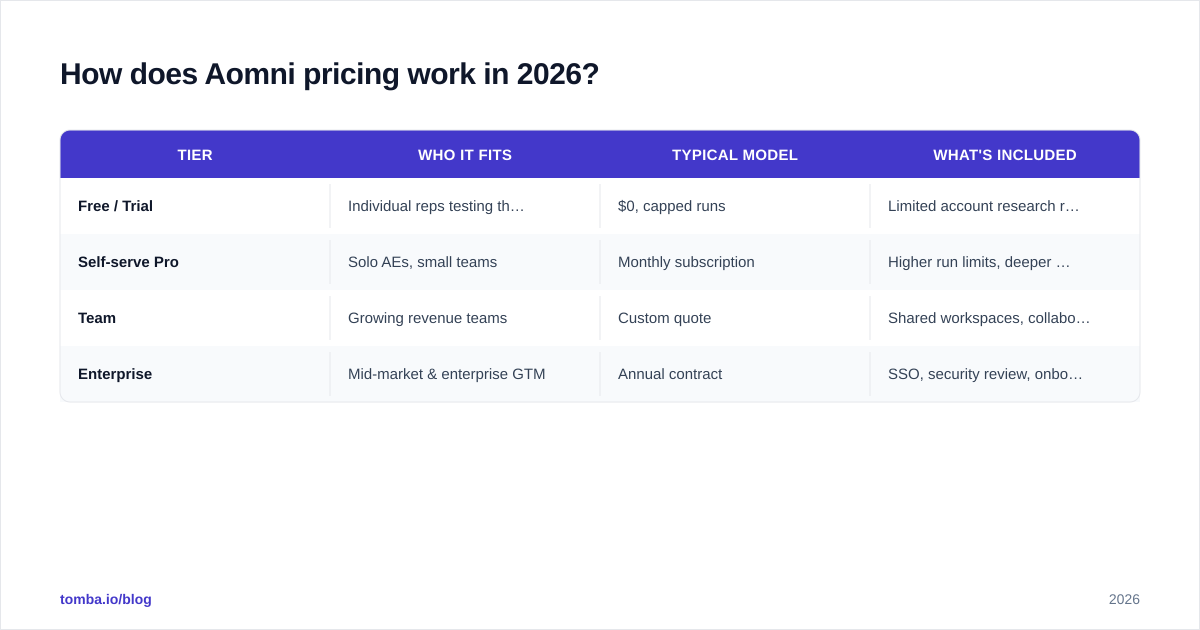
Aomni pricing is largely quote-based, which is the single most common complaint in reviews. There is no fully public seat-priced table the way you would see from a self-serve SaaS tool. Based on Aomni's published tiers and user-reported contracts, the structure breaks down into three buckets.
| Tier | Who it fits | Typical model | What's included |
|---|---|---|---|
| Free / Trial | Individual reps testing the agent | $0, capped runs | Limited account research runs, basic outputs |
| Self-serve Pro | Solo AEs, small teams | Monthly subscription | Higher run limits, deeper reports, exports |
| Team | Growing revenue teams | Custom quote | Shared workspaces, collaboration, integrations |
| Enterprise | Mid-market & enterprise GTM | Annual contract | SSO, security review, onboarding, volume runs |
A few honest caveats so you negotiate from a real baseline:
- The free tier is a sampler, not a workhorse. It exists to prove the research quality. Then it nudges you to a paid plan once you hit run limits.
- Team and Enterprise are sales-led. Expect an annual commitment. Expect the per-seat number to scale with how many accounts you research and which integrations you need.
- Budget for the full stack, not just Aomni. Research is one line item. You will still pay separately for verified contact data, sequencing, and a CRM. Compare that to a transparent, public model like Tomba pricing, where a Free tier (25 searches/mo), Starter at $49/mo, Growth at $99/mo, and Pro at $249/mo are listed up front.
If predictable, line-item budgeting matters to your finance team, the quote-based model is a friction point — not a dealbreaker, but something to surface early.

What do Aomni reviews say? (Pros and cons)#
Pulling from public review sites like G2 and practitioner commentary, the sentiment clusters into a clear set of pros and cons. Here is the balanced version.
The pros reviewers consistently mention#
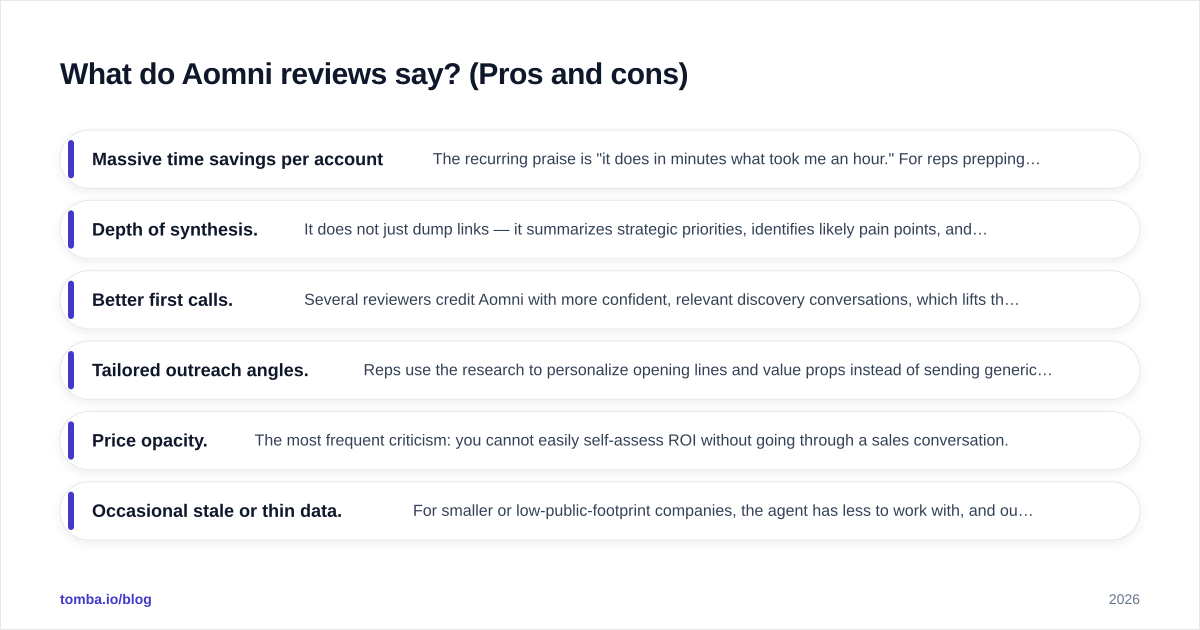
- Massive time savings per account. The recurring praise is "it does in minutes what took me an hour." For reps prepping multiple discovery calls a day, that compounds fast.
- Depth of synthesis. It does not just dump links. It summarizes strategic priorities, identifies likely pain points, and suggests talking points tied to the account's actual situation.
- Better first calls. Several reviewers credit Aomni with more confident, relevant discovery conversations, which lifts their early-stage conversion.
- Tailored outreach angles. Reps use the research to personalize opening lines and value props instead of sending generic templates.
The cons reviewers consistently mention#
- Price opacity. The most frequent criticism: you cannot easily self-assess ROI without going through a sales conversation.
- Occasional stale or thin data. For smaller or low-public-footprint companies, the agent has less to work with, and outputs can feel generic.
- Learning curve. Getting the best results takes some prompt-craft and iteration. The "magic on first run" expectation is not always met.
- It is not a contact database. This is the one buyers most often misread. Aomni tells you who matters and why. It does not reliably hand you a verified work email or direct dial. That is a separate problem you still have to solve.
That last point is the crux of fitting Aomni into a real workflow, so it deserves its own section.
Does Aomni replace a contact-data or email-finding tool?#
No — and treating it like one is the most expensive mistake buyers make. Aomni is account intelligence. An email finder is contact acquisition. They sit next to each other; neither replaces the other.
Here is the everyday analogy. Aomni is the scout who tells you which house on the street is worth visiting and what the family cares about. The email finder is the address book. It tells you exactly which door to knock on and confirms someone actually lives there. You need both to make the visit happen.
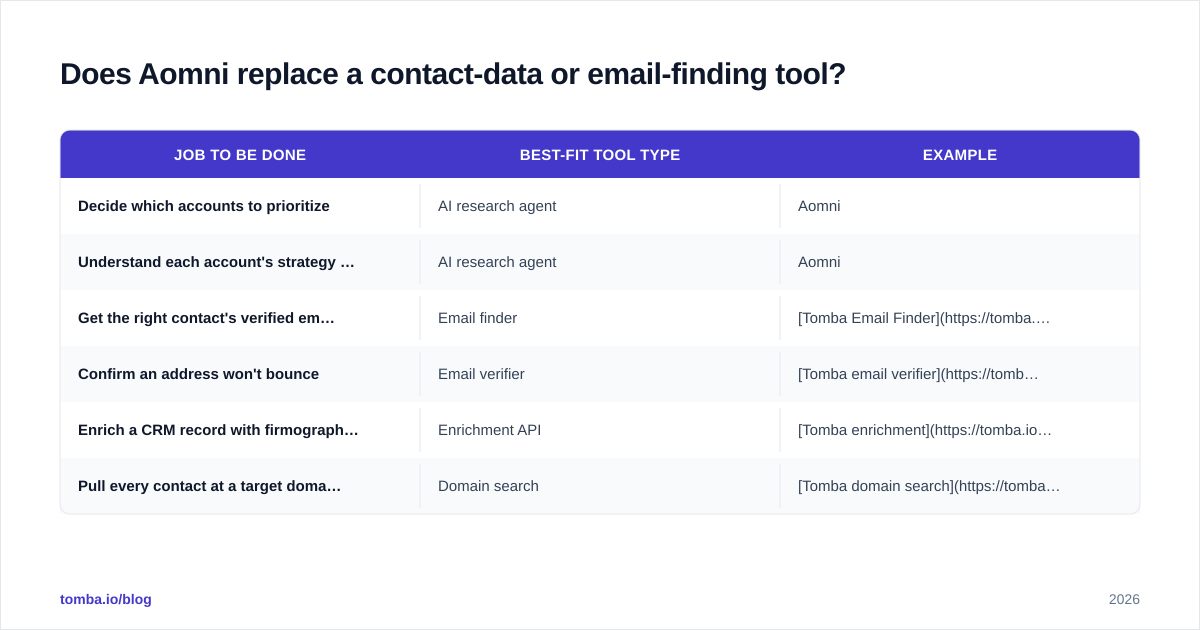
In practice, a clean division of labor looks like this:
| Job to be done | Best-fit tool type | Example |
|---|---|---|
| Decide which accounts to prioritize | AI research agent | Aomni |
| Understand each account's strategy & pain | AI research agent | Aomni |
| Get the right contact's verified email | Email finder | Tomba Email Finder |
| Confirm an address won't bounce | Email verifier | Tomba email verifier |
| Enrich a CRM record with firmographics | Enrichment API | Tomba enrichment |
| Pull every contact at a target domain | Domain search | Tomba domain search |
The teams that get the most from an Aomni-style agent already have reliable contact data flowing in. Great research on an account you cannot reach is wasted effort. Accurate emails with zero account context produce generic outreach that gets ignored. The win is the combination.
How does Aomni compare to alternatives?#
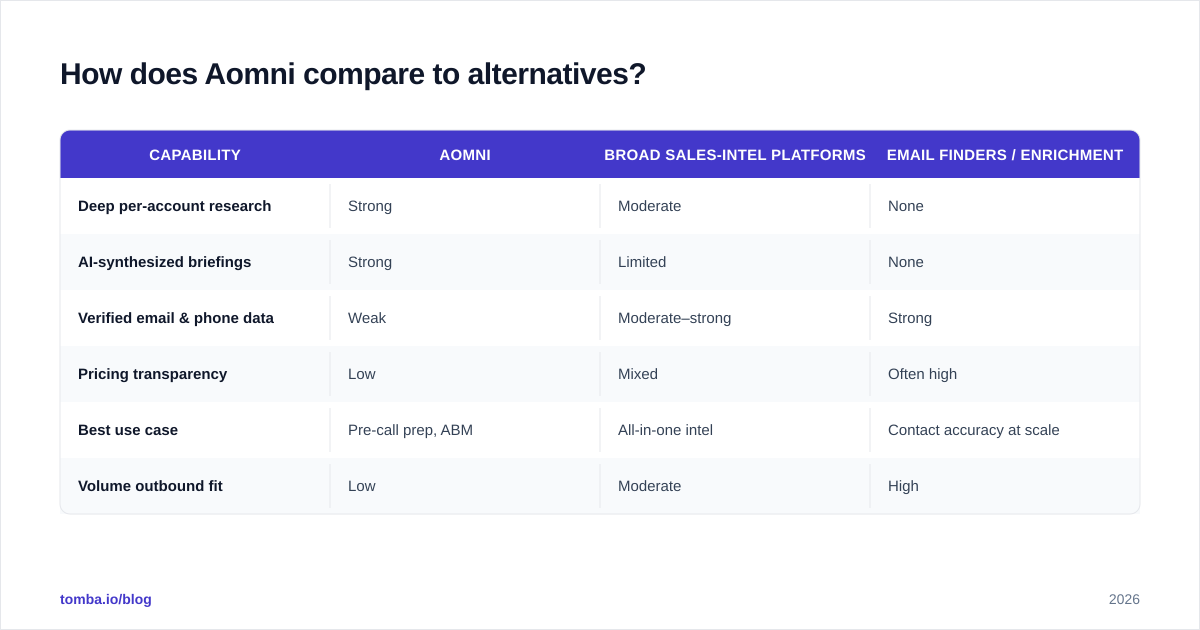
Aomni sits in the "AI sales research / account intelligence" category, which overlaps messily with adjacent tools. Buyers often shortlist it against sales-intelligence platforms and AI prospecting assistants. The honest comparison is less about feature checklists and more about what each tool is actually for.
| Capability | Aomni | Broad sales-intel platforms | Email finders / enrichment |
|---|---|---|---|
| Deep per-account research | Strong | Moderate | None |
| AI-synthesized briefings | Strong | Limited | None |
| Verified email & phone data | Weak | Moderate–strong | Strong |
| Pricing transparency | Low | Mixed | Often high |
| Best use case | Pre-call prep, ABM | All-in-one intel | Contact accuracy at scale |
| Volume outbound fit | Low | Moderate | High |
A few takeaways:
- If your bottleneck is "my reps show up to calls unprepared," Aomni is a direct fix.
- If your bottleneck is "we can't find or trust contact data," an email finder or enrichment layer solves that far more cheaply — and with public pricing.
- If you want both, you are building a stack, not buying one product. That is normal in 2026. The best GTM teams compose specialized tools rather than betting on a single suite.
For research-heavy ABM motions, you can also enrich Aomni's account targets with B2B phone numbers so reps have a multi-channel path, not just email. Independent category overviews from analysts like Gartner are also worth reading before any annual commitment, since the AI-sales-tooling space is shifting quarterly.
Is Aomni worth it? A simple decision framework#
Weighing Aomni pricing, reviews, pros and cons comes down to three conditions that must hold at once. If any one fails, reconsider.
- Your average deal size justifies per-account research. Per-account intelligence pays off on five-figure-plus deals, not on low-ticket transactional sales.
- Your reps have the time and skill to act on briefings. The research only converts if someone uses it to change how they sell. If reps will skim and ignore it, you are paying for shelf-ware.
- You already have — or will add — a verified contact-data layer. Without accurate emails and numbers, the research has nowhere to go.
If you check all three, run the free tier on ten real target accounts. Measure two things: time saved per prep, and whether first-call quality improves. That is a concrete ROI test you can defend to finance without guessing at the enterprise quote.
If you fail condition three — which most teams do — fix the data layer first. It is the cheaper, more transparent half of the equation. It also makes every downstream research investment more valuable.
How do you build the contact layer Aomni assumes you have?#
Start with the part you can price and verify today. Account research is only actionable when you can reach the right person. So the foundation is finding and confirming real contact details at scale.
Tomba's Email Finder locates professional email addresses by name, company, or domain, then validates them so your researched accounts turn into deliverable conversations instead of bounces. It is transparently priced — a Free tier with 25 searches/mo, Starter at $49/mo, and Growth at $99/mo — so you can size the contact layer before you ever sit through an enterprise demo. Pair it with data enrichment to fill CRM gaps, and you have the half of the stack that AI research agents quietly assume you already own. Build the reliable contact foundation first, then let an Aomni-style agent make every outreach smarter.
// get started
Find, verify and enrich your first contacts today
Start on the free plan with 25 searches a month, then scale when your team is ready.
Free plan · No credit card required · GDPR & CCPA
// about the author