ApexVerify vs Apollo.io (2026): Which Email Tool Should You Use?
ApexVerify verifies emails; Apollo.io finds and sequences them. We break down accuracy, pricing, and the right use case for each in 2026 — plus where a dedicated stack beats both.
TL;DR
- ApexVerify and Apollo.io solve different problems. ApexVerify is a focused email-verification service for cleaning lists; Apollo.io is a full prospecting database with email finding, sequencing, and CRM features bolted on.
- If you only need clean lists, a dedicated verifier wins on price and bounce-rate accuracy. If you need to build lists from scratch, Apollo's 200M+ contact database does what a verifier can't.
- Apollo's verification is "good enough" but not best-in-class — its strength is data volume, not deliverability hygiene.
- The hidden third option: pair a dedicated email finder with a dedicated verifier. You get higher accuracy on both finding and cleaning than either single tool delivers.
- Pricing gap is real: ApexVerify-style verifiers run pay-as-you-go from a few dollars per thousand; Apollo's useful tiers start around $49–$99/user/mo.
What is the real difference between ApexVerify and Apollo.io?#
The short answer: ApexVerify checks whether an email is real; Apollo.io finds the email in the first place — and a lot more. Comparing them head-to-head is a little like comparing a smoke detector to a whole home-security system. Both touch "safety," but they sit at different points in the workflow.
ApexVerify (and tools like it) take an email address you already have and run it through a chain of checks — syntax, MX records, SMTP handshake, catch-all detection, role-account and disposable-domain flags — then return a verdict: valid, invalid, risky, or unknown. That's the entire job. The value is keeping your bounce rate under the ~2–3% threshold that protects your sender reputation.
Apollo.io is a go-to-market platform. Its core asset is a contact database of 200M+ people and 35M+ companies, wrapped in filters, a Chrome extension, email sequencing, dialer, and a lightweight CRM. Verification is a feature inside Apollo, not the product itself. You search for "VP of Marketing at SaaS companies in Texas with 50–200 employees," Apollo returns a list with emails attached, and it stamps each one with a deliverability guess.
So the honest framing of apexverify vs apolloio is not "which is better" but "which layer of the funnel are you trying to fix?"
Which one is more accurate?#
Accuracy means two different things here, so separate them.
Verification accuracy (does the "valid" verdict actually land in an inbox?) is where a dedicated verifier like ApexVerify has the structural advantage. A pure-play verifier's entire business depends on its bounce-rate reliability, so it invests in SMTP infrastructure, IP rotation to avoid greylisting, and catch-all handling. Independent verifier benchmarks routinely show the specialist tools clustering at 97–99% real-world accuracy on deliverable addresses.
Finding accuracy (is the email Apollo handed you the right one for that person?) is Apollo's battlefield, and it's noisier. Database-sourced emails can be stale — people change jobs, companies change naming conventions, and a contact pulled six months ago may already bounce. Apollo's own deliverability flags help, but they are probabilistic, not a fresh SMTP check at send time.

This is the crux: Apollo optimizes for coverage, a verifier optimizes for precision. A big database will find an email for almost anyone, but "found" is not "deliverable." That gap is exactly why so many teams run Apollo exports through a separate verifier before loading them into a sequencer. If you want to understand how providers source and refresh records, it's worth reading about where the data actually comes from before trusting any single accuracy claim.
A practical rule: never send to a database-sourced list without a final verification pass. Even Apollo power users do this, which tells you something about treating Apollo's built-in verification as the last line of defense.
How do ApexVerify and Apollo.io compare on features and pricing?#
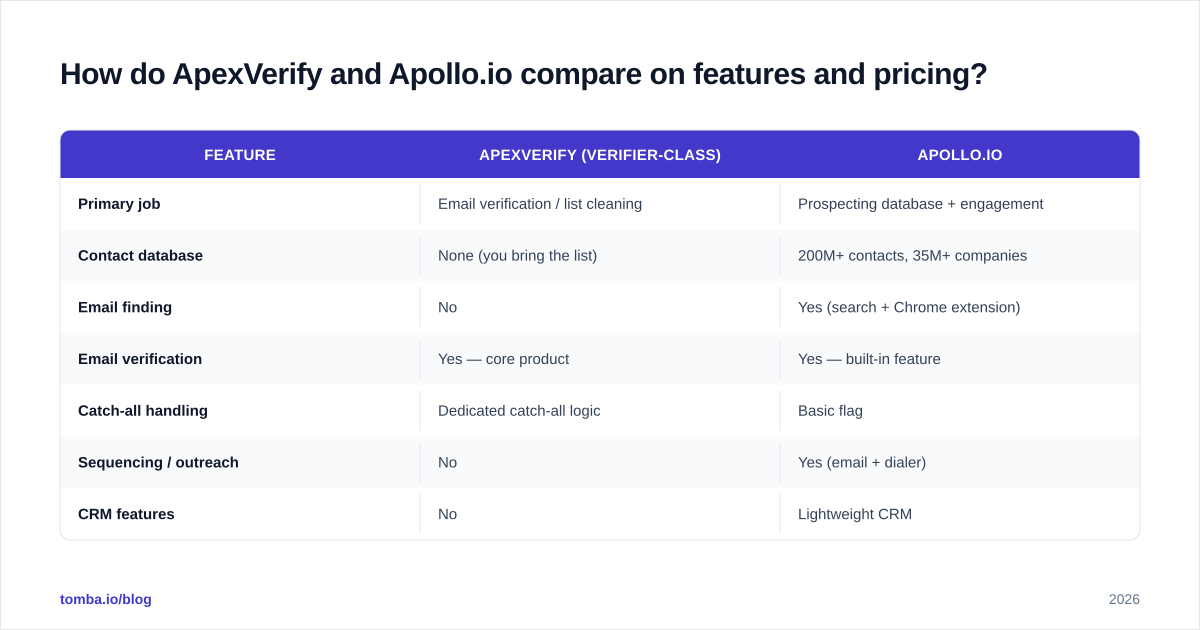
Here's the side-by-side. Apollo and a dedicated verifier overlap only on the verification row — everywhere else they're complementary, not competitive.
| Feature | ApexVerify (verifier-class) | Apollo.io |
|---|---|---|
| Primary job | Email verification / list cleaning | Prospecting database + engagement |
| Contact database | None (you bring the list) | 200M+ contacts, 35M+ companies |
| Email finding | No | Yes (search + Chrome extension) |
| Email verification | Yes — core product | Yes — built-in feature |
| Catch-all handling | Dedicated catch-all logic | Basic flag |
| Sequencing / outreach | No | Yes (email + dialer) |
| CRM features | No | Lightweight CRM |
| Typical entry price | Pay-as-you-go, ~$3–$7 / 1k | Free tier; paid from ~$49–$99/user/mo |
| Best for | Hygiene on existing lists | Building lists from zero |
| API access | Yes | Yes |
Two takeaways. First, the pricing models aren't comparable — verifiers charge per-credit for one task, Apollo charges per-seat for a platform. A 100k-record cleanup might cost $300–$500 on a verifier; the same money buys you a couple of months of Apollo seats with database access you don't get from a verifier at all.
Second, if your only pain is bounce rate, paying for Apollo seats to use its verification is overkill. And if your pain is "I have no leads," a verifier does nothing for you.
)
Is Apollo.io's built-in verification good enough to skip a dedicated tool?#
For low-stakes volume, often yes. For anything where deliverability is your livelihood, usually no.
Apollo's verification is a convenience feature designed to reduce obvious junk — it'll catch malformed addresses, dead domains, and known disposables. What it's weaker at is the hard 20%: catch-all domains, recently-deactivated mailboxes, and risky-but-not-invalid addresses. Those are precisely the ones that quietly tank your reputation because they don't bounce loudly; they get filtered, or they hit spam traps.
Catch-all domains deserve special mention. A catch-all server accepts mail for any address, so a naive SMTP check returns "valid" for everything — including addresses that route straight to a black hole. Distinguishing a real mailbox on a catch-all domain from a fake one takes specialized logic, which is why a dedicated catch-all verifier exists as its own product category. If a meaningful share of your list sits on catch-all domains (common in enterprise), Apollo's flag alone will let bounces through.
The deliverability stakes are not abstract. Mailbox providers like Google and Yahoo tightened bulk-sender requirements, and a sustained bounce or complaint rate above their thresholds can throttle your entire domain. Google's own sender guidelines spell out the bounce and spam-rate limits — once you're over them, no amount of clever copy saves you. Treat verification as risk management, not a nice-to-have.
So the honest answer: Apollo's verification is fine as a first filter, but if your monthly send volume is meaningful, a second pass through a dedicated email verifier pays for itself in protected reputation.
When should you choose a dedicated verifier over Apollo?#
Pick the verifier-only path when these are true:
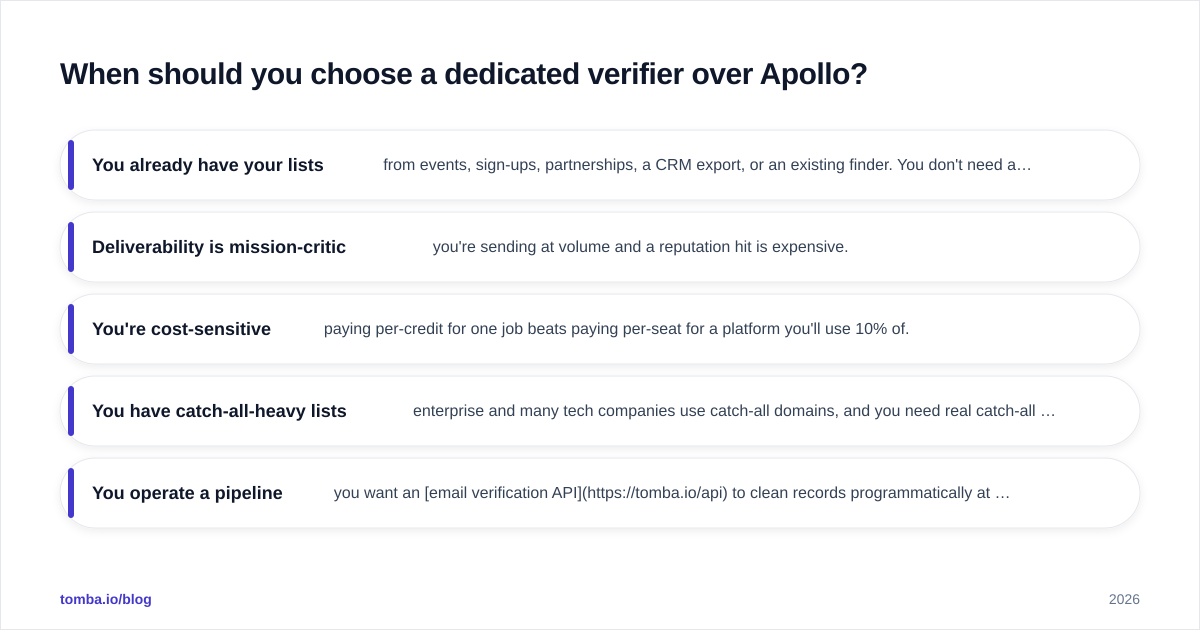
- You already have your lists — from events, sign-ups, partnerships, a CRM export, or an existing finder. You don't need a database; you need hygiene.
- Deliverability is mission-critical — you're sending at volume and a reputation hit is expensive.
- You're cost-sensitive — paying per-credit for one job beats paying per-seat for a platform you'll use 10% of.
- You have catch-all-heavy lists — enterprise and many tech companies use catch-all domains, and you need real catch-all logic.
- You operate a pipeline — you want an email verification API to clean records programmatically at ingestion, not a UI you log into.
In these cases Apollo is the wrong tool — you'd be buying a database engine to use a single feature.
)
When is Apollo.io the better pick?#
Choose Apollo when the bottleneck is finding people, not cleaning them:
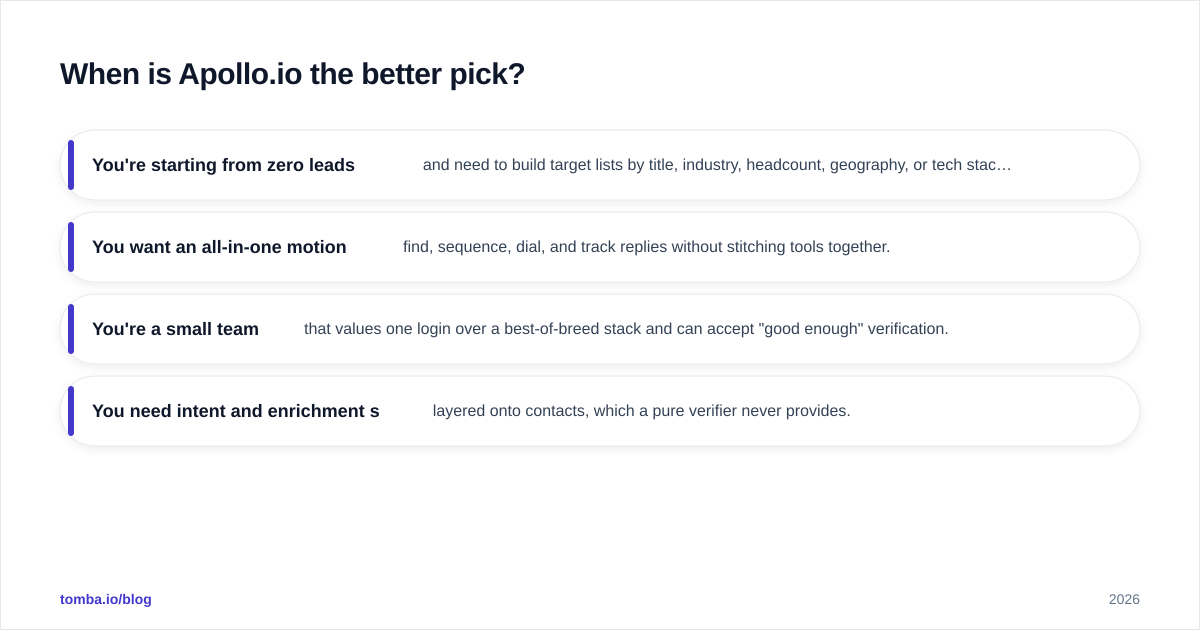
- You're starting from zero leads and need to build target lists by title, industry, headcount, geography, or tech stack.
- You want an all-in-one motion — find, sequence, dial, and track replies without stitching tools together.
- You're a small team that values one login over a best-of-breed stack and can accept "good enough" verification.
- You need intent and enrichment signals layered onto contacts, which a pure verifier never provides.
Apollo's weakness is that you pay for the whole platform even if you only use the database, and its data freshness varies by segment. But for net-new pipeline generation, a verifier can't compete because it doesn't generate anything — it only validates.
If Apollo's per-seat pricing or data limits push you to look around, there's a healthy market of Apollo alternatives that unbundle the database from the sequencer, which often lands cheaper for teams that already own an outreach tool.
What's the smarter setup most teams actually use?#
Decouple finding from verifying, and use a specialist for each. This is the setup that quietly outperforms both single-tool approaches, and it's cheaper than most people expect.
The workflow looks like this:
- Find the emails with a dedicated email finder or domain search, which pulls verified professional addresses by name or company domain.
- Verify the results — including catch-all resolution — before they ever touch your sequencer.
- Enrich with phone, role, and company data so reps have context, using data enrichment rather than a manual lookup.
- Load the clean, enriched list into whatever outreach tool you already pay for.
Why this beats both? A finder built specifically to discover emails tends to return fresher, more targeted results than a giant static database, and a verifier built specifically to validate beats a bolt-on feature on catch-alls and risky addresses. You get the precision of the verifier-only path and the list-building of the Apollo path, without overpaying for an all-in-one that's only average at each job.
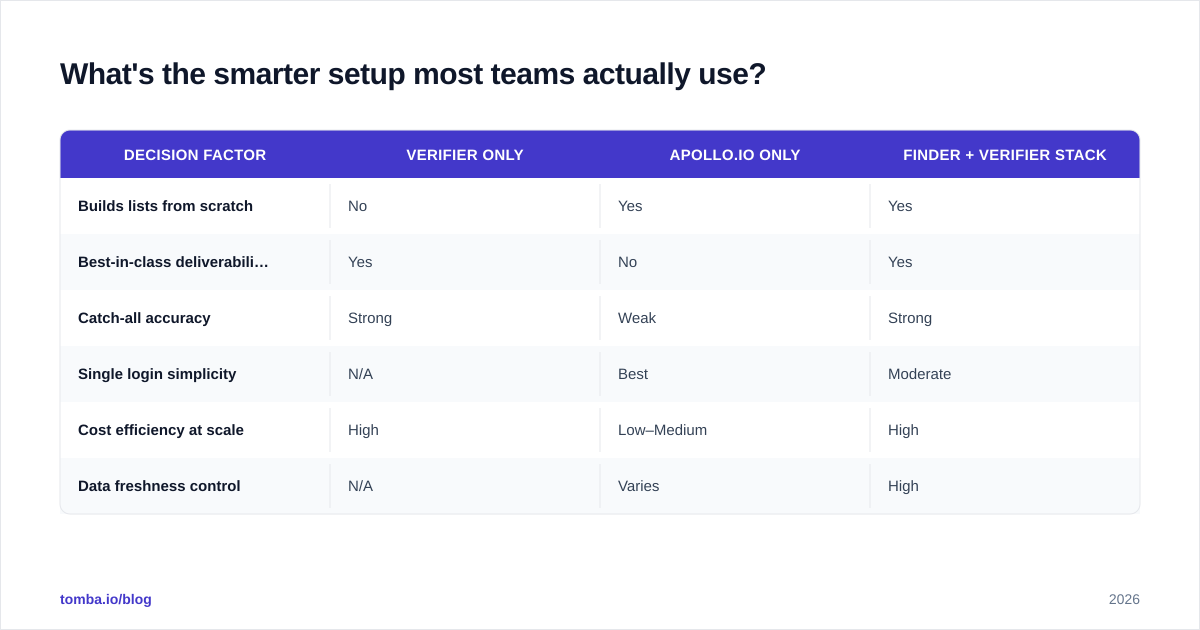
Here's how the three approaches stack up on the dimensions that matter:
| Decision factor | Verifier only | Apollo.io only | Finder + verifier stack |
|---|---|---|---|
| Builds lists from scratch | No | Yes | Yes |
| Best-in-class deliverability | Yes | No | Yes |
| Catch-all accuracy | Strong | Weak | Strong |
| Single login simplicity | N/A | Best | Moderate |
| Cost efficiency at scale | High | Low–Medium | High |
| Data freshness control | N/A | Varies | High |
For teams running this at scale, a bulk email finder plus API verification turns the whole thing into a pipeline step instead of a manual chore. You can review full pricing details to size it against an Apollo seat count — the per-credit math usually favors the unbundled stack once you're past a trial.
One caveat worth stating plainly: no tool, Apollo or otherwise, hits 100%. Job changes, typos at the source, and freshly-deactivated mailboxes guarantee some decay. The goal isn't perfection; it's keeping your bounce rate low enough that mailbox providers keep trusting your domain. If you want to validate vendor claims yourself, third-party review sites like G2 publish user-reported accuracy and support data that cut through marketing copy.
So, ApexVerify or Apollo.io?#
Buy the verifier if you have lists and need them clean. Buy Apollo if you have no lists and need to build them. Build the finder-plus-verifier stack if you want the best of both at the lowest realistic cost. That's the entire decision compressed to one line.
The mistake to avoid is treating this as a winner-take-all. ApexVerify-class tools and Apollo.io aren't really competitors — they're neighbors in the same funnel. The teams that get the most out of their budget map each tool to the job it's actually best at, rather than forcing one platform to do everything average.
If your real problem is finding accurate, verified professional emails to begin with, start with the Tomba Email Finder — search by name, company, or domain, get results that are verified at the point of discovery, and pipe them straight into verification and enrichment without juggling a second platform. The Free tier gives you 25 searches a month to test the accuracy yourself, and paid plans start at $49/mo when you're ready to scale. Find clean, send clean, and keep your domain reputation where it belongs.
Ready to find emails that actually work?
Join 150,000+ professionals who stopped guessing and started sending. Free credits on signup — no credit card required.
Get the Tomba newsletter
Practical outbound tactics and product updates — once every two weeks.
About the author