Apexverify vs Leadzenai: Email Finder Showdown (2026)
Apexverify vs Leadzenai compared on accuracy, pricing, data coverage, and verification — plus where a leaner email finder beats both for B2B prospecting.
Choosing between Apexverify and Leadzenai usually comes down to one question: which one hands you deliverable B2B emails without burning credits on guesses? Both market themselves as accuracy-first email finders, but they make very different trade-offs on data sourcing, verification depth, and price. This breakdown is for revenue teams who need to pick one — or decide neither fits.
TL;DR#
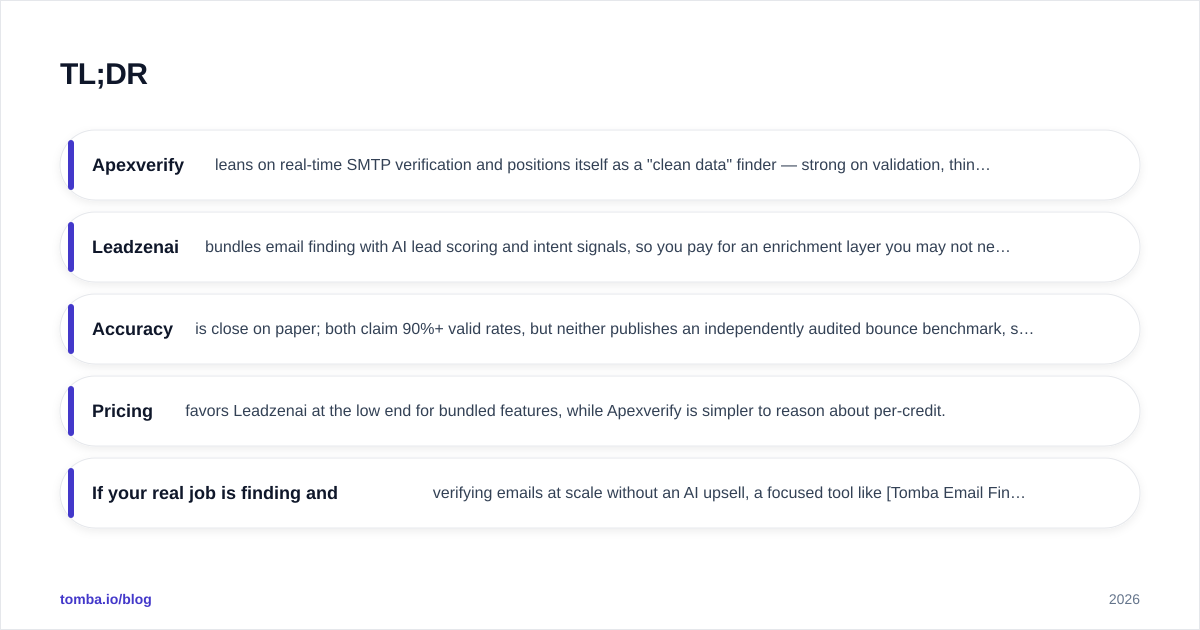
- Apexverify leans on real-time SMTP verification and positions itself as a "clean data" finder — strong on validation, thinner on raw database size.
- Leadzenai bundles email finding with AI lead scoring and intent signals, so you pay for an enrichment layer you may not need if you just want emails.
- Accuracy is close on paper; both claim 90%+ valid rates, but neither publishes an independently audited bounce benchmark, so treat the marketing numbers with caution.
- Pricing favors Leadzenai at the low end for bundled features, while Apexverify is simpler to reason about per-credit.
- If your real job is finding and verifying emails at scale without an AI upsell, a focused tool like Tomba Email Finder often beats both on cost-per-valid-email — more on that below.
What are Apexverify and Leadzenai?#
Both are B2B contact-data tools, but they sit at slightly different points on the spectrum between "email finder" and "sales intelligence platform."
Apexverify is built around the find-then-verify loop. You give it a name and a domain (or upload a list), and it returns an email with a confidence label backed by SMTP-level checks. Its pitch is deliverability: fewer bounces, cleaner sender reputation, less time scrubbing lists. If you've ever watched a campaign tank because 18% of your list hard-bounced, that pitch lands.
Leadzenai is closer to a lightweight sales-intelligence platform. Email finding is one feature among several — it layers AI lead scoring, firmographic enrichment, and intent-style signals on top. The promise is that you don't just get an email; you get a ranked, context-rich lead. That's useful if your team lacks a data layer, and redundant if you already run a CRM with enrichment.
The distinction matters because you should not pay platform prices for a point solution, or vice versa. A good way to frame it: Apexverify sells you a sharp knife; Leadzenai sells you a Swiss Army knife. Which is "better" depends entirely on what you're cutting.

How do Apexverify and Leadzenai actually find emails?#
Every email finder runs some mix of three plays: pulling from a stored database, generating likely patterns (first.last@, flast@) from known company formats, and verifying candidates against the mail server in real time. The differences are in the weighting.
Apexverify weights heavily toward the verification step. Its strength is catching the catch-all problem — domains that accept every address at the SMTP handshake, which makes naive "valid" checks lie to you. If you do a lot of outreach into mid-market companies with catch-all domains, that depth is worth real money. You can test how your own targets behave with a catch-all verifier before you commit budget.
Leadzenai weights toward the database-and-enrichment side. It's optimized to return a profile, not just an address, so it pulls more context per lookup. The risk is that enrichment-heavy tools sometimes return an email from a stale record without re-validating it at send time, which is exactly when freshness matters most.
Neither approach is wrong. But know which one you're buying, because it predicts your bounce rate more than any headline accuracy stat.

Apexverify vs Leadzenai: side-by-side comparison#
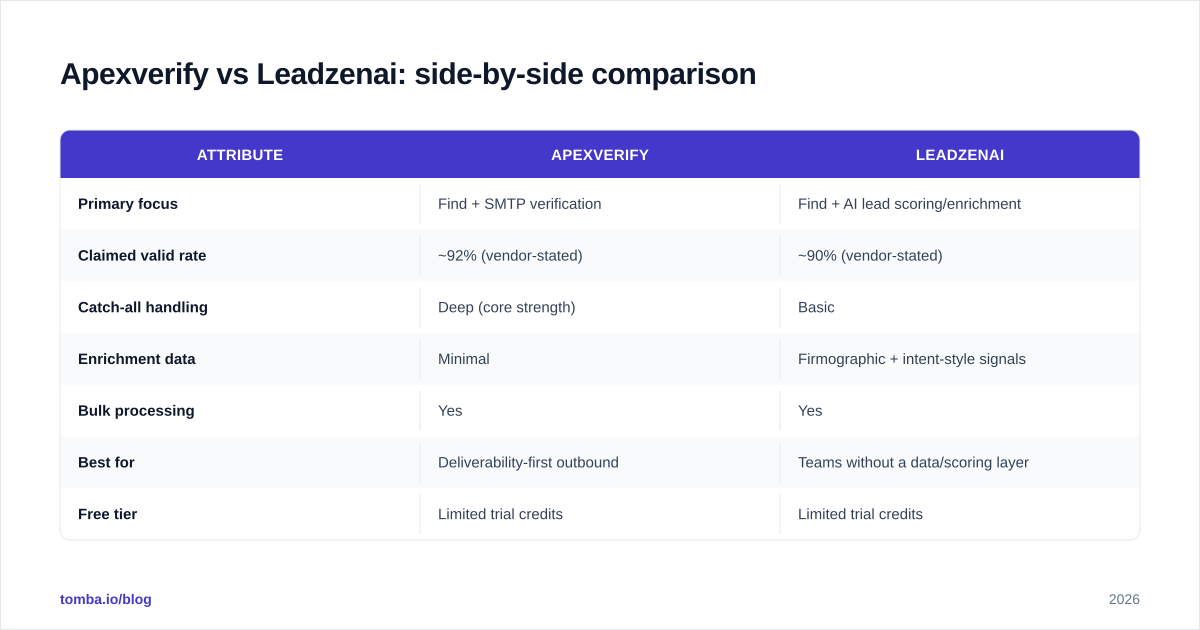
Here's the head-to-head on the attributes that actually change your results. Treat vendor-published accuracy as directional, not gospel — request a trial and measure your own bounce rate before signing anything.
| Attribute | Apexverify | Leadzenai |
|---|---|---|
| Primary focus | Find + SMTP verification | Find + AI lead scoring/enrichment |
| Claimed valid rate | ~92% (vendor-stated) | ~90% (vendor-stated) |
| Catch-all handling | Deep (core strength) | Basic |
| Enrichment data | Minimal | Firmographic + intent-style signals |
| Bulk processing | Yes | Yes |
| Best for | Deliverability-first outbound | Teams without a data/scoring layer |
| Free tier | Limited trial credits | Limited trial credits |
| Learning curve | Low | Moderate (more features) |
The pattern: Apexverify is the better pure email finder; Leadzenai is the better all-in-one for a team that has no other data infrastructure. If you already own a CRM, an outreach tool, and a verification step, Leadzenai's extra layer is cost you don't need.
Which one is more accurate?#
Accuracy is the whole point, and it's also where marketing claims get slippery. "92% accurate" is meaningless without knowing the denominator — accurate on which industries, which seniority levels, which regions, and measured against what bounce definition?
Three things drive real-world accuracy more than any vendor stat:
- Verification at send time, not lookup time. An email that was valid six months ago bounces today if the person changed jobs. Re-verifying right before a campaign matters more than the original find quality. A standalone email verifier lets you do this regardless of which finder sourced the address.
- Catch-all transparency. Tools that label catch-all results as "valid" inflate their numbers. Apexverify is more honest here; that's a point in its favor.
- Data recency. This is where you should scrutinize any vendor — ask how often the underlying data refreshes and where it comes from. Tomba publishes its data sources openly; ask Apexverify and Leadzenai to do the same.
The honest verdict: on accuracy, this is close to a wash on paper, with Apexverify's catch-all handling giving it a slight, real edge for deliverability-obsessed teams. Don't decide on the marketing percentages — run 200 lookups through each on a trial and count the bounces yourself.

How does pricing compare?#
Both run credit-style models with trial tiers, and both move you to custom enterprise quotes at scale. The catch is that "price per lookup" hides the number that matters: price per valid, deliverable email. A cheaper tool that returns more bounces is more expensive once you factor in damaged sender reputation.
Leadzenai tends to look cheaper at entry level because it bundles enrichment into the seat price — good value if you'll use the scoring, dead weight if you won't. Apexverify's per-credit math is simpler to forecast, which finance teams appreciate.
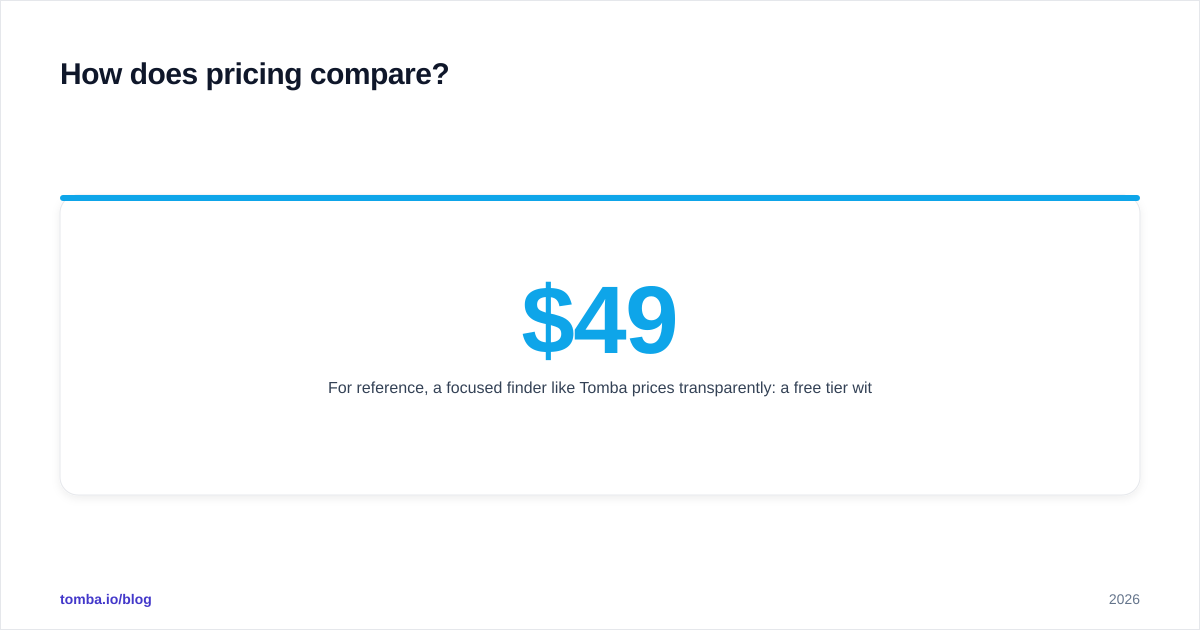
For reference, a focused finder like Tomba prices transparently: a free tier with 25 searches a month, Starter at $49/mo, Growth at $99/mo, Pro at $249/mo, and custom enterprise. You can see the full breakdown on the Tomba pricing page. The takeaway isn't "Tomba is cheapest" — it's that you should normalize every vendor to cost-per-valid-email before comparing, not cost-per-search.
Where does a focused email finder beat both?#
If your core need is "find professional emails and verify them so my campaigns don't bounce," a dedicated finder usually wins on three fronts: predictable cost, no feature bloat, and a workflow built around verification rather than bolted onto it.
That's the niche Tomba occupies. It does the find-and-verify loop, plus the adjacent jobs you actually hit in practice:
- Domain search to pull every email pattern at a target company in one shot.
- Bulk email finder for list-building without per-lookup babysitting.
- A Tomba API and native HubSpot integration so the data lands where your reps already work.
- A Chrome extension for finding emails while you're already on a prospect's site or LinkedIn profile.
What you don't get is an AI-scoring layer you may already have in your CRM — which is the point. You can compare how it stacks up against named competitors directly on pages like the Apollo alternative breakdown if your shortlist is wider than these two.

How should you choose between them?#
Use this decision flow rather than a feature checklist:
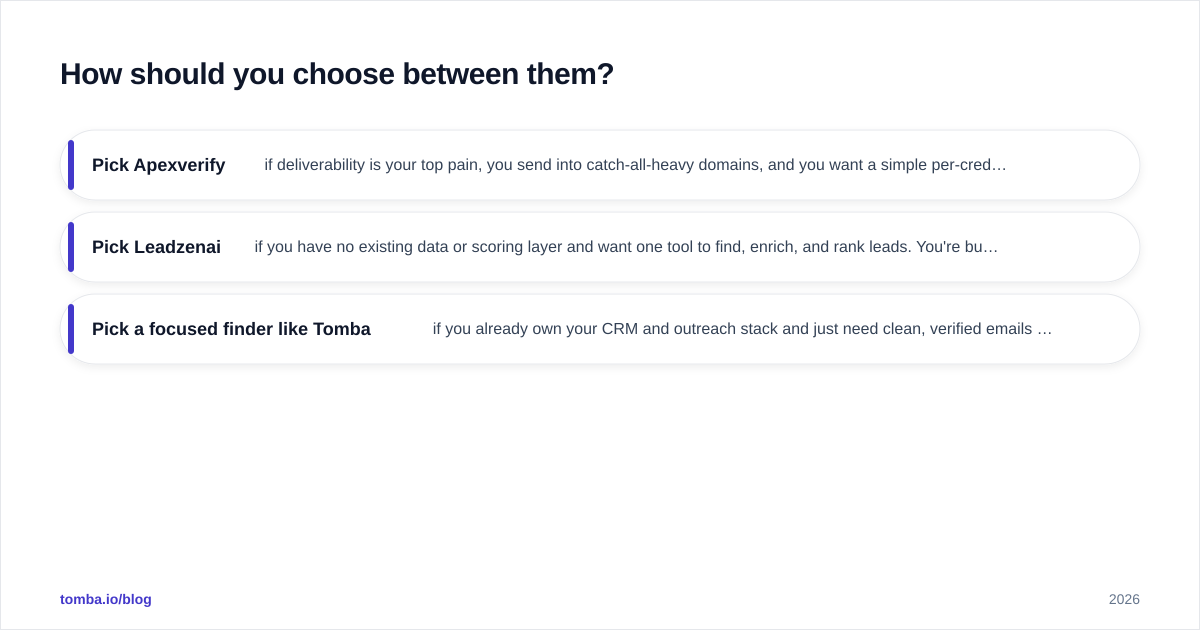
- Pick Apexverify if deliverability is your top pain, you send into catch-all-heavy domains, and you want a simple per-credit cost. You're buying verification depth.
- Pick Leadzenai if you have no existing data or scoring layer and want one tool to find, enrich, and rank leads. You're buying a lightweight platform.
- Pick a focused finder like Tomba if you already own your CRM and outreach stack and just need clean, verified emails at a predictable cost — without paying for an enrichment tier you won't open.
Whatever you choose, validate with your own data. Vendor accuracy claims are a starting hypothesis, not a guarantee. Pull a representative sample of your real target accounts, run them through each tool's trial, and measure two numbers: hit rate (did it find an email at all?) and bounce rate (did that email actually deliver?). The winner on those two numbers — for your market — is the right answer, regardless of what any comparison post, including this one, concludes.
One more practical note: keep verification independent of your finder. Even the best finder benefits from a final validation pass right before send, because data decays daily. Whether you stay with Apexverify, Leadzenai, or move to something leaner, a re-verification step is the cheapest insurance you can buy for your sender reputation. For broader context on what drives inbox placement, the fundamentals of email deliverability are worth a refresher before you scale any sending program.
The bottom line#
Apexverify and Leadzenai are both credible, but they solve slightly different problems: Apexverify is the sharper email finder with better catch-all honesty, while Leadzenai is the more complete lightweight platform for teams without a data layer. Neither publishes an audited accuracy benchmark, so the burden is on you to trial-test against your real list.
If your job is simply to find and verify B2B emails at a price you can forecast — without paying for AI scoring you may already have — start with the Tomba Email Finder. The free tier (25 searches a month) is enough to benchmark it against both tools on your own data before you spend a dollar. Find the emails, verify them, and let the bounce rate pick your winner.
// get started
Find, verify and enrich your first contacts today
Start on the free plan with 25 searches a month, then scale when your team is ready.
Free plan · No credit card required · GDPR & CCPA
// about the author