Apollo Email Verification: How Accurate Is It in 2026?
Apollo email verification looks convenient, but how accurate is it really? See bounce rates, hidden gaps, and when a dedicated verifier saves your sender reputation in 2026.
Apollo.io bundles email verification into its prospecting workflow, which is convenient — but convenience and accuracy are not the same thing. If you export a list of "verified" Apollo contacts and your bounce rate still creeps past 5%, you are not imagining it. This guide breaks down exactly how Apollo email verification works, where it falls short, and how to protect your sender reputation in 2026.
TL;DR#
- Apollo email verification flags emails as verified, unverified, or likely-to-engage, but "verified" is a confidence label, not a guarantee of inbox delivery.
- Real-world bounce rates on Apollo-verified lists commonly land between 3% and 9%, especially on catch-all domains and older records.
- Apollo's verifier struggles most with catch-all domains, role-based addresses, and stale data — the same weak spots most bundled verifiers share.
- For cold outreach at scale, run Apollo exports through a dedicated email verifier before sending to keep bounces under 2%.
- The safest 2026 stack is Apollo for discovery plus a specialist verifier for the final cleanup pass.
What is Apollo email verification?#
Apollo email verification is the built-in process Apollo.io uses to label whether a contact's email address is likely to be deliverable. When you pull a contact from Apollo's database, each email carries a status — typically verified, unverified, likely to engage, or unavailable — based on Apollo's internal data signals and SMTP-style checks.
Think of it like a used-car inspection sticker. The sticker tells you someone looked at the car, but it does not promise the engine will start on a cold morning. Apollo's "verified" label means the address passed Apollo's checks at some point in time, not that it will accept your message today.
Under the hood, most email verifiers run a similar sequence: syntax validation, MX record lookup, and an SMTP handshake that asks the receiving server whether a mailbox exists without actually sending mail. You can read the mechanics of the SMTP protocol on Wikipedia. The accuracy gap between tools comes down to data freshness, how they treat ambiguous responses, and how they handle catch-all domains.

How accurate is Apollo email verification?#
The honest answer: accurate enough for warm CRM enrichment, risky for high-volume cold email. Apollo is primarily a prospecting and sales-engagement platform, so verification is a feature, not the core product. That focus shows up in the numbers.
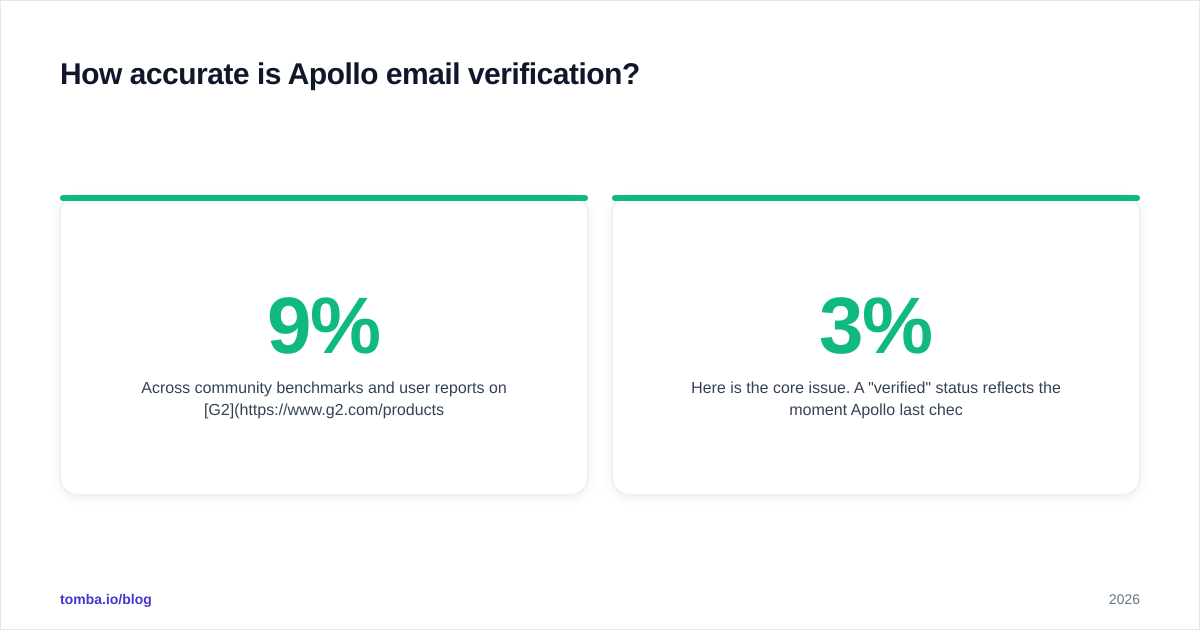
Across community benchmarks and user reports on G2, teams running cold campaigns on Apollo-verified data frequently see bounce rates in the 3–9% range — well above the under-2% threshold most email service providers want you to hold. The variance depends heavily on your target market: tech companies with strict mail servers and catch-all setups skew the failure rate higher.
Here is the core issue. A "verified" status reflects the moment Apollo last checked the address. People change jobs roughly every 2–4 years, and B2B data decays at an estimated 2–3% per month. A contact verified eight months ago may have left the company entirely. Apollo does re-verify, but not necessarily on the day you export.
The framework above shows the three accuracy layers that matter: syntax and domain validity (easy, nearly every tool nails this), mailbox existence (harder, depends on SMTP cooperation), and deliverability intent (hardest — will this person actually receive and not auto-junk your mail). Apollo handles the first layer well and the third layer poorly, which is exactly where cold-email bounces are born.
Why do Apollo verified emails still bounce?#
Five recurring culprits explain almost every "but it said verified!" bounce.
- Catch-all domains. A catch-all server accepts mail for any address at the domain, so an SMTP check returns "valid" even when the specific mailbox does not exist. Apollo often marks these as deliverable. You need a dedicated catch-all verifier to probe deeper.
- Stale records. The contact was real and verified — last quarter. They have since changed roles, and the address now bounces or forwards to a dead box.
- Role-based addresses. Generic inboxes like info@, sales@, or support@ pass technical checks but tank engagement and trip spam filters.
- Greylisting and rate limits. Some servers temporarily defer unknown senders. A verifier that reads this as "valid" can be wrong when you send in volume.
- Acceptance without delivery. A server can accept a message at the SMTP layer and then silently route it to spam or a quarantine. Verification cannot see past the front door.
None of this means Apollo's data is bad — it means a bundled verifier optimized for breadth is not the same as a specialist verifier optimized for deliverability. If your domain reputation is on the line, that distinction is everything. Poor list hygiene directly damages your sender reputation, and reputation is slow to rebuild once burned.
Should you use a dedicated email verifier with Apollo?#
Yes, if you send cold email at any meaningful volume. The pattern that works in 2026 is simple: use Apollo to find and organize prospects, then run the final list through a dedicated verifier before it ever touches your sending tool.
This two-step flow catches the records Apollo's bundled check misses — the catch-alls, the stale mailboxes, the role accounts — and it does so without forcing you to abandon Apollo's prospecting strengths. A dedicated verifier also gives you granular statuses (valid, invalid, accept-all, disposable, unknown) so you can decide your own risk tolerance instead of trusting a single "verified" flag.

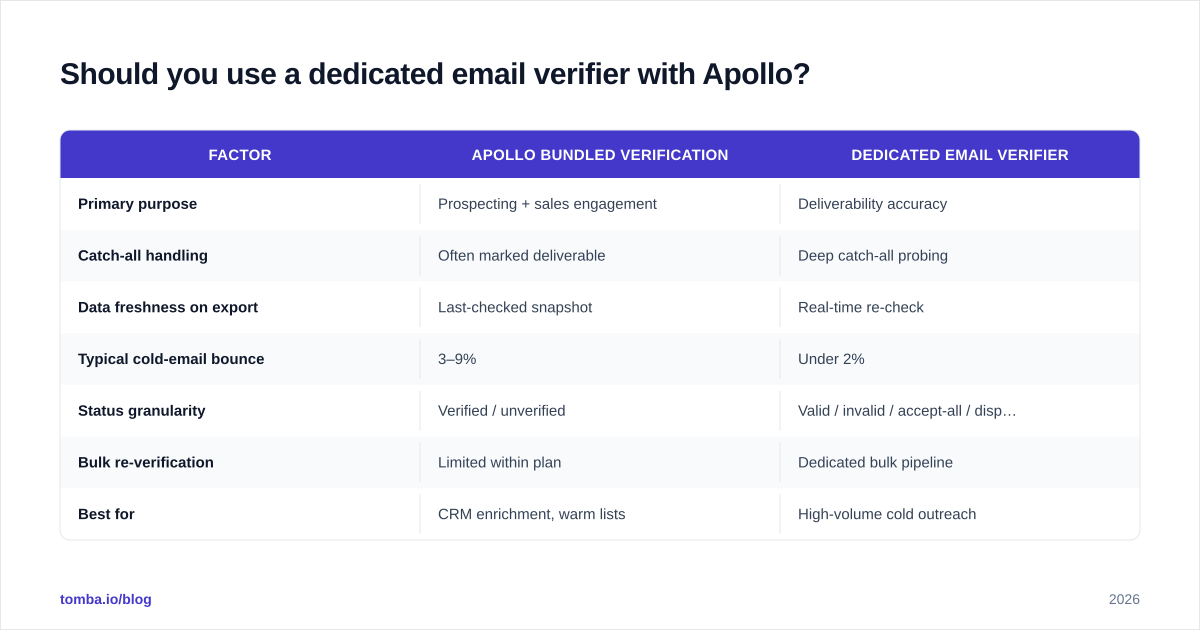
The table below compares Apollo's bundled verification against a dedicated verification layer on the dimensions that actually move your bounce rate.
| Factor | Apollo bundled verification | Dedicated email verifier |
|---|---|---|
| Primary purpose | Prospecting + sales engagement | Deliverability accuracy |
| Catch-all handling | Often marked deliverable | Deep catch-all probing |
| Data freshness on export | Last-checked snapshot | Real-time re-check |
| Typical cold-email bounce | 3–9% | Under 2% |
| Status granularity | Verified / unverified | Valid / invalid / accept-all / disposable / unknown |
| Bulk re-verification | Limited within plan | Dedicated bulk pipeline |
| Best for | CRM enrichment, warm lists | High-volume cold outreach |

The takeaway is not "Apollo bad." It is "use each tool for what it is best at." Apollo's discovery engine is genuinely strong. Its verification is a reasonable first pass, not a final gate. If you want a side-by-side of the broader platform, see this breakdown of Apollo alternatives.
How do you verify Apollo emails before sending?#
Here is a repeatable workflow that keeps your bounce rate low without slowing your pipeline.
- Export from Apollo. Pull your segmented list as a CSV. Include the company domain column — your verifier will use it for catch-all and pattern checks.
- Strip obvious junk. Remove role-based addresses (info@, admin@, no-reply@) unless they are intentional targets, and drop duplicates.
- Run a bulk verification pass. Upload the CSV to a dedicated verifier. A bulk verify pipeline handles thousands of addresses in one job and returns a per-row status.
- Segment by status. Send confidently to valid. Quarantine accept-all/unknown for a smaller warm-up batch or manual review. Discard invalid and disposable.
- Re-verify on a cadence. Because data decays monthly, re-check any list older than 60–90 days before reusing it.
This is the difference between treating verification as a checkbox and treating it as a recurring hygiene practice. The second approach is what protects long-term email deliverability.
What about catch-all domains specifically?#
Catch-all domains deserve their own step because they are the single biggest source of false positives. When a verifier reports "accept-all," it genuinely cannot confirm the mailbox via SMTP — the server says yes to everything. A specialist tool layers additional signals (historical sends, pattern matching, engagement data) to estimate whether the address is real. Treat accept-all addresses as medium-risk: include a small sample in early sends, watch the bounce response, then expand only if the domain behaves.
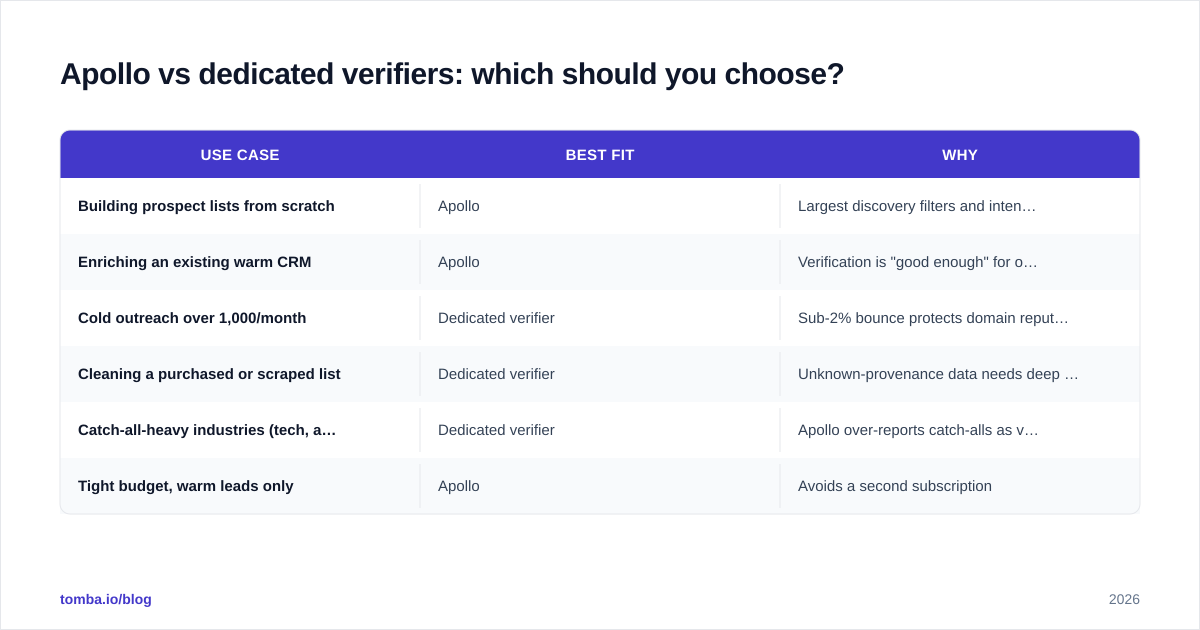
Apollo vs dedicated verifiers: which should you choose?#
You do not have to choose one — but if budget forces a single tool, match it to your motion.
| Use case | Best fit | Why |
|---|---|---|
| Building prospect lists from scratch | Apollo | Largest discovery filters and intent data |
| Enriching an existing warm CRM | Apollo | Verification is "good enough" for opted-in contacts |
| Cold outreach over 1,000/month | Dedicated verifier | Sub-2% bounce protects domain reputation |
| Cleaning a purchased or scraped list | Dedicated verifier | Unknown-provenance data needs deep checks |
| Catch-all-heavy industries (tech, agencies) | Dedicated verifier | Apollo over-reports catch-alls as valid |
| Tight budget, warm leads only | Apollo | Avoids a second subscription |
For most outbound teams, the answer is both, sequenced. Apollo finds the people; a verifier confirms the addresses are safe to email. If you also need to find missing emails that Apollo lacks, a standalone email finder fills the gaps before verification.
How much does each option cost?#
Apollo's verification is folded into its platform pricing, so you are paying for the whole sales-engagement suite whether or not you use the verifier heavily. Dedicated verifiers price by credits or volume, which makes them cheaper to scale for verification alone.
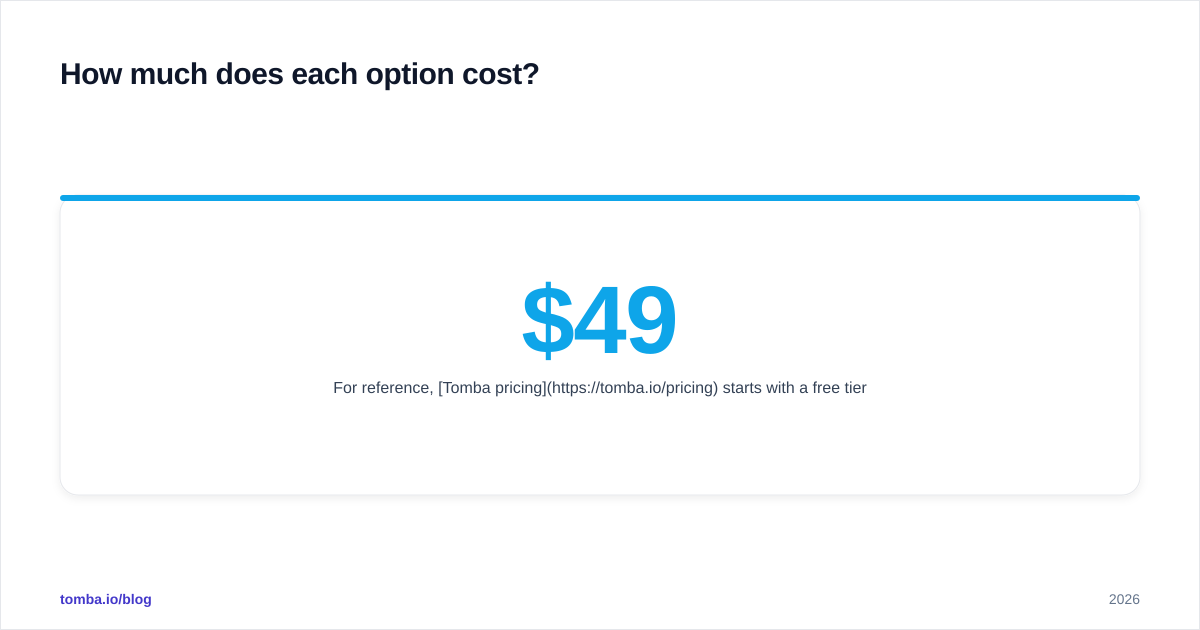
For reference, Tomba pricing starts with a free tier (25 searches/month), then Starter at $49/mo, Growth at $99/mo, and Pro at $249/mo — with verification and finding sharing the same credit pool. That credit model means you only pay for the cleanup volume you actually need, rather than bundling it into a broader seat license. Compare that against Apollo's per-seat plans on the official Apollo.io site to see which structure fits your team size.
Final verdict: trust Apollo to find, trust a verifier to confirm#
Apollo email verification is a useful first filter, not a deliverability guarantee. Its "verified" label tells you an address was plausible when last checked — but catch-alls, stale records, and role accounts slip through, which is why Apollo-only cold lists routinely bounce above the safe threshold. The fix is not to drop Apollo; it is to add a dedicated verification pass before you hit send.
If you are running cold outreach in 2026 and your bounce rate keeps you up at night, layer a specialist verifier on top of your Apollo exports. Start free with the Tomba Email Finder and its built-in verifier — find the contacts Apollo misses, re-verify the ones it marked "verified," and ship lists that land in the inbox instead of the bounce folder. Your domain reputation will thank you.
Ready to find emails that actually work?
Join 150,000+ professionals who stopped guessing and started sending. Free credits on signup — no credit card required.
Get the Tomba newsletter
Practical outbound tactics and product updates — once every two weeks.
About the author