Apollo.io Accuracy in 2026: How Reliable Is Its Data?
How accurate is Apollo.io data in 2026? We break down email match rates, bounce risk, and where Apollo wins and loses against dedicated email finders.
Apollo.io is one of the most widely used sales-intelligence platforms on the market. Its 270M+ contact database is its biggest selling point. But a big database and an accurate one are not the same thing. So how good is Apollo.io accuracy once you start sending? If you run cold outreach, one number matters most: how many of those contacts have a correct, deliverable email. The rest quietly bounce and burn your sender reputation.
This post is a neutral, data-driven look at Apollo.io accuracy in 2026. We cover where the data holds up, where it slips, and what to do about it.
TL;DR#
- Apollo's headline accuracy claim (~95%) is best-case, not real-world. Effective deliverable rates on cold lists typically land in the 70–85% range depending on region, seniority, and how fresh the segment is.
- Apollo is a breadth tool, not a precision tool. It's excellent for building large lists fast; it's weaker on hard-to-find contacts, catch-all domains, and non-US data.
- Stale data is the #1 accuracy killer. Job changes, layoffs, and rebrands degrade any database — Apollo included — between scrapes.
- Always re-verify before you send. Running Apollo exports through a dedicated email verifier cuts bounces dramatically regardless of source accuracy.
- For pure email-finding precision, a specialized finder often beats a bundled database on match rate and bounce control.
What does "Apollo.io accuracy" actually mean?#
Accuracy is not one number. It's several, and vendors love to quote the friendliest one. When people ask "how accurate is Apollo.io," they're usually conflating four distinct metrics:
- Match rate — of the contacts you searched, how many came back with an email at all.
- Deliverability / valid rate — of those emails, how many actually land in an inbox without bouncing.
- Freshness — how recently the record was confirmed (a correct email from 18 months ago may be dead today).
- Field accuracy — whether the title, company, phone, and location are still right.
A tool can have a high match rate and a mediocre deliverable rate at the same time. Guessed or pattern-derived emails inflate "matches" without ever being verified. That gap is where most cold-email bounces come from.

How accurate is Apollo.io in 2026?#
Short answer: good for breadth, average for deliverability. Apollo publicly markets accuracy figures in the mid-90s. But those numbers reflect ideal conditions — verified records and US-based senior contacts at mid-to-large companies. Once you pull a broad, multi-region list, real-world deliverable rates compress.
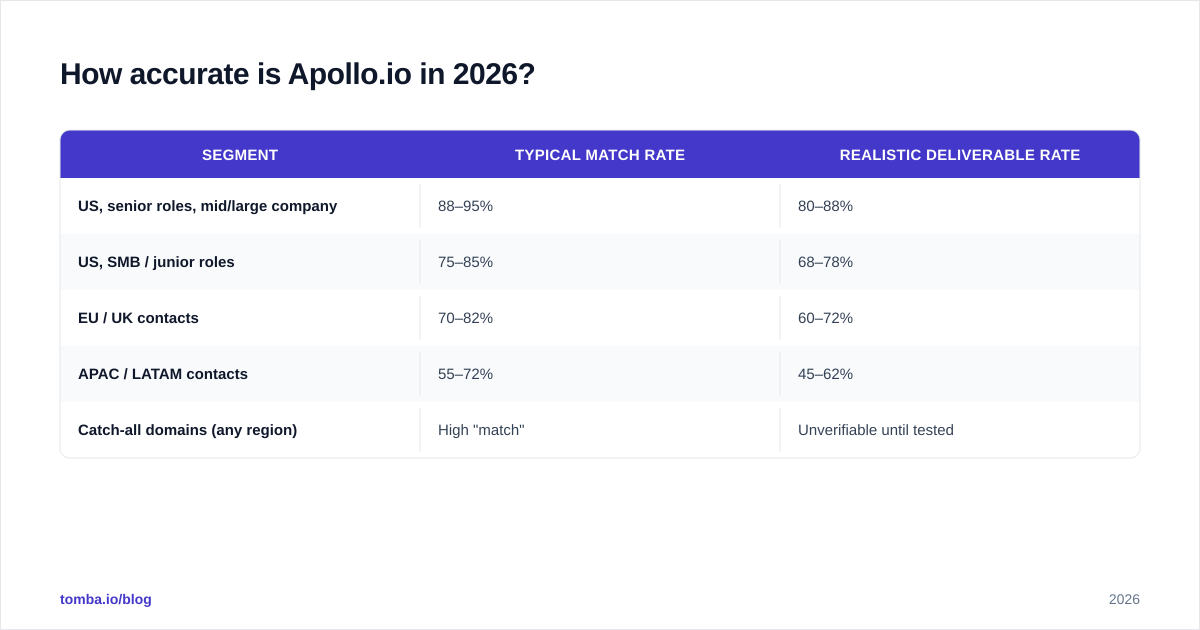
Based on aggregate user reports, vendor benchmarks, and the structural realities of any crowd-and-scrape database, here's a realistic picture for 2026:
| Segment | Typical match rate | Realistic deliverable rate |
|---|---|---|
| US, senior roles, mid/large company | 88–95% | 80–88% |
| US, SMB / junior roles | 75–85% | 68–78% |
| EU / UK contacts | 70–82% | 60–72% |
| APAC / LATAM contacts | 55–72% | 45–62% |
| Catch-all domains (any region) | High "match" | Unverifiable until tested |
The pattern is consistent with every large database. Accuracy is highest where the data is densest (US enterprise) and degrades at the edges. Apollo isn't unusually bad here — it's typical. The mistake is assuming the marketed 95% applies to your segment.
Why the marketed number and your number differ#
Three structural reasons:
- Verified vs. unverified flags. Apollo labels emails as "verified" or "guessed/likely." The blended export mixes both. If you don't filter to verified-only, your bounce rate climbs.
- Catch-all domains. Many companies accept mail to any address at their domain, so a server can't confirm a specific mailbox exists. These show as deliverable-ish but are genuinely unknown until tested. A dedicated catch-all verifier is the only way to resolve them with confidence.
- Decay between refreshes. People change jobs every ~3–4 years on average. That means roughly 2–2.5% of any B2B database goes stale per month. A record that was perfect at scrape time may be wrong by the time you email it.
)
Is Apollo.io accurate enough for cold email?#
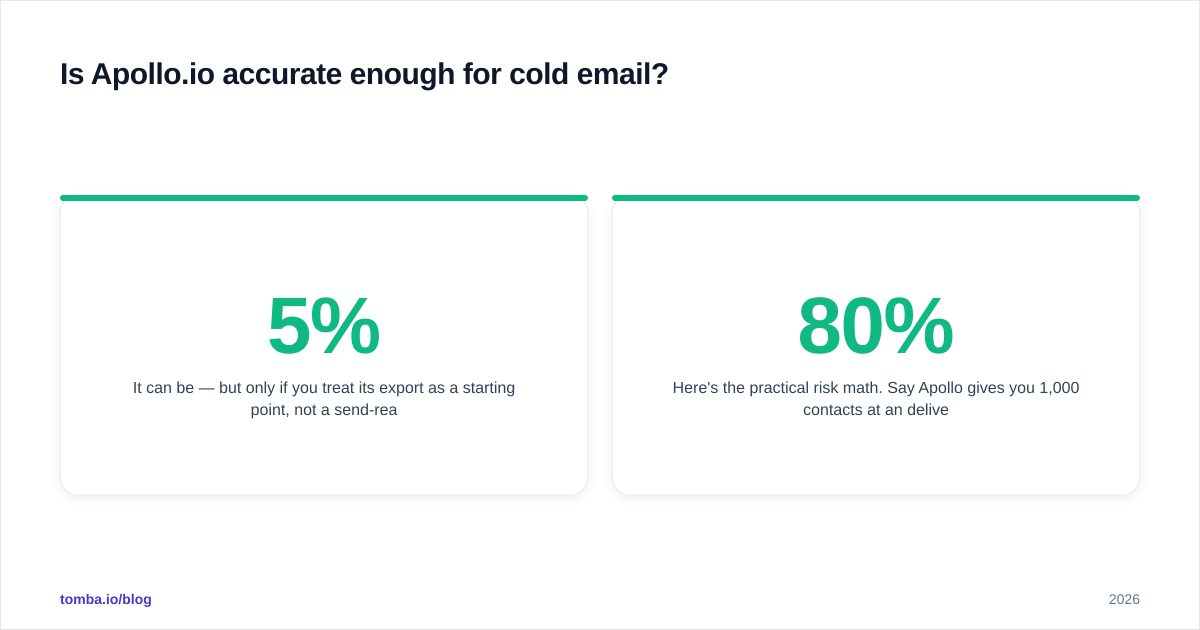
It can be — but only if you treat its export as a starting point, not a send-ready list. Cold email is unforgiving. Mailbox providers watch your bounce rate closely. A list above ~3–5% hard bounces can throttle your email deliverability and damage your sender reputation for weeks.
Here's the practical risk math. Say Apollo gives you 1,000 contacts at an 80% deliverable rate. That's 200 bad addresses. Send to all 1,000 cold and you're looking at a ~20% bounce rate — catastrophic for a new domain. Re-verify first, drop the dead and risky addresses, and you can push the effective bounce rate under 2%.
That's why experienced operators never send straight from any database export — Apollo,
ZoomInfo, or otherwise. The verification step is non-negotiable.
A simple pre-send workflow#
- Export from Apollo with the verified filter on where possible.
- Run the full list through a standalone verifier to catch decay and catch-alls.
- Segment catch-all results separately and warm into them slowly.
- Suppress role-based addresses (info@, sales@) unless they're your target.
- Re-verify any list older than 30 days before reusing it.
How does Apollo.io accuracy compare to dedicated email finders?#
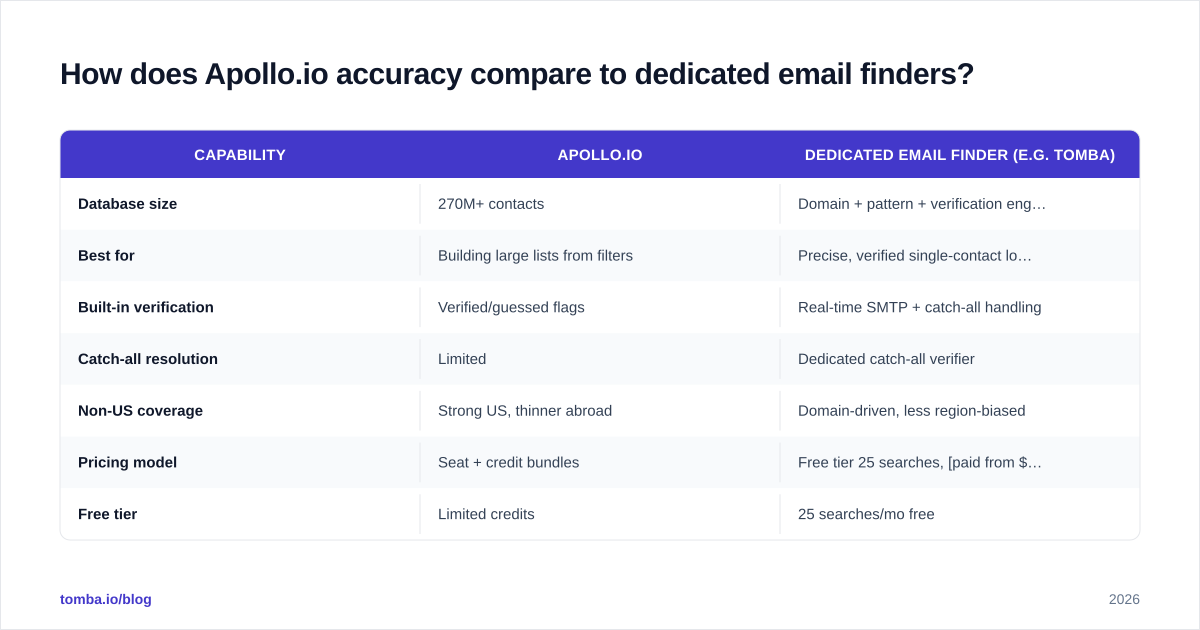
Apollo optimizes for database breadth; dedicated finders optimize for per-contact precision. They're built for different jobs. The accuracy trade-off follows from that design choice.
A platform like Apollo wins when you want to build a list from filters — industry, headcount, title, tech stack — and accept that some records will be stale. A dedicated email finder wins when you already know who you want. It returns the single correct, verified address with the lowest possible bounce risk.
| Capability | Apollo.io | Dedicated email finder (e.g. Tomba) |
|---|---|---|
| Database size | 270M+ contacts | Domain + pattern + verification engine |
| Best for | Building large lists from filters | Precise, verified single-contact lookups |
| Built-in verification | Verified/guessed flags | Real-time SMTP + catch-all handling |
| Catch-all resolution | Limited | Dedicated catch-all verifier |
| Non-US coverage | Strong US, thinner abroad | Domain-driven, less region-biased |
| Pricing model | Seat + credit bundles | Free tier 25 searches, paid from $49/mo |
| Free tier | Limited credits | 25 searches/mo free |
This isn't an either/or in practice. Many teams use Apollo to source and a finder/verifier to clean. The database gives you reach; the finder gives you a deliverable list.

Where Apollo's accuracy is strongest#
- US enterprise and mid-market. Dense data, frequent confirmation, high match rates.
- Sales-title contacts. VPs, directors, and reps in revenue roles are well-covered.
- Firmographic filtering. Company-level data (size, industry, funding) is reliable and useful for targeting.
Where it's weakest#
- International contacts, especially outside North America.
- Catch-all domains, which it can't fully resolve.
- Fast-moving startups where titles and emails change quickly.
- Niche or technical roles with thin coverage.

How can you improve Apollo.io data accuracy?#
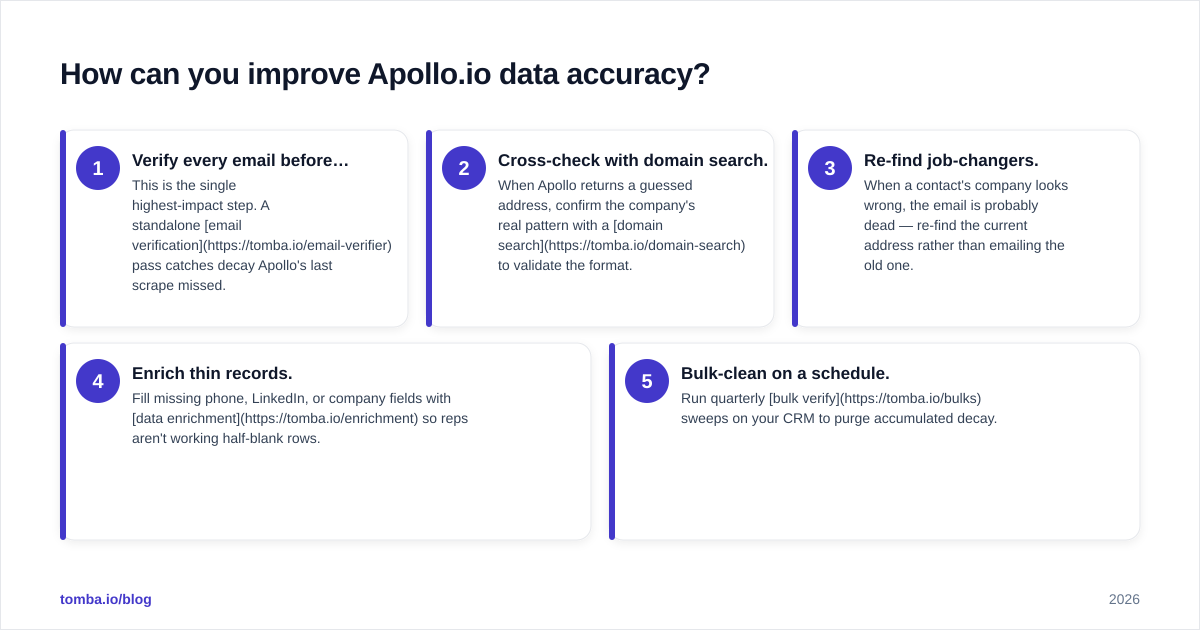
Layer verification and enrichment on top of the export. You can lift Apollo.io accuracy in practice without leaving your stack:
- Verify every email before sending. This is the single highest-impact step. A standalone email verification pass catches decay Apollo's last scrape missed.
- Cross-check with domain search. When Apollo returns a guessed address, confirm the company's real pattern with a domain search to validate the format.
- Re-find job-changers. When a contact's company looks wrong, the email is probably dead. Re-find the current address rather than emailing the old one.
- Enrich thin records. Fill missing phone, LinkedIn, or company fields with data enrichment so reps aren't working half-blank rows.
- Bulk-clean on a schedule. Run quarterly bulk verify sweeps on your CRM to purge accumulated decay.
For teams running high volume, an email finder API lets you verify at the point of import automatically. That way no unverified record ever reaches a sequence.
Is Apollo.io's accuracy claim trustworthy?#
Treat the headline number as a ceiling, not an expectation. Apollo isn't being uniquely deceptive. Nearly every data vendor quotes a best-case figure measured on their strongest segment. The honest read is:
- The ~95% figure is achievable on verified US enterprise records.
- Your blended, multi-region list will run lower — plan for 70–85% deliverable.
- The variance is real and segment-dependent. Test on your own data rather than trusting any single published stat.
You can sanity-check any vendor's claim yourself. Pull a representative sample, run it through an independent verifier, and measure the true valid rate. Cross-referencing against neutral review sources like G2 and Apollo's own accuracy documentation helps separate marketing from measured performance. For context on how data providers report quality, analyst coverage from firms like Gartner on B2B data is a useful neutral benchmark.
So, should you rely on Apollo.io accuracy in 2026?#
Use Apollo for what it's genuinely great at — fast, filter-driven list building at scale — and never skip verification before you send. The database is large and the US coverage is strong. But the marketed accuracy number won't survive contact with a broad, real-world list. Decay, catch-alls, and international gaps are structural, not fixable by hope.
The winning play is layered. Source with a database, then clean with a precision finder and verifier. Your actual send list ends up as close to 100% deliverable as you can get. That's how you protect your domain and keep reply rates high.
If your priority is finding and verifying the right email with the lowest bounce risk, start with the Tomba Email Finder. Pair it with the built-in verifier and catch-all checks, try it on the free tier (25 searches/month), and compare the deliverable rate against your last Apollo export. Then scale up on a plan from $49/mo once the numbers prove out. Your bounce rate, and your sender reputation, will thank you.
// get started
Find, verify and enrich your first contacts today
Start on the free plan with 25 searches a month, then scale when your team is ready.
Free plan · No credit card required · GDPR & CCPA
// about the author