Apollo.io Email Finder and Open Tracker: 2026 Review
A neutral, hands-on look at the Apollo.io email finder and open tracker in 2026 — accuracy, deliverability impact, pricing, and where a specialist tool wins.
Apollo.io sells itself as the all-in-one sales platform: a B2B database, a sequencer, and built-in engagement analytics all under one login. Two of its most-used features are the email finder (pull a verified work email from a name and company) and the open tracker (see when a prospect opens your message). This review tests both honestly — what they do well, where they quietly cost you deals, and when you should pair Apollo with a dedicated tool.
TL;DR#
- The Apollo.io email finder is convenient but variable — accuracy is strong for mid-market US tech contacts and weaker for SMBs, non-US domains, and catch-all servers.
- The open tracker works on a tracking pixel — useful for prioritizing follow-ups, but it inflates open rates, can hurt deliverability, and is increasingly blocked by Apple Mail Privacy Protection.
- Apollo's pricing bundles everything, which is great value if you live inside Apollo and wasteful if you only need accurate emails.
- For pure email accuracy and verification, a specialist like Tomba's email finder typically returns cleaner data with explicit confidence scoring.
- Best practice in 2026: use Apollo for sequencing and reply-based signals, and verify your list before sending to protect sender reputation.
What is the Apollo.io email finder and open tracker?#
The Apollo io email finder and open tracker are two distinct features that often get talked about together because they sit in the same workflow: find the contact, then watch what they do with your email.
The email finder takes an input — a person's name plus a company domain, or a LinkedIn profile via the Chrome extension — and returns a work email address with a status label (verified, guessed, or unavailable). It draws on Apollo's contact database of several hundred million records, supplemented by real-time verification at lookup time.
The open tracker is an engagement feature inside Apollo sequences. When you enable tracking, Apollo embeds a tiny invisible image (a "tracking pixel") in your outbound email. When the recipient's mail client loads that image, Apollo logs an "open" with a timestamp, and optionally surfaces it as a task or notification for the rep.
Think of the email finder as the address book and the open tracker as the doorbell camera: one tells you where to knock, the other tells you whether anyone looked through the peephole. Neither guarantees a conversation, but together they shape how reps prioritize their day.
How accurate is the Apollo.io email finder?#
Accuracy is the whole game for an email finder, because a bounced email does more than waste a send — it erodes your domain reputation and pushes future messages toward spam folders.
In practice, the Apollo.io email finder performs along predictable lines:
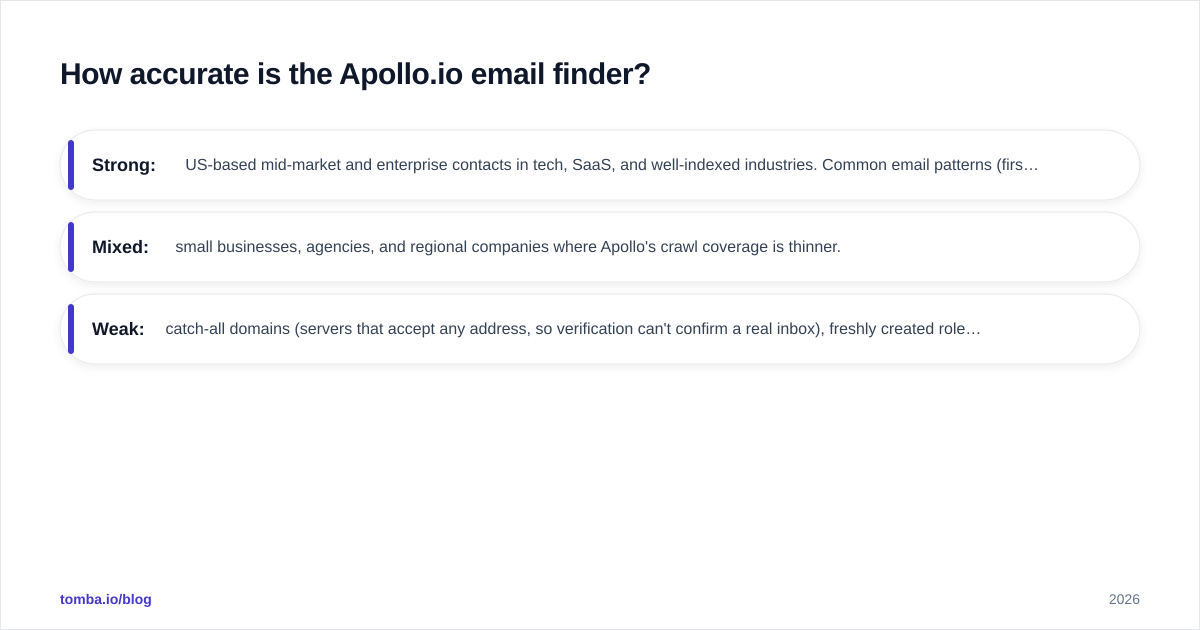
- Strong: US-based mid-market and enterprise contacts in tech, SaaS, and well-indexed industries. Common email patterns (first.last@, first@) on standard domains resolve reliably.
- Mixed: small businesses, agencies, and regional companies where Apollo's crawl coverage is thinner.
- Weak: catch-all domains (servers that accept any address, so verification can't confirm a real inbox), freshly created roles, and many non-US/non-English domains.
The biggest gotcha is the difference between a guessed email and a verified one. Apollo will often return a pattern-based guess when it can't confirm the inbox. Those guesses are sometimes right, but they're exactly the addresses that bounce. If your team treats every returned email as send-ready, your bounce rate climbs.

This is where a dedicated workflow matters. Running results through an independent email verifier before they hit a sequence catches the guesses Apollo flags loosely. For catch-all domains specifically, a catch-all verifier gives you a far more honest read than a generic "accept-all" label. The rule of thumb: never let an unverified bulk export go straight into a cold sequence.
How does the Apollo.io open tracker work?#
The open tracker relies on a single mechanism: the tracking pixel. Here's the chain of events.
- You enable open tracking on a sequence or one-off email.
- Apollo injects a 1x1 transparent image hosted on its tracking domain into the email body.
- The recipient opens the email; their client requests the image from Apollo's server.
- Apollo records that request as an "open," with time and (sometimes) device data.
- The rep sees an open event and can trigger a follow-up.
It's elegant, but the mechanism has structural weaknesses that have gotten worse, not better, by 2026:
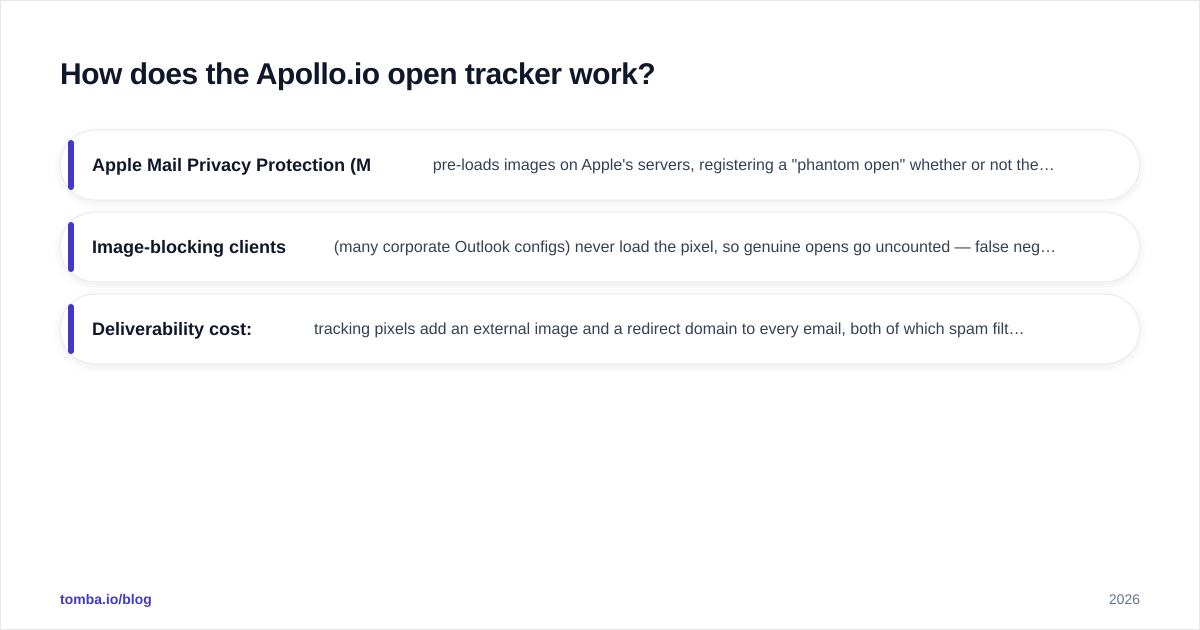
- Apple Mail Privacy Protection (MPP) pre-loads images on Apple's servers, registering a "phantom open" whether or not the human read anything. Given Apple Mail's share of inboxes, a large slice of your "opens" are noise.
- Image-blocking clients (many corporate Outlook configs) never load the pixel, so genuine opens go uncounted — false negatives.
- Deliverability cost: tracking pixels add an external image and a redirect domain to every email, both of which spam filters weigh. Heavy tracking on a cold domain can measurably lower inbox placement.
For a deeper primer on why this matters, see the fundamentals of email deliverability — open tracking is one of the most common, least-examined causes of reputation drift.
How does Apollo.io compare to a dedicated email finder?#
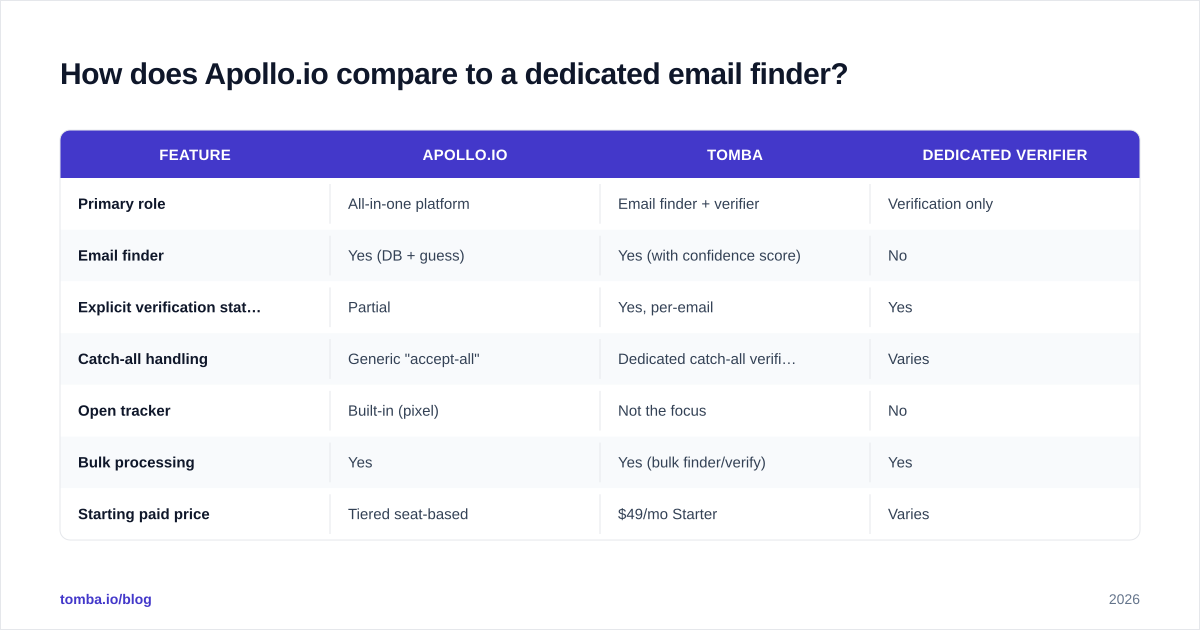
Apollo is a platform; a tool like Tomba is a specialist. The right comparison isn't "which is better" but "which job are you hiring it for." Here's a concrete side-by-side.
| Feature | Apollo.io | Tomba | Dedicated verifier |
|---|---|---|---|
| Primary role | All-in-one platform | Email finder + verifier | Verification only |
| Email finder | Yes (DB + guess) | Yes (with confidence score) | No |
| Explicit verification status | Partial | Yes, per-email | Yes |
| Catch-all handling | Generic "accept-all" | Dedicated catch-all verifier | Varies |
| Open tracker | Built-in (pixel) | Not the focus | No |
| Bulk processing | Yes | Yes (bulk finder/verify) | Yes |
| Starting paid price | Tiered seat-based | $49/mo Starter | Varies |
| Free tier | Limited credits | 25 searches/mo | Often none |
| Best for | Reps living in Apollo | Clean, verified lists | List hygiene |

The pattern most teams land on: Apollo earns its seat as the engagement and sequencing layer, while a specialist owns data quality. If your only need is finding and verifying emails, paying for a full platform is overkill — and you can compare Tomba pricing against Apollo's per-seat bundles to see the gap. If you specifically want an alternative to Apollo for the data layer, the Apollo alternative breakdown goes feature by feature.
What are the real limitations of Apollo's open tracker?#
Beyond MPP and image-blocking, three operational issues trip teams up.
1. Opens are a vanity-adjacent metric. An open tells you the email arrived and the pixel loaded. It does not tell you the prospect read it, cared, or is anywhere near a buying decision. Teams that chase open rates often optimize subject lines that get curiosity-clicks but no replies. The signal that actually predicts revenue is the response rate, not the open rate.
2. Tracking can flag you as automated. Some security gateways treat tracking pixels and link-wrapping as cold-outreach fingerprints. Combine that with an unverified list, and you've stacked two deliverability risks on the same send.
3. Attribution gets muddy at scale. When MPP inflates opens by a large factor, your A/B tests on subject lines become unreliable. You can't optimize against a metric that's half phantom.
The honest takeaway: keep open tracking on for prioritization ("who should I call first") but never use it for measurement ("is my campaign working"). For measurement, anchor on replies, meetings booked, and pipeline.
Is the Apollo.io email finder and open tracker worth it in 2026?#
It depends entirely on how you work.
Apollo is worth it if:
- Your reps live inside one platform and value a single pane of glass over best-of-breed data.
- You run high-volume sequences and want engagement signals attached to each contact automatically.
- You're a fast-moving team that prizes setup speed over data precision.
You should look elsewhere (or supplement) if:
- Bounce rate and sender reputation are your top concern.
- You sell into SMB, regional, or non-US markets where Apollo's coverage thins out.
- You need defensible, per-email confidence scores for compliance or RevOps reporting.
- You only need accurate emails, not a full sequencer — in which case you're overpaying.
A practical hybrid most modern teams adopt: source contacts in Apollo, export, then verify and enrich through a specialist before sequencing. You keep Apollo's workflow and bolt on the data quality it doesn't prioritize. Tools like the Tomba Chrome extension and bulk email finder slot into that step without replacing your CRM.
How do you combine Apollo with a specialist email finder?#
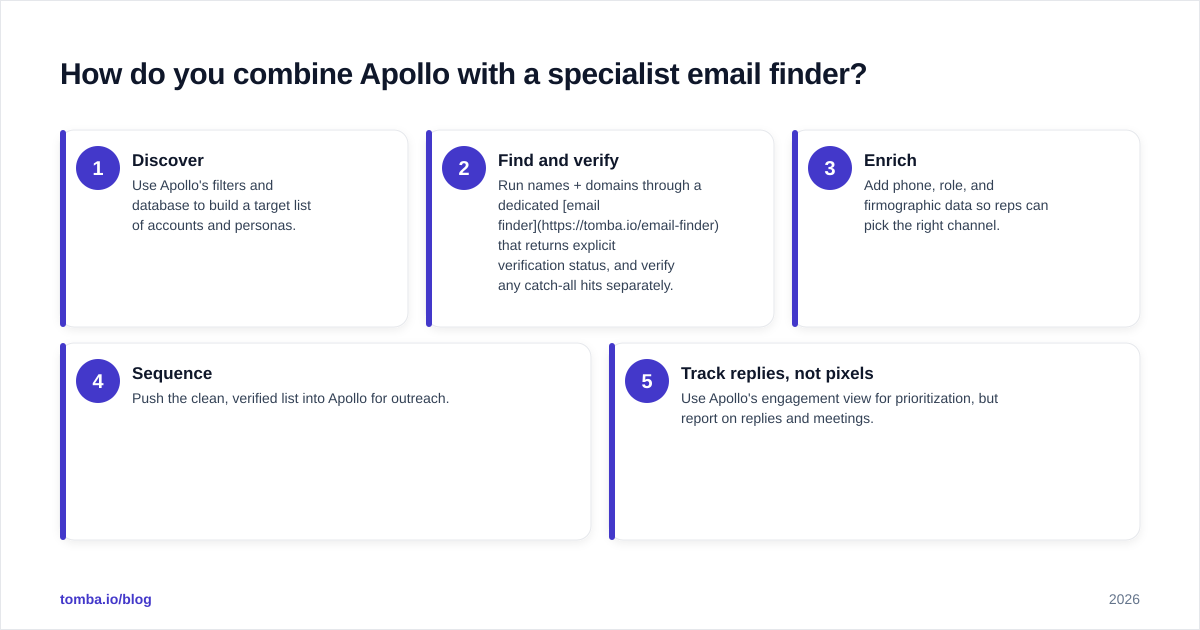
A clean stack looks like this:
- Discover — Use Apollo's filters and database to build a target list of accounts and personas.
- Find and verify — Run names + domains through a dedicated email finder that returns explicit verification status, and verify any catch-all hits separately.
- Enrich — Add phone, role, and firmographic data so reps can pick the right channel.
- Sequence — Push the clean, verified list into Apollo for outreach.
- Track replies, not pixels — Use Apollo's engagement view for prioritization, but report on replies and meetings.
This sequence protects the two things Apollo's open tracker can quietly damage: your sender reputation and your metrics integrity. You can validate vendor coverage on third-party review sites like G2 and confirm Apollo's current feature set on the Apollo.io site directly, and cross-check deliverability best practices against guidance from established CRMs like HubSpot.
Frequently asked questions#
Does the Apollo.io email finder verify emails before returning them? Partially. Apollo labels results, but it returns pattern-based guesses when it can't confirm an inbox. Independent verification before sending is the safe default.
Does Apollo's open tracker work with Apple Mail? It records "opens," but Apple's Mail Privacy Protection pre-loads images, so many of those are phantom opens rather than genuine human reads. Treat Apple-heavy audiences with skepticism.
Will open tracking hurt my deliverability? It can. Tracking pixels add an external image and a redirect domain to every email, both of which spam filters evaluate. On a cold or low-reputation domain, heavy tracking measurably lowers inbox placement.
Is there a cheaper way to just find and verify emails? Yes. If you don't need the full platform, a specialist tool is more cost-effective. Tomba starts at $49/mo with a free tier of 25 searches/month, versus Apollo's seat-based bundles.
Can I use Apollo and Tomba together? That's the most common setup — Apollo for sourcing and sequencing, a specialist for verification and enrichment so your sends stay clean.
The bottom line#
The Apollo.io email finder and open tracker are genuinely useful when you understand their edges: the finder is fast but returns guesses you must verify, and the tracker is good for prioritization but unreliable as a metric. In 2026, the teams getting the best results don't pick one tool — they pair Apollo's workflow with a specialist data layer.
If your priority is finding professional emails that actually land, start with the Tomba Email Finder. Search by name, company, or domain, get explicit per-email confidence scores, verify catch-all addresses before you send, and protect the sender reputation that every reply depends on. Try it free with 25 searches a month and feed Apollo a list that won't bounce.
// get started
Find, verify and enrich your first contacts today
Start on the free plan with 25 searches a month, then scale when your team is ready.
Free plan · No credit card required · GDPR & CCPA
// about the author