Apollo Prospecting in 2026: A Complete Playbook & Setup Guide
Apollo prospecting can fill your pipeline fast — or burn your domain. Here's the 2026 playbook for filters, sequences, data hygiene, and where Apollo falls short.
Apollo Prospecting in 2026: A Complete Playbook & Setup Guide
TL;DR
- Apollo prospecting works best when you treat it as a targeting and sequencing engine, not a magic list — tight filters beat big lists every time.
- The biggest risk is data decay and catch-all domains: verify before you send or you will torch your sender reputation in a week.
- Build saved personas, layer intent and technographic signals, then push only verified contacts into sequences.
- Apollo's built-in data is strong on mid-market US tech and weaker on EU, SMB, and niche verticals — pair it with a dedicated finder/verifier to close gaps.
- This guide gives you a repeatable workflow, a comparison table, and the exact guardrails to keep replies high and bounces low.
What is Apollo prospecting?#
Apollo prospecting is the process of using Apollo.io — a combined B2B database, sales engagement, and enrichment platform — to find target accounts and contacts, then move them into outbound sequences. Think of it like a fishing trawler with a built-in sorting deck: it pulls a huge catch (260M+ contacts), lets you filter what you keep, and then routes the keepers straight into your nets (email and call sequences) without switching boats.
That all-in-one design is Apollo's main appeal. Instead of stitching a database, an email finder, a verifier, and a sequencer together, you get one login. The trade-off is that "good enough at everything" sometimes means "not the best at the one thing your campaign depends on" — usually data accuracy on harder regions and roles.
Before you write a single line of copy, the work that determines your results is targeting. A precise list of 300 contacts who genuinely fit will out-perform a sloppy list of 5,000 every time, because reply rate is a function of relevance, and deliverability is a function of list quality.
How do you set up Apollo prospecting filters that actually convert?#
Apollo's power lives in its filters. Most reps use three or four and wonder why their lists feel generic. Strong prospecting stacks filters in layers so each contact clears multiple relevance gates.
Layer 1 — Firmographics. Industry, headcount, revenue, and location. Be specific. "Software, 50–200 employees, United States" is a starting point, not a target. Narrow to the sub-vertical you actually win in.
Layer 2 — Persona. Job titles plus seniority plus department. Use Apollo's title keywords and exclusions. If you sell to RevOps, exclude "junior" and "intern" and add management levels so you're not emailing someone with no budget.
Layer 3 — Signals. This is where 2026 prospecting separates from 2020 prospecting. Layer in technographics (what stack they run), intent topics, headcount-growth, recent funding, and job-change triggers. A contact who just changed jobs or whose company just raised a round is dramatically more likely to reply.
Layer 4 — Data quality. Filter to contacts with a verified email status and exclude catch-all-only domains for your first send. You can chase catch-all domains separately with a dedicated catch-all verifier once your core list is running.
Save every winning combination as a persona. Named, reusable personas are how you turn one good search into a repeatable pipeline machine instead of starting from a blank filter screen each Monday.

What does a healthy Apollo prospecting workflow look like?#
Here is the loop that keeps pipeline full without burning your domain:
- Define the persona in filters and save it.
- Pull a capped batch — 200 to 500 contacts, never your whole TAM at once.
- Verify emails before sequencing. Apollo gives a status, but a second independent pass catches what one source misses.
- Enrich gaps — missing phone numbers, LinkedIn URLs, or company data.
- Sequence with personalized first lines tied to the signal that got them on the list.
- Measure and prune — kill steps and personas that bounce or go silent.
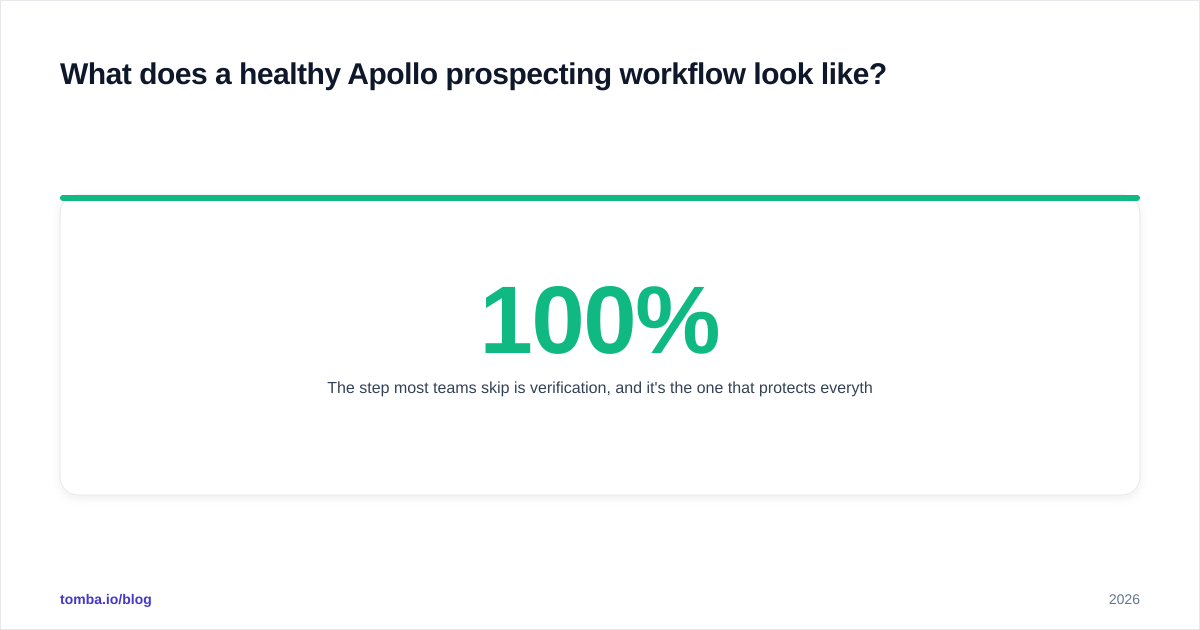
The step most teams skip is verification, and it's the one that protects everything else. Apollo's email status is a useful signal, but no single provider is right 100% of the time. Running your export through a dedicated email verifier before you load a sequence is the cheapest insurance you can buy against a bounce-driven reputation collapse. A 3% bounce rate quietly tells inbox providers you're a careless sender; a sub-1% rate tells them you're trustworthy.
Is Apollo's data accurate enough to prospect with?#
Mostly yes for its sweet spot, with real gaps everywhere else. Apollo's contact data is genuinely strong on US-based mid-market and enterprise technology companies, where its community-contributed and licensed sources overlap heavily. Coverage and freshness thin out as you move toward European contacts (GDPR pressure), small businesses, and specialized verticals like manufacturing, healthcare, or local services.
Two failure modes hurt prospecting most:
- Decay. B2B data rots at roughly 25–30% per year as people change roles. A contact verified eight months ago may now be a bounce.
- Catch-all domains. Many companies accept mail for any address, so a finder can't confirm a specific inbox exists. Apollo will often mark these as "likely" — send to too many and your bounce rate creeps up invisibly.
The fix isn't to abandon Apollo; it's to stop treating any one database as ground truth. Cross-check critical contacts, and route catch-all and international gaps to a specialized finder. Independent reviews on G2 consistently praise Apollo's breadth while flagging accuracy variance by region — which matches what most teams see in practice.

Apollo prospecting vs. a dedicated finder/verifier stack#
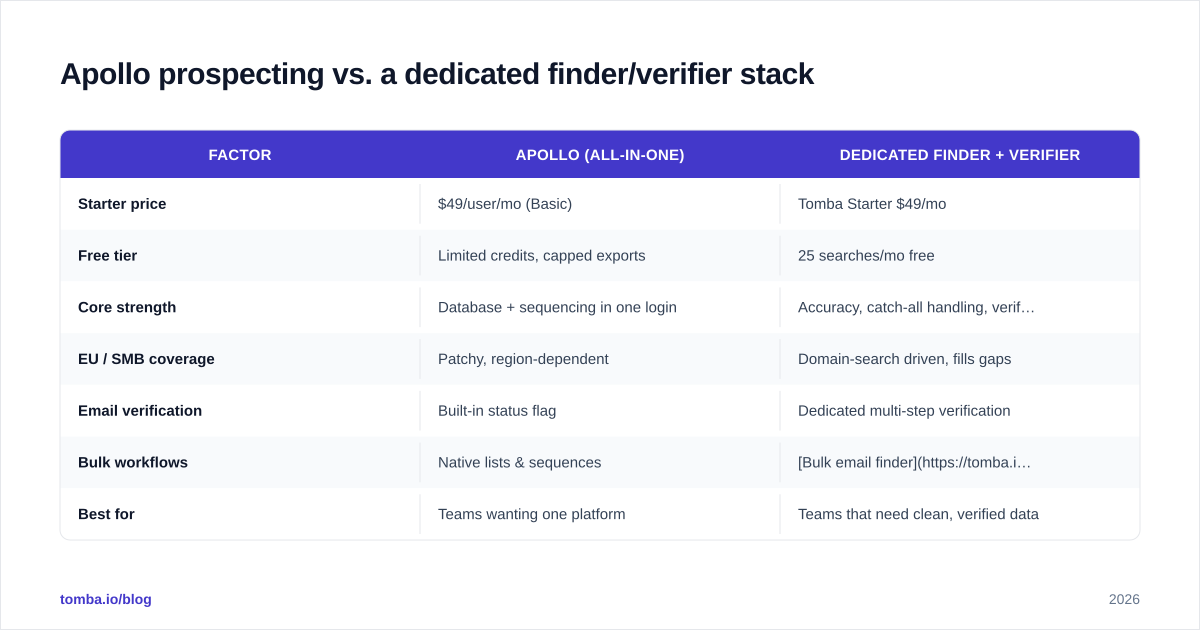
You don't have to choose one tool forever. The honest question is where each approach wins. Here's how the all-in-one Apollo model compares to pairing a focused finder/verifier with your existing sequencer.
| Factor | Apollo (all-in-one) | Dedicated finder + verifier |
|---|---|---|
| Starter price | $49/user/mo (Basic) | Tomba Starter $49/mo |
| Free tier | Limited credits, capped exports | 25 searches/mo free |
| Core strength | Database + sequencing in one login | Accuracy, catch-all handling, verification depth |
| EU / SMB coverage | Patchy, region-dependent | Domain-search driven, fills gaps |
| Email verification | Built-in status flag | Dedicated multi-step verification |
| Bulk workflows | Native lists & sequences | Bulk email finder + API |
| Best for | Teams wanting one platform | Teams that need clean, verified data |
The pattern that works for most teams in 2026: use Apollo for targeting and sequencing where its data is strong, and bolt on a dedicated finder/verifier to clean exports and cover the regions and roles Apollo misses. If you're evaluating whether to replace Apollo outright, the trade-offs are laid out in this Apollo alternative breakdown.
How do you keep Apollo prospecting from hurting deliverability?#
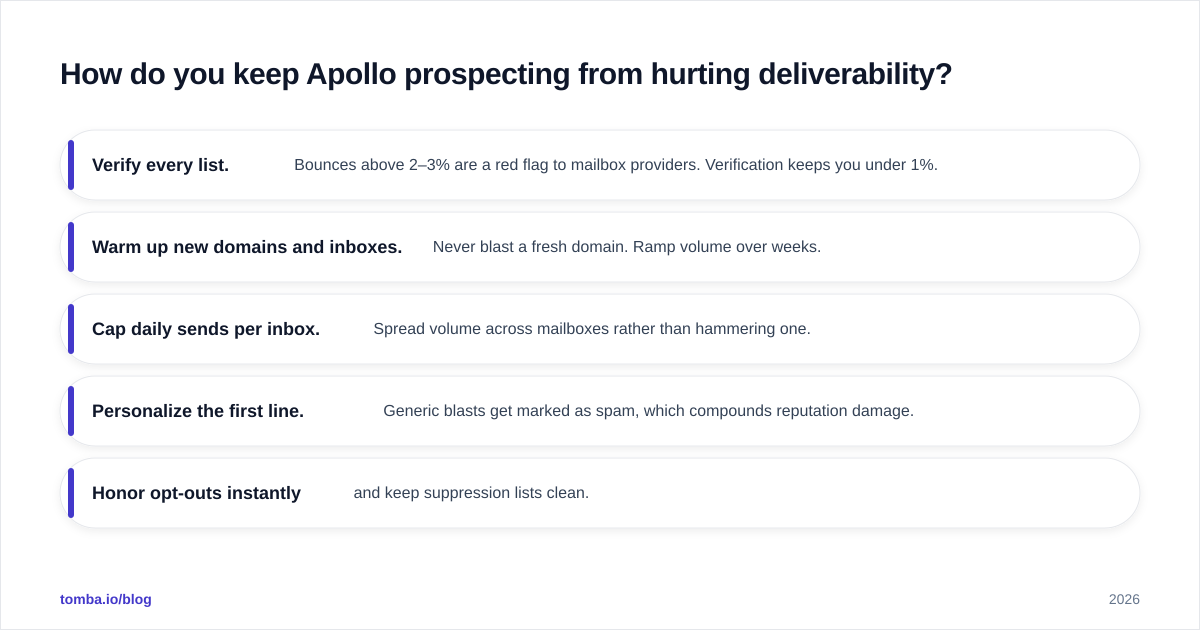
Deliverability is the silent killer of outbound. You can run perfect filters and great copy, and still land in spam if your list quality and sending behavior signal "spammer." Treat these as non-negotiable guardrails:
- Verify every list. Bounces above 2–3% are a red flag to mailbox providers. Verification keeps you under 1%.
- Warm up new domains and inboxes. Never blast a fresh domain. Ramp volume over weeks.
- Cap daily sends per inbox. Spread volume across mailboxes rather than hammering one.
- Personalize the first line. Generic blasts get marked as spam, which compounds reputation damage.
- Honor opt-outs instantly and keep suppression lists clean.
Enrichment also plays a deliverability role. When you fill in missing fields with reliable data enrichment, your personalization gets sharper, which lifts engagement — and engagement is exactly what inbox algorithms reward. For a deeper view of how sender trust is scored, HubSpot's email deliverability guide is a solid, vendor-neutral primer.
What does a strong Apollo sequence look like?#
Targeting gets the right person; the sequence earns the reply. A few principles that hold up across industries:
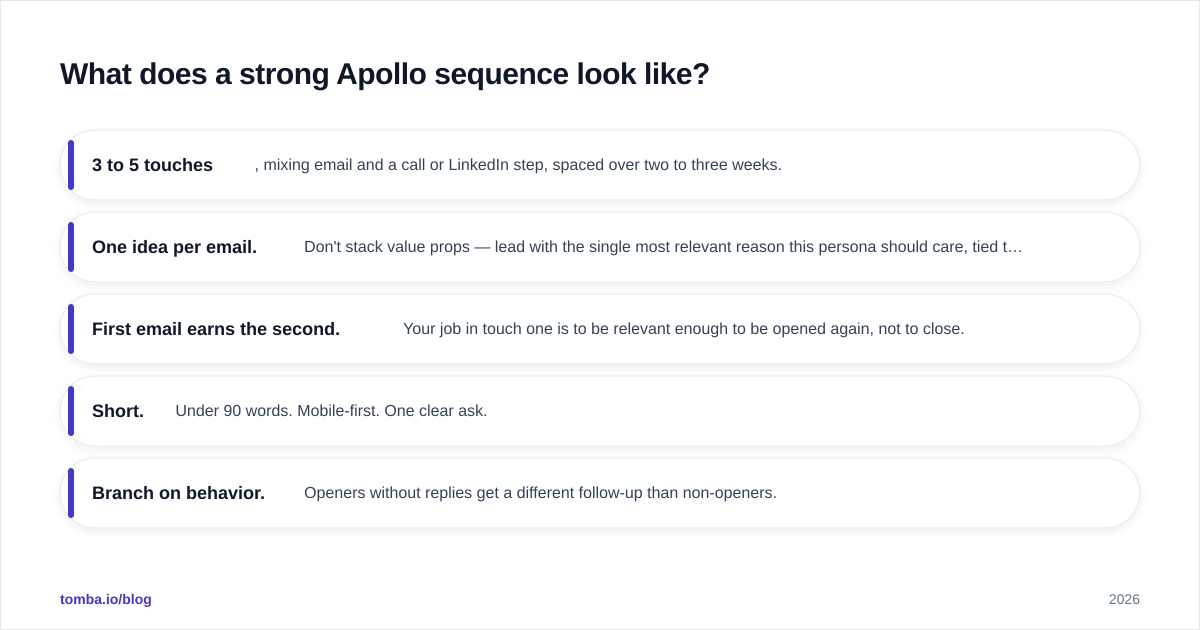
- 3 to 5 touches, mixing email and a call or LinkedIn step, spaced over two to three weeks.
- One idea per email. Don't stack value props — lead with the single most relevant reason this persona should care, tied to the signal that surfaced them.
- First email earns the second. Your job in touch one is to be relevant enough to be opened again, not to close.
- Short. Under 90 words. Mobile-first. One clear ask.
- Branch on behavior. Openers without replies get a different follow-up than non-openers.
Resist the urge to automate personalization into oblivion. The fields you merge — role, company event, tech stack — only help if the underlying data is correct. A merge field that pulls the wrong company name does more damage than no merge field at all, which loops right back to why verified, enriched data is the foundation everything else sits on.
When should you graduate beyond Apollo?#
Consider expanding your stack when you hit any of these walls:
- Bounce rates won't drop even after cleaning Apollo lists — a sign you need stronger verification.
- You sell internationally and Apollo's EU/APAC coverage leaves you guessing.
- You target SMBs or niche verticals where Apollo's database is thin.
- You need API-level control to enrich contacts inside your own product or workflow.
- Credits get expensive at scale and a focused finder delivers better cost-per-verified-contact.
None of these mean Apollo is bad — they mean you've outgrown a single source of truth. The mature outbound stack in 2026 is modular: a strong database for reach, a dedicated finder and verifier for accuracy, and a sequencer that ties it together. You can compare credit economics directly against Tomba pricing to see where the math tips for your volume.
Common Apollo prospecting mistakes to avoid#
- Exporting your entire TAM at once. You'll waste credits and overwhelm your sequences. Batch it.
- Trusting email status blindly. Always run an independent verification pass.
- Ignoring catch-all domains until your bounce rate spikes. Handle them deliberately.
- Reusing one generic persona for every campaign. Tailor filters to each offer.
- Set-and-forget sequences. Prune dead steps weekly. The reps who win treat sequences as living experiments, not fixtures.
The bottom line on Apollo prospecting#
Apollo is a genuinely capable prospecting engine, and for US-focused mid-market teams it can carry a huge share of pipeline on its own. But its all-in-one convenience hides a single point of failure: data accuracy varies, and outbound punishes bad data harder than almost any other channel. The teams that win with Apollo in 2026 are the ones who pair its reach with disciplined verification, enrichment, and sending hygiene.
If your bounces are creeping up or your international and SMB lists feel hollow, plug the gap before it costs you your domain reputation. Start by running your next Apollo export through the Tomba Email Finder and verifier to catch what one database misses — find the right people, confirm they're reachable, and send with confidence. Clean data is the difference between a sequence that books meetings and one that quietly lands in spam.
Ready to find emails that actually work?
Join 150,000+ professionals who stopped guessing and started sending. Free credits on signup — no credit card required.
Get the Tomba newsletter
Practical outbound tactics and product updates — once every two weeks.
About the author