Apollo.io Pros and Cons (2026): An Honest B2B Review
A neutral, hands-on look at Apollo.io's strengths and weaknesses in 2026 — data quality, pricing traps, sequencing, and when a leaner stack wins.
Apollo.io is one of the most-installed sales platforms on the market, but "popular" and "right for your team" are not the same thing. This review breaks down where Apollo genuinely earns its seat and where it quietly costs you more than the sticker price.
TL;DR#
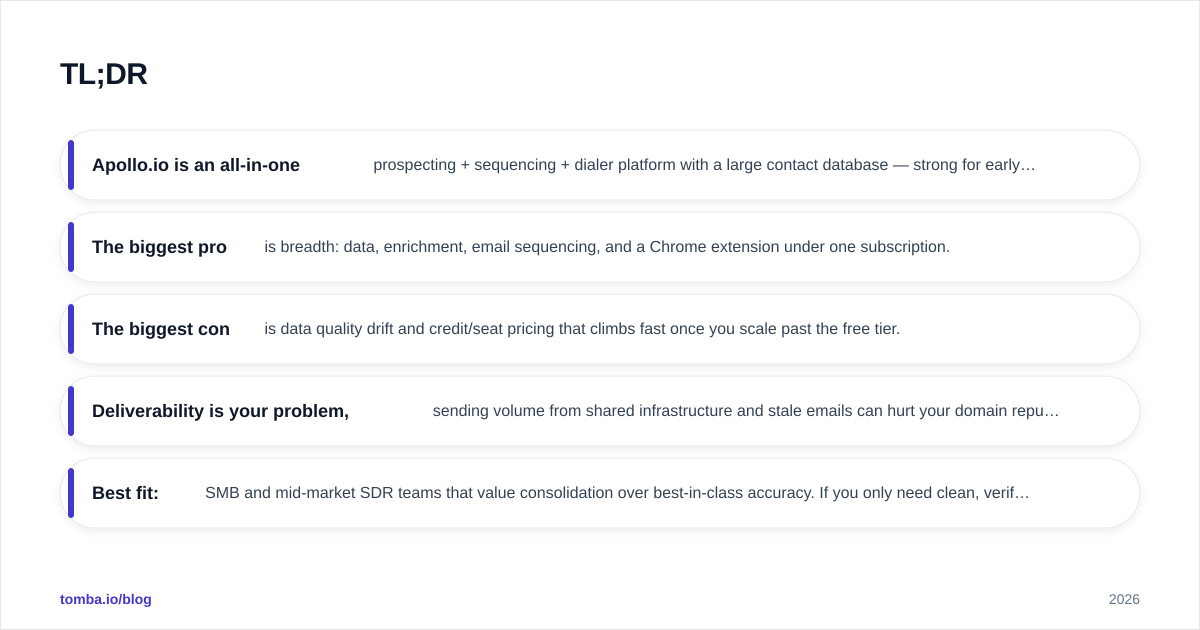
- Apollo.io is an all-in-one prospecting + sequencing + dialer platform with a large contact database — strong for early-stage teams that want one login instead of five.
- The biggest pro is breadth: data, enrichment, email sequencing, and a Chrome extension under one subscription.
- The biggest con is data quality drift and credit/seat pricing that climbs fast once you scale past the free tier.
- Deliverability is your problem, not Apollo's — sending volume from shared infrastructure and stale emails can hurt your domain reputation.
- Best fit: SMB and mid-market SDR teams that value consolidation over best-in-class accuracy. If you only need clean, verified emails, a focused tool is cheaper and more accurate.
What is Apollo.io and who is it for?#
Apollo.io is a go-to-market platform that bundles a B2B contact database (Apollo claims 200M+ contacts and 60M+ companies), email and call sequencing, a dialer, basic CRM features, and a browser extension that pulls contact data while you browse LinkedIn or company sites.
Think of it like a Swiss Army knife. It does many jobs passably from a single handle, which is exactly what you want when you are traveling light. But when you need to cut something precisely every day, a dedicated blade wins. Apollo is the knife; the question this post answers is whether your team needs the whole knife or just one good blade.
The typical buyer is a founder-led sales motion or a small-to-mid SDR team that wants to find prospects, enrich them, and start outreach without stitching together separate tools. Enterprise teams tend to layer Apollo with — or replace it by — dedicated data, intent, and engagement platforms.
What are the main pros of Apollo.io?#
Here is where Apollo consistently delivers value.
1. Genuine all-in-one consolidation. Prospecting, enrichment, sequencing, and dialing in one subscription removes integration headaches and reduces the number of vendors you manage. For a two-person sales team, that simplicity is real money saved on both tools and admin time.
2. Large database with decent filtering. Apollo's search filters (title, seniority, headcount, technology used, funding) are robust. You can build a targeted list in minutes without exporting to a spreadsheet first.
3. Chrome extension workflow. The extension surfaces contact details on LinkedIn and company pages and lets you push people into sequences without leaving the tab. It is one of Apollo's most-loved features in user reviews on G2.
4. Built-in sequencing and a dialer. You can write a multi-step cadence, add call tasks, and dial — all natively. Smaller teams avoid paying separately for an engagement platform like Outreach or Salesloft.
5. A usable free tier. Apollo offers free monthly credits, which makes it easy to test before committing. That low barrier is a major reason for its adoption.
What are the main cons of Apollo.io?#
Now the trade-offs — the parts that don't show up in the demo.
1. Data accuracy drifts. Apollo's scale is also its weakness. Large crowd-sourced and scraped datasets age quickly. Job changes, departures, and reorganizations mean a meaningful share of emails go stale. Users frequently report bounce rates that are fine at first and creep upward on older records. If you do not run an independent email verifier before sending, you will feel it in your bounce rate.
2. Credit and seat pricing climbs. The entry price looks friendly, but export credits, mobile-number credits, and per-seat costs compound. Teams routinely report that the "real" cost at scale is several multiples of what they budgeted. Always model your annual export volume before signing.
3. Deliverability risk is on you. Sending high volumes through sequences built on unverified contacts is a fast route to spam folders and a damaged sender reputation. Apollo gives you the gun; aim matters. Pair any sending tool with strong email deliverability hygiene — warmup, SPF/DKIM, and list cleaning.
4. Catch-all and international gaps. Coverage outside North America thins out, and catch-all domains (which accept every address) are hard to validate inside Apollo alone. A dedicated catch-all verifier closes that gap.
5. Feature breadth over depth. The dialer, CRM, and analytics are "good enough," not best-in-class. Teams that grow usually outgrow one module first — often the CRM or the engagement reporting — and end up bolting on a specialist tool anyway.

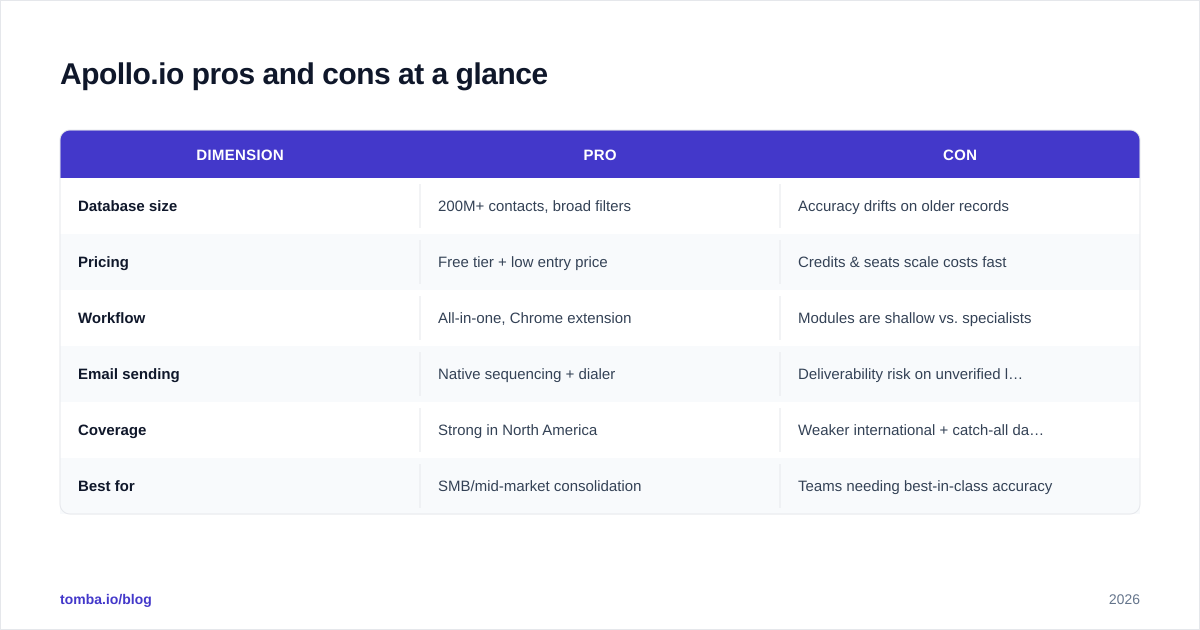
Apollo.io pros and cons at a glance#
| Dimension | Pro | Con |
|---|---|---|
| Database size | 200M+ contacts, broad filters | Accuracy drifts on older records |
| Pricing | Free tier + low entry price | Credits & seats scale costs fast |
| Workflow | All-in-one, Chrome extension | Modules are shallow vs. specialists |
| Email sending | Native sequencing + dialer | Deliverability risk on unverified lists |
| Coverage | Strong in North America | Weaker international + catch-all data |
| Best for | SMB/mid-market consolidation | Teams needing best-in-class accuracy |
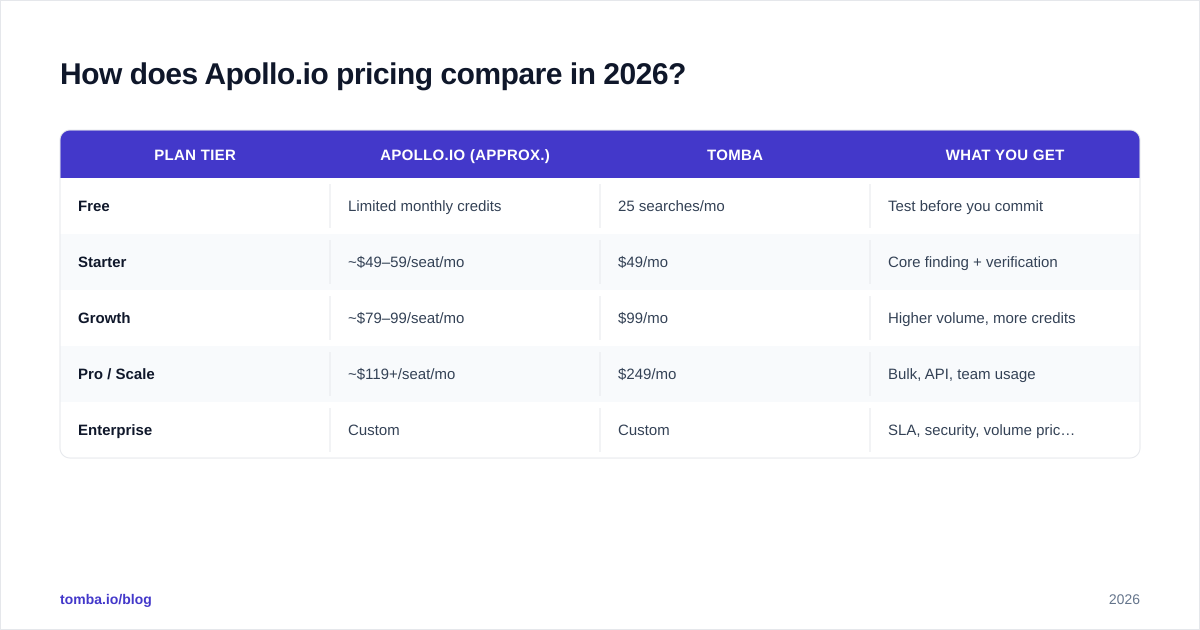
How does Apollo.io pricing compare in 2026?#
Apollo uses a freemium + per-seat + credit model. The headline tiers are affordable, but exports and mobile numbers are metered, so usage drives the bill. Below is a representative comparison against a focused email-finding stack so you can see the trade-off between breadth and cost-per-verified-contact.
| Plan tier | Apollo.io (approx.) | Tomba | What you get |
|---|---|---|---|
| Free | Limited monthly credits | 25 searches/mo | Test before you commit |
| Starter | ~$49–59/seat/mo | $49/mo | Core finding + verification |
| Growth | ~$79–99/seat/mo | $99/mo | Higher volume, more credits |
| Pro / Scale | ~$119+/seat/mo | $249/mo | Bulk, API, team usage |
| Enterprise | Custom | Custom | SLA, security, volume pricing |
Two things to note. First, Apollo's cost is per seat, so a five-rep team multiplies quickly. Second, Apollo bundles engagement features into that price — if you will actually use the sequencer and dialer, the bundle can be efficient. If you only want clean emails, you are paying for a sequencer you will not touch. Compare the math against transparent Tomba pricing before deciding.
Rule of thumb: if more than half of Apollo's modules will sit idle, you are buying a Swiss Army knife to open one letter.
Is Apollo.io's data accurate enough for cold outreach?#
Short answer: accurate enough to start, not accurate enough to send blind.
Apollo's data is sourced from a mix of public web, contributory networks, and third-party providers. That breadth is great for discovery and terrible for freshness consistency — different records age at different rates. The professional standard in 2026 is to treat any database (Apollo included) as a source, then verify in a separate step before the email ever leaves your domain.
A practical two-step pattern works best:
- Discover in Apollo (or any database) to build the raw list.
- Verify and enrich through a dedicated checker — use a real-time email finder and verification pass to confirm the address is live, then enrich missing fields. This is also where a domain search helps when you have the company but not the person.
This separation protects your sender reputation. Bounces above 2–3% start to drag your domain down with mailbox providers, and once reputation slips, even your verified emails land in spam. Verification is cheap insurance against an expensive problem.
For teams whose entire need is "give me correct, deliverable emails," routing around Apollo's send features and using a focused finder is both cheaper and measurably more accurate. That is the core argument behind most Apollo alternative evaluations.
When should you choose Apollo.io — and when shouldn't you?#
Choose Apollo if:
- You are an early-stage or SMB team that wants one tool for finding, enriching, and sending.
- Your reps live in the Chrome extension and value speed over surgical accuracy.
- You will genuinely use the sequencer and dialer (otherwise you are overpaying).
- Your market is primarily North American.
Look elsewhere if:
- Accuracy and low bounce rates are mission-critical (regulated industries, ABM with small TAM).
- You already own an engagement platform and only need data.
- You operate heavily in EMEA/APAC where coverage thins.
- Your finance team needs predictable, non-credit-based costs.
For the "data-only" case, a specialist stack is the better buy. You verify before you send, you pay for exactly what you use, and you keep deliverability in your control. Tools like the bulk email finder handle list-scale work without per-seat penalties, and the Tomba API plugs verification into your existing CRM or sequencer.
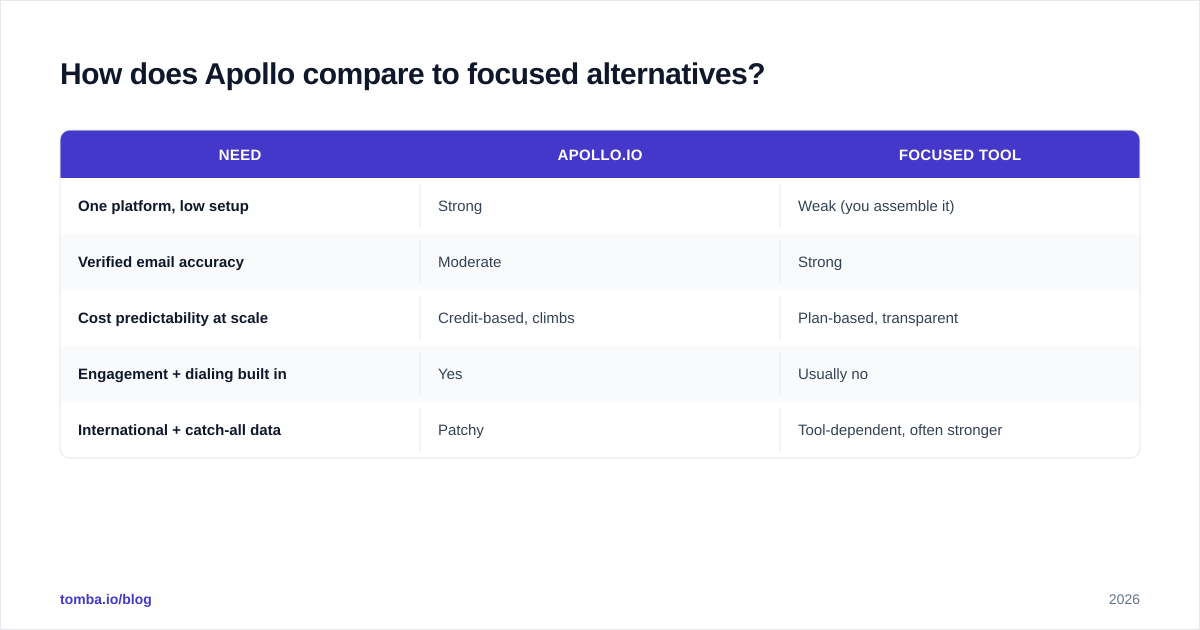
How does Apollo compare to focused alternatives?#
Apollo competes on breadth; alternatives compete on depth. Independent analyst coverage of the sales-intelligence category (see Gartner's market overview) consistently frames the choice as consolidation vs. specialization. Neither is universally "better" — it depends on how many jobs you need done from one login.
| Need | Apollo.io | Focused tool |
|---|---|---|
| One platform, low setup | Strong | Weak (you assemble it) |
| Verified email accuracy | Moderate | Strong |
| Cost predictability at scale | Credit-based, climbs | Plan-based, transparent |
| Engagement + dialing built in | Yes | Usually no |
| International + catch-all data | Patchy | Tool-dependent, often stronger |
If you want to keep your engagement platform and simply feed it clean contacts, a finder-plus-verifier combination beats paying for Apollo's full bundle. If you want to fire everyone else and run lean, Apollo's all-in-one nature is the draw.
The verdict on Apollo.io pros and cons#
Apollo.io is a strong consolidation play and a weak precision play. It is the right first sales platform for a lot of teams and the wrong long-term data source for teams whose deliverability depends on accuracy. The smart move is rarely "Apollo or nothing" — it is "Apollo for discovery, a dedicated verifier before you send," or skipping the bundle entirely when you only need correct emails.
If your real goal is clean, deliverable contact data without per-seat credit math, start with the Tomba Email Finder. Find professional emails by domain, name, or company, verify them in the same flow, and push them straight into the sequencer you already use — so your bounce rate stays low and your domain reputation stays intact. Pair it with the email verifier and you have the accurate half of Apollo's promise, at a fraction of the cost and with none of the deliverability gambles.
// get started
Find, verify and enrich your first contacts today
Start on the free plan with 25 searches a month, then scale when your team is ready.
Free plan · No credit card required · GDPR & CCPA
Get the Tomba newsletter
Product and data updates
// about the author