App Go-To-Market Strategy: The 2026 Launch Playbook
A practical, channel-by-channel framework for taking a new app to market in 2026 — positioning, pricing, distribution, and the metrics that prove traction before you scale spend.
TL;DR
- An app go to market strategy is the plan that connects who you sell to, what you say, where you reach them, and how you price — not a launch-day checklist.
- Start with a sharp ICP and a positioning statement before you touch a single channel. Most failed launches are positioning failures wearing a marketing costume.
- Pick two channels and go deep, not eight channels and go broad. Channel-fit beats channel-count every time in the first 12 months.
- Instrument activation and payback from day one. If you cannot see your activation rate and CAC payback, you are flying blind.
- Use a tight feedback loop: launch a wedge, measure, refine positioning, then expand. GTM is iterative, not a one-shot event.
What is an app go to market strategy?#
An app go to market strategy is the operating plan that defines who you are selling to, what value you promise them, where you reach them, and how you price and deliver. It is the bridge between "we built an app" and "people pay us for it repeatedly."
Think of it like opening a restaurant. The food (your app) matters, but the location, the menu pricing, the sign on the street, and the regulars you build relationships with decide whether you survive year one. A great kitchen with no foot traffic still closes.
Most teams confuse a go-to-market strategy with a launch. A launch is a single moment — Product Hunt, a press push, a webinar. A GTM strategy is the repeatable system that keeps acquiring, activating, and retaining users long after launch week traffic dies. According to Gartner's research on go-to-market planning, the companies that scale are the ones that treat GTM as a continuously refined motion, not a campaign.
The framework above has five layers, and they stack in order. You cannot skip a layer and expect the ones above it to hold. Get the foundation — ICP and positioning — wrong, and every dollar you spend on channels amplifies the wrong message to the wrong people.
How do you define your ICP and positioning first?#
Conclusion first: nail your ideal customer profile (ICP) and positioning before you spend a cent on acquisition. Everything downstream — copy, channel choice, pricing — is a derivative of these two decisions.
Your ICP is not a demographic. "Marketing managers at SaaS companies" is a segment, not an ICP. A real ICP describes the specific situation in which your app is the obvious answer: company size, tech stack, the trigger event that creates urgency, and the pain that makes them reach for a credit card today.
To build that profile you need real contact data, not guesses. Teams that win pull a list of accounts that match their hypothesis, enrich it, and interview real buyers. Tools like data enrichment and a clean B2B database turn a vague "I think our user is X" into a verifiable list of 50 companies you can actually call.
Once the ICP is clear, write a positioning statement. The classic structure still works:
For [ICP] who [trigger/pain], [your app] is the [category] that [unique benefit]. Unlike [main alternative], we [key differentiator].
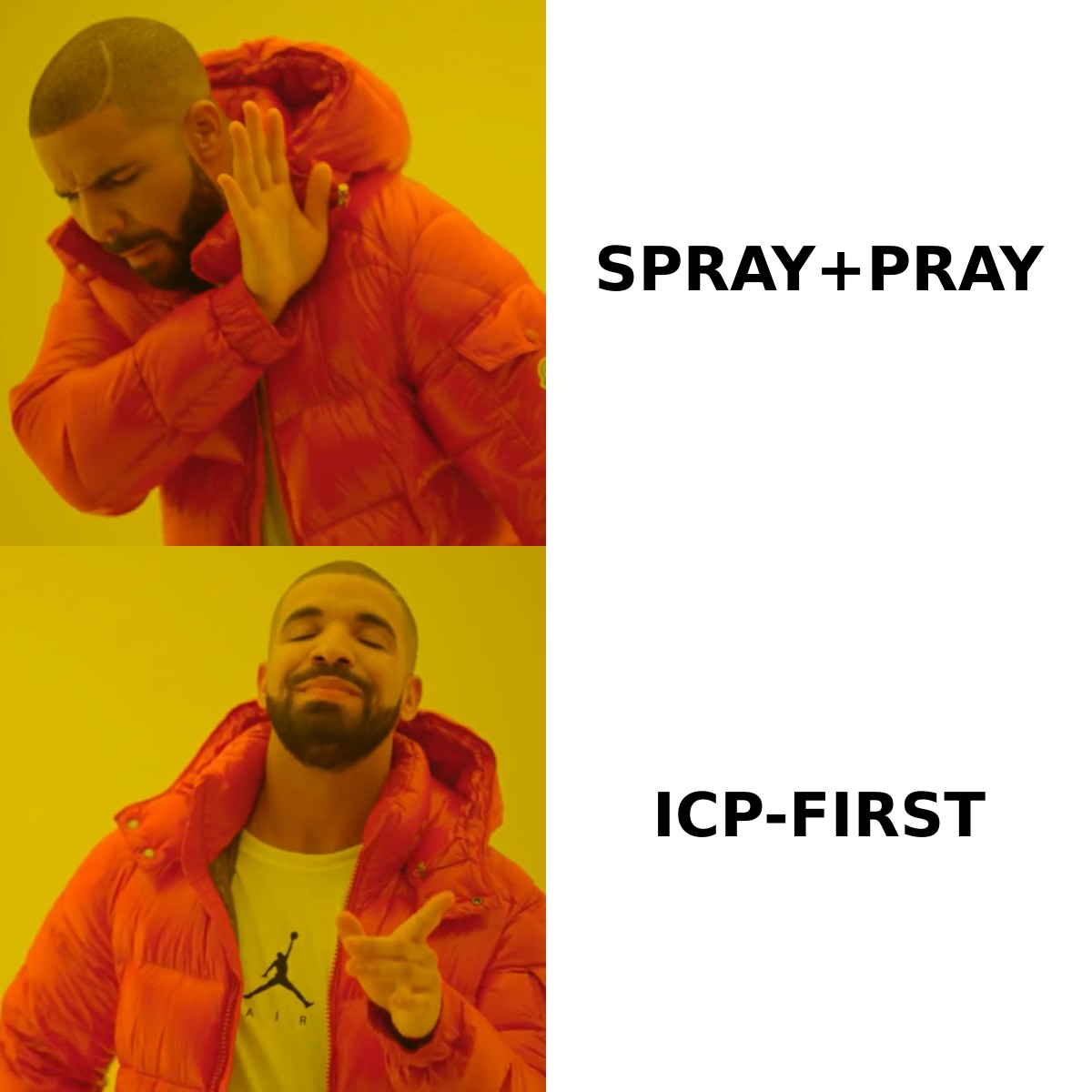
The difference between a spray-and-pray launch and an ICP-first launch is the difference between burning $50k on broad ads and spending $5k on the 200 accounts that will actually convert. Narrow wins.
Which go-to-market motion fits your app?#
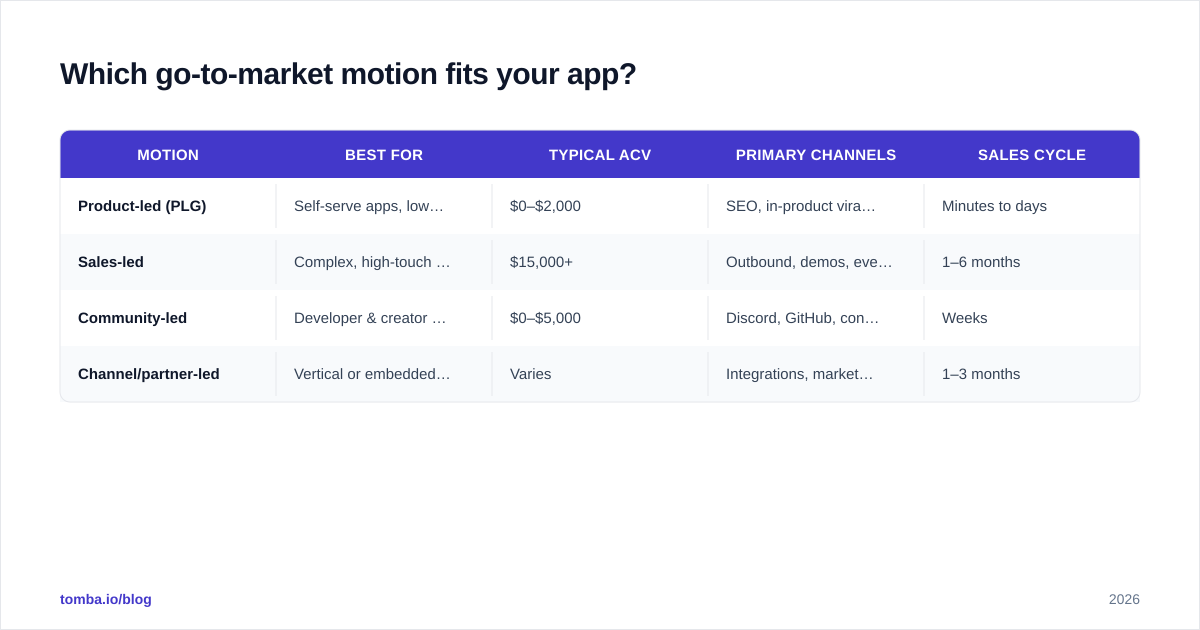
There is no single "best" GTM motion — there is the one that matches your price point, sales complexity, and buyer behavior. Here are the four dominant motions and where each fits.
| Motion | Best for | Typical ACV | Primary channels | Sales cycle |
|---|---|---|---|---|
| Product-led (PLG) | Self-serve apps, low friction | $0–$2,000 | SEO, in-product virality, free tier | Minutes to days |
| Sales-led | Complex, high-touch B2B | $15,000+ | Outbound, demos, events | 1–6 months |
| Community-led | Developer & creator tools | $0–$5,000 | Discord, GitHub, content | Weeks |
| Channel/partner-led | Vertical or embedded apps | Varies | Integrations, marketplaces, resellers | 1–3 months |
Most successful apps blend motions over time. A typical path: start product-led to prove the value loop, then layer a sales-led motion on top once you spot accounts expanding organically. HubSpot's own scaling story — documented across their go-to-market resources — is a textbook example of PLG feeding a sales-assist layer.
The mistake is picking a motion that fights your price. If your app costs $29/month, you cannot afford a human to demo it — the unit economics collapse. If it costs $40,000/year, nobody swipes a card without talking to a person. Match motion to money.
How do you choose acquisition channels?#
Pick two channels, go deep, and ignore the rest until those two are working. Channel sprawl is the most common way early teams waste their runway.
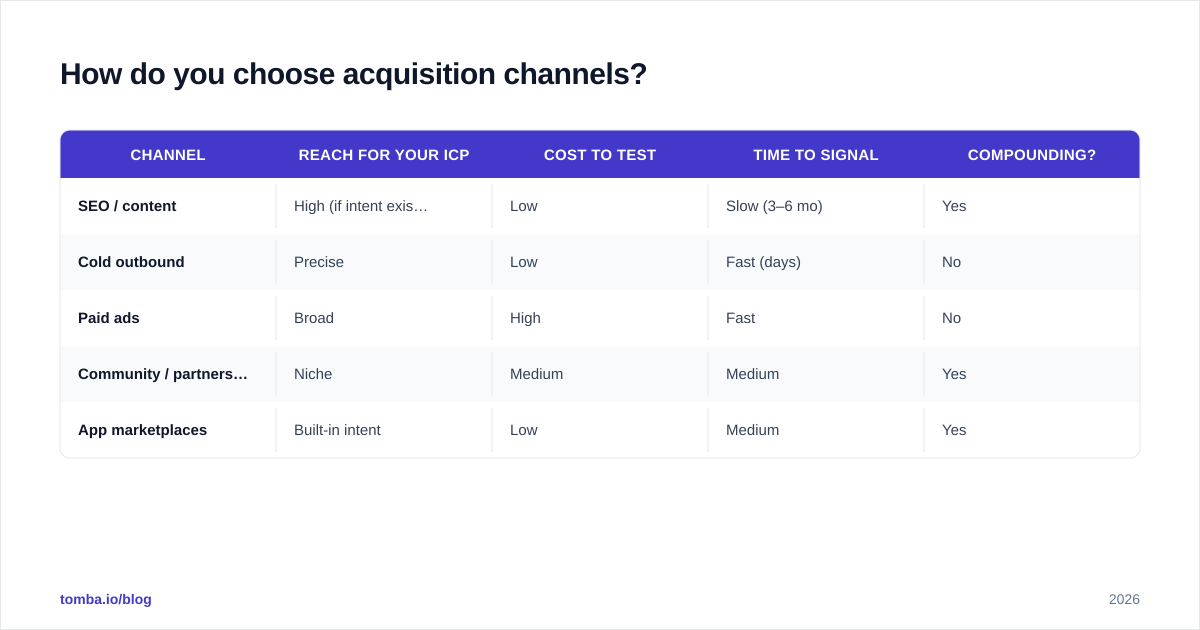
Run a simple scoring exercise across candidate channels:
| Channel | Reach for your ICP | Cost to test | Time to signal | Compounding? |
|---|---|---|---|---|
| SEO / content | High (if intent exists) | Low | Slow (3–6 mo) | Yes |
| Cold outbound | Precise | Low | Fast (days) | No |
| Paid ads | Broad | High | Fast | No |
| Community / partnerships | Niche | Medium | Medium | Yes |
| App marketplaces | Built-in intent | Low | Medium | Yes |
For B2B apps, cold outbound is the fastest way to get signal — you can email 200 perfect-fit prospects this week and learn whether your positioning lands. The catch is that outbound only works if your contact data is accurate; bouncing emails wreck your sender reputation before you've learned anything. That's where an email finder and verified contacts matter more than clever copy. A 40% bounce rate doesn't just waste sends — it can torch your domain.
Content and SEO compound, but slowly. Treat them as the long game you start on day one and harvest in month six. Outbound and paid buy you data now; content buys you a moat later. You want both running, but you sequence them: outbound for learning, content for durability.
What does a launch sequence actually look like?#
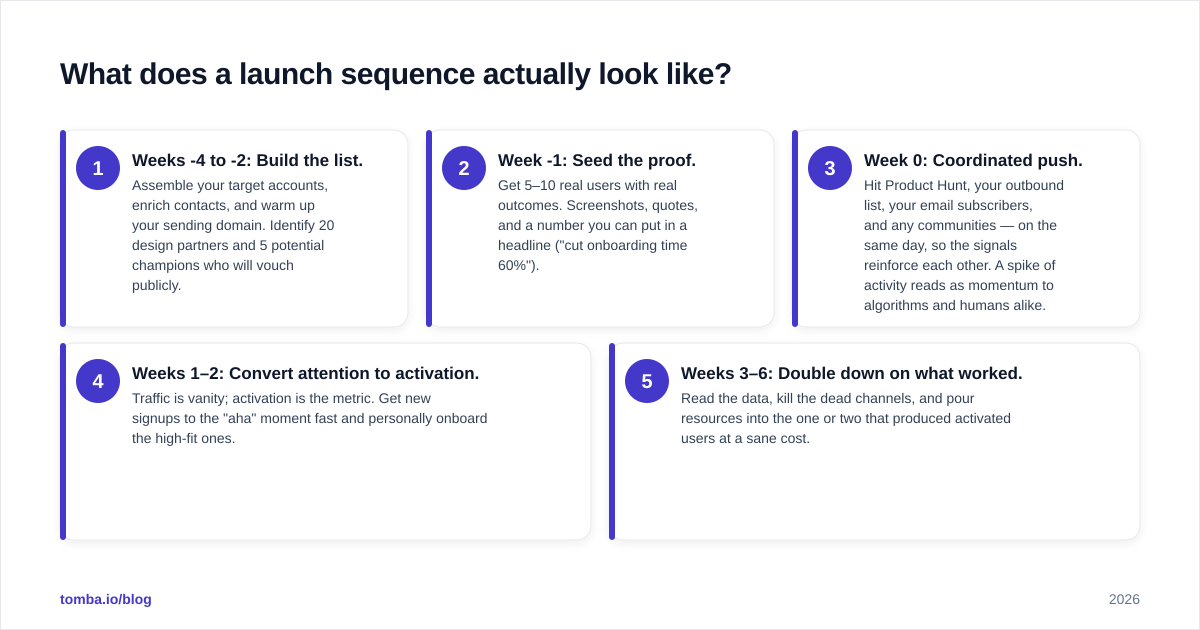
A launch is a sequence, not a day. Here is a 6-week structure that consistently outperforms the "ship and pray" approach.
- Weeks -4 to -2: Build the list. Assemble your target accounts, enrich contacts, and warm up your sending domain. Identify 20 design partners and 5 potential champions who will vouch publicly.
- Week -1: Seed the proof. Get 5–10 real users with real outcomes. Screenshots, quotes, and a number you can put in a headline ("cut onboarding time 60%").
- Week 0: Coordinated push. Hit Product Hunt, your outbound list, your email subscribers, and any communities — on the same day, so the signals reinforce each other. A spike of activity reads as momentum to algorithms and humans alike.
- Weeks 1–2: Convert attention to activation. Traffic is vanity; activation is the metric. Get new signups to the "aha" moment fast and personally onboard the high-fit ones.
- Weeks 3–6: Double down on what worked. Read the data, kill the dead channels, and pour resources into the one or two that produced activated users at a sane cost.
Notice the gravitational pull in week 3: a new channel always looks shinier than the boring one that's actually working. Resist it. The founder who chases every new channel instead of compounding the one that converts their core ICP is the single most common GTM failure mode.
Which metrics prove your GTM is working?#
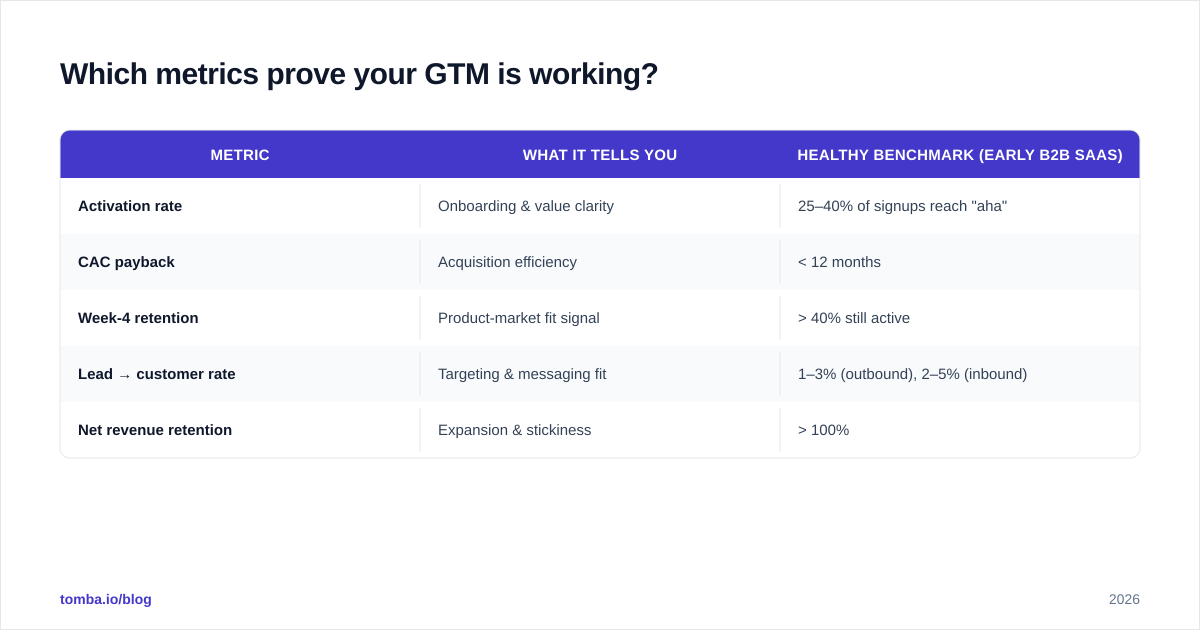
If you can't measure it, you can't scale it. These are the metrics that separate a GTM motion that's ready to scale from one that's burning cash.
| Metric | What it tells you | Healthy benchmark (early B2B SaaS) |
|---|---|---|
| Activation rate | Onboarding & value clarity | 25–40% of signups reach "aha" |
| CAC payback | Acquisition efficiency | < 12 months |
| Week-4 retention | Product-market fit signal | > 40% still active |
| Lead → customer rate | Targeting & messaging fit | 1–3% (outbound), 2–5% (inbound) |
| Net revenue retention | Expansion & stickiness | > 100% |
Track your response rate on outbound separately from conversion — a low response rate usually means a targeting or copy problem, while a high response but low conversion points at a product or pricing gap. The two failures need opposite fixes, so don't average them together.
Don't scale spend until activation and payback are healthy. Pouring money into a leaky funnel just makes you lose money faster. Fix the funnel, then turn up the volume. Platforms like G2 are also worth watching — buyer reviews and category placement become a meaningful acquisition channel once you have a base of happy customers to mobilize.
How is app GTM different in 2026?#
Three shifts changed the playbook this year, and ignoring them is expensive.
AI raised the floor and the bar. Anyone can ship an app fast now, so the differentiator moved from "do you have the feature" to "do you own the distribution and the trust." A clean, verified contact list and a sharp message beat a marginally better feature set.
Deliverability got stricter. Inbox providers tightened authentication and spam thresholds. Sending to unverified lists doesn't just waste effort — it gets your domain throttled. Verifying contacts before you send is no longer optional hygiene; it's a survival requirement for any outbound-led motion. Treat data quality as part of the product, not an afterthought.
Buyers self-educate further before talking to you. By the time a prospect books a demo, they've read your site, your reviews, and three competitors'. Your positioning has to do the selling before a human ever enters the conversation. That puts even more weight on getting layers one and two — ICP and positioning — exactly right.
The teams winning in 2026 treat GTM as a data problem as much as a creative one. Sharp targeting, verified contacts, and tight measurement compound; clever campaigns on bad data evaporate.
Common app GTM mistakes to avoid#
- Launching before you have proof. Five real outcomes beat fifty signups who never activate.
- Targeting "everyone." A broad ICP produces vague copy that converts no one.
- Channel-hopping. Switching channels every two weeks means none of them ever get the iteration they need to work.
- Sending to unverified data. Bounces destroy deliverability and bury your message before it's read.
- Scaling spend on a leaky funnel. Fix activation first; volume second.
Closing: build your launch list the right way#
Every strong app go to market strategy rests on one unglamorous foundation: knowing exactly who to reach and being able to reach them. Before you write a single line of launch copy, build a verified list of the accounts and people who match your ICP.
That's where Tomba Email Finder fits your GTM motion. Find and verify professional email addresses by domain, name, or company, so your outbound launch sequence lands in real inboxes instead of bouncing into spam folders. Start on the free tier (25 searches/month) to validate your first target list, then move to the Starter plan at $49/month once your motion is proven — full Tomba pricing scales with you from first launch to full-volume outbound. Get the data right, and the rest of your strategy finally has something solid to stand on.
// get started
Find, verify and enrich your first contacts today
Start on the free plan with 25 searches a month, then scale when your team is ready.
Free plan · No credit card required · GDPR & CCPA
// about the author