Appointment Setters in 2026: Roles, Pay, and How to Hire
Appointment setters book the meetings your closers live on. Here's what they actually do, what they cost, and how to staff the role without torching your pipeline in 2026.
TL;DR
- Appointment setters are the specialists who turn raw prospects into booked meetings, so your closers spend their time selling instead of dialing.
- The role splits the sales motion: setters handle the top of the funnel (research, outreach, qualification), closers handle the bottom (demo, negotiation, close).
- You can staff it three ways — in-house, agency, or AI-assisted — and each has a very different cost and control profile in 2026.
- Setters live or die on data quality. Bad contact lists wreck even great scripts, which is why accurate phone numbers and verified emails matter more than headcount.
- Measure setters on meetings held and conversion-to-opportunity, not just meetings booked, or you'll reward no-shows.
What is an appointment setter?#
An appointment setter is a sales rep whose entire job is to book qualified meetings between prospects and the closers who run the actual sales conversation. Think of a restaurant: the host who seats you, takes your name, and reads the room is not the chef. The setter is the host of your sales process — they get the right people to the table so the closer can cook.
In practice, an appointment setter spends the day reaching out to prospects by phone, email, and LinkedIn, asking a few qualifying questions, and dropping a confirmed slot on a closer's calendar. They are not paid to close deals. They are paid to fill the calendar with people who are actually worth a closer's time.
This is a deliberate division of labor. When one rep tries to do everything — prospect, qualify, demo, negotiate, and close — they end up doing all of it at about 60% quality. Splitting the funnel lets each person specialize. Setters get good at opening conversations; closers get good at finishing them.
What does an appointment setter actually do all day?#
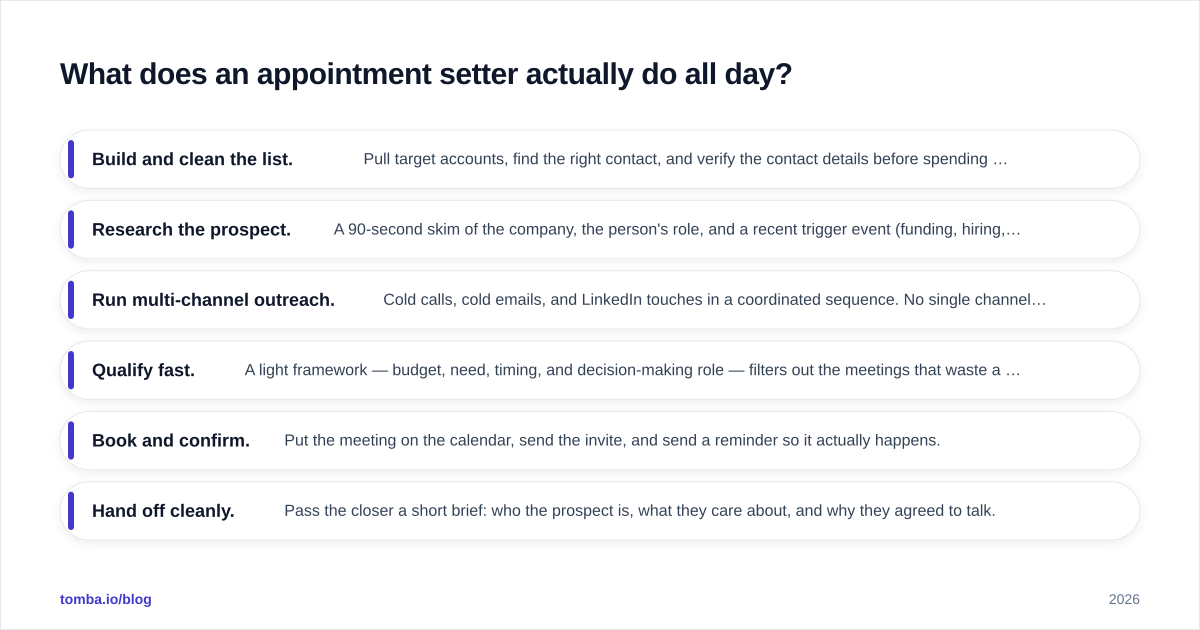
The job is more structured than "make calls." A strong setter runs a repeatable daily loop:
- Build and clean the list. Pull target accounts, find the right contact, and verify the contact details before spending a single dial on them. A setter working from a dirty list burns hours on disconnected numbers and bounced emails.
- Research the prospect. A 90-second skim of the company, the person's role, and a recent trigger event (funding, hiring, a product launch) is the difference between a generic pitch and a relevant one.
- Run multi-channel outreach. Cold calls, cold emails, and LinkedIn touches in a coordinated sequence. No single channel carries the whole load anymore.
- Qualify fast. A light framework — budget, need, timing, and decision-making role — filters out the meetings that waste a closer's afternoon.
- Book and confirm. Put the meeting on the calendar, send the invite, and send a reminder so it actually happens.
- Hand off cleanly. Pass the closer a short brief: who the prospect is, what they care about, and why they agreed to talk.
That first step is where most teams quietly leak money. If your setter is guessing at email formats or dialing main switchboards, their effective output drops by half. Pairing setters with a reliable email finder and a phone finder for direct-dial numbers means more of their day goes to conversations and less to detective work.
Wait — that image tag is wrong, here it is correctly:
Appointment setter vs SDR vs closer: what's the difference?#
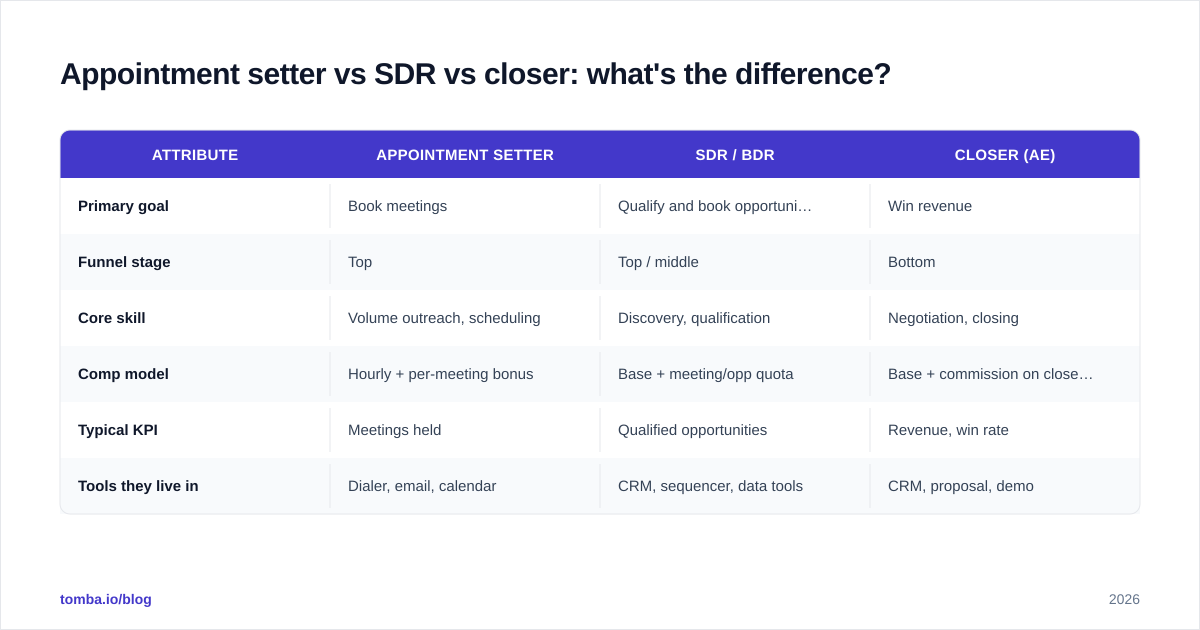
These titles overlap and companies use them loosely, so it's worth being precise. The cleanest way to think about it: setters and SDRs both work the top of the funnel, but "appointment setter" usually implies a narrower, more volume-driven booking role, while "SDR" (sales development rep) often carries more qualification and research responsibility. Closers own the deal once a meeting is set.
| Attribute | Appointment Setter | SDR / BDR | Closer (AE) |
|---|---|---|---|
| Primary goal | Book meetings | Qualify and book opportunities | Win revenue |
| Funnel stage | Top | Top / middle | Bottom |
| Core skill | Volume outreach, scheduling | Discovery, qualification | Negotiation, closing |
| Comp model | Hourly + per-meeting bonus | Base + meeting/opp quota | Base + commission on closed deals |
| Typical KPI | Meetings held | Qualified opportunities | Revenue, win rate |
| Tools they live in | Dialer, email, calendar | CRM, sequencer, data tools | CRM, proposal, demo |
The boundaries shift by company size. A 10-person startup might have one person doing all three jobs. A scaled outbound org separates them sharply because the economics demand it. If you want a deeper definition of the surrounding terminology, Tomba's B2B glossary breaks down the related roles and metrics.
How much do appointment setters cost in 2026?#
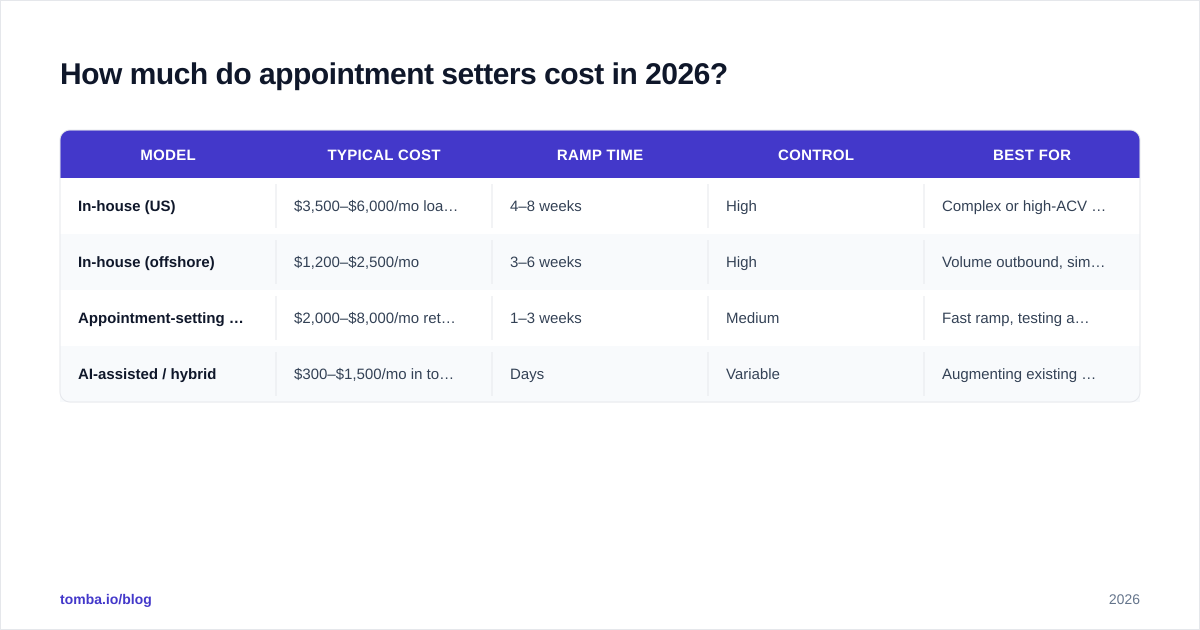
Cost depends entirely on how you staff the role. There are three common models, and the right one is mostly a function of your volume and how much control you want.
| Model | Typical cost | Ramp time | Control | Best for |
|---|---|---|---|---|
| In-house (US) | $3,500–$6,000/mo loaded | 4–8 weeks | High | Complex or high-ACV sales |
| In-house (offshore) | $1,200–$2,500/mo | 3–6 weeks | High | Volume outbound, simpler offers |
| Appointment-setting agency | $2,000–$8,000/mo retainer | 1–3 weeks | Medium | Fast ramp, testing a market |
| AI-assisted / hybrid | $300–$1,500/mo in tooling | Days | Variable | Augmenting existing reps |
A few honest caveats. In-house gives you the most control over quality and brand, but you carry the management overhead and the cost of a bad hire. Agencies ramp fast and absorb the hiring risk, but you're one of many clients and the meetings can be thinner than promised — always tie payment to meetings held and qualified, not meetings booked. AI tooling is improving quickly but in 2026 it still works best as an accelerator for human setters, not a full replacement, especially for anything above a low average deal size.
Whatever model you pick, your per-meeting cost is dominated by data quality. A setter who reaches a decision-maker on the first dial costs you a fraction of one who leaves five voicemails on dead numbers. That's a tooling problem, not a talent problem.
What skills make a great appointment setter?#
The best setters share a recognizable profile, and most of it is coachable.
- Conversational resilience. They hear "no" forty times a day and keep their energy. Rejection rolls off.
- Tight qualification instinct. They know within two minutes whether a prospect is worth a closer's time, and they disqualify quickly instead of forcing weak bookings.
- Scripting discipline with improvisation. They follow a proven framework but adapt to the human on the other end.
- CRM hygiene. Every touch logged, every outcome recorded. A setter who doesn't update the CRM creates chaos for the closer.
- Calendar fluency. They protect the closer's calendar, avoid double-booking, and build in confirmation steps to fight no-shows.
Notice what's not on the list: deep product expertise. Setters need enough to qualify and create curiosity, not enough to run a technical demo. Over-training setters on product detail often backfires — they start trying to close, blow past the booking, and lose the meeting.
How do you build an appointment-setting process that works?#
Hiring a setter without a process is like hiring a driver and forgetting the map. Build the system first.
1. Define your ICP and trigger events. Be specific about who you target and what signals make a prospect timely. Vague targeting produces vague meetings.
2. Source clean contact data. This is the foundation. Your setters need verified emails and direct-dial numbers, not generic info@ inboxes and switchboards. Run lists through an email verifier before outreach so bounces don't tank your sender reputation, and pull direct numbers so dials connect to humans. For high-volume operations, a bulk email finder lets a setter prep a week of outreach in an afternoon.
3. Write a real script — then test it. Open with relevance, ask 2–3 qualifying questions, and drive to a specific calendar slot. Track which openers book and which die.
4. Build a confirmation sequence. Most no-shows are preventable. An invite plus a same-day reminder plus a short value-add message lifts show rates meaningfully.
5. Create a clean handoff. The closer should walk into every meeting with a one-paragraph brief. No cold starts.
6. Review the numbers weekly. Adjust scripts, lists, and targeting based on what the data says, not what feels right.
This is also where good data enrichment earns its keep: the more your setter knows about a prospect before the first touch, the more relevant the opener, and the higher the booking rate.
How do you measure appointment setter performance?#
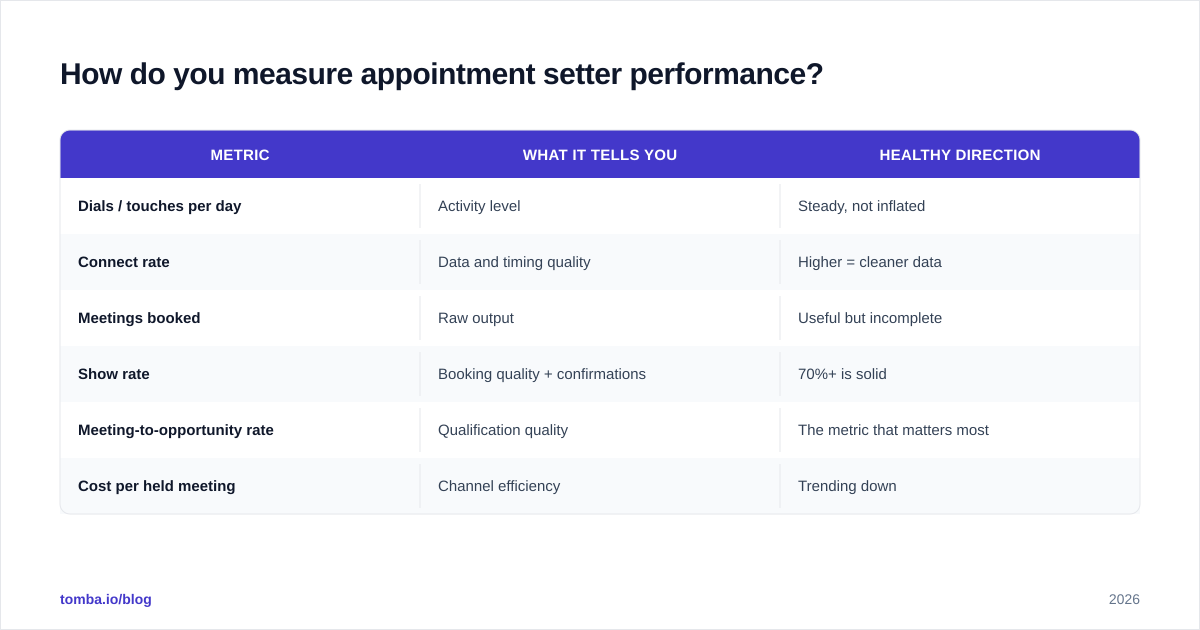
Measure the wrong thing and you'll optimize for garbage. The classic mistake is paying setters purely on meetings booked, which rewards them for booking anyone — including no-shows and unqualified prospects who waste your closers' time.
Track this stack of metrics instead:
| Metric | What it tells you | Healthy direction |
|---|---|---|
| Dials / touches per day | Activity level | Steady, not inflated |
| Connect rate | Data and timing quality | Higher = cleaner data |
| Meetings booked | Raw output | Useful but incomplete |
| Show rate | Booking quality + confirmations | 70%+ is solid |
| Meeting-to-opportunity rate | Qualification quality | The metric that matters most |
| Cost per held meeting | Channel efficiency | Trending down |
The two numbers that protect you are show rate and meeting-to-opportunity rate. A setter booking 30 meetings a month at a 40% show rate is worse than one booking 18 at an 85% show rate. Compensate accordingly — base plus a bonus on qualified, held meetings aligns everyone.
For benchmarks on outbound conversion and meeting metrics, industry resources like the HubSpot Sales Blog and software reviews on G2 are useful reality checks against vendor claims. For broader role definitions and market data, Salesforce's sales resources are a reasonable neutral reference.
Should you use an agency, hire in-house, or go AI-assisted?#
There's no universal answer, but there is a decision framework.
- Go in-house when your sale is complex, your average deal size is high, and brand consistency matters. The control is worth the management cost.
- Go agency when you need to test a new market fast, you lack hiring bandwidth, or you want to validate that outbound works before you build a team. Just structure the contract around held, qualified meetings.
- Go AI-assisted when you already have reps and want to multiply their output — automating research, list-building, and follow-up while humans handle the actual conversations.
Most scaled teams in 2026 run a hybrid: human setters whose busywork is automated away by good tooling, so they spend their hours talking to qualified humans instead of building lists. The constraint is almost never "we need more dials." It's "we need better data so the dials land." You can see how the math changes across volumes on the Tomba pricing page.
The bottom line#
Appointment setters are a force multiplier when they're set up right and a money pit when they're not. The difference is rarely the setter's talent — it's the system around them: a sharp ICP, a tested script, a confirmation sequence that kills no-shows, and above all, clean contact data so every hour goes to conversations instead of dead ends.
That last piece is the one most teams underinvest in. If your setters are guessing at emails and dialing switchboards, no amount of coaching fixes the leak. Start by giving them verified contact data: use the Tomba Email Finder to get accurate, deliverable email addresses by name, company, or domain, pair it with a phone finder for direct dials, and watch your cost per held meeting drop. Spin up a free account (25 searches a month, no card), point your setters at a clean list, and let them do the one thing they're great at — filling your closers' calendars.
Ready to find emails that actually work?
Join 150,000+ professionals who stopped guessing and started sending. Free credits on signup — no credit card required.
Get the Tomba newsletter
Practical outbound tactics and product updates — once every two weeks.
About the author