Appointment Setting Agency Toronto: 2026 Buyer's Guide
Vetting an appointment setting agency in Toronto? Compare pricing models, vetting criteria, and in-house vs outsourced trade-offs before you sign a 2026 contract.
Booking qualified meetings is the hardest, least glamorous part of B2B sales — and it's why a whole industry of appointment setting agencies exists in Toronto and across the GTA. But the gap between a great agency and a money-pit is enormous, and the sales pitch sounds identical from both. This guide gives you the numbers, the vetting questions, and the data-stack reality so you can sign a contract you won't regret in Q3.
TL;DR#
- An appointment setting agency in Toronto typically charges $3,000–$8,000/month retainer, $50–$150 per booked meeting on pay-per-appointment models, or a hybrid of both.
- Outsourcing makes sense when you need pipeline in under 60 days and can't hire, train, and ramp SDRs fast enough. In-house wins on long-term cost-per-meeting once volume is steady.
- The single biggest predictor of ROI is data quality, not script quality. Agencies dialing stale lists burn your domain reputation and your brand.
- Ask for the show-rate (meetings that actually happen), not the book-rate. A 40% no-show rate quietly halves the price you were quoted.
- Whether you outsource or not, owning a clean contact layer — verified emails and direct dials — is what makes the whole motion work.
What does an appointment setting agency in Toronto actually do?#
An appointment setting agency is a team of outbound reps who book qualified sales meetings on your calendar so your closers only talk to people worth talking to. Think of them as the kitchen prep crew in a restaurant: they wash, chop, and portion (research, dial, qualify) so the chef (your account executive) only does the high-skill final plating (the close).
In practice, a Toronto agency engagement includes list building from your ICP, multichannel outreach (cold calls, email, LinkedIn), qualification against your criteria (often BANT or a custom checklist), objection handling, and calendar booking with reminders to reduce no-shows. Good ones also feed structured notes into your CRM so the AE walks in warm.
Toronto specifically has a deep bench of bilingual (English/French) reps, which matters if you sell into Quebec or pan-Canadian accounts, and a time-zone overlap that covers both North American coasts in a single shift.
How much does an appointment setting agency cost in 2026?#
Pricing falls into three models, and the one you pick should match how much risk you want to carry versus how much margin you want to protect.
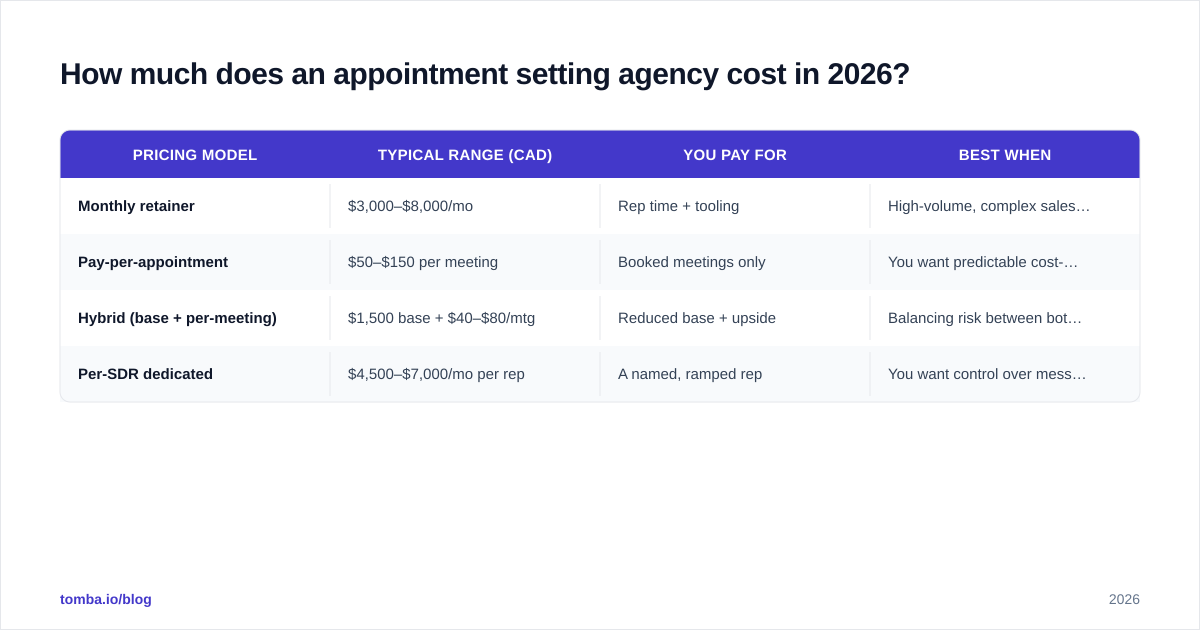
| Pricing model | Typical range (CAD) | You pay for | Best when |
|---|---|---|---|
| Monthly retainer | $3,000–$8,000/mo | Rep time + tooling | High-volume, complex sales cycles |
| Pay-per-appointment | $50–$150 per meeting | Booked meetings only | You want predictable cost-per-lead |
| Hybrid (base + per-meeting) | $1,500 base + $40–$80/mtg | Reduced base + upside | Balancing risk between both sides |
| Per-SDR dedicated | $4,500–$7,000/mo per rep | A named, ramped rep | You want control over messaging |
A word of caution on pay-per-appointment: it sounds the safest, but it quietly incentivizes the agency to book anyone who says yes, not anyone who fits. You can end up paying $120 a head for meetings that no-show or were never qualified in the first place. Always tie payment to a qualified meeting definition you both sign off on, and add a clawback clause for no-shows.
For reference, industry directories like G2 and Clutch list dozens of Canadian appointment setting providers with verified reviews — start there rather than with a cold sales email in your inbox.
Is an appointment setting agency better than building an in-house SDR team?#
The honest answer: it depends on your timeline and your volume. Here's the math most founders skip.
A single in-house SDR in Toronto runs roughly $55,000–$75,000 base salary, plus commission, plus benefits, plus tooling (CRM seat, dialer, data, sequencer) — call it $90,000–$110,000 fully loaded per year, or about $7,500–$9,000/month. And that rep needs 60–90 days to ramp before they're booking at full clip.
An agency gets you booking in two to three weeks with zero hiring risk. But you give up message control, you rent the relationship, and your cost-per-meeting stops dropping once you're at scale.
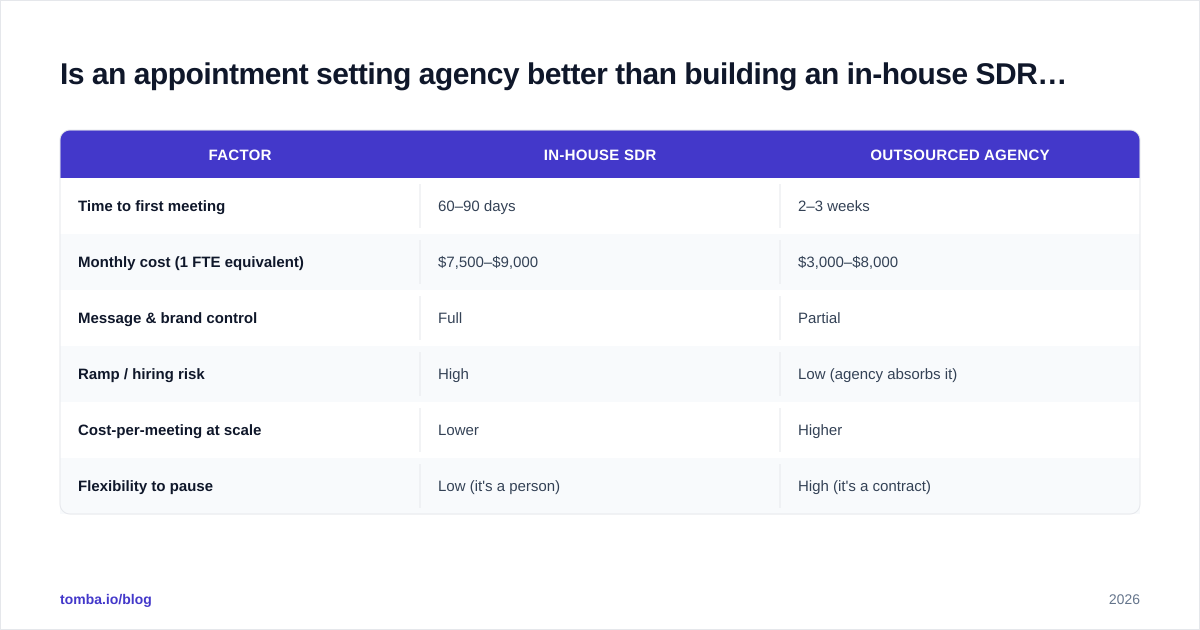
| Factor | In-house SDR | Outsourced agency |
|---|---|---|
| Time to first meeting | 60–90 days | 2–3 weeks |
| Monthly cost (1 FTE equivalent) | $7,500–$9,000 | $3,000–$8,000 |
| Message & brand control | Full | Partial |
| Ramp / hiring risk | High | Low (agency absorbs it) |
| Cost-per-meeting at scale | Lower | Higher |
| Flexibility to pause | Low (it's a person) | High (it's a contract) |
The pattern that works for a lot of GTA companies: start with an agency to prove the channel and generate near-term pipeline, then build in-house once you know your ICP, your messaging, and your real cost-per-meeting. The agency becomes your overflow or your new-market test bed.
If you want a deeper framework for scoring channels before you commit budget, our guide to lead generation tactics breaks down which motions pay back fastest.
What separates a great Toronto agency from an expensive one?#
Five things, and none of them are the pitch deck.
1. They lead with data, not scripts. A polished cold-call script reading off a garbage list still gets hung up on. Ask what their connect rate is and how they source and verify contact data before a single dial. Agencies that can't answer this in detail are winging it.
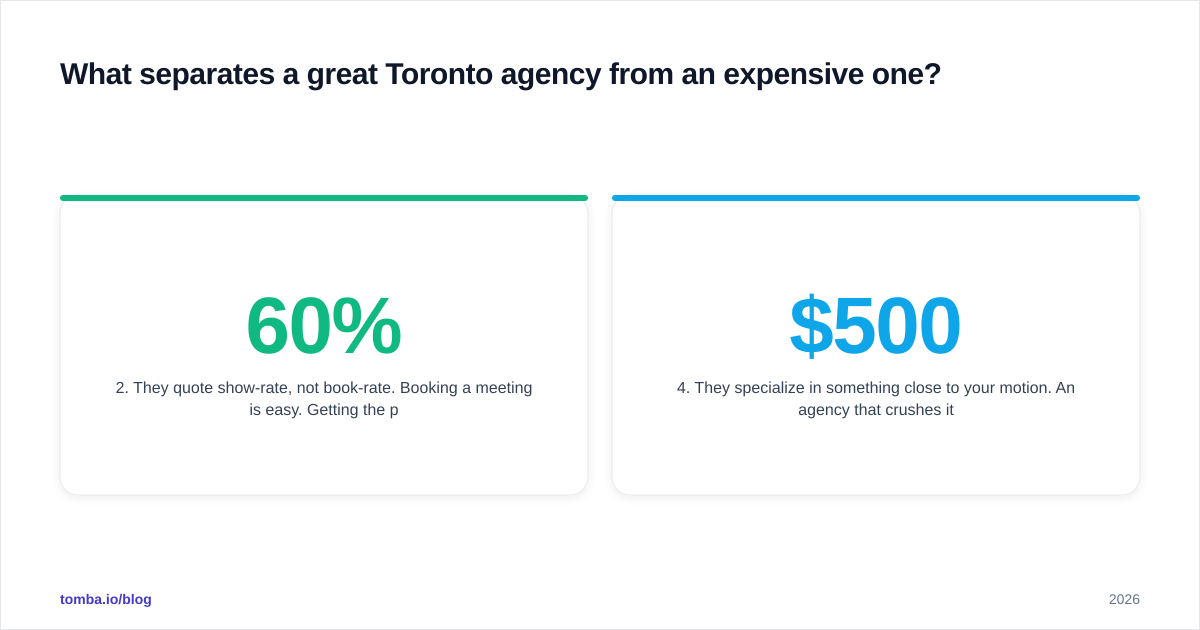
2. They quote show-rate, not book-rate. Booking a meeting is easy. Getting the prospect to actually show up — and be qualified when they do — is the whole game. A 30 booked / 18 showed month is a 60% show rate, which is decent. Below 50% and you're paying for ghosts.
3. They protect your domain and brand. Sloppy email outreach from your domain tanks your sender reputation and lands you on blocklists that take weeks to escape. A serious agency uses separate sending domains, warms them, and verifies every address before send.
4. They specialize in something close to your motion. An agency that crushes it booking demos for $500/mo SaaS may flop selling $250K enterprise services with a 9-month cycle. Ask for references in your deal-size band.
5. They give you the data back. When the contract ends, you should own the enriched contact records, call notes, and disposition data. If it all lives in their tooling and walks out the door with them, you rented results instead of building an asset.

What questions should you ask before signing?#
Run every shortlisted agency through this checklist. The good ones answer fast and specifically; the weak ones get vague.
- What's your qualified-meeting definition, in writing? If it's not contractual, it's marketing.
- What's your average show-rate across clients in my industry? Ask for a real number, not "high."
- Where does your contact data come from, and how is it verified? You're looking for verified emails and validated phone numbers, not a scraped CSV.
- What's your no-show policy? Clawback, re-book, or you eat it?
- How do you protect my domain reputation? Separate domains, warmup, verification — all three should be a yes.
- Who actually makes the calls? A named, dedicated rep beats a rotating pool that never learns your product.
- What's the ramp timeline and the out clause? Month-to-month after an initial term is ideal.
- What CRM do you push into, and do I own the data? HubSpot and Salesforce are the common targets; confirm the integration is real, not a weekly CSV.
Why does data quality decide whether the whole thing works?#
Because no script, no rep, and no agency can dial a phone number that's wrong or email an address that bounces. The list is the ceiling on performance.
Here's what actually happens with a stale list: connect rates collapse, reps spend their day on dead numbers instead of conversations, your sending domain accumulates bounces and spam flags, and your cost-per-meeting silently triples. You blame the agency. The agency blames the market. Nobody blames the spreadsheet, which is the actual culprit.
This is true whether you outsource or build in-house, which is why the smartest move — regardless of agency decision — is to own a clean, verified contact layer underneath the whole motion. Before any rep dials, the workflow should be:
- Build the target list against a tight ICP.
- Find verified work emails and direct-dial phone numbers for each contact.
- Run data enrichment to fill in title, company size, and tech stack so reps personalize.
- Verify every email and validate every phone before the campaign starts.
- Push the clean records into your CRM, and only then start outreach.
When you do this with a bulk lead generation workflow, you can hand an agency a pre-verified list — which both lowers your per-meeting cost (they spend time talking, not researching) and gives you a clean asset you keep when the contract ends.
How do you measure whether the agency is actually working?#
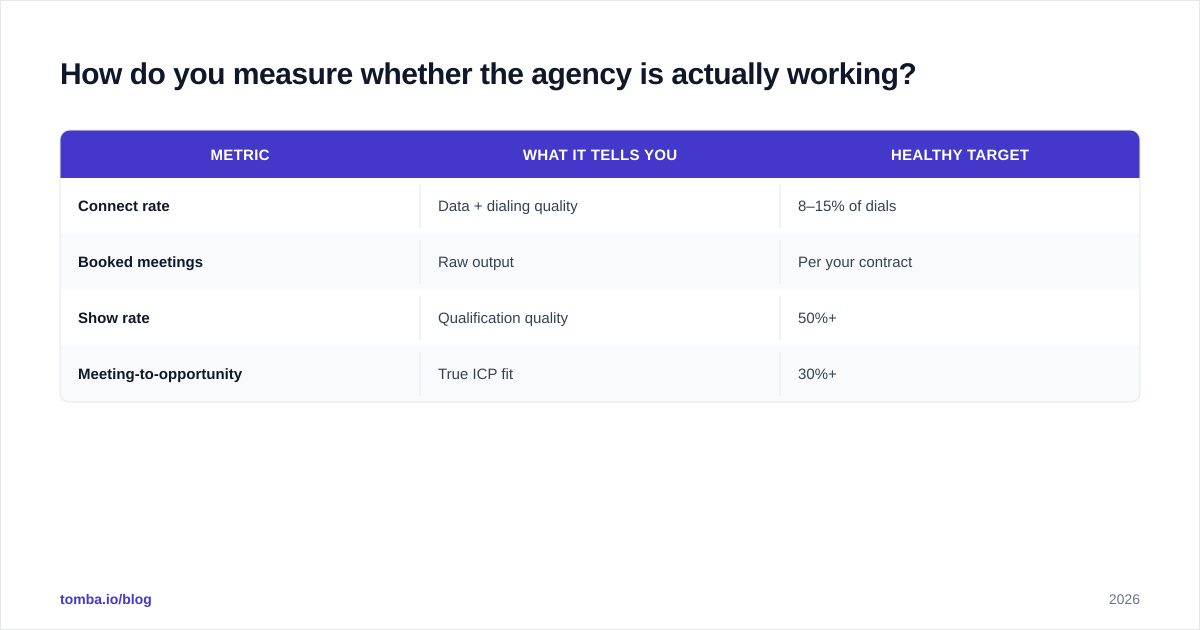
Track four numbers monthly, and judge the engagement on the trend, not a single month.
| Metric | What it tells you | Healthy target |
|---|---|---|
| Connect rate | Data + dialing quality | 8–15% of dials |
| Booked meetings | Raw output | Per your contract |
| Show rate | Qualification quality | 50%+ |
| Meeting-to-opportunity | True ICP fit | 30%+ |
The metric that catches most problems early is meeting-to-opportunity. An agency can juice booked meetings and even show rate by loosening qualification, but if those meetings never convert to real opportunities, your AEs are wasting their highest-value hours. If that number is low after 60 days, your ICP definition or the agency's qualification is broken — fix it before you renew.
The bottom line#
An appointment setting agency in Toronto can get you qualified pipeline in weeks instead of months, and for many companies it's the right call to prove the channel before building in-house. But the agency is only as good as the data it dials and the qualification bar you enforce in the contract. Quote show-rate, define qualified meetings in writing, protect your domain, and insist on owning the data when you're done.
And no matter which way you go on the agency question, build your motion on a verified contact layer first. Start with the Tomba Email Finder to find and verify professional emails by name, domain, or company — feed your reps (or your agency) a clean list, and watch your cost-per-meeting drop. You can test it free with 25 searches a month, then scale on the Starter plan at $49/mo when the pipeline starts flowing.
// get started
Find, verify and enrich your first contacts today
Start on the free plan with 25 searches a month, then scale when your team is ready.
Free plan · No credit card required · GDPR & CCPA
// about the author