Appointment Setting Campaign: The 2026 Playbook for Booked Meetings
A practical 2026 guide to building an appointment setting campaign that books qualified meetings instead of no-shows — targeting, channels, scripts, metrics, and tools.
TL;DR
- An appointment setting campaign is a structured outbound program whose only job is to convert cold or warm prospects into booked, qualified sales meetings — not to close deals.
- The four levers that decide success are list quality, channel mix, message relevance, and follow-up discipline. Weak data sinks the other three.
- Multichannel beats single-channel: email + phone + LinkedIn booked roughly 2-3x more meetings in most 2026 outbound benchmarks than email alone.
- Track meetings booked, show rate, and meeting-to-opportunity rate — booked meetings that never show are vanity metrics.
- Tools matter, but the unglamorous foundation is verified contact data. Bad emails and dead numbers kill campaigns before a script ever gets read.
What is an appointment setting campaign?#
An appointment setting campaign is a focused outbound effort designed to turn a target list of accounts into scheduled sales conversations. Think of it like a restaurant host: the host's job is not to cook the meal or close the bill, it's to seat the right guests at the right table so the kitchen can do its work. In sales terms, the appointment setter fills the calendar; the account executive runs the meeting and closes.
That separation is the whole point. When you ask one rep to prospect, qualify, demo, and close, prospecting always loses — it's the least urgent task on any given day. A dedicated appointment setting campaign protects top-of-funnel activity by making "booked meetings" the single output everyone is measured on.
Campaigns can be run by an in-house SDR team, an outsourced agency, or a hybrid. The mechanics are the same regardless of who runs them: define an ICP, build a clean list, sequence outreach across channels, handle objections, and confirm the meeting so it actually happens.
Why do most appointment setting campaigns fail?#
Most campaigns fail for boring, fixable reasons — not because the script wasn't clever enough.
The number one killer is bad data. If 30% of your list bounces or rings dead numbers, you've thrown away a third of your budget before the first conversation. Deliverability craters, your sending domain gets flagged, and reps burn hours on contacts who left the company eight months ago. Strong email deliverability starts with a verified list, not with clever subject lines.
The second killer is targeting too broad. "Anyone in SaaS" is not an ICP. A campaign aimed at the wrong persona produces polite no's at best and spam complaints at worst.
The third is giving up too early. Industry data consistently shows most booked meetings come after the third or fourth touch, yet a large share of reps stop after one or two attempts. The follow-up is the campaign.
How do you build the target list?#
Everything downstream depends on this step. A precise list of 500 right-fit contacts outperforms a sloppy list of 5,000 every time.
Work in three layers:
- Account fit — firmographics that match your best customers: industry, headcount, revenue band, tech stack, region. Use signals like funding, hiring, or recent leadership changes to prioritize.
- Persona fit — the specific titles who feel the pain you solve and can take a meeting. Map the economic buyer and the champion separately.
- Contact accuracy — the verified email and direct phone number for each named person, confirmed within the last 30-60 days.
This is where a purpose-built data tool pays for itself. You can find professional addresses by company with a domain search, pull direct dials with a phone finder, and confirm every address with an email verifier before a single message goes out. Verifying first protects your sender reputation and your show rate at the same time.
A quick gut check: if you can't name the trigger event or pain that makes each contact worth calling this quarter, they don't belong on the list yet.
Which channels work best in 2026?#
Single-channel outreach is the slowest path to a booked meeting. The winning pattern in 2026 is a coordinated sequence where email, phone, and LinkedIn reinforce each other across the same week.
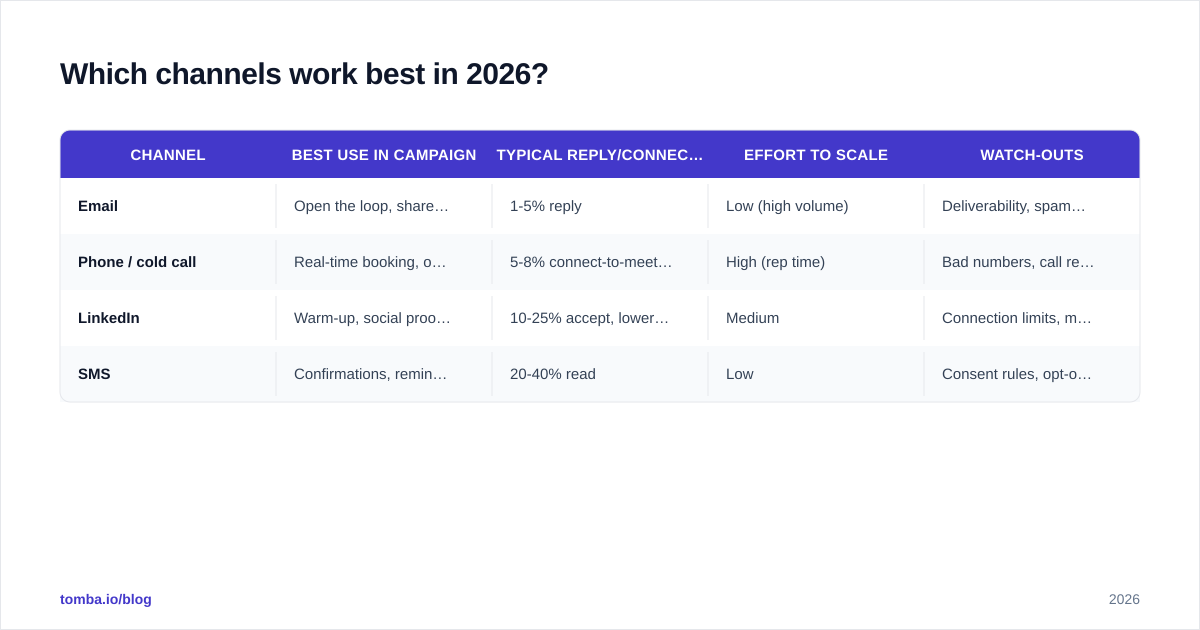
Here's how the main channels compare for appointment setting:
| Channel | Best use in campaign | Typical reply/connect rate | Effort to scale | Watch-outs |
|---|---|---|---|---|
| Open the loop, share context, book async | 1-5% reply | Low (high volume) | Deliverability, spam filters | |
| Phone / cold call | Real-time booking, objection handling | 5-8% connect-to-meeting | High (rep time) | Bad numbers, call reluctance |
| Warm-up, social proof, lighter touch | 10-25% accept, lower reply | Medium | Connection limits, manual | |
| SMS | Confirmations, reminders, nudges | 20-40% read | Low | Consent rules, opt-out |
The practical takeaway: lead with email to create context, layer LinkedIn to build familiarity, and use the phone to actually close the booking. Reserve SMS for confirming and reminding meetings you've already set — that single move is one of the cheapest ways to lift your show rate.
If you run outreach through a connected stack, a HubSpot integration or Salesforce integration keeps every touch logged against the contact so reps never double-tap or miss a follow-up.
What does a multichannel sequence look like?#
A reliable structure runs 14-21 business days with 8-12 touches. The cadence matters more than any single message.
A workable skeleton:
- Day 1 — Email 1: short, specific, one trigger + one ask for time.
- Day 2 — LinkedIn: view profile, send a no-pitch connection request.
- Day 4 — Call 1 + voicemail referencing your email.
- Day 6 — Email 2: new angle, social proof, soft CTA.
- Day 9 — Call 2 at a different time of day.
- Day 11 — LinkedIn message or comment on their post.
- Day 14 — Email 3: case study relevant to their segment.
- Day 18 — Call 3 + breakup email option.
Two rules keep this from becoming spam. First, every touch must add something — a new angle, a relevant proof point, a question — not "just bumping this." Second, vary the channel and the time. The prospect who ignores 9 a.m. emails may pick up a 4:30 p.m. call.
What should the messaging actually say?#
Keep it about them, keep it short, and make the ask tiny. The goal of every message is one thing: a 15-20 minute conversation, not a sale.
A simple, durable cold email frame:
- Line 1 — relevance. Reference a trigger: a hire, a launch, a result a peer company got. Prove you're not blasting.
- Line 2 — value. One sentence on the outcome you help create, ideally with a number.
- Line 3 — ask. A low-friction, specific request: "Worth a 15-minute call Thursday?"
For phone scripts, open with permission ("Did I catch you at an okay time?"), state your reason in one sentence, and move straight to a calendar ask. Don't pitch features — book the meeting. If you need help drafting variations fast, a cold email AI writer or a subject line generator can produce starting points you then make specific.
Whatever you do, personalize the first line by hand or with a real signal. Generic "I came across your profile" openers are why response rates keep falling.
How do you measure an appointment setting campaign?#
Measure the funnel, not the activity. Dials and sends tell you effort; booked-and-held meetings tell you whether the campaign works.
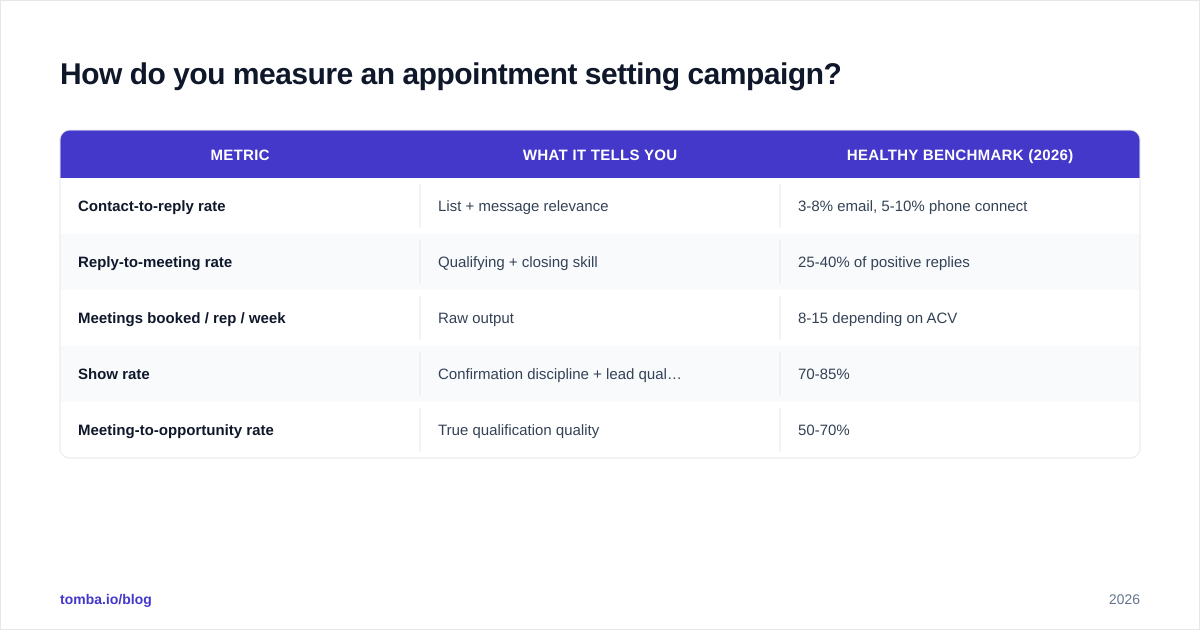
The metrics that matter, in order:
| Metric | What it tells you | Healthy benchmark (2026) |
|---|---|---|
| Contact-to-reply rate | List + message relevance | 3-8% email, 5-10% phone connect |
| Reply-to-meeting rate | Qualifying + closing skill | 25-40% of positive replies |
| Meetings booked / rep / week | Raw output | 8-15 depending on ACV |
| Show rate | Confirmation discipline + lead quality | 70-85% |
| Meeting-to-opportunity rate | True qualification quality | 50-70% |
The two most-ignored numbers are show rate and meeting-to-opportunity rate. A setter who books 20 meetings a week with a 40% show rate and weak qualification is worse than one booking 12 that show and convert. Reward held, qualified meetings — not calendar invites.
Watch one leading indicator daily: bounce rate. If it climbs above 3-5%, stop the campaign and re-verify the list. You can re-check addresses in bulk with a bulk email finder before resuming.
In-house vs outsourced appointment setting?#
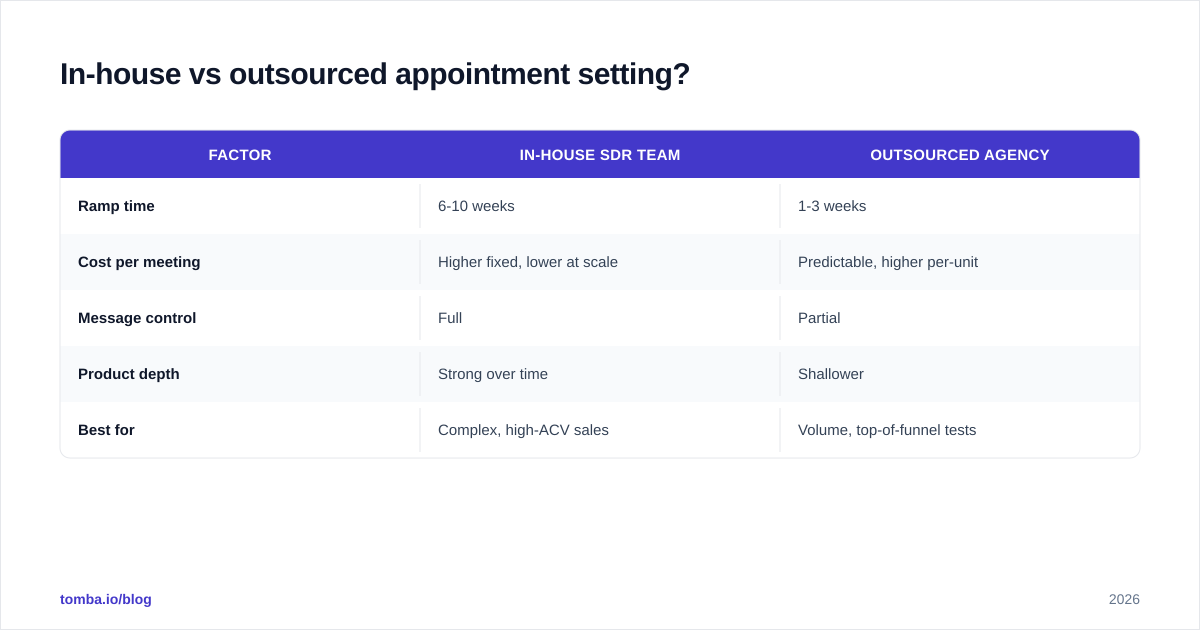
Both models work; the right choice depends on your motion, margins, and how much control you need over messaging.
| Factor | In-house SDR team | Outsourced agency |
|---|---|---|
| Ramp time | 6-10 weeks | 1-3 weeks |
| Cost per meeting | Higher fixed, lower at scale | Predictable, higher per-unit |
| Message control | Full | Partial |
| Product depth | Strong over time | Shallower |
| Best for | Complex, high-ACV sales | Volume, top-of-funnel tests |
A common 2026 pattern is hybrid: outsource volume top-of-funnel to fill the calendar, keep complex or strategic accounts in-house where product nuance and relationships matter. Whatever you pick, own your data layer. If an agency churns or you bring it back in-house, a clean, verified contact database is the asset that travels with you — not their tooling.
What tools do you need to run one?#
You need four capabilities, and you can assemble them without a bloated stack:
- Accurate contact data — verified emails and direct dials. This is the foundation; everything else is downstream of it.
- A sequencer / dialer — to run cadences across email and phone and log activity.
- A CRM — your CRM is the system of record for every touch and outcome.
- Reporting — even a simple dashboard tracking the five metrics above.
The single highest-leverage investment is the data layer, because it multiplies the return on every other tool. A dialer is worthless dialing dead numbers; a sequencer hurts you sending to invalid addresses. Industry sources like G2 and HubSpot's sales research consistently rank data quality among the top predictors of outbound performance.
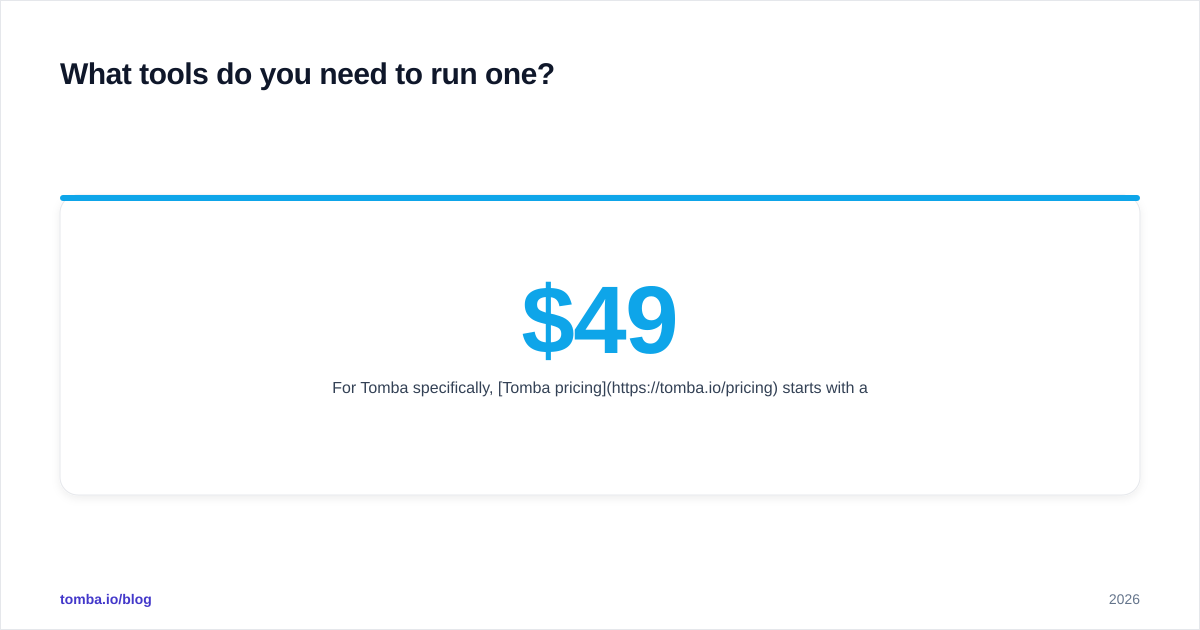
For Tomba specifically, Tomba pricing starts with a free tier of 25 searches a month, then Starter at $49/mo, Growth at $99/mo, and Pro at $249/mo — enough to source and verify a focused campaign list without enterprise commitment. You can also extend it into your workflow through the Tomba API or a Chrome extension for one-off lookups while reps work in LinkedIn or a CRM.
How do you keep a campaign healthy over time?#
Campaigns decay. Contact data goes stale at roughly 2-3% per month as people change jobs, so a list that was 95% accurate in January is meaningfully worse by summer. Re-verify before every major send, refresh personas quarterly, and retire messaging the moment reply rates flatten.
Run small, controlled tests: change one variable at a time — subject line, opening trigger, or call timing — and let the meeting-booked number decide, not your gut. Keep a tight feedback loop between setters and the AEs who run the meetings; the AEs know which "qualified" meetings were actually junk, and that signal should reshape your targeting within days, not quarters.
Closing: start with the data, then scale the campaign#
The best appointment setting campaign in the world still fails on a bad list, and a mediocre one wins on a great one. Before you obsess over scripts and cadences, get the foundation right: a tight ICP, named personas, and verified contact details for every person on the list.
That's exactly where Tomba Email Finder fits. Use it to find professional email addresses by domain, name, or company, confirm them with the built-in verifier, and hand your reps a list that actually connects — so every dial, email, and LinkedIn touch lands on a real, reachable person. Build the list right, and the booked meetings follow.
// get started
Find, verify and enrich your first contacts today
Start on the free plan with 25 searches a month, then scale when your team is ready.
Free plan · No credit card required · GDPR & CCPA
// about the author