Appointment Setting Cold Calling Scripts: 2026 Playbook
Steal seven proven appointment setting cold calling scripts, plus the framework, objection rebuttals, and metrics that turn dials into booked meetings in 2026.
TL;DR
- The job of an appointment setting cold call is one thing: earn a 20-minute meeting, not close a deal. Scripts that try to sell on dial one fail.
- Use a five-part frame — pattern interrupt, permission, relevance hook, single ask, lock the calendar — and you'll book more meetings than any clever opener.
- Below are seven copy-paste appointment setting cold calling scripts for cold prospects, referrals, inbound follow-up, voicemail, gatekeepers, re-engagement, and event leads.
- Objections ("not interested," "send me an email," "we already use someone") are signals, not stops. Each has a one-line rebuttal that keeps the call alive.
- Track connect rate, conversation-to-meeting rate, and show rate separately. A booking that no-shows is not a booking.
What is an appointment setting cold call?#
An appointment setting cold call has exactly one goal: get a qualified prospect to agree to a future conversation. That's it. You are not closing, not demoing, not negotiating price. You are selling the next 20 minutes.
Think of it like asking someone out at a coffee shop. You don't propose marriage — you ask if they'd grab a drink Thursday. The lower the ask, the higher the yes rate. Reps who confuse "book the meeting" with "win the deal" cram features into 90 seconds, the prospect feels sold to, and the line goes dead.
Good appointment setting cold calling scripts do three things at once: respect the prospect's time, prove in one sentence why this call is relevant to them specifically, and make saying yes easier than saying no. The script is a rail, not a cage — it keeps you from rambling while leaving room to sound human.
What makes a cold calling script convert?#
Before the scripts, internalize the five-part frame. Every script below is built on it.
- Pattern interrupt — Break the telemarketer rhythm. "Hey [Name], this is going to sound like a cold call, because it is — can I give you 30 seconds and you decide if it's worth continuing?" Honesty disarms.
- Permission — Asking for time gives the prospect control, which lowers their guard. Skipping this is the single most common script mistake.
- Relevance hook — One sentence tying your reason for calling to their world: a trigger event, a role-specific pain, a competitor they know.
- Single ask — One clear request for a meeting. Never stack two asks.
- Lock the calendar — Offer two specific times, confirm the email, and send the invite before you hang up.
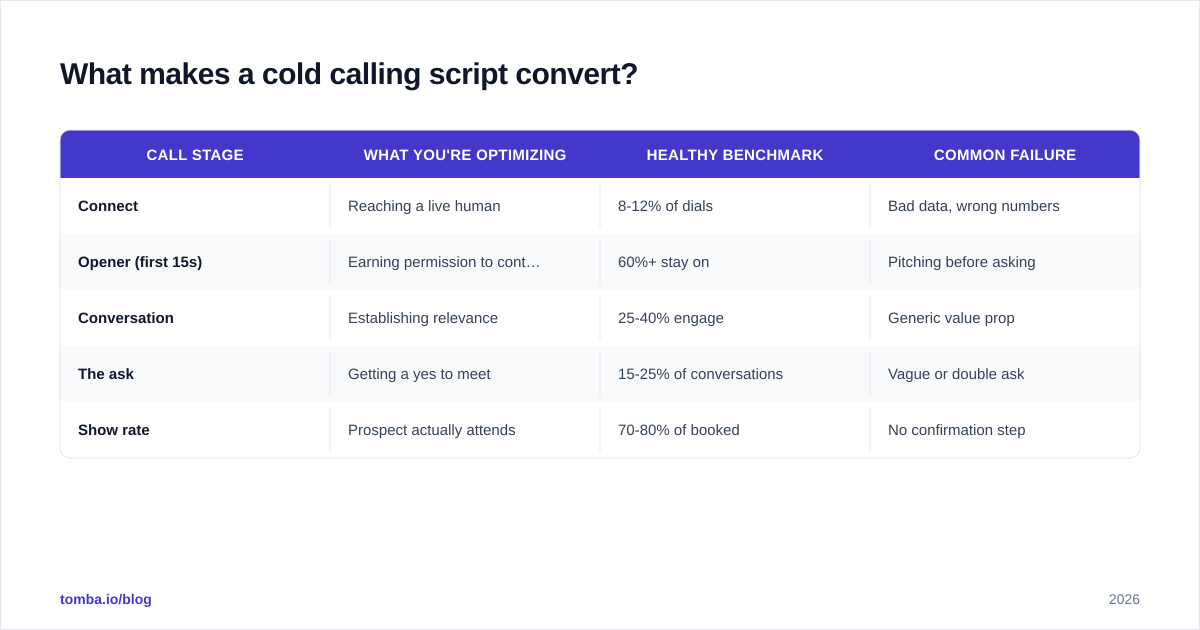
Here is how those stages map to the numbers you should be watching.
| Call stage | What you're optimizing | Healthy benchmark | Common failure |
|---|---|---|---|
| Connect | Reaching a live human | 8-12% of dials | Bad data, wrong numbers |
| Opener (first 15s) | Earning permission to continue | 60%+ stay on | Pitching before asking |
| Conversation | Establishing relevance | 25-40% engage | Generic value prop |
| The ask | Getting a yes to meet | 15-25% of conversations | Vague or double ask |
| Show rate | Prospect actually attends | 70-80% of booked | No confirmation step |
Notice connect rate sits at the top. The best appointment setting cold calling scripts in the world do nothing if you're dialing dead numbers. Clean, current direct-dial data is the multiplier on every other stage — which is why teams pair their dialer with a reliable phone finder and run lists through a phone validator before a campaign rather than burning live conversations on bad records.
Which appointment setting cold calling scripts actually work?#
Here are seven scripts. Read them out loud once, then make them yours — verbatim delivery sounds like verbatim delivery.
1. The cold prospect (no prior relationship)#
"Hi [Name], this is [You] from [Company]. I'll be honest — this is a cold call. Can I take 30 seconds to tell you why I called, and you can tell me to get lost if it's off base?
(pause for yes)
Great. We work with [role] at [similar companies] who are dealing with [specific pain — e.g., reps wasting half their day on bad-fit leads]. I'm not sure that's even a problem for you, which is why I'm calling. Worth a quick 20 minutes next week to find out?"
The "tell me to get lost" line is the pattern interrupt and permission rolled into one. The "I'm not sure that's a problem for you" is reverse psychology that invites them to qualify themselves in.
2. The referral warm-up#
"Hi [Name], [Referrer] suggested I reach out — we just helped their team [specific result]. They thought you might be wrestling with the same thing. Do you have 30 seconds for me to explain, or should I find a better time?"
Leading with the referrer's name is your strongest relevance hook. Use it in the first sentence, not buried in the third.
3. The inbound follow-up#
"Hi [Name], I saw you downloaded our [asset] / signed up for [thing]. I'm not calling to pitch — I'm calling to ask one question: what made you grab that? (listen) That's exactly what we help with. Can I show you how in 15 minutes Thursday?"
Inbound leads earned the call. Acknowledge the action, ask why, then book.
4. The voicemail (yes, leave one)#
"Hi [Name], it's [You] at [Company], my number is [number]. I called about [specific, one-line reason relevant to them]. I'll try you again [day], but if it's easier, grab a slot at [link]. Again, [number]. Thanks [Name]."
Keep it under 20 seconds. Say your number slowly, twice. Most voicemails fail because the rep mumbles the callback number once at warp speed.
5. The gatekeeper#
"Hi, I'm hoping you can help me — I need to reach whoever owns [function] at [Company]. I'm not 100% sure I've got the right person, what's the best way to get 10 minutes on their calendar?"
Treat the gatekeeper as an ally, not an obstacle. "Hoping you can help me" flips the dynamic.
6. The re-engagement (gone quiet)#
"Hi [Name], we talked back in [month] about [topic] and the timing wasn't right. I'm calling because [new trigger — funding, product launch, hire]. Has anything changed on your end that'd make a quick conversation worth it now?"
Timing objections aren't no — they're "not yet." A trigger event resets the clock.
7. The event / webinar lead#
"Hi [Name], we met at [event] / you joined our session on [topic]. You asked about [detail if you have it]. I wanted to keep that going — are you free for 20 minutes [day] to pick up where we left off?"
Specificity proves you remember them. "We met at the event" is weak; "you asked about integration timelines" is strong.

How do you handle the four objections that kill most calls?#
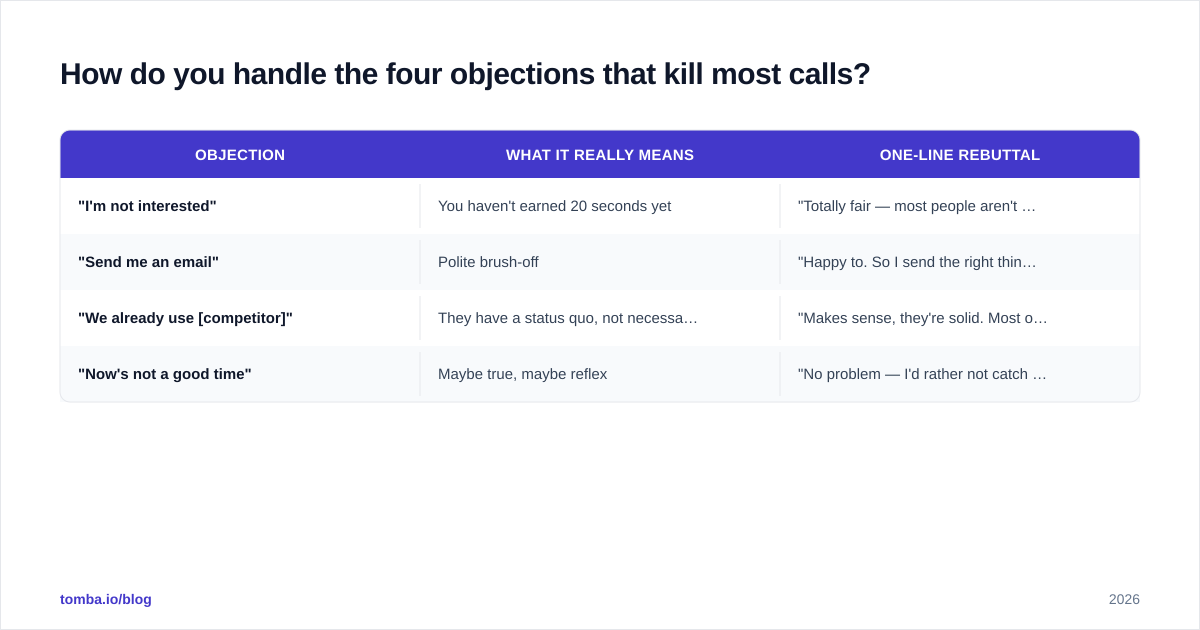
Objections mean the prospect is still on the line. Silence is the real enemy. Memorize one rebuttal per objection so you never freeze.
| Objection | What it really means | One-line rebuttal |
|---|---|---|
| "I'm not interested" | You haven't earned 20 seconds yet | "Totally fair — most people aren't until they hear the one thing I called about. Can I give it to you in a sentence?" |
| "Send me an email" | Polite brush-off | "Happy to. So I send the right thing and not spam — is [pain] something on your radar this quarter?" |
| "We already use [competitor]" | They have a status quo, not necessarily love | "Makes sense, they're solid. Most of our clients came from them — can I share the one gap they ran into? Worth 15 minutes." |
| "Now's not a good time" | Maybe true, maybe reflex | "No problem — I'd rather not catch you mid-fire-drill. Is Thursday morning or afternoon cleaner?" |
The pattern across all four: acknowledge, then pivot to a small ask. Never argue. You're not trying to win the objection; you're trying to keep the conversation alive long enough to book.
For deeper context on what "good" looks like over a full campaign, study your response rate alongside call metrics — a phone script and a follow-up email sequence should reinforce each other, not compete. The U.S. Federal Trade Commission's telemarketing rules are also worth a read if you're calling at scale, especially around Do-Not-Call compliance.
How should you prep before you dial?#
The call is 20% of the work. The list is 80%. Reps who "smile and dial" through a stale CSV will lose to reps who spend 30 minutes prepping a clean, researched list.
A tight pre-call routine:
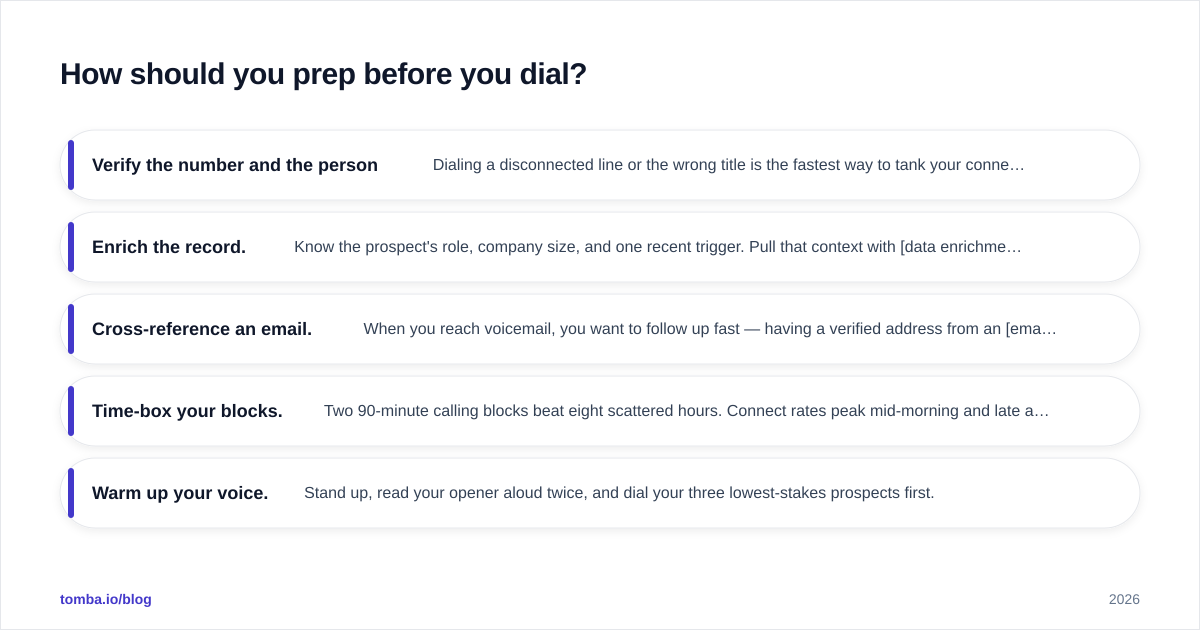
- Verify the number and the person. Dialing a disconnected line or the wrong title is the fastest way to tank your connect rate. Build your direct-dial list with a phone finder, then confirm reachability before the session.
- Enrich the record. Know the prospect's role, company size, and one recent trigger. Pull that context with data enrichment so every opener has a real relevance hook instead of a generic one.
- Cross-reference an email. When you reach voicemail, you want to follow up fast — having a verified address from an email finder means your "I'll send a slot" voicemail is backed by an actual email in their inbox within the hour.
- Time-box your blocks. Two 90-minute calling blocks beat eight scattered hours. Connect rates peak mid-morning and late afternoon in the prospect's timezone.
- Warm up your voice. Stand up, read your opener aloud twice, and dial your three lowest-stakes prospects first.
This is also where pricing reality matters. If you're equipping a team, you want data tooling that scales without per-seat surprises — see Tomba pricing for how credit-based plans compare to per-contact dialers. For broader cold-calling vendor comparisons, G2's sales engagement category is a neutral starting point.
How do you measure whether your scripts are working?#
You can't improve what you average together. Break the funnel into discrete rates and fix the weakest one.
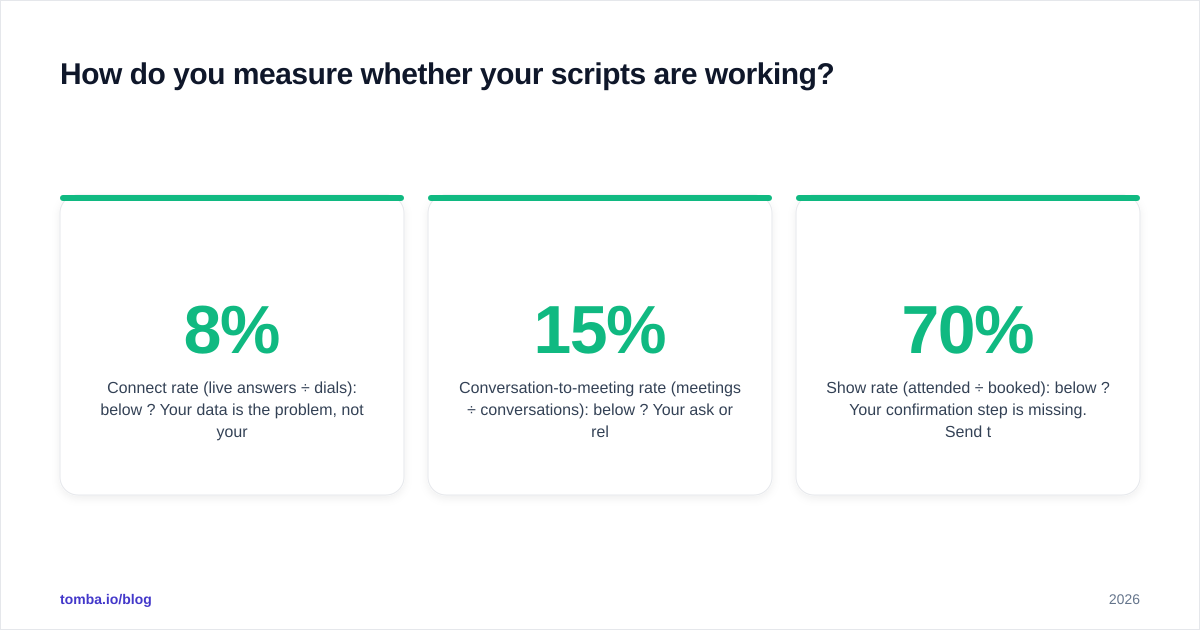
- Connect rate (live answers ÷ dials): below 8%? Your data is the problem, not your script. Re-verify numbers.
- Conversation-to-meeting rate (meetings ÷ conversations): below 15%? Your ask or relevance hook is weak. A/B test openers.
- Show rate (attended ÷ booked): below 70%? Your confirmation step is missing. Send the invite on the call and a reminder the morning of.
- Meetings per hour: the north-star efficiency metric. Track it per rep and per script.
Run one script change at a time for a full week before judging it. Swapping your opener and your objection rebuttal in the same week tells you nothing about which one moved the number. According to HubSpot's sales research, it takes an average of multiple touches to connect — so a single bad day isn't a verdict on your script.
The reps who win at appointment setting aren't the ones with the slickest pitch. They're the ones with clean lists, a tight five-part frame, memorized rebuttals, and the discipline to measure each stage separately.
Ready to dial better lists?#
Great scripts die on bad data. Before your next calling block, build a verified, enriched list of decision-makers with real direct dials and confirmed emails — so every connection counts and every voicemail has a fast email follow-up. Start with the Tomba Email Finder to pair each phone number with a verified contact, layer in the phone finder for direct dials, and you'll spend your calling hours talking to the right people instead of chasing dead numbers. Your scripts are ready — now give them an audience worth pitching.
// get started
Find, verify and enrich your first contacts today
Start on the free plan with 25 searches a month, then scale when your team is ready.
Free plan · No credit card required · GDPR & CCPA
// about the author