Appointment Setting Companies: 2026 Buyer's Guide & Costs
A neutral breakdown of how appointment setting companies work, what they cost in 2026, and when to outsource versus build an in-house SDR team.
TL;DR
- Appointment setting companies book qualified sales meetings on your behalf, usually charging $3,000–$10,000/month on retainer or $150–$400 per booked meeting.
- They make sense when you need pipeline fast, lack SDR headcount, or want to test a new market before committing to hiring.
- The biggest risk is low-quality meetings: "showed up but never a fit." Pay-per-appointment models hide this cost.
- Vet on lead-list ownership, data accuracy, ramp time, and how "qualified" is defined in writing — not on logo walls.
- Hybrid setups win in 2026: an agency drives volume while your own tooling (an email finder plus a verified list) keeps data clean and costs down.
What are appointment setting companies?#
An appointment setting company is an outsourced team that does the top-of-funnel grind for you: building target lists, sending cold emails, dialing prospects, working LinkedIn, and qualifying interest until a meeting lands on your AE's calendar. You pay them; they hand you booked calls.
Think of it like hiring a fishing charter instead of buying your own boat. You skip the capital outlay, the licensing, and the learning curve. You show up, the captain knows where the fish are, and you reel in what they put in front of you. The catch — pun intended — is that you're trusting their map. If their "fishing spots" are stale lists scraped two years ago, you spend the day pulling up empty hooks while still paying for fuel.
Technically, these firms operate as an extension of your sales development function. Most blend three motions:
- Outbound prospecting — cold email sequences and cold calls to net-new accounts.
- Inbound qualification — following up on your marketing-qualified leads so AEs only talk to ready buyers.
- List building and enrichment — finding contacts, titles, and verified emails before any outreach starts.
The category overlaps heavily with outbound sales strategy and lead generation, but the deliverable is narrower and more measurable: a scheduled, qualified meeting.
How do appointment setting companies actually work?#
The workflow is more standardized than most vendors admit. Almost every reputable firm runs some version of this five-step loop:
- Onboarding and ICP definition. You define the ideal customer profile, disqualifiers, and what "qualified" means. This step decides 80% of your outcome — vague ICPs produce vague meetings.
- List building. They source contacts matching the ICP. Quality here varies wildly. The best firms verify every email and phone number; the worst recycle a generic database.
- Messaging and sequencing. Multi-channel cadences — email, phone, LinkedIn — get built and A/B tested. Expect 8–14 touches per prospect.
- Outreach and qualification. Reps run the cadence, handle objections, and confirm budget, authority, need, and timeline (or a lighter framework) before booking.
- Handoff and reporting. The meeting hits your calendar with notes; you get weekly dashboards on sends, replies, booked rate, and show rate.
The quiet failure point is step 2. If a firm blasts a dirty list, your domain reputation tanks and your booked meetings shrink. This is why email deliverability and list hygiene matter as much as the script. A good partner verifies contacts before sending; if they can't explain how, that's a red flag.
What do appointment setting companies cost in 2026?#
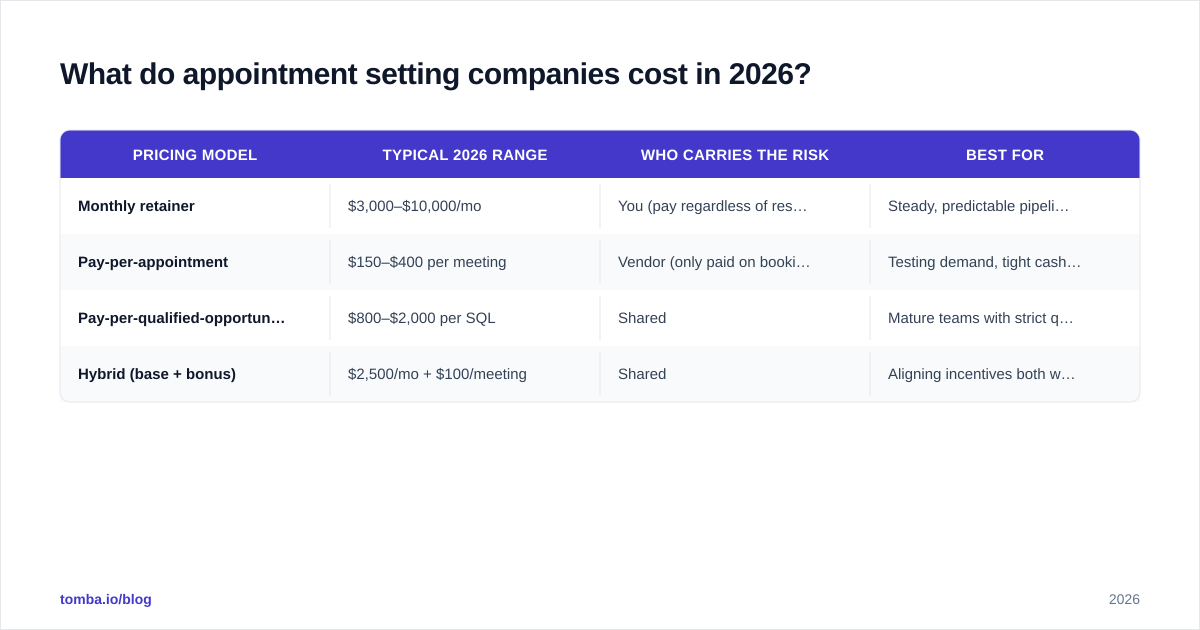
Pricing falls into three models, each with a different risk profile.
| Pricing model | Typical 2026 range | Who carries the risk | Best for |
|---|---|---|---|
| Monthly retainer | $3,000–$10,000/mo | You (pay regardless of results) | Steady, predictable pipeline at scale |
| Pay-per-appointment | $150–$400 per meeting | Vendor (only paid on booking) | Testing demand, tight cash flow |
| Pay-per-qualified-opportunity | $800–$2,000 per SQL | Shared | Mature teams with strict qualification |
| Hybrid (base + bonus) | $2,500/mo + $100/meeting | Shared | Aligning incentives both ways |
Retainers look expensive but often produce cheaper meetings at volume, because the vendor isn't tempted to book weak calls just to trigger a fee. Pay-per-appointment looks safe but creates a perverse incentive: the firm gets paid for a meeting that shows up, not one that converts. You can end up with a packed calendar and an empty pipeline.
Compare that to building in-house. A single SDR in North America runs roughly $5,000–$7,000/month fully loaded (salary, tools, management), and takes 2–3 months to ramp. Two SDRs plus a manager and a tool stack easily clears $20,000/month before a single meeting books. The outsourced math gets attractive fast when you need pipeline this quarter, not next year. For context on tooling costs you'd carry either way, the Tomba pricing page shows how data spend scales independently of headcount.
Is outsourcing appointment setting better than building in-house?#
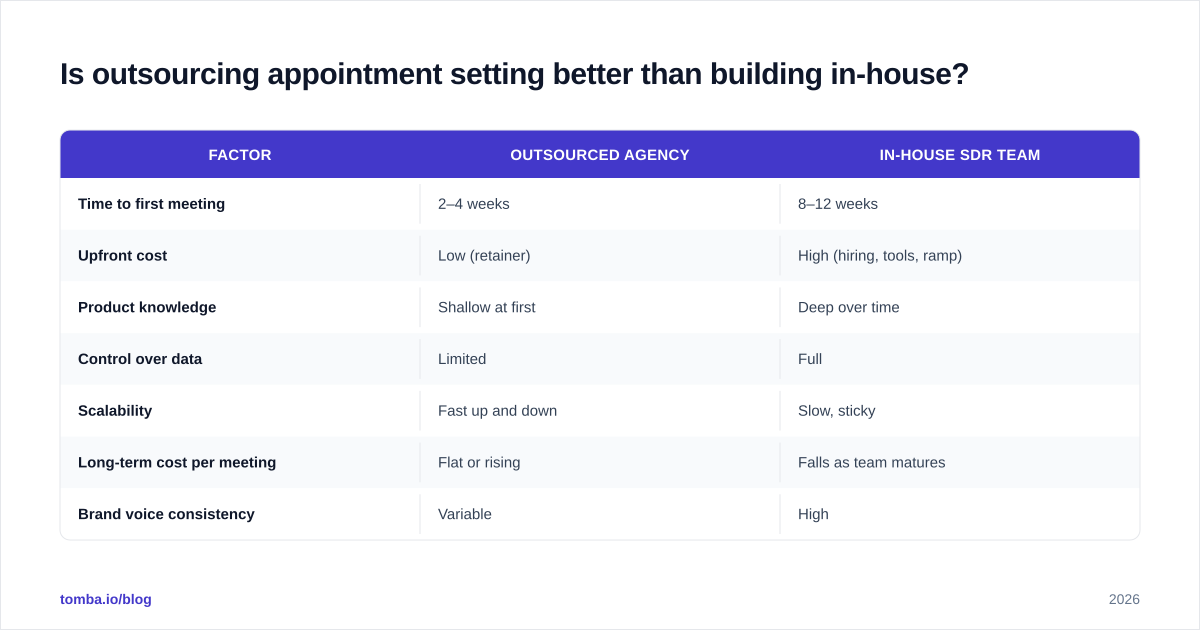
Neither wins universally — it depends on your stage, margin, and how defensible your messaging is. Here's the honest trade-off.
| Factor | Outsourced agency | In-house SDR team |
|---|---|---|
| Time to first meeting | 2–4 weeks | 8–12 weeks |
| Upfront cost | Low (retainer) | High (hiring, tools, ramp) |
| Product knowledge | Shallow at first | Deep over time |
| Control over data | Limited | Full |
| Scalability | Fast up and down | Slow, sticky |
| Long-term cost per meeting | Flat or rising | Falls as team matures |
| Brand voice consistency | Variable | High |
Outsource when speed matters more than depth — entering a new vertical, validating a market, or covering a gap while you hire. Build in-house when your sale is complex, your messaging is a competitive asset, or you're committed to a market for years. Many teams run both: agencies handle volume plays and new segments, in-house reps own strategic accounts and anything requiring real product fluency.
A subtle point most guides miss: the data layer should be yours either way. If an agency owns the list and you part ways, you walk away with nothing. Keeping enrichment in your own stack — through a domain search or bulk verification tool — means the contact data is an asset you retain, not a hostage.
How do you vet appointment setting companies?#
Skip the case studies and logos — every vendor has a polished deck. Ask questions that expose how they actually operate.
On data and lists:
- Where do your contact lists come from, and do you verify emails before sending?
- What's your bounce rate, and what happens to my domain reputation if it spikes?
- Do I own the list and the data after we stop working together?
On qualification:
- Define "qualified" in writing. What gets a meeting booked versus rejected?
- What's your historical show rate, and how do you handle no-shows?
- Who actually runs the calls — dedicated reps or a shared pool across clients?
On performance:
- What's the realistic ramp time before meetings flow?
- Can I see anonymized reporting from a similar client?
- How do you A/B test messaging, and how often do scripts change?
On the contract:
- What's the minimum term and the exit clause?
- Are meetings guaranteed, and what's the make-good policy for unqualified ones?
A firm that answers crisply on data hygiene and qualification — and pushes back on unrealistic expectations — is usually the better partner. One that promises "50 qualified meetings in month one" without seeing your ICP is selling you a number, not a result. According to G2's category reviews, the most common complaint across appointment setting vendors is exactly this: meetings that technically count but never convert.
What separates a good booked meeting from a wasted one?#
A booked meeting is only valuable if the prospect is real, reachable, and a genuine fit. Three things drive that, and all three trace back to data quality before outreach even starts.
First, accurate contact data. If the email bounces or the phone number is dead, the meeting never happens — and your sender reputation absorbs the damage. Verifying contacts with an email verifier before the cadence runs is the cheapest insurance in the funnel.
Second, right-person targeting. Booking a meeting with someone who can't sign or influence the deal wastes your AE's time. Title and seniority filtering during list building prevents this.
Third, honest qualification. A meeting where the prospect "agreed to learn more" under sales pressure is noise. Real qualification confirms a problem worth solving and a timeline to solve it. This is where the cheap pay-per-meeting model often breaks down.
The teams that get the most from appointment setting — outsourced or in-house — treat the contact database as the foundation. HubSpot's research on outbound performance, summarized in their sales statistics roundup, consistently shows that data accuracy and targeting beat volume. More sends to bad data just burns your domain faster.
When should you skip appointment setting companies entirely?#
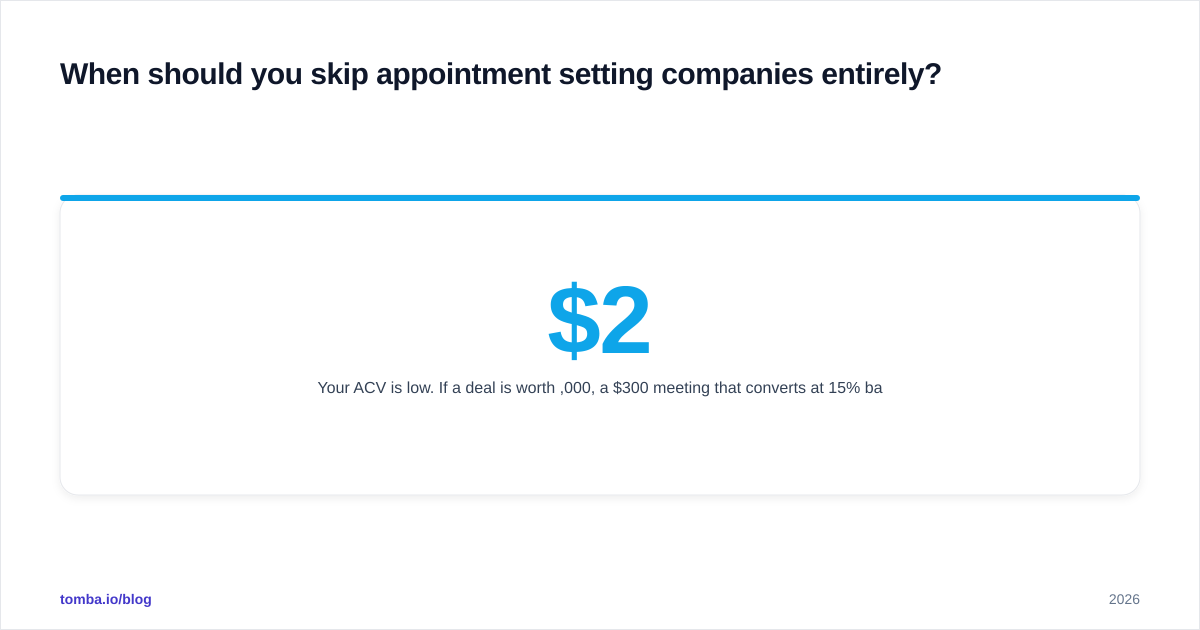
Outsourcing isn't always the answer. Skip it when:
- Your ACV is low. If a deal is worth $2,000, a $300 meeting that converts at 15% barely breaks even. Self-serve or product-led motions fit better.
- Your messaging isn't validated. Agencies amplify what you give them. If you don't yet know what resonates, you'll pay them to fail faster. Nail product-market fit first.
- You have spare SDR capacity. If your reps aren't fully booked, adding an agency creates lead conflict and double-touches that annoy prospects.
- Compliance is strict. In heavily regulated industries, you may need tighter control over every touchpoint than a third party can offer.
In these cases, a lean in-house motion powered by good tooling often outperforms. You can build targeted lists with a bulk email finder, verify them, and run sequences yourself for a fraction of an agency retainer — keeping full control of voice, data, and compliance.
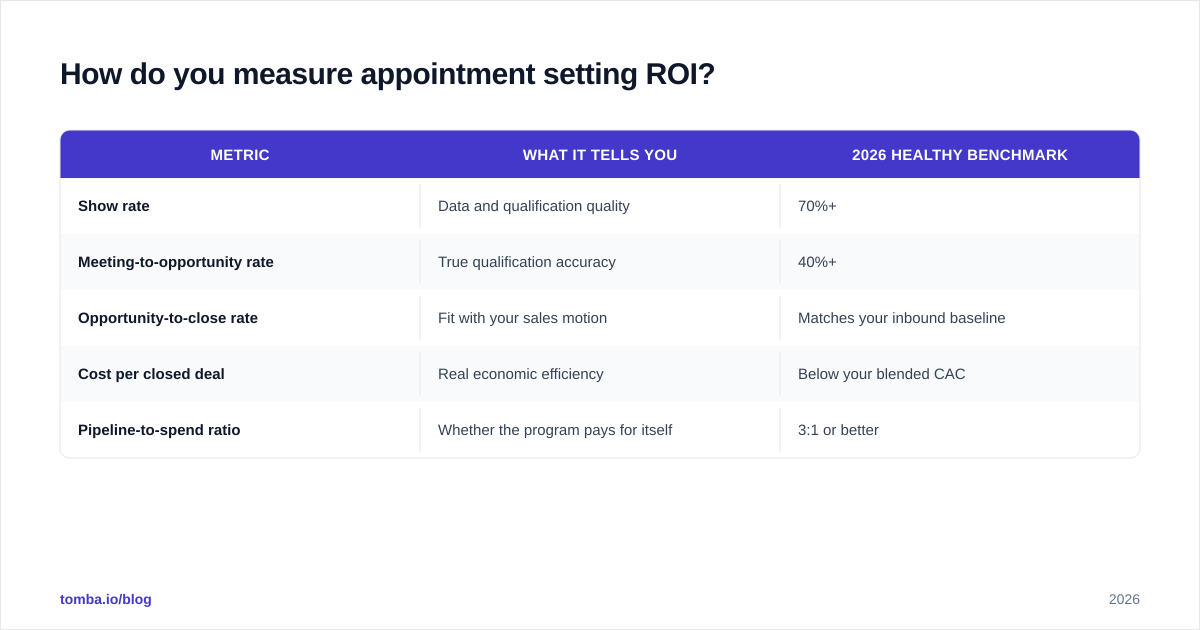
How do you measure appointment setting ROI?#
Track the full chain, not just the vanity metric of "meetings booked." A useful scorecard:
| Metric | What it tells you | 2026 healthy benchmark |
|---|---|---|
| Show rate | Data and qualification quality | 70%+ |
| Meeting-to-opportunity rate | True qualification accuracy | 40%+ |
| Opportunity-to-close rate | Fit with your sales motion | Matches your inbound baseline |
| Cost per closed deal | Real economic efficiency | Below your blended CAC |
| Pipeline-to-spend ratio | Whether the program pays for itself | 3:1 or better |
Watch show rate and meeting-to-opportunity rate together. A 90% show rate with a 10% opportunity rate means the firm is booking warm bodies, not buyers. The reverse — lower show rate but high opportunity conversion — usually signals stricter, more honest qualification, which is what you want. Tie every number back to your own win rate so you can compare outsourced pipeline against your in-house baseline on equal footing.
The bottom line#
Appointment setting companies are a speed-and-scale tool, not a magic pipeline machine. They earn their fee when you need meetings faster than you can hire, when you're testing a new market, or when you want to free AEs to sell instead of prospect. They waste your money when your messaging is unproven, your ACV is thin, or you let a vendor define "qualified" loosely.
Whichever path you choose, own your data layer. The contact list is the one asset that outlives any agency relationship — and the one most responsible for whether a booked meeting is gold or garbage. Build your prospecting lists on verified, accurate data with the Tomba Email Finder: find professional emails by name, company, or domain, verify them before you send, and keep the database yours no matter who books the meeting. Start on the free tier with 25 searches a month, and scale to the Starter plan at $49/month when your pipeline demands it.
// get started
Find, verify and enrich your first contacts today
Start on the free plan with 25 searches a month, then scale when your team is ready.
Free plan · No credit card required · GDPR & CCPA
// about the author