Appointment Setting Goals: How to Set & Hit Them in 2026
A practical framework for setting realistic appointment setting goals, the KPIs that actually predict booked meetings, and how to hit your targets in 2026.
Appointment setting goals are the single biggest lever between "we made a lot of calls" and "we filled the pipeline." Set them wrong and your reps burn out chasing vanity numbers. Set them right and every dial, email, and LinkedIn touch ladders up to revenue you can forecast.
This guide gives you the math, the benchmarks, and the framework to set appointment setting goals your team can actually hit in 2026 — without guessing.
TL;DR#
- Appointment setting goals are measurable targets for the number and quality of qualified meetings your reps book in a given period — not raw activity counts.
- Work backward from revenue: pipeline target → meetings needed → activity required. Never start from "how many calls can a rep make?"
- Track a small KPI set: meetings booked, show-up rate, meeting-to-opportunity rate, and cost per booked meeting. Skip vanity metrics.
- Realistic 2026 benchmarks: 8–15 booked meetings per SDR per week, 60–75% show-up rate, 30–40% meeting-to-opportunity conversion.
- Tooling matters: accurate contact data, a clean CRM, and a tight follow-up cadence can lift booked meetings 20–40% without adding headcount.
What are appointment setting goals?#
Appointment setting goals are the specific, time-bound targets you set for booking qualified sales meetings. Think of them like a thermostat for your pipeline: instead of hoping the room warms up, you set the number you need and let activity adjust to hit it.
A weak goal sounds like "make more calls." A real appointment setting goal sounds like "book 12 qualified discovery meetings per SDR per week, with at least a 65% show-up rate, that convert to pipeline at 35%."
Notice the difference. The second version has three properties every good goal needs:
- A volume number (12 meetings) so reps know the target.
- A quality gate (qualified, 65% show-up) so they don't game it with junk bookings.
- A downstream link (35% to pipeline) so the goal ties to revenue, not activity for its own sake.
If you only measure volume, you get what you measure: a calendar full of no-shows and unqualified prospects who waste your AEs' time.

Why do appointment setting goals matter in 2026?#
Because buyers are harder to reach and reps are more expensive than ever. Connect rates on cold calls have slid for years, inboxes are noisier, and the cost of a fully loaded SDR keeps climbing. You can't afford to point that expensive activity at the wrong target.
Clear appointment setting goals do three things for a modern sales org:
- They make pipeline predictable. When you know your conversion math, a meeting target becomes a revenue forecast you can defend in a board meeting.
- They protect rep morale. Reps quit when goals feel arbitrary. A goal derived from real conversion data feels fair and achievable.
- They expose process gaps fast. If show-up rates crater, you know the problem is confirmation cadence, not effort. Goals turn vague frustration into a diagnosable funnel.
According to HubSpot's sales research, the highest-performing teams are the ones that align activity metrics with outcomes — not the ones that simply do more. Goals are how that alignment happens.
How do you set realistic appointment setting goals?#
Work backward from revenue, never forward from activity. This is the mistake that sinks most quota-setting exercises: a manager asks "how many dials can a rep make?" and multiplies up. That produces a number disconnected from what the business actually needs.
Instead, run the reverse-funnel math:
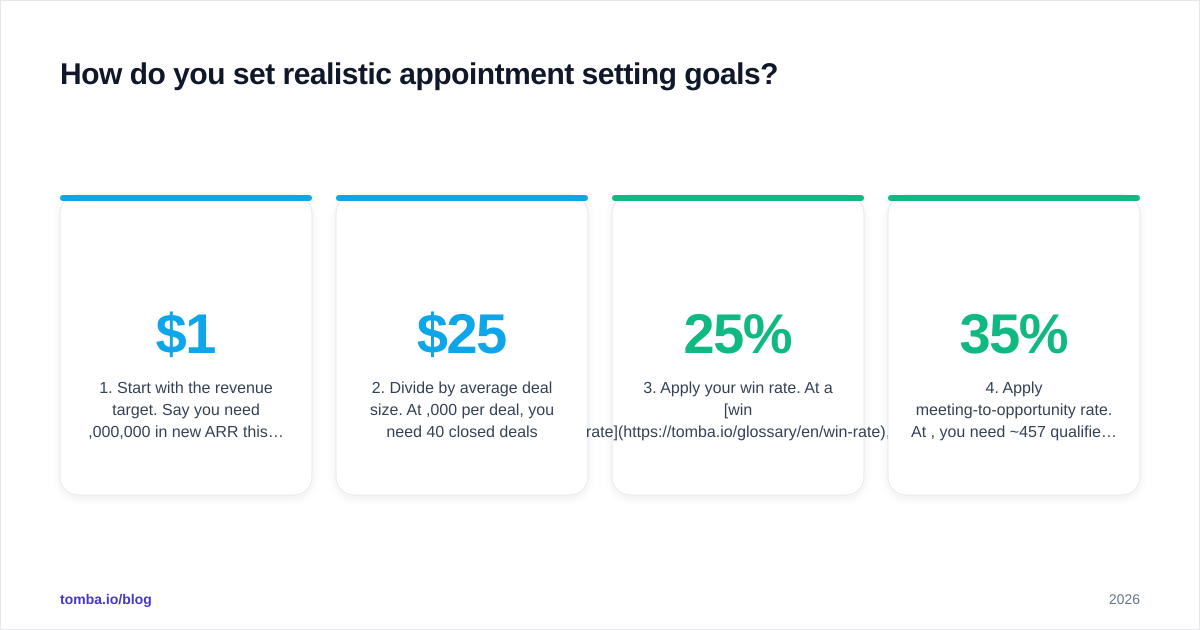
Here is the framework step by step:
- Start with the revenue target. Say you need $1,000,000 in new ARR this quarter.
- Divide by average deal size. At $25,000 per deal, you need 40 closed deals.
- Apply your win rate. At a 25% win rate, you need 160 opportunities.
- Apply meeting-to-opportunity rate. At 35%, you need ~457 qualified meetings.
- Account for no-shows. At a 65% show-up rate, you must book ~703 meetings.
- Divide across reps and weeks. With 6 SDRs over 13 weeks, that's ~9 booked meetings per rep per week.
Now you have a goal grounded in the only number that matters: revenue. If 9 per week is unrealistic for your motion, you don't lower the revenue target arbitrarily — you fix an upstream conversion rate, add headcount, or improve data quality so each touch converts better.
The same math works in reverse for diagnosing a miss. If a rep books their 9 meetings but pipeline doesn't grow, the leak isn't volume — it's qualification or show-up rate.
What KPIs should you track for appointment setting goals?#
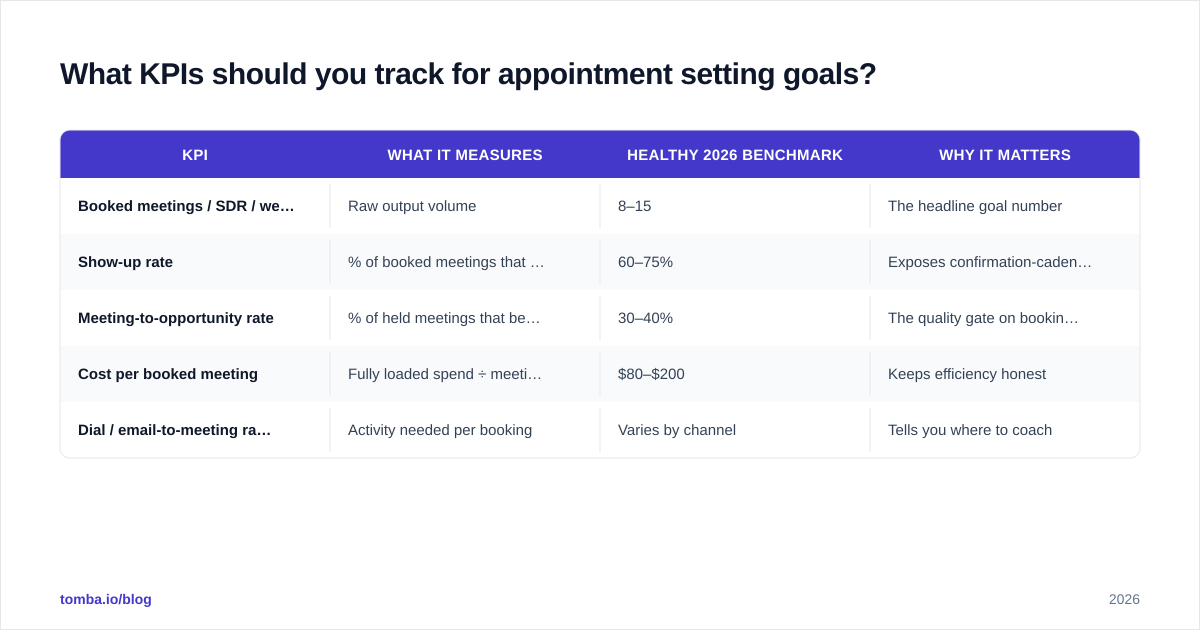
Track a small set that predicts revenue, not a dashboard of 30 metrics nobody reads. These five carry the most signal:
| KPI | What it measures | Healthy 2026 benchmark | Why it matters |
|---|---|---|---|
| Booked meetings / SDR / week | Raw output volume | 8–15 | The headline goal number |
| Show-up rate | % of booked meetings that happen | 60–75% | Exposes confirmation-cadence gaps |
| Meeting-to-opportunity rate | % of held meetings that become pipeline | 30–40% | The quality gate on bookings |
| Cost per booked meeting | Fully loaded spend ÷ meetings | $80–$200 | Keeps efficiency honest |
| Dial / email-to-meeting ratio | Activity needed per booking | Varies by channel | Tells you where to coach |
A quick rule: if a metric can't be tied to either more pipeline or less waste, it's a vanity metric. "Total dials" feels productive but tells you nothing on its own — 300 dials that book zero meetings is a problem, not an achievement.
To track these well you need clean data in your CRM. Bad records inflate your activity numbers (reps dialing dead numbers) and crush your show-up rate (meetings booked with the wrong contact). Garbage in, garbage goals.
What are realistic appointment setting benchmarks?#
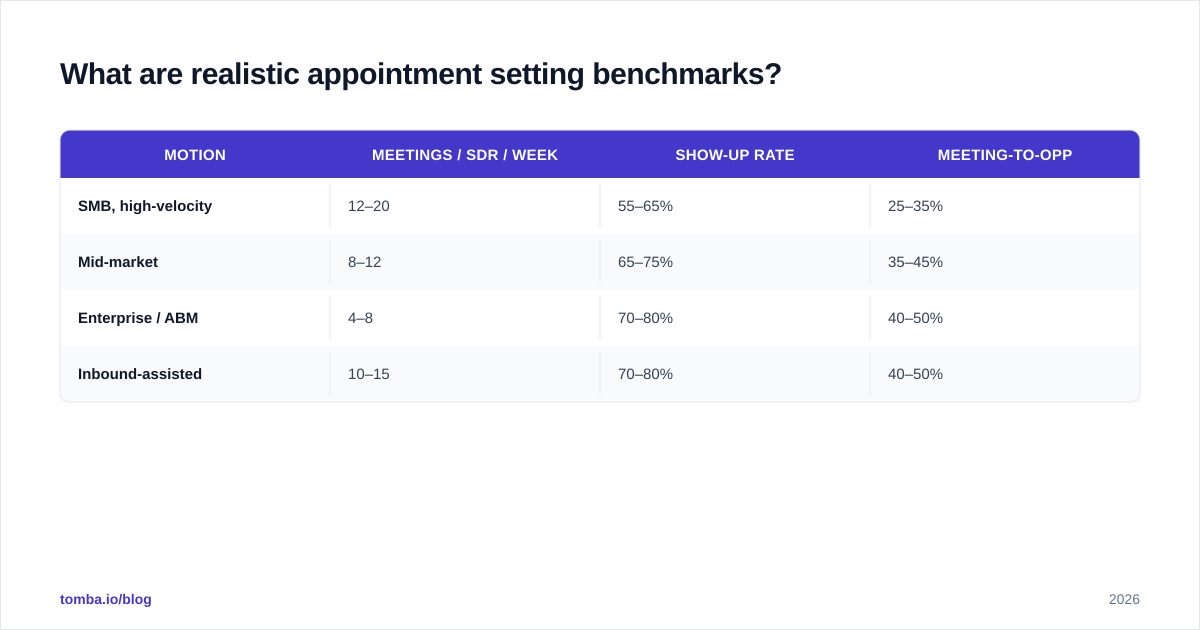
Benchmarks vary by motion, deal size, and channel, but these ranges hold for most B2B teams in 2026. Use them as guardrails, then calibrate to your own historical data within 60–90 days.
| Motion | Meetings / SDR / week | Show-up rate | Meeting-to-opp |
|---|---|---|---|
| SMB, high-velocity | 12–20 | 55–65% | 25–35% |
| Mid-market | 8–12 | 65–75% | 35–45% |
| Enterprise / ABM | 4–8 | 70–80% | 40–50% |
| Inbound-assisted | 10–15 | 70–80% | 40–50% |
Notice the inverse relationship: as you move upmarket, volume drops but quality climbs. An enterprise SDR booking 5 meetings a week that convert at 45% is outperforming an SMB rep booking 18 that convert at 25%. This is exactly why a volume-only goal misleads — it punishes your most valuable reps.
If you're a new team without historical data, start at the conservative end of each range and ratchet up as your conversion data stabilizes. Setting a stretch goal before you know your real funnel just manufactures a guaranteed miss.

How do you actually hit your appointment setting goals?#
Goals don't book meetings — process does. Once the target is set, four operational levers determine whether you hit it.
1. Feed reps accurate contact data#
Every minute a rep spends on a wrong number or bounced email is a minute not spent booking. Connect rates and deliverability both depend on data quality. Use a verified email finder and a reliable phone finder so your team dials live numbers and emails real inboxes — not stale records scraped two years ago.
2. Run a true multi-channel cadence#
No single channel hits target alone anymore. The teams that win sequence phone, email, and LinkedIn together over 10–14 touches. Phone gets the conversation; email confirms; LinkedIn builds familiarity so the cold call isn't fully cold.
3. Defend your show-up rate#
A booked meeting that doesn't happen is worse than no meeting — it cost you the booking effort and an AE's blocked calendar slot. Send a same-day confirmation, a value-add reminder 24 hours out, and a morning-of nudge. This alone often lifts show-up rates 10–15 points.
4. Close the feedback loop weekly#
Review the funnel every week, not every quarter. If booked meetings are on target but response rate is sliding, your messaging is fatiguing. If show-up is dropping, fix the confirmation cadence. Weekly review turns a missed goal into a one-week course correction instead of a end-of-quarter surprise.
What tools help you reach appointment setting goals?#
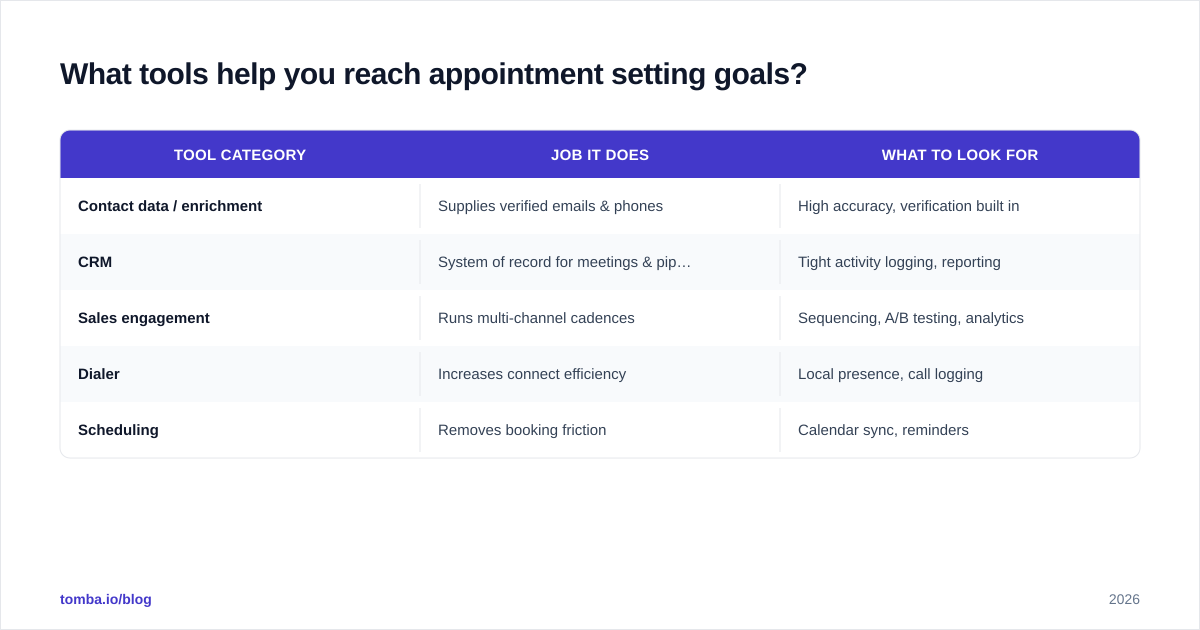
The right stack removes friction from each step of the funnel. You don't need 20 tools — you need clean data, a system of record, and a way to execute cadences. Here's how the core categories stack up:
| Tool category | Job it does | What to look for |
|---|---|---|
| Contact data / enrichment | Supplies verified emails & phones | High accuracy, verification built in |
| CRM | System of record for meetings & pipeline | Tight activity logging, reporting |
| Sales engagement | Runs multi-channel cadences | Sequencing, A/B testing, analytics |
| Dialer | Increases connect efficiency | Local presence, call logging |
| Scheduling | Removes booking friction | Calendar sync, reminders |
Data quality sits at the foundation. Tools like Salesforce and HubSpot give you the system of record, but they're only as good as the contacts you load into them. That's where enrichment matters: piping verified contact data and data enrichment into your CRM means your reps spend their hours talking to real prospects, not chasing bad records. You can compare vendor options on a marketplace like G2 before committing.
What are the most common appointment setting goal mistakes?#
Avoid these and you're ahead of most teams:
- Goaling on activity alone. "Make 100 dials a day" optimizes for noise. Goal on booked qualified meetings and let activity follow.
- Ignoring show-up rate. Teams celebrate bookings and never check how many actually happen. A 50% show-up rate quietly halves your real output.
- Setting goals from gut feel. Without reverse-funnel math, your number is a wish. Derive it from revenue and conversion data.
- Never recalibrating. Your funnel changes as markets and messaging shift. Revisit benchmarks every quarter.
- Tolerating dirty data. Stale contacts inflate activity and crush conversion. Clean, verified data is the cheapest performance boost available.
- No qualification standard. Without a clear definition of "qualified," reps book anyone to hit the number — and your AEs pay for it.
The thread connecting all six: appointment setting goals fail when they drift from revenue. Keep every target tied to a downstream outcome and the whole system stays honest.
How often should you review and reset goals?#
Review weekly, reset quarterly. The weekly review is operational — spot leaks early and coach in the moment. The quarterly reset is strategic — update your benchmarks with the last 90 days of real conversion data so next quarter's goals reflect reality, not last year's assumptions.
When you reset, change one variable at a time where possible. If you simultaneously raise the meeting target, switch messaging, and add a new channel, you'll never know what moved the number. Treat goal-setting like an experiment with a control.
Conclusion: turn goals into booked pipeline#
Appointment setting goals work when they're built backward from revenue, gated on quality, and reviewed often enough to correct course. Set a volume number, defend it with a show-up and conversion standard, and feed your reps the clean data they need to execute — that's the whole game.
The fastest fix most teams overlook is data quality. If half your reps' touches land on dead numbers and bounced emails, no goal-setting framework will save you. Start by giving your team accurate, verified contacts: use the Tomba Email Finder to find professional emails by name, domain, or company, verify them before they hit your sequence, and watch connect rates — and booked meetings — climb. Check the Tomba pricing plans, from the free tier to scale, and give your appointment setters a fighting chance at hitting their number.
// get started
Find, verify and enrich your first contacts today
Start on the free plan with 25 searches a month, then scale when your team is ready.
Free plan · No credit card required · GDPR & CCPA
// about the author