Appointment Setting Over The Phone: 2026 Playbook
A practical 2026 guide to appointment setting over the phone: scripts, call structure, KPIs, and the tech stack that books more qualified meetings.
TL;DR
- Appointment setting over the phone is the discipline of turning a cold or warm contact into a booked, qualified meeting for a closer — measured in meetings held, not dials made.
- The call that books meetings follows a tight structure: pattern interrupt, permission, problem-anchored value, and a specific time ask. Improvising kills your connect-to-meeting rate.
- Good benchmarks in 2026: 5-8% dials-to-conversation, 15-25% conversation-to-meeting, and a 60-75% meeting-held rate after confirmation.
- The phone fails when the data fails. A bad number or wrong title wastes the dial before you say a word, so accurate contact data is the cheapest lever you have.
- A lean stack — verified mobile numbers, a power dialer, a CRM, and a confirmation sequence — beats an expensive one that skips data quality.
What is appointment setting over the phone?#
Appointment setting over the phone is the job of getting a prospect to agree to a specific calendar slot with your sales team. Think of it like a restaurant host: the host doesn't cook the meal or take payment, but if nobody is seated, the kitchen has nothing to do. The appointment setter seats qualified diners so closers can cook.
That distinction matters because setters and closers are measured differently. A closer is judged on revenue and win rate. A setter is judged on qualified meetings held — a meeting that the prospect actually attends and that fits your ideal-customer profile. Booking 40 meetings where 30 no-show or were never a fit is worse than booking 12 that all show and convert.
Over the phone specifically means live voice — outbound cold calls, callbacks on inbound leads, and follow-ups on email or LinkedIn touches. Voice still converts because it compresses the buying conversation: you can handle three objections in ninety seconds that would take a week of email tag.
Why does the phone still beat email for booking meetings?#
Conclusion first: the phone wins on speed and objection-handling, not on volume. Email scales to thousands; a phone rep makes maybe 80-120 dials a day. But the conversations that happen are richer.
Three reasons the phone keeps earning its place in 2026:
- Real-time objection handling. When a prospect says "we already use a competitor," you can ask one question and reframe in the same breath. Email gives them an exit; the phone gives you a rebuttal.
- Tone carries trust. Buyers decide fast whether you sound like a peer or a telemarketer. That signal doesn't travel in text.
- Speed-to-lead. Calling an inbound lead within five minutes can lift contact rates several times over compared with calling an hour later. According to research summarized by HubSpot, response time is one of the strongest predictors of whether a lead ever converts.
The catch: the phone amplifies whatever data you feed it. Dial a disconnected number or the wrong decision-maker and you've burned the most expensive channel you own. That's why serious teams pair dialing with a clean source of numbers — more on the stack below.
What does a high-converting appointment-setting call look like?#
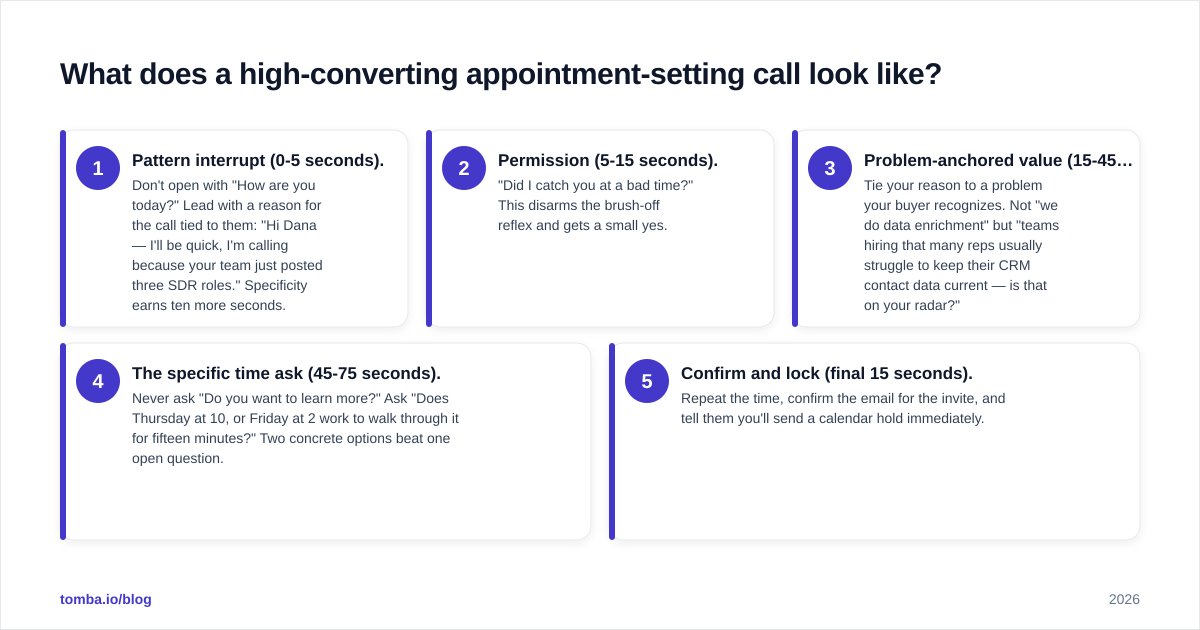
A booking call is a structure, not a script you read word for word. The structure keeps you in control while sounding human. Here is the five-part frame most top setters use.
- Pattern interrupt (0-5 seconds). Don't open with "How are you today?" Lead with a reason for the call tied to them: "Hi Dana — I'll be quick, I'm calling because your team just posted three SDR roles." Specificity earns ten more seconds.
- Permission (5-15 seconds). "Did I catch you at a bad time?" This disarms the brush-off reflex and gets a small yes.
- Problem-anchored value (15-45 seconds). Tie your reason to a problem your buyer recognizes. Not "we do data enrichment" but "teams hiring that many reps usually struggle to keep their CRM contact data current — is that on your radar?"
- The specific time ask (45-75 seconds). Never ask "Do you want to learn more?" Ask "Does Thursday at 10, or Friday at 2 work to walk through it for fifteen minutes?" Two concrete options beat one open question.
- Confirm and lock (final 15 seconds). Repeat the time, confirm the email for the invite, and tell them you'll send a calendar hold immediately.
The biggest mistake is skipping step 3 and jumping to the ask. Without a problem the prospect feels, the meeting is a favor — and favors no-show.
Want a quick subject line and opener to warm the contact before you dial? Tools like the subject line generator help you send a one-line pre-call email so your name isn't cold when the phone rings.
How do you handle the four objections that block every booking?#
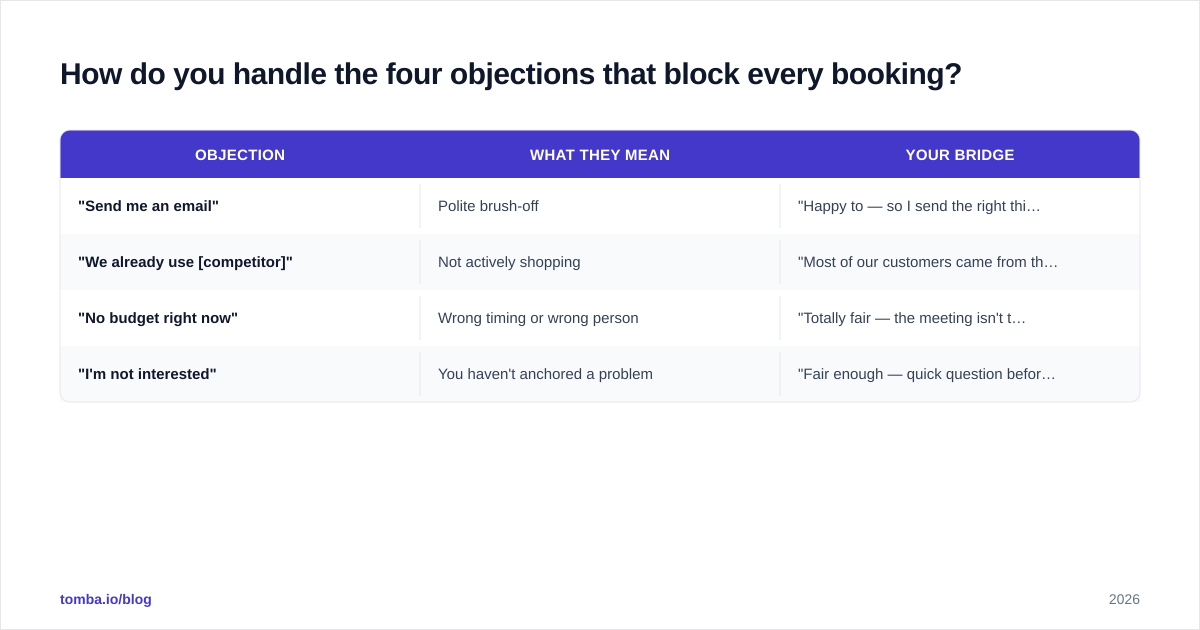
Most failed booking calls die on one of four objections. Memorize a one-line bridge for each.
| Objection | What they mean | Your bridge |
|---|---|---|
| "Send me an email" | Polite brush-off | "Happy to — so I send the right thing, are you the person who owns [problem], or should I loop in someone else?" |
| "We already use [competitor]" | Not actively shopping | "Most of our customers came from there. The one thing they switched for was [differentiator] — worth fifteen minutes to compare?" |
| "No budget right now" | Wrong timing or wrong person | "Totally fair — the meeting isn't to buy, it's to scope so you're ready when budget opens. Thursday or Friday?" |
| "I'm not interested" | You haven't anchored a problem | "Fair enough — quick question before I go: is [problem] something your team has already solved, or just not a priority this quarter?" |
The pattern across all four: acknowledge, ask one question, reframe toward the meeting. You're not arguing — you're keeping the conversation open long enough to find the real objection.
What KPIs and benchmarks should an appointment setter hit in 2026?#
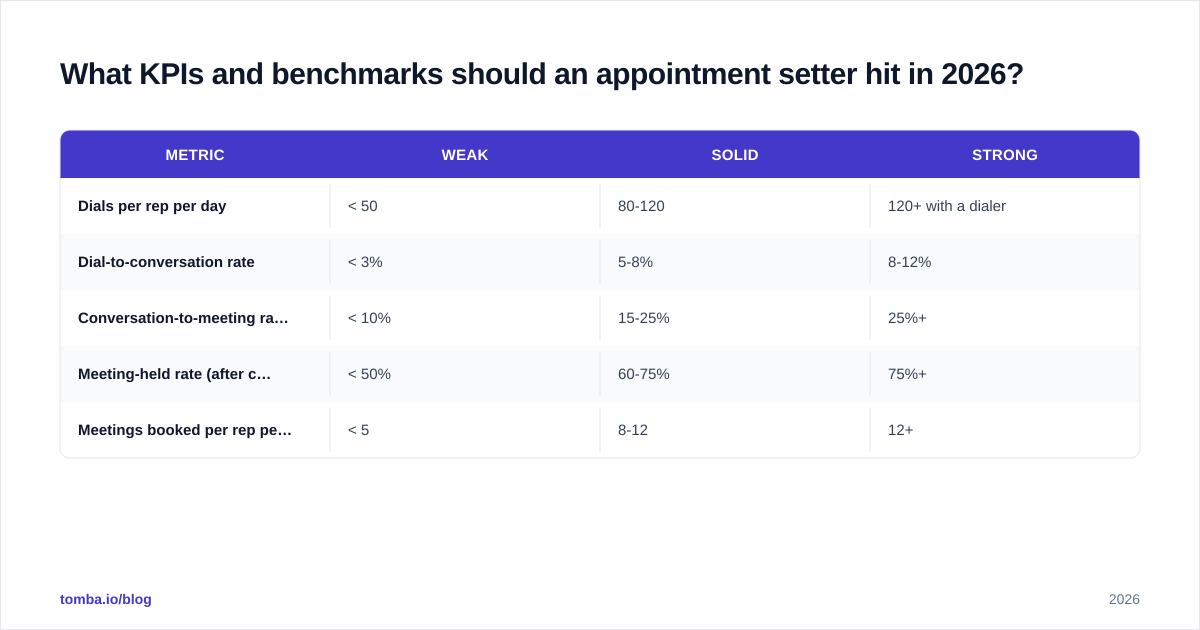
Track the funnel, not just activity. Dials alone tell you nothing about quality. Here's a realistic benchmark table for B2B outbound in 2026.
| Metric | Weak | Solid | Strong |
|---|---|---|---|
| Dials per rep per day | < 50 | 80-120 | 120+ with a dialer |
| Dial-to-conversation rate | < 3% | 5-8% | 8-12% |
| Conversation-to-meeting rate | < 10% | 15-25% | 25%+ |
| Meeting-held rate (after confirm) | < 50% | 60-75% | 75%+ |
| Meetings booked per rep per week | < 5 | 8-12 | 12+ |
Two numbers deserve obsession. Conversation-to-meeting measures your script and skill. Meeting-held rate measures your confirmation process — a booked meeting that no-shows is wasted pipeline. A simple confirmation sequence (calendar invite at booking, a value-add email the day before, a same-day reminder) routinely lifts held rates by 15-20 points.
If your dial-to-conversation rate is in the basement, the problem usually isn't your pitch — it's your list. Wrong numbers and wrong titles cap your connect rate before skill ever enters the picture.
What tech stack books the most phone meetings?#
A setter needs four things: accurate contact data, a dialer, a CRM, and a confirmation flow. Skip any one and the others underperform. Here's how the layers compare.
| Layer | Job | Examples | Why it matters |
|---|---|---|---|
| Contact data | Verified mobile + direct dials | Tomba phone finder,ZoomInfo | Bad numbers cap connect rate before you dial |
| Power/parallel dialer | More live conversations per hour | Orum, Apollo dialer, Aircall | Removes dead time between dials |
| CRM | Disposition, sequence, pipeline | HubSpot, Salesforce, Pipedrive | Tracks the funnel and meeting outcomes |
| Confirmation | Cut no-shows | Calendar invite + reminder email | Protects your meeting-held rate |
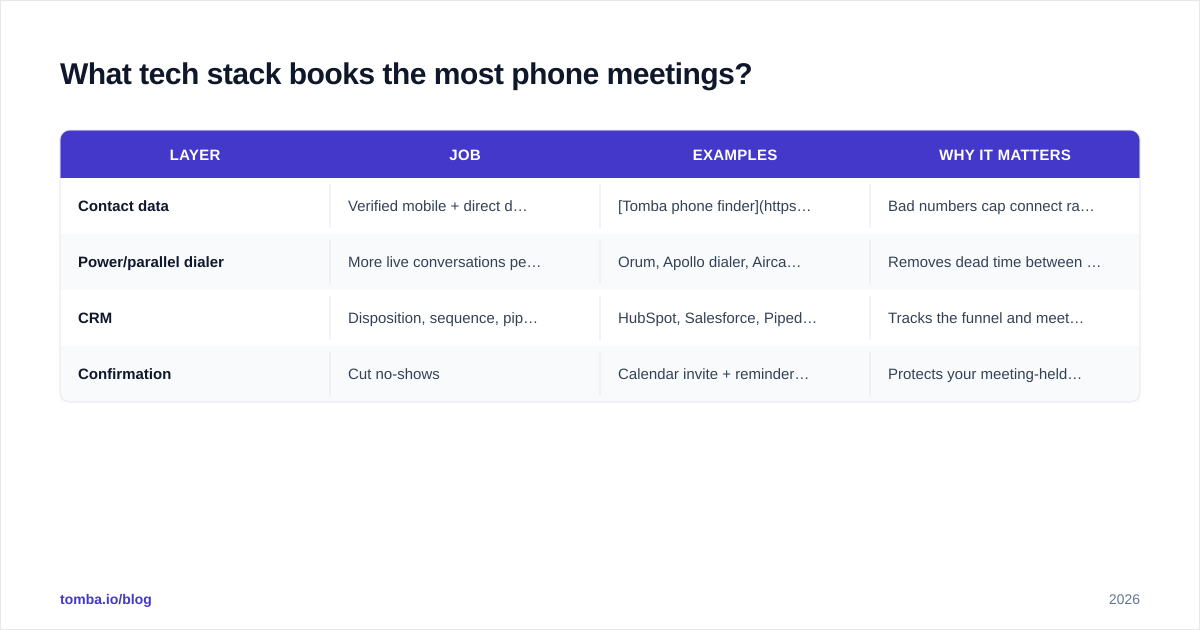
Start with data. A power dialer that fires through a list of disconnected numbers just wastes money faster. Pull verified direct dials and mobile numbers, validate them with a phone validator so you're not burning dials on dead lines, then layer the dialer on top. If your team also works email and LinkedIn touches before calling, an email finder and a LinkedIn finder let you build the full contact record — number, email, and profile — in one pass.
For CRM choice and integration depth, vendor comparison sites like G2 are a reasonable neutral starting point, and most data tools — including Tomba — push contacts straight into HubSpot or Salesforce so your setters never copy-paste.

How do you build a calling list that actually connects?#
The list is the silent variable behind every booking rate. Conclusion first: a small list of verified, well-targeted contacts beats a giant list of guesses every time.
Build it in four steps:
- Define the trigger. Hiring, funding, a new tool in their stack, a leadership change. Triggers give your pattern interrupt its teeth.
- Find the right person, not just the company. Use domain search to map the org and surface the actual decision-maker's contact rather than the generic info@ line.
- Get a reachable number. A title is useless without a live line. Pull direct dials and mobiles, then validate them so your dialer isn't chewing through disconnects.
- Enrich and dedupe. Run data enrichment to fill in title, seniority, and company size, then remove duplicates so two reps don't call the same prospect.
A list built this way commonly doubles dial-to-conversation rate versus a scraped, unverified one — same script, same reps, better inputs.
How many calls and follow-ups does it actually take to book a meeting?#
Most setters quit too early. Conclusion: persistence within reason is the difference between 5 and 12 meetings a week.
Industry data has long shown that a large share of prospects are reached only after the fourth or later attempt, yet many reps stop at one or two. A workable cadence for a single prospect over two weeks:
- Day 1: Call + voicemail + a one-line email
- Day 3: Call at a different time of day
- Day 5: Call + LinkedIn touch
- Day 8: Call + value-add email (a relevant stat or case)
- Day 12: Breakup call + breakup email
Vary the time of day — a prospect who never answers at 9 a.m. may pick up at 4:45 p.m. And always pair the call with a light async touch so your name is familiar by the third dial. The goal isn't to harass; it's to be consistently present until the timing is right.
Common mistakes that quietly kill booking rates#
- Reading a script flat. Buyers hear it instantly. Internalize the structure, then talk like a person.
- Asking "are you interested?" Open questions invite "no." Offer two specific times.
- No problem anchor. A meeting without a felt problem is a favor and will no-show.
- Skipping confirmation. No invite, no reminder, no-show. Lock the calendar before you hang up.
- Dialing bad data. The most expensive mistake. Verify numbers before the dialer ever touches them.
Frequently asked questions#
Is appointment setting over the phone still effective in 2026? Yes. Voice converts faster than any async channel because it handles objections in real time. It works best when paired with light email and LinkedIn touches and fed by verified contact data.
How many dials should an appointment setter make per day? With a power dialer, 120 or more is achievable. Without one, 80-120 is a healthy target. Volume matters less than connecting with the right people, which is a data problem first.
What's a good conversation-to-meeting rate? 15-25% is solid for cold outbound. Above 25% is strong and usually reflects a tight problem anchor and a specific, two-option time ask.
Ready to dial smarter?#
Better phone results start before the dial. If your connect rate is stuck, the fix is almost always cleaner data, not a louder pitch. Use the Tomba Email Finder and pair it with the phone finder to build contact records that have a real name, a real email, and a real number — so every dial lands on someone who can actually say yes. Start on the free tier (25 searches/month), and when you're ready to scale your lists, the Starter plan runs $49/mo. Check full Tomba pricing to match a plan to your call volume, and stop wasting your best channel on dead numbers.
// get started
Find, verify and enrich your first contacts today
Start on the free plan with 25 searches a month, then scale when your team is ready.
Free plan · No credit card required · GDPR & CCPA
// about the author