Appointment Setting Pricing in 2026: Models, Costs & ROI
Per-appointment, per-hour, retainer, or in-house? A neutral breakdown of appointment setting pricing in 2026 — real cost ranges, hidden fees, and how to calculate ROI before you sign.
Appointment setting pricing looks simple from the outside — pay someone to book meetings — but the moment you ask three vendors for a quote, you get three completely different number shapes. One charges per meeting, one charges a flat retainer, one charges per hour, and a fourth wants a base fee plus performance bonus. This guide breaks down every model, the real 2026 cost ranges, the fees nobody advertises, and a simple formula to figure out which option actually pays for itself.
TL;DR#
- Four main models dominate: per-appointment ($50–$350+ per booked meeting), monthly retainer ($1,500–$8,000+/mo), hourly ($15–$50+/hr offshore to onshore), and in-house (fully loaded SDR cost of $5,000–$10,000+/mo).
- Per-appointment looks safest but isn't always cheapest — low per-meeting prices often hide loose qualification criteria, so you pay for meetings that never had buying intent.
- Retainers reward volume and quality but transfer risk to you; demand a meeting quota or SLA in writing.
- In-house wins on control and long-term cost once you're booking 30+ qualified meetings a month, but it requires data, tooling, and management you have to buy separately.
- Your real cost is cost-per-qualified-meeting, not the sticker price. A clean contact database and verified phone numbers cut wasted dials and lower every model's effective price.
What is appointment setting and what are you actually paying for?#
Appointment setting is the outbound function that turns a raw list of prospects into booked, calendar-confirmed sales conversations for your closers. Think of it like a restaurant host: the host doesn't cook your meal or take payment, they just make sure the right guests are seated at the right table at the right time so the kitchen can do its job. An appointment setter does the dialing, emailing, objection-handling, and scheduling — your account executives walk into a warm, pre-qualified meeting.
That means when you pay for appointment setting, you're paying for a bundle: a contact list (sometimes), outreach labor (calls, emails, LinkedIn touches), qualification logic, and the scheduling itself. The pricing model a vendor uses tells you which of those pieces they're putting their margin — and their risk — on.
The single biggest mistake buyers make is comparing sticker prices across models that aren't measuring the same unit. "$75 per appointment" and "$4,000 per month" are not comparable until you convert both into cost per qualified meeting that shows up.
What are the main appointment setting pricing models in 2026?#
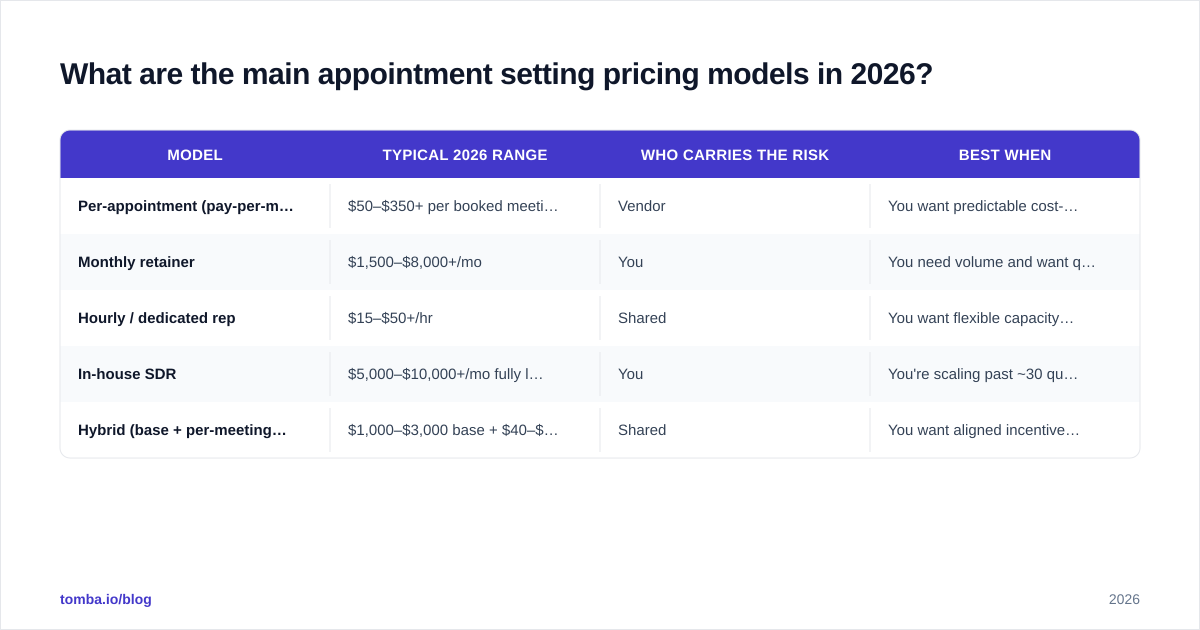
There are four pricing structures you'll encounter, plus a few hybrids. Each shifts risk between you and the provider differently.
| Model | Typical 2026 range | Who carries the risk | Best when |
|---|---|---|---|
| Per-appointment (pay-per-meeting) | $50–$350+ per booked meeting | Vendor | You want predictable cost-per-meeting and have a clear ICP |
| Monthly retainer | $1,500–$8,000+/mo | You | You need volume and want quality control over scripts/lists |
| Hourly / dedicated rep | $15–$50+/hr | Shared | You want flexible capacity or are testing a new segment |
| In-house SDR | $5,000–$10,000+/mo fully loaded | You | You're scaling past ~30 qualified meetings/month |
| Hybrid (base + per-meeting bonus) | $1,000–$3,000 base + $40–$120/meeting | Shared | You want aligned incentives without full retainer risk |
Per-appointment is the most marketed model because it sounds risk-free: you only pay when a meeting is booked. The catch is the qualification bar. If "appointment" just means someone agreed to a call, low-intent meetings inflate your invoice. Always tie the price to a definition — title, company size, budget signal, and a no-show clause.
Retainers are common with established agencies. You pay a fixed monthly fee regardless of output, though reputable shops attach a meeting quota or service-level agreement. The upside is they'll invest in your messaging and list quality because they're not penny-pinching per call.
Hourly pricing is most common with offshore teams and freelance setters. Offshore rates can start near $15/hour; specialized onshore reps with industry knowledge run $35–$50+. You're buying time, not outcomes, so management overhead is on you.
In-house means hiring your own sales development reps. The base salary is only part of it — once you add benefits, tooling, data, and management, the fully loaded monthly cost lands between $5,000 and $10,000+ per rep in most U.S. markets. HubSpot's sales benchmarks and salary data on G2 are useful sanity checks before you budget a hire.

How much does appointment setting cost per meeting, really?#
Here's the number that matters: effective cost per qualified meeting. Take any model, divide total spend by the number of meetings that (a) matched your ICP and (b) actually happened.
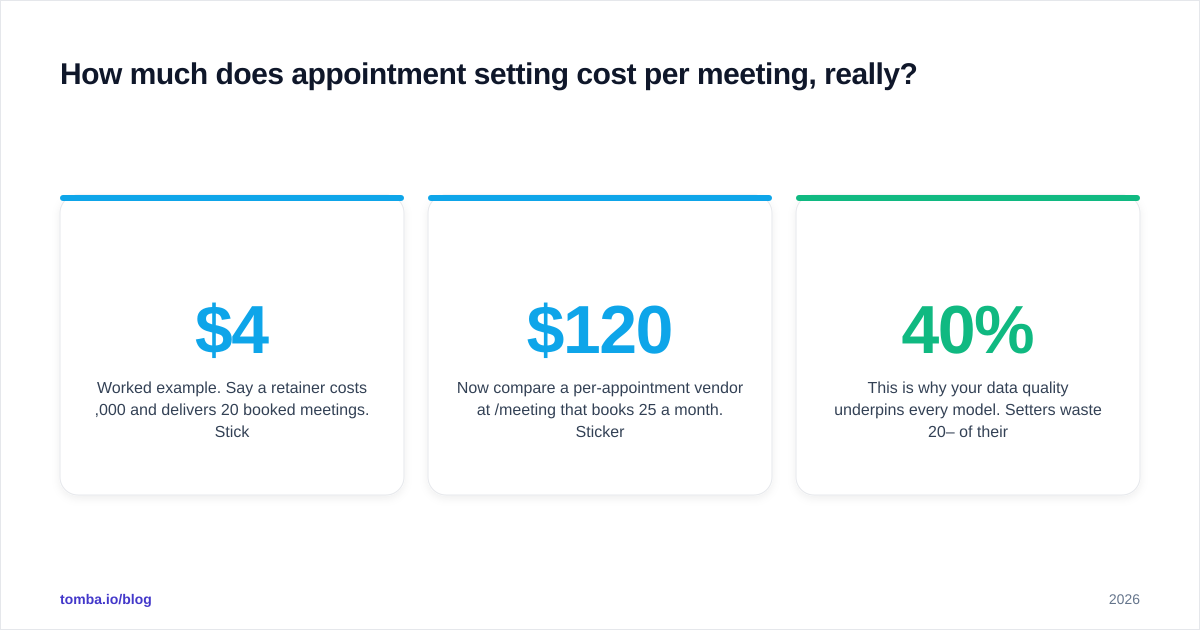
Worked example. Say a retainer costs $4,000/month and delivers 20 booked meetings. Sticker math says $200/meeting. But if only 12 fit your ICP and 2 of those no-showed, your effective cost is $4,000 ÷ 10 = $400 per real, qualified meeting — double the headline figure.
Now compare a per-appointment vendor at $120/meeting that books 25 a month. Sticker total: $3,000. If 18 are qualified and 15 show, effective cost is $3,000 ÷ 15 = $200 per qualified meeting. The "more expensive per unit" model can be the cheaper choice once you normalize.
This is why your data quality underpins every model. Setters waste 20–40% of their dials on wrong numbers, gatekeepers, and people who left the company. Feeding them verified contacts from a clean B2B database and accurate B2B phone numbers directly lowers the denominator-killing waste. If you're running this in-house, an email verifier step before any sequence keeps bounce rates down and protects sender reputation.
Is per-appointment pricing better than a retainer?#
It depends on how mature your targeting is and how much risk you want to hold.
Per-appointment is better when your ideal customer profile is well-defined, your offer is proven, and you want the vendor to carry delivery risk. You only pay for output, which caps your downside. The trade-off is that vendors protect their margin by booking the easiest meetings, not the best-fit ones, unless your qualification criteria are airtight.
Retainers are better when you want control over scripts, lists, and segments, or when your sales cycle requires nuanced conversations that a low-bid per-meeting shop won't invest in. You carry the risk if the campaign underperforms, but you also keep the upside of a team that learns your market.
A practical tie-breaker: if you can't yet write a crisp, testable definition of a "qualified meeting," start hourly or with a short retainer pilot. Lock in per-appointment pricing only after you know exactly what a good meeting looks like — otherwise you're outsourcing a definition you haven't finished writing.
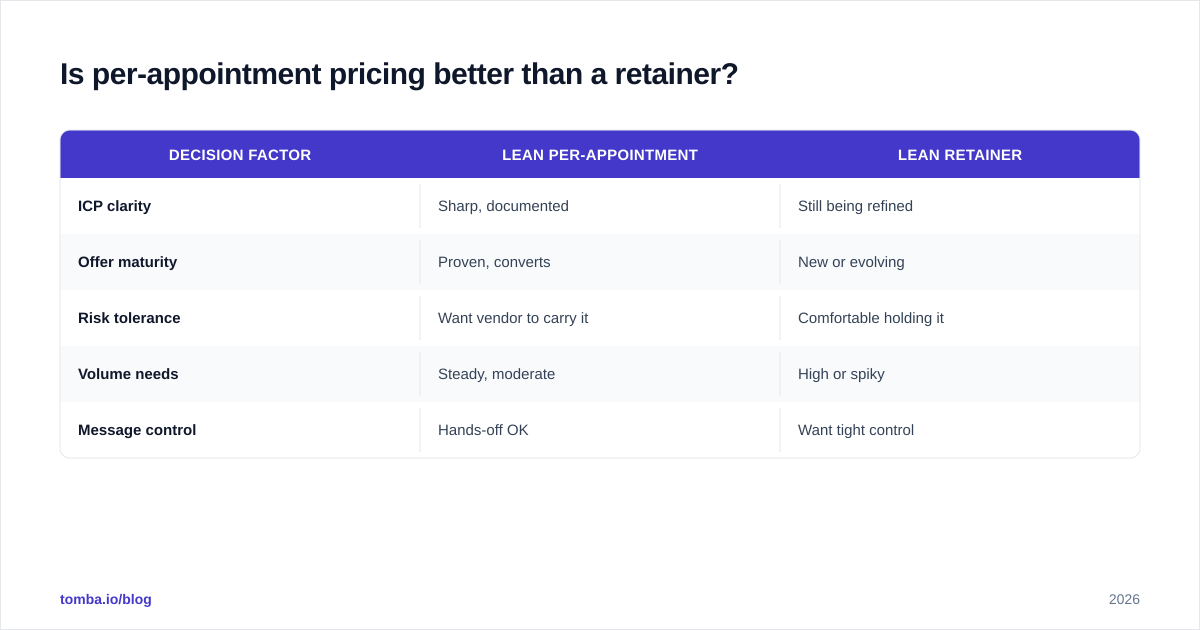
| Decision factor | Lean per-appointment | Lean retainer |
|---|---|---|
| ICP clarity | Sharp, documented | Still being refined |
| Offer maturity | Proven, converts | New or evolving |
| Risk tolerance | Want vendor to carry it | Comfortable holding it |
| Volume needs | Steady, moderate | High or spiky |
| Message control | Hands-off OK | Want tight control |
What hidden fees inflate appointment setting pricing?#
The quote is rarely the whole bill. Watch for these line items, because they're where the real cost-per-meeting hides:
- Data and list fees. Some vendors charge separately for the contact list, or mark up data they resell. Owning your own enrichment via contact enrichment often costs less than the markup.
- Setup and onboarding. One-time fees of $500–$2,500 for scripting, CRM integration, and campaign build.
- No-show policy gaps. If the contract pays for booked meetings rather than held meetings, no-shows are billed to you. Negotiate a credit or reschedule clause.
- Minimum commitments. Many retainers require a 3- or 6-month minimum, so "month-to-month" pricing isn't always real.
- Qualification disputes. Without a written ICP definition, you'll argue over whether a meeting counts. Put the criteria in the SOW.
- Tooling pass-through. Dialers, sequencing software, and data platforms sometimes get re-billed at a markup.
A good rule: ask every vendor for an itemized first-quarter total, not a monthly rate. The annualized number with all fees included is the only honest basis for comparison.

How do I calculate ROI on appointment setting?#
Conclusion first: appointment setting is worth it when (meetings × show rate × close rate × average deal value) > total cost, with enough margin to justify the management effort.
Walk through it with numbers. Suppose a vendor delivers 20 qualified meetings a month for $4,000.
- Show rate: 80% → 16 held meetings
- Close rate: 20% → 3.2 new customers
- Average deal value: $6,000 → $19,200 in new revenue
Against $4,000 in cost, that's a 4.8x return before factoring lifetime value. If your close rate were 10% instead, you'd net 1.6 deals = $9,600, still positive but thinner. And if show rate collapsed to 50% because the list was stale, the math turns ugly fast — which loops right back to data quality.
Two levers move ROI more than the pricing model itself:
- Show rate, driven by how well-qualified and how reachable the contact is. Verified mobile numbers and confirmed emails raise both connect and show rates.
- Close rate, driven by fit. Meetings booked against a tight ICP close far better than volume-padded ones.
For deeper benchmarks on conversion stages, Salesforce's sales resources publish useful funnel data you can compare against your own pipeline.
Should you build appointment setting in-house instead?#
Build in-house when your monthly qualified-meeting need is high enough that the fully loaded cost of a rep beats your blended vendor cost — usually around 30+ qualified meetings a month — and when control over messaging is strategically important.
The honest accounting for one in-house SDR in 2026:
| Cost component | Monthly (fully loaded) |
|---|---|
| Base + variable comp | $4,000–$6,500 |
| Benefits + payroll tax (~25%) | $1,000–$1,600 |
| Tooling (dialer, sequencer, CRM seat) | $200–$600 |
| Data / enrichment | $100–$500 |
| Management overhead (share of manager) | $500–$1,500 |
| Total | ~$5,800–$10,700 |
The advantage of in-house isn't just cost at scale — it's that the institutional knowledge, the call recordings, and the refined ICP stay with you instead of walking out when a contract ends. The disadvantage is that you now own recruiting, ramp time (60–90 days before a new SDR is productive), and the data stack.
If you go in-house, the data layer is what makes or breaks the unit economics. Pulling verified contacts with an email finder and confirming reachability before reps spend time dialing is the difference between a rep booking 8 meetings a week and 3.
What's the smartest way to lower your cost per meeting?#
Across every model, the cheapest lever is also the least glamorous: better data going in. You can negotiate a vendor's rate by 10–15%; you can cut wasted outreach 30%+ by fixing the list.
- Verify before you dial or send. Dead numbers and bounced emails are pure waste in every pricing model.
- Enrich for intent and fit so setters spend time on prospects who can actually buy.
- Deduplicate and standardize so two reps don't burn the same lead twice.
This is where Tomba fits regardless of whether you outsource or build. Use the Tomba Email Finder to source verified, professional email addresses by domain, name, or company — so your setters (or your agency) start from a clean, accurate list instead of paying per meeting on top of paying for wasted dials. On the Free tier you get 25 searches a month, and paid plans start at $49/mo (Starter), $99/mo (Growth), and $249/mo (Pro) — a fraction of what a single wasted week of appointment setting costs. Pair it with the email verifier to protect deliverability, and your effective cost per qualified meeting drops no matter which pricing model you choose.
Start by cleaning your list, define a qualified meeting in writing, then pick the model that matches your ICP maturity and risk appetite. Do those three things and appointment setting pricing stops being a guessing game.
// get started
Find, verify and enrich your first contacts today
Start on the free plan with 25 searches a month, then scale when your team is ready.
Free plan · No credit card required · GDPR & CCPA
// about the author