Appointment Setting Pricing Models: 2026 Cost Guide
Pay-per-meeting, retainer, per-hour, or commission? Compare the five appointment setting pricing models, see real 2026 cost ranges, and learn which one fits your pipeline.
TL;DR
- There are five common appointment setting pricing models: pay-per-appointment, monthly retainer, per-hour, commission/pay-per-close, and hybrid. Each shifts risk between you and the vendor differently.
- Pay-per-appointment looks safest but quietly incentivizes volume over quality — you can pay for meetings that never had buying intent.
- Retainers cost more up front but align better when you need named-account targeting and consistent brand control.
- Expect rough 2026 ranges of $50–$120 per qualified appointment, $3,000–$8,000/mo per retainer seat, or $20–$50/hour offshore.
- The cheapest model on paper is rarely the cheapest per closed deal. Always price on cost-per-opportunity, not cost-per-meeting.
What are appointment setting pricing models?#
An appointment setting pricing model is simply how a vendor charges you to book qualified sales meetings. Think of it like hiring a contractor to renovate a kitchen: one will quote a fixed price per cabinet installed, another bills by the hour, and a third wants a flat monthly retainer to manage the whole job. The work can be identical — the way risk and incentive land on each side is completely different.
That distinction matters more than the headline number. A vendor billing per appointment is motivated to maximize bookings. A vendor on retainer is motivated to keep you renewing. Those two incentives produce very different behavior on the phones and in your inbox, and they explain why two providers quoting "the same price" can deliver wildly different pipeline.
Before you compare quotes, you need a shared definition of the unit you're buying. A "qualified appointment" to one vendor means a confirmed calendar slot with a decision-maker who matched your ICP and agreed to a discovery call. To another, it means anyone who said "sure, send me something." Pin that definition down first — it changes the math on every model below.
Which appointment setting pricing models exist in 2026?#
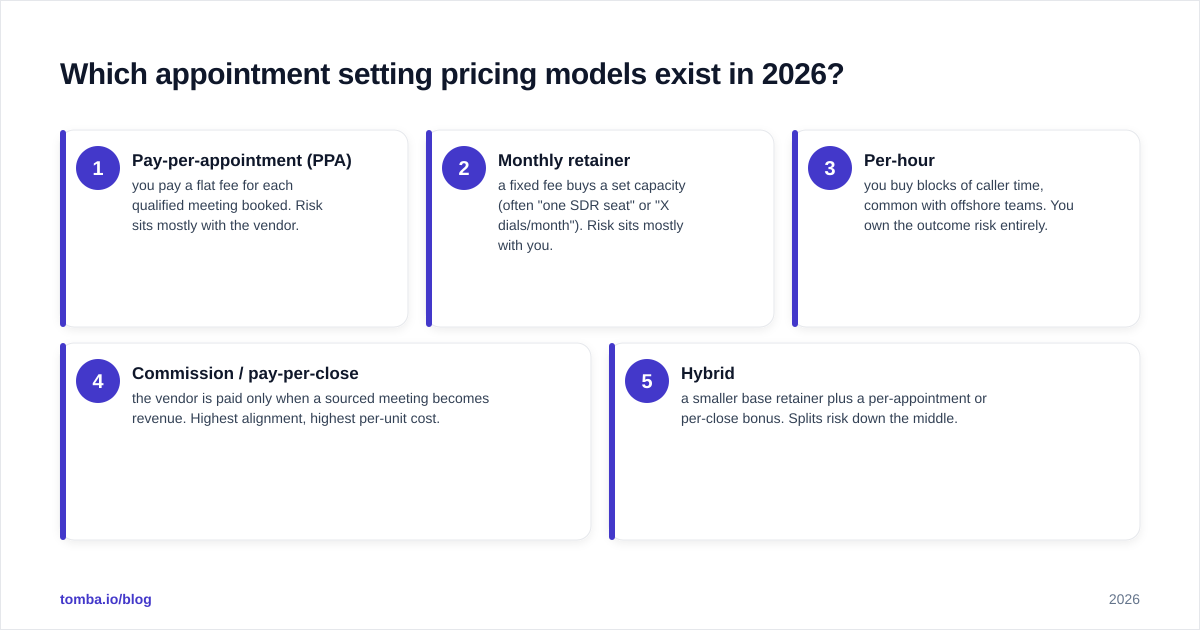
There are five structures you'll encounter when shopping vendors or building an in-house comp plan. Most providers use one as a headline and blend in a second.
- Pay-per-appointment (PPA) — you pay a flat fee for each qualified meeting booked. Risk sits mostly with the vendor.
- Monthly retainer — a fixed fee buys a set capacity (often "one SDR seat" or "X dials/month"). Risk sits mostly with you.
- Per-hour — you buy blocks of caller time, common with offshore teams. You own the outcome risk entirely.
- Commission / pay-per-close — the vendor is paid only when a sourced meeting becomes revenue. Highest alignment, highest per-unit cost.
- Hybrid — a smaller base retainer plus a per-appointment or per-close bonus. Splits risk down the middle.
The right answer depends on three things: how well-defined your ICP is, how complex your sale is, and how much pipeline predictability you need month to month. A transactional SMB sale with a clear ICP runs fine on pay-per-appointment. A six-figure enterprise motion with named accounts usually needs a retainer so you control messaging and target precision.
How much does each model cost?#
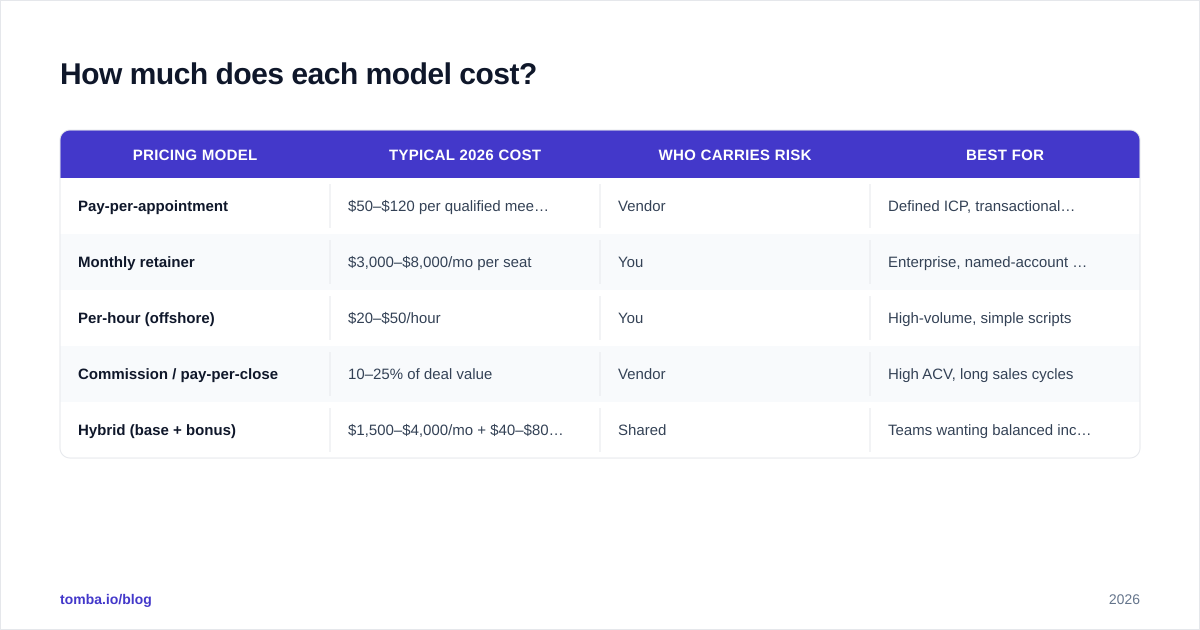
Here are realistic 2026 ranges. Treat them as starting points — geography, seniority of the callers, and sale complexity move these numbers a lot.
| Pricing model | Typical 2026 cost | Who carries risk | Best for |
|---|---|---|---|
| Pay-per-appointment | $50–$120 per qualified meeting | Vendor | Defined ICP, transactional sales |
| Monthly retainer | $3,000–$8,000/mo per seat | You | Enterprise, named-account ABM |
| Per-hour (offshore) | $20–$50/hour | You | High-volume, simple scripts |
| Commission / pay-per-close | 10–25% of deal value | Vendor | High ACV, long sales cycles |
| Hybrid (base + bonus) | $1,500–$4,000/mo + $40–$80/meeting | Shared | Teams wanting balanced incentives |
A few honest caveats. The per-appointment range assumes the vendor sources its own data; if you supply a clean list, you should negotiate the per-meeting fee down. Per-hour offshore looks irresistible until you factor in the hours spent on bad data and unqualified dials — a $25/hour caller working a 20%-accurate list is more expensive per booked meeting than a $90 pay-per-appointment vendor. And commission models only work when attribution is clean; messy CRM hygiene turns them into monthly disputes.
For context on how peers benchmark these spends, vendor-review aggregators like G2 and Clutch publish buyer reviews that are useful sanity checks on quotes you receive.
Is pay-per-appointment better than a retainer?#
Short answer: pay-per-appointment is better when your ICP is tight and your sale is simple; a retainer is better when you need control and your accounts are named.
Pay-per-appointment feels like the obvious win because you only pay for results. But the model's incentive is volume, not fit. A vendor paid $80 per meeting makes more money by booking more meetings — and the fastest way to book more meetings is to loosen qualification. You end up with a calendar full of "interested" prospects who ghost the discovery call. The cost didn't disappear; it moved from your invoice to your reps' wasted hours.
Retainers flip that. Because the vendor's revenue is fixed, they have no reason to inflate meeting counts — their renewal depends on quality and your satisfaction. The trade-off is that you carry the risk: a slow month still costs full price. Retainers also demand more management overhead from you, since you're effectively renting a team rather than buying an outcome.
The deciding factor is usually data quality and targeting precision. Appointment setting lives or dies on reaching the right person with a real direct line. If your list is stale, every model underperforms. This is why teams pair any setting model with a verified contact source — feeding callers accurate direct dials and emails from a phone finder and a current B2B database does more for cost-per-meeting than switching billing structures ever will.
How do you calculate true cost per opportunity?#
Stop comparing cost per appointment. Compare cost per qualified opportunity — a meeting that actually entered your pipeline.
The formula is straightforward:
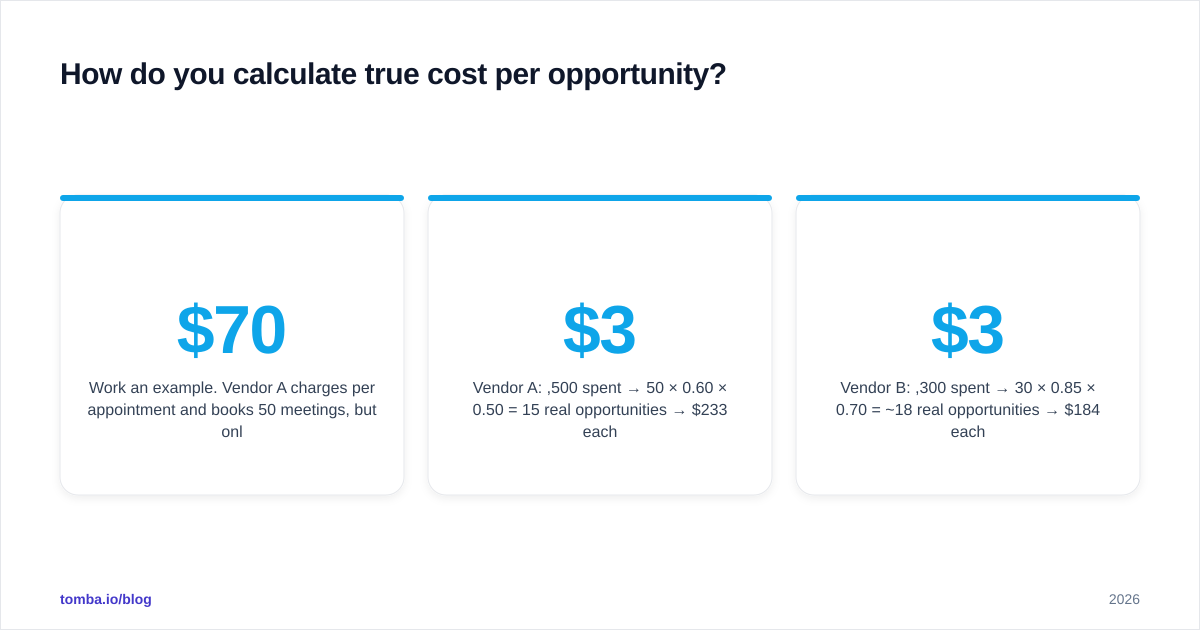
Cost per opportunity = Total spend / (Meetings booked × Show rate × Qualification rate)Work an example. Vendor A charges $70 per appointment and books 50 meetings, but only 60% show and 50% qualify. Vendor B charges $110 per appointment, books 30 meetings, with an 85% show rate and 70% qualification.
- Vendor A: $3,500 spent → 50 × 0.60 × 0.50 = 15 real opportunities → $233 each
- Vendor B: $3,300 spent → 30 × 0.85 × 0.70 = ~18 real opportunities → $184 each
Vendor B is "more expensive" per meeting and cheaper per opportunity. The teams that win at outbound learn to model this before signing. If you want to go deeper on aligning targets and conversion math, our guide to outbound sales strategy and the underlying response rate benchmarks are a useful next read.
Show rate and qualification rate are the two numbers most buyers never ask about — and they swing the real cost by 2–3x. Demand them in writing, with definitions, before you compare any quotes.
What hidden costs do appointment setting vendors add?#
The headline price is rarely the full price. Watch for these line items, because they're where margins quietly erode:
- Data and list fees — some vendors charge separately for sourcing contacts, often at a markup. If you can supply verified data yourself, you reclaim that margin.
- Onboarding / ramp fees — a one-time setup charge, sometimes a full month, before any meetings land.
- Minimum commitments — pay-per-appointment vendors frequently bundle a monthly minimum, which quietly turns the model into a soft retainer.
- Replacement policy gaps — what happens when a "qualified" meeting no-shows or was never a fit? Strong contracts replace it free; weak ones don't.
- Tooling pass-through — dialers, CRM seats, and enrichment tools billed back to you.
The data fee is the one most worth attacking. Outsourced appointment setting often re-sells the same contact records you could pull yourself for a fraction of the cost. Owning your data sourcing — verified emails via an email verifier and direct numbers from your own enrichment — lets you negotiate a leaner per-meeting rate and removes the vendor's incentive to pad bookings with low-quality contacts. Authoritative sales-ops references like HubSpot's sales benchmark research consistently show that contact accuracy, not channel choice, is the largest single driver of connect rates.
Which appointment setting pricing model should you choose?#
Match the model to your motion, not to the lowest sticker price. A quick decision guide:
| If your situation is... | Choose | Why |
|---|---|---|
| Clear ICP, sub-$10k deals, need volume | Pay-per-appointment | Vendor carries risk, fast to start |
| Named accounts, $50k+ ACV, brand-sensitive | Retainer | You control messaging and targeting |
| Simple script, huge list, tight budget | Per-hour | Lowest unit cost at scale |
| High ACV, clean attribution, patient | Commission | Pays only on real revenue |
| Want balanced incentives, mid-market | Hybrid | Splits risk, aligns on quality |
Whatever you pick, the lever you fully control is data quality. Every model assumes your callers are dialing real people at real numbers with a relevant reason to talk. The moment that breaks, the cheapest model becomes the most expensive one. Build your motion on a verified foundation, measure cost per opportunity rather than cost per meeting, and renegotiate the moment a vendor's incentive drifts from yours.
If you're keeping appointment setting in-house — or want to stop paying vendor markups on contact data — start with the source. Tomba's Email Finder gives your SDRs verified professional emails by name, domain, or company, so every booked meeting starts from accurate contact data instead of a recycled list. Pair it with the phone finder for direct dials, and you'll cut the single biggest hidden cost in any appointment setting pricing model. The free tier gives you 25 searches a month to test it against your current vendor's data before you spend a dollar on meetings.
// get started
Find, verify and enrich your first contacts today
Start on the free plan with 25 searches a month, then scale when your team is ready.
Free plan · No credit card required · GDPR & CCPA
// about the author