Appointment Setting Services in 2026: The Complete Guide
Outsourced appointment setting can fill your calendar with qualified meetings—or burn cash on no-shows. Here's how to pick the right model, vendor, and price in 2026.
TL;DR
- Appointment setting services book qualified sales meetings on your reps' calendars so closers spend time selling, not prospecting.
- The three real pricing models are pay-per-appointment ($150–$400/meeting), monthly retainer ($3,000–$10,000/mo), and per-SDR ($4,500–$8,000/SDR/mo). Each rewards a different sales motion.
- Outsourcing wins on speed and cost; in-house wins on control and product depth. Most teams over $2M ARR end up running a hybrid.
- A service is only as good as its data. Bad contact data quietly destroys connect rates—fix the list before you blame the script.
- Score vendors on lead quality, not raw meeting count. A "booked meeting" that no-shows or doesn't fit your ICP is a refund you'll fight for.
What are appointment setting services?#
Appointment setting services are outsourced or in-house teams that do one job: turn a list of target accounts into booked sales meetings for your closers. Think of them as the host at a busy restaurant—their entire role is seating the right guests at the right table so the kitchen (your account executives) can cook. They don't negotiate contracts or run demos. They research, reach out, qualify, and book.
In practice, an appointment setter (often a sales development rep, or SDR) works through three layers of activity: building or cleaning a contact list, running multichannel outreach (email, phone, LinkedIn), and qualifying interested prospects against your criteria before dropping a calendar invite. The handoff to a closer is the finish line.
The category exists because prospecting and closing are different skills with different economics. A seasoned AE costs a lot per hour and is wasted on cold dials. An appointment setter, internal or agency, is built and priced for volume top-of-funnel work. Separating the two roles is one of the oldest plays in B2B sales, and it still works.
How does appointment setting actually work?#
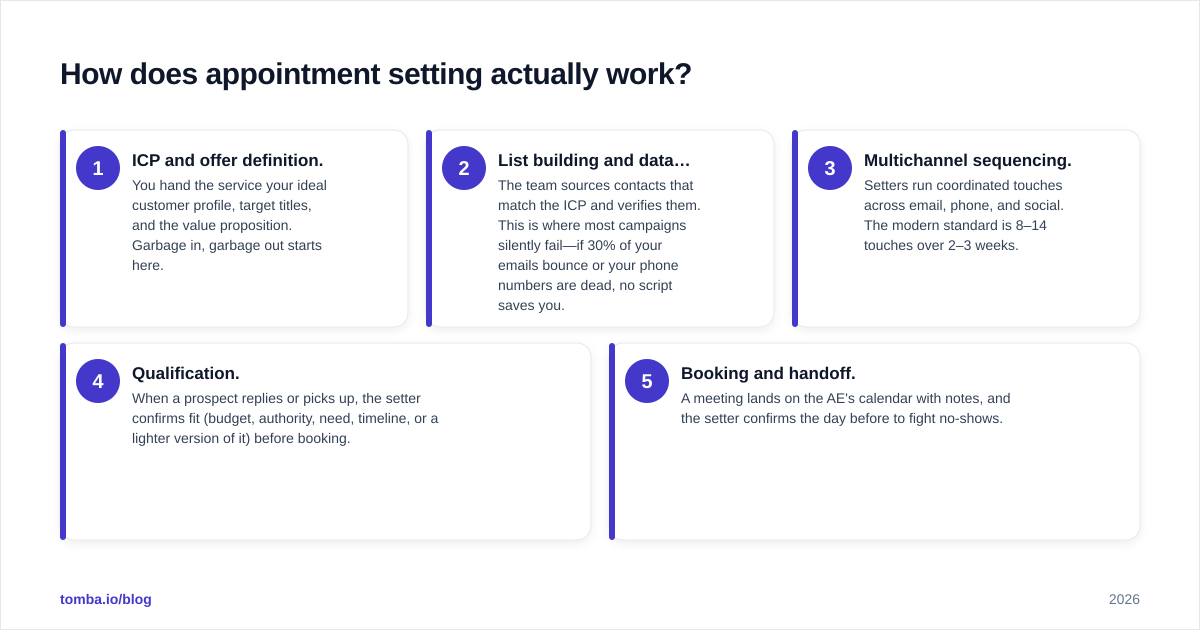
The mechanics are simple to describe and hard to execute. A standard engagement runs in five stages:
- ICP and offer definition. You hand the service your ideal customer profile, target titles, and the value proposition. Garbage in, garbage out starts here.
- List building and data enrichment. The team sources contacts that match the ICP and verifies them. This is where most campaigns silently fail—if 30% of your emails bounce or your phone numbers are dead, no script saves you.
- Multichannel sequencing. Setters run coordinated touches across email, phone, and social. The modern standard is 8–14 touches over 2–3 weeks.
- Qualification. When a prospect replies or picks up, the setter confirms fit (budget, authority, need, timeline, or a lighter version of it) before booking.
- Booking and handoff. A meeting lands on the AE's calendar with notes, and the setter confirms the day before to fight no-shows.
The unglamorous truth is that stages two and four decide everything. A flashy outreach sequence on a stale list produces nothing. That's why the best services treat data quality and a clean email verifier step as non-negotiable infrastructure, not an afterthought.
In-house vs outsourced: which model fits you?#
The decision comes down to control versus speed. Building an in-house SDR team gives you product depth and brand control but takes 3–6 months to hire, train, and ramp. Outsourcing gets you booked meetings in weeks but trades away some control and product nuance.
)
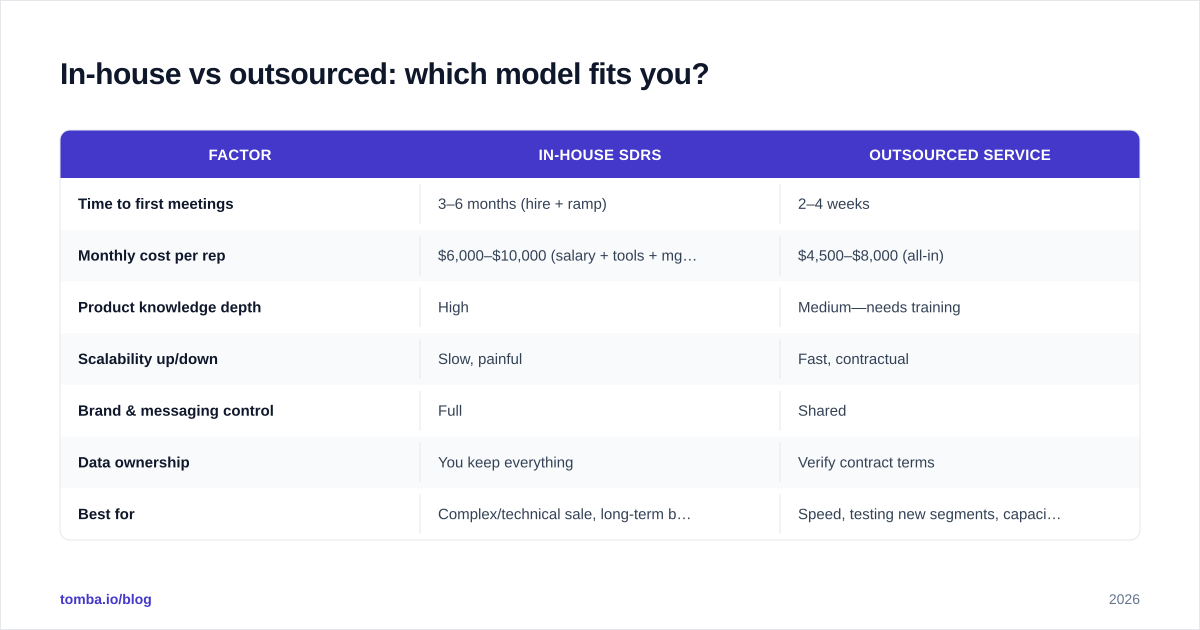
Here's how the two stack up on the dimensions that matter:
| Factor | In-house SDRs | Outsourced service |
|---|---|---|
| Time to first meetings | 3–6 months (hire + ramp) | 2–4 weeks |
| Monthly cost per rep | $6,000–$10,000 (salary + tools + mgmt) | $4,500–$8,000 (all-in) |
| Product knowledge depth | High | Medium—needs training |
| Scalability up/down | Slow, painful | Fast, contractual |
| Brand & messaging control | Full | Shared |
| Data ownership | You keep everything | Verify contract terms |
| Best for | Complex/technical sale, long-term build | Speed, testing new segments, capacity spikes |
A reasonable rule: if your sale is highly technical or your brand voice is a differentiator, lean in-house. If you need pipeline this quarter, are testing a new vertical, or want to validate a motion before hiring, outsource first and internalize what works.
Most companies past roughly $2M ARR run a hybrid—a small in-house core for strategic accounts plus an agency for volume and new-segment experiments. You don't have to pick a religion.
How much do appointment setting services cost in 2026?#
Pricing follows three models, and each one quietly changes the vendor's incentives. Understand the incentive and you'll understand the pitch.
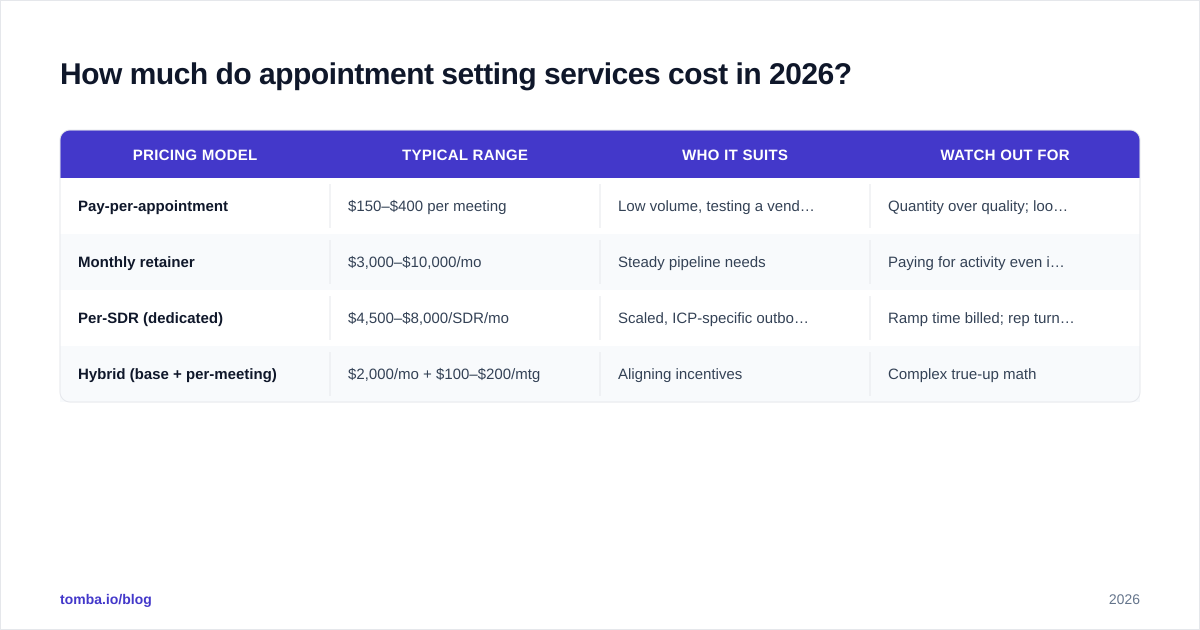
| Pricing model | Typical range | Who it suits | Watch out for |
|---|---|---|---|
| Pay-per-appointment | $150–$400 per meeting | Low volume, testing a vendor | Quantity over quality; loose qualification to hit numbers |
| Monthly retainer | $3,000–$10,000/mo | Steady pipeline needs | Paying for activity even in slow months |
| Per-SDR (dedicated) | $4,500–$8,000/SDR/mo | Scaled, ICP-specific outbound | Ramp time billed; rep turnover |
| Hybrid (base + per-meeting) | $2,000/mo + $100–$200/mtg | Aligning incentives | Complex true-up math |
Pay-per-appointment looks the safest because you "only pay for results," but it's the model most prone to gaming—when a vendor only earns on booked meetings, qualification standards have a way of loosening. Retainers and dedicated-SDR models cost more upfront but align better with quality when you set the right scorecard.
Whatever the model, the hidden cost is always data. A meeting that no-shows because the contact was wrong still ate outreach hours. Before signing anything, confirm whose data you're using and how it's verified. If you're supplying the list, a solid bulk email finder and verification pass will do more for your cost-per-meeting than renegotiating the rate card. For context on what credits and tiers look like, the Tomba pricing page shows how list-building costs scale separately from the service fee.
How do you choose an appointment setting vendor?#
Score vendors on lead quality and process, not on the meeting count in their deck. Anyone can book 40 meetings; the question is how many turn into pipeline. Use this checklist:
- ICP precision. Can they describe your buyer back to you better than your last vendor? Vague answers predict vague targeting.
- Data sourcing and verification. Ask exactly where contacts come from and how they're verified. If the answer is "we have a database" with no verification step, expect bounces. Compare their approach to how a transparent provider documents its data sources.
- Qualification framework. Get the literal questions a setter asks before booking. No framework means no consistency.
- Reporting cadence. You want connect rate, reply rate, meetings booked, show rate, and meeting-to-opportunity rate—weekly. Show rate is the honesty metric.
- Ramp and offboarding terms. How long until full productivity, and do you keep the data and call recordings when you leave?
- References in your segment. A great healthcare-SaaS setter may flop selling devtools. Ask for references that match your motion.
A useful gut check during the sales call: a strong vendor pushes back on your assumptions. If they agree with everything and promise the moon, they're selling you, not qualifying you—which is exactly the behavior you don't want their setters doing to your prospects. For broader vendor evaluation patterns, third-party review sites like G2 are useful for filtering by company size and verified reviews.
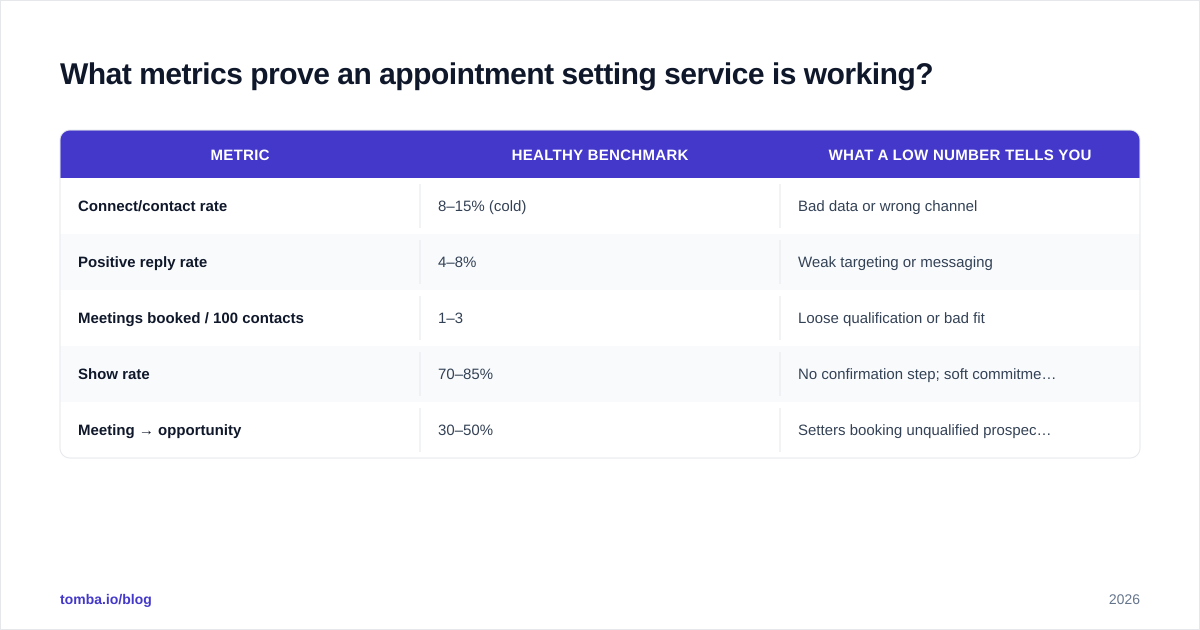
What metrics prove an appointment setting service is working?#
Booked meetings is a vanity number on its own. The chain that matters runs from contact data all the way to closed revenue, and a weak link anywhere drags down the whole result.
| Metric | Healthy benchmark | What a low number tells you |
|---|---|---|
| Connect/contact rate | 8–15% (cold) | Bad data or wrong channel |
| Positive reply rate | 4–8% | Weak targeting or messaging |
| Meetings booked / 100 contacts | 1–3 | Loose qualification or bad fit |
| Show rate | 70–85% | No confirmation step; soft commitments |
| Meeting → opportunity | 30–50% | Setters booking unqualified prospects |
If show rate is low, the fix is process (confirmation calls, calendar reminders), not more outreach. If meeting-to-opportunity is low, your setters are booking the wrong people—a qualification problem. And if connect rate is in the basement, stop everything and audit the list. A campaign built on a 25%-bounce list is a campaign that fails before the first dial.
This is the part teams skip. They optimize scripts and A/B test subject lines while sitting on a contact list that's quietly 30% wrong. Run your list through verification first. A clean domain search to confirm you have the right contacts at each target account, paired with verification to drop dead addresses, will move connect and show rates more than any messaging tweak.
)
What are the pros and cons of outsourcing appointment setting?#
Pros:
- Speed. Pipeline in weeks instead of a multi-month hiring cycle.
- Cost flexibility. Scale up for a launch, down in a slow quarter, without severance.
- Specialized skill. Good agencies do nothing but outbound all day and bring tested playbooks.
- Focus. Your closers stop prospecting and start closing, which is where their comp and skill actually live.
Cons:
- Control gap. A third party represents your brand on the first touch—training and oversight are on you.
- Product depth. Setters rarely know your product as well as an internal hire; complex sales suffer.
- Quality-incentive risk. Wrong pricing model nudges vendors toward quantity.
- Data dependency. If the vendor's data is weak and you can't see it, you pay for failed outreach.
The cons are all manageable, and notice they trace back to two roots: oversight and data. Set a tight scorecard, demand weekly reporting, and own (or verify) the contact data. Do those three things and outsourcing's downside shrinks fast. Skip them and you'll churn vendors every six months blaming "bad leads."
For teams that want the speed of outsourcing without surrendering data quality, the move is to control the list yourself and let the service run outreach. You feed them verified, enriched contacts; they book meetings. That split keeps the cost-per-meeting honest because the most failure-prone input—the data—stays in your hands. Pairing your CRM with proper data enrichment before handing accounts to setters is the highest-leverage thing most teams aren't doing.
When should you build appointment setting in-house instead?#
Build in-house when control and product depth outweigh speed. Specifically:
- Your sale is technical enough that setters need real product fluency to qualify well.
- Your brand voice on the first touch is a genuine differentiator.
- You're past the experimentation phase and have a repeatable motion worth owning.
- You have a sales manager with the bandwidth to coach SDRs—an unmanaged in-house team underperforms a managed agency every time.
The trap is building in-house too early, before you know what message and segment work. You end up paying full salaries to learn lessons an agency could have taught you in a quarter for less. Validate the motion first, then internalize it.
Whichever way you go, the unglamorous foundation is the same: accurate contact data, a real qualification framework, and weekly metrics. The org chart matters less than those three things.
The bottom line#
Appointment setting services work when the inputs are right and the scorecard is honest. Pick the pricing model whose incentives match yours, judge vendors on lead quality over meeting count, and—above all—fix the data layer before you spend a dollar on outreach. The cheapest way to lower your cost-per-meeting isn't a better script; it's a list that doesn't bounce.
That data layer is where you can win before outreach even starts. Whether you outsource or build in-house, feed your setters verified, accurate contacts and watch connect and show rates climb. Start with the Tomba Email Finder to find and verify professional emails at your target accounts—free for your first 25 searches, then $49/mo on Starter when you're ready to scale your pipeline. Build the list right, and the meetings follow.
// get started
Find, verify and enrich your first contacts today
Start on the free plan with 25 searches a month, then scale when your team is ready.
Free plan · No credit card required · GDPR & CCPA
// about the author