Appointment Setting Strategies That Book More Meetings in 2026
The appointment setting strategies that actually fill a calendar in 2026: research-first targeting, multichannel cadences, qualification frameworks, and the metrics that prove it works.
Appointment setting is where pipeline is won or lost. You can have a brilliant demo and a closer who never misses, but if the calendar is empty none of it matters. The hard part in 2026 isn't sending more messages — it's earning attention from buyers who screen aggressively, ignore generic outreach, and book only when the relevance is obvious in the first sentence.
This guide breaks down the appointment setting strategies that consistently convert cold contacts into held meetings: how to build the list, sequence the touches, qualify before the call, and measure what's actually working.
TL;DR#
- Targeting beats volume. A tight list of 200 well-researched accounts outperforms 2,000 scraped contacts every time.
- Multichannel cadences win. Email + phone + LinkedIn over 14–21 days books far more meetings than any single channel.
- Qualify before you book, not after. A BANT or MEDDIC-lite check on the booking form kills no-shows and wasted demos.
- Data quality is the silent killer. Bad emails and stale numbers cap your connect rate before strategy even matters — verify everything.
- Track held meetings, not booked meetings. Show rate is the metric that separates a real pipeline from a vanity calendar.
What is appointment setting, really?#
Appointment setting is the process of turning a raw prospect into a confirmed, qualified meeting on a sales rep's calendar. Think of it like a restaurant host: the kitchen (your closers) can only cook for the people the host actually seats. A great host doesn't just fill tables — they seat the right guests at the right time so the kitchen runs smoothly.
In practice, an appointment setter (often an SDR or BDR) owns the top of the funnel: researching accounts, reaching out across channels, handling early objections, confirming fit, and scheduling the meeting. The handoff to an account executive only happens once the prospect is genuinely qualified.
The discipline matters because the economics are brutal. According to widely cited benchmarks from HubSpot's sales research, most reps spend a minority of their week actually selling — the rest goes to admin, list-building, and chasing dead contacts. Every hour you reclaim with better appointment setting strategies is an hour back in front of buyers.
How do you build a list worth working?#
Start with the account, not the contact. The single biggest lever in appointment setting is whom you choose to contact. A spray-and-pray list guarantees low connect rates, high spam complaints, and a demoralized team.
Build your list in three layers:
- Ideal Customer Profile (ICP) accounts — companies that match your best closed-won deals on size, industry, tech stack, and trigger events (funding, hiring, leadership changes).
- Buying-committee roles — the economic buyer, the champion, and the blocker. Map 3–5 contacts per account, not one.
- Verified contact data — accurate work emails and direct dials. This is where most teams quietly lose. A 30% bounce rate doesn't just waste sends; it damages your sender reputation and pushes future emails to spam.
To find decision-makers fast, use a domain search to pull every contact at a target company, then run an email verifier before a single message goes out. Clean data is the cheapest performance boost available to an SDR team.
Which appointment setting strategies actually work in 2026?#
Here are the tactics that move the needle, ranked by impact.
1. Research-first personalization#
Generic "I'd love to pick your brain" emails are dead. Open with something only research could surface: a recent product launch, a podcast the prospect appeared on, a job posting that signals pain. Two specific sentences of relevance beat ten lines of flattery.
2. Multichannel cadences#
No single channel carries a campaign anymore. The winning pattern interleaves email, phone, and LinkedIn over roughly three weeks. Each channel reinforces the others — a prospect who ignored two emails often answers the call because your name now looks familiar.
3. Trigger-based outreach#
Reaching out within 48 hours of a trigger event (funding round, new VP hire, expansion) can multiply reply rates. Timing is a feature, not an afterthought.
4. Value-first voicemails and DMs#
When you can't connect live, leave a 15-second voicemail that states one concrete reason to call back. Pair it with a short LinkedIn note that references the same point. Consistency across channels builds credibility.
5. Qualify on the booking step#
Add two or three qualifying questions to your scheduling form. You'll book slightly fewer meetings, but the ones you book will show up and convert.
What does a high-converting cadence look like?#
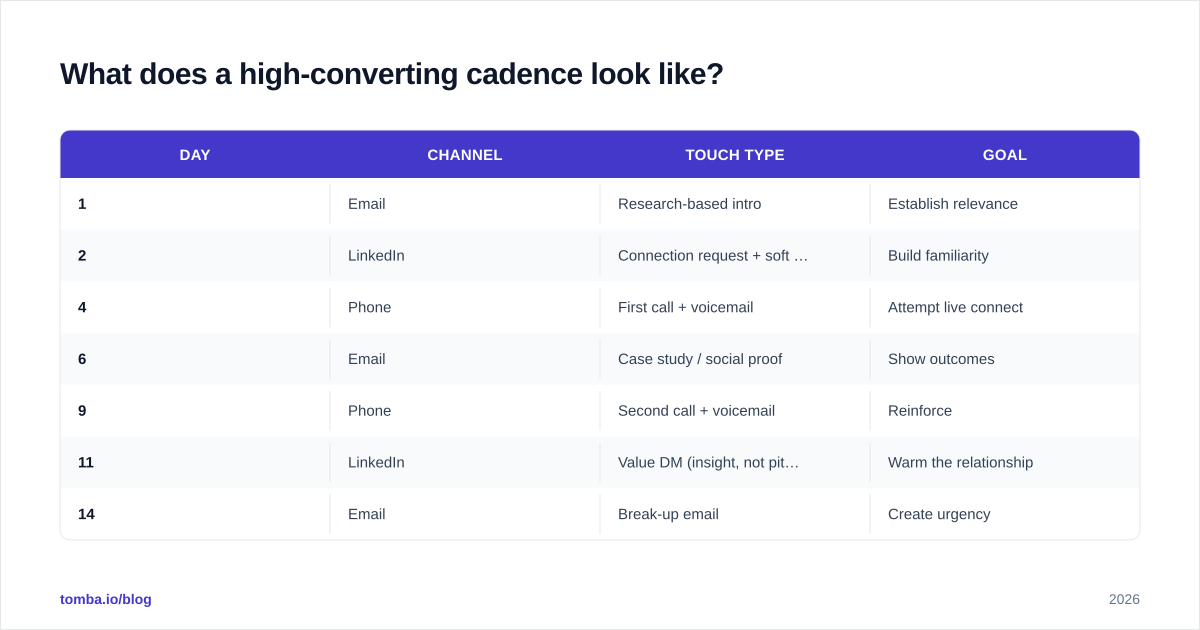
A cadence is a scripted, multi-touch sequence with defined timing and channels. Here's a proven 14-day structure for a mid-market SDR motion:
| Day | Channel | Touch type | Goal |
|---|---|---|---|
| 1 | Research-based intro | Establish relevance | |
| 2 | Connection request + soft note | Build familiarity | |
| 4 | Phone | First call + voicemail | Attempt live connect |
| 6 | Case study / social proof | Show outcomes | |
| 9 | Phone | Second call + voicemail | Reinforce |
| 11 | Value DM (insight, not pitch) | Warm the relationship | |
| 14 | Break-up email | Create urgency |
Two rules make cadences work: don't skip the phone, and don't end after one email. Most meetings are booked on touches 4 through 8, long after the average rep has given up.
How do you qualify a prospect before booking?#
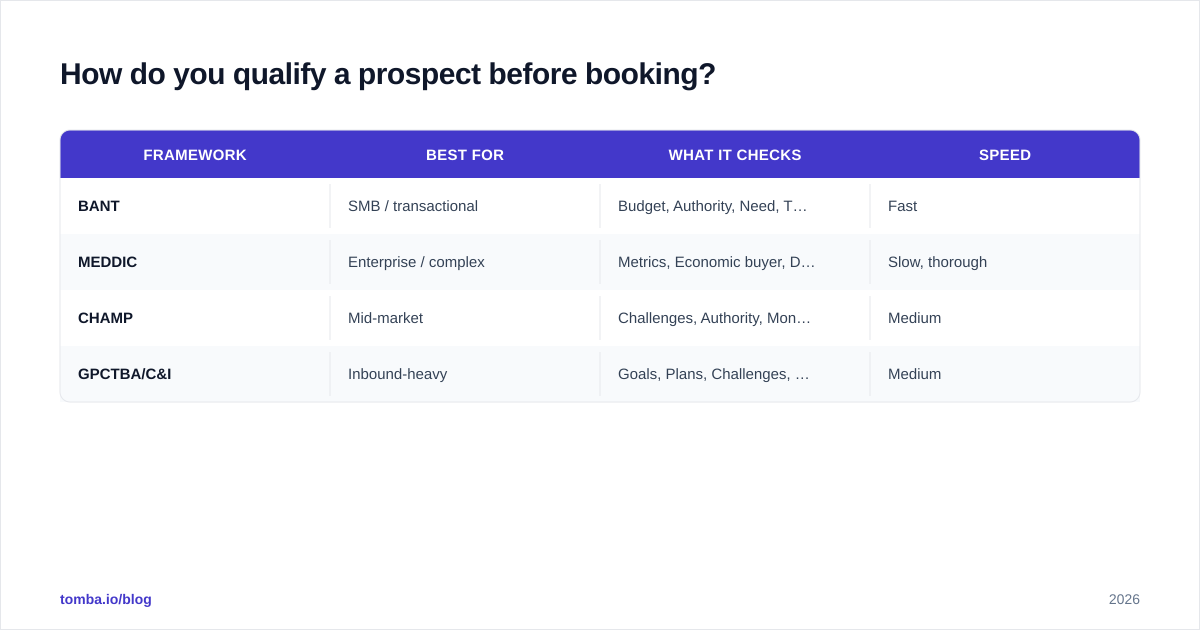
Qualification frameworks keep your calendar full of real opportunities instead of tire-kickers. The classic options each suit a different motion:
| Framework | Best for | What it checks | Speed |
|---|---|---|---|
| BANT | SMB / transactional | Budget, Authority, Need, Timeline | Fast |
| MEDDIC | Enterprise / complex | Metrics, Economic buyer, Decision criteria, etc. | Slow, thorough |
| CHAMP | Mid-market | Challenges, Authority, Money, Prioritization | Medium |
| GPCTBA/C&I | Inbound-heavy | Goals, Plans, Challenges, Timeline, budget | Medium |
For most appointment setting motions, a lightweight BANT or CHAMP check during the discovery touch is enough. Reserve MEDDIC for high-ACV enterprise deals where a wasted demo is genuinely expensive. The point isn't to interrogate — it's to confirm there's a real problem, a real budget, and a real path to a decision before you take an AE's time.

Should you build an in-house team or outsource?#
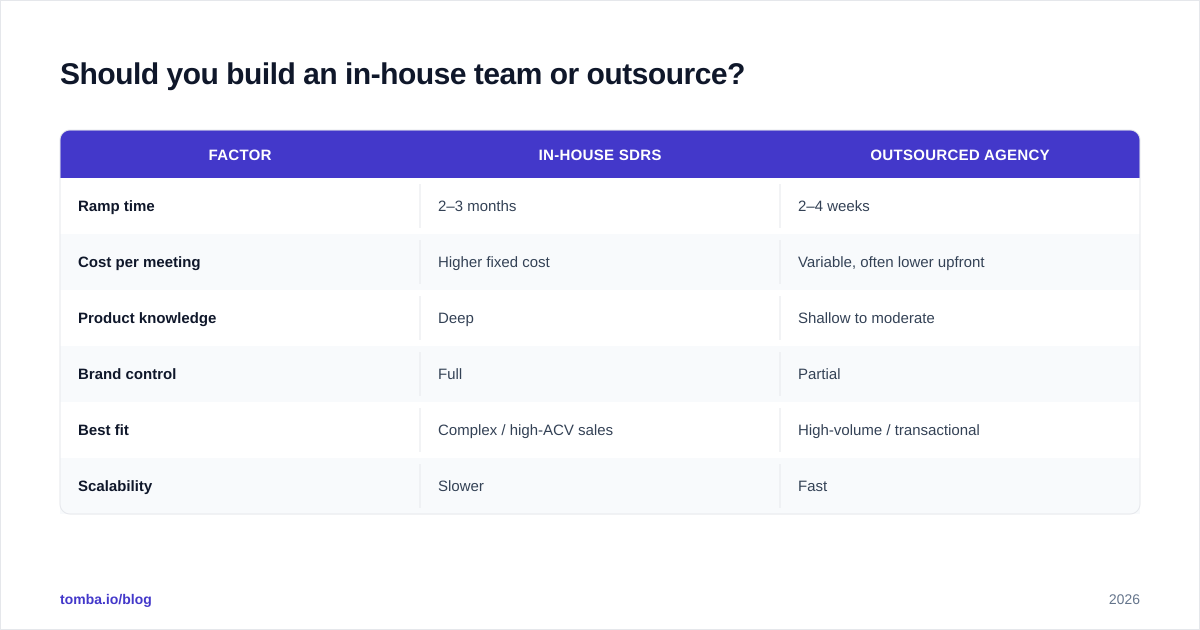
This is the perennial appointment setting question, and the honest answer is: it depends on your average contract value and how technical your sale is.
| Factor | In-house SDRs | Outsourced agency |
|---|---|---|
| Ramp time | 2–3 months | 2–4 weeks |
| Cost per meeting | Higher fixed cost | Variable, often lower upfront |
| Product knowledge | Deep | Shallow to moderate |
| Brand control | Full | Partial |
| Best fit | Complex / high-ACV sales | High-volume / transactional |
| Scalability | Slower | Fast |
A reasonable middle path: keep strategy, messaging, and qualification in-house, but outsource raw list-building and top-of-funnel dialing if you need volume fast. Whatever you choose, own your data and your messaging — those are the assets that compound. If you're weighing tooling for an in-house team, compare options against your real call volume rather than headline pricing; many platforms look cheap until you hit credit limits.
What tools power modern appointment setting?#
The stack matters less than the workflow, but the right tools remove friction at every stage:
- Prospecting data — accurate emails and direct dials. A phone finder for live conversations and an email finder for the written touches.
- Sequencer — a cadence tool (Outreach, Salesloft, Instantly, or similar) to automate timing and track replies.
- CRM — your single source of truth for response rate, stage, and ownership.
- Calendar / scheduler — frictionless booking with built-in qualification questions.
- Enrichment — fill data gaps automatically so reps never manually research a record. Contact enrichment pays for itself in saved SDR hours.
A note on data sources: tools vary wildly in coverage and accuracy by region and seniority. Cross-reference vendor claims with independent reviews on G2 before you commit budget. The cheapest tool with a 40% bounce rate is more expensive than a premium one that actually lands.
How do you keep meetings from becoming no-shows?#
Booking a meeting is only half the job — getting the prospect to actually show up is the other half. No-show rates of 20–40% are common, and every no-show is wasted pipeline.
Cut your no-show rate with these tactics:
- Confirm immediately. Send a calendar invite within 60 seconds of booking, with a clear agenda and value statement.
- Send a reminder 24 hours out, and a second one the morning of, ideally with a one-line "here's what we'll cover."
- Make rescheduling easy. A prospect who can move the meeting in one click is far better than a silent no-show.
- Add a small commitment. Ask the prospect to bring one specific question or metric — light skin-in-the-game raises show rates.
- Qualify hard up front. The strongest predictor of a no-show is weak qualification. People show up for meetings they believe will help them.
What metrics prove your strategy is working?#
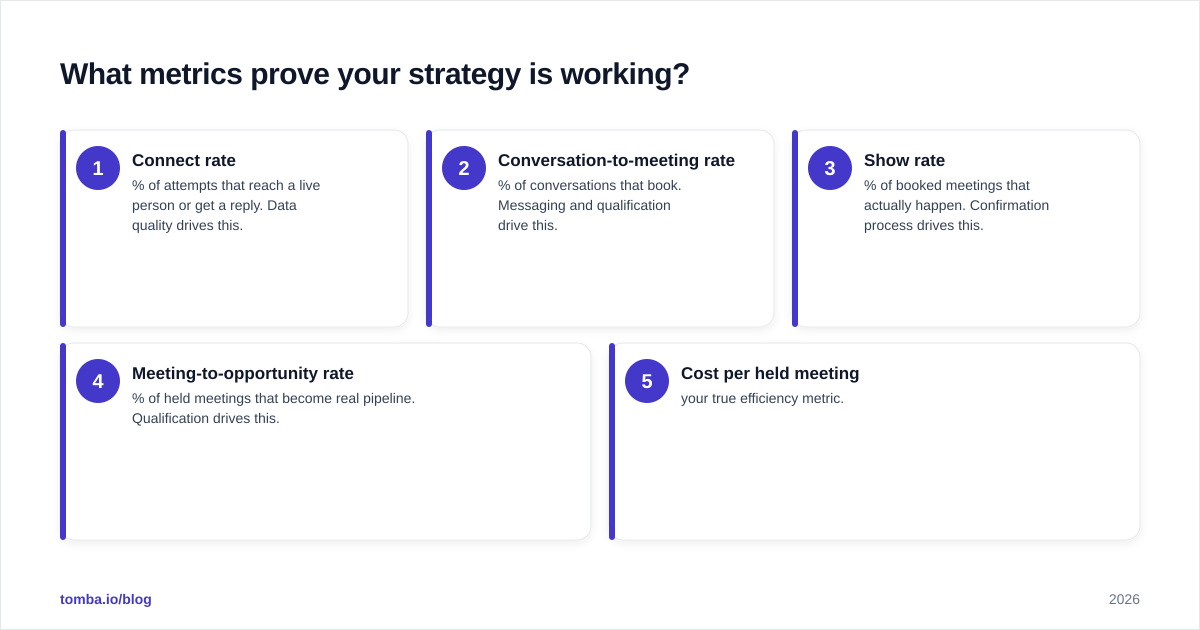
Track the full funnel, not just activity. Dialing 100 numbers a day means nothing if none convert. The metrics that matter, in order:
- Connect rate — % of attempts that reach a live person or get a reply. Data quality drives this.
- Conversation-to-meeting rate — % of conversations that book. Messaging and qualification drive this.
- Show rate — % of booked meetings that actually happen. Confirmation process drives this.
- Meeting-to-opportunity rate — % of held meetings that become real pipeline. Qualification drives this.
- Cost per held meeting — your true efficiency metric.
If connect rate is low, fix your data and channels. If show rate is low, fix your confirmation flow. If meeting-to-opportunity is low, tighten qualification. Each metric points to a specific fix — that's why you measure them separately. For a deeper view on pipeline health, the frameworks in outbound sales strategy tie these numbers back to revenue.
Common appointment setting mistakes to avoid#
- Pitching too early. The first touch earns the conversation, not the sale.
- Single-channel dependence. Email-only or phone-only campaigns leave meetings on the table.
- Skipping verification. Sending to unverified addresses tanks deliverability and reputation.
- Giving up after two touches. The follow-up gap is where competitors win.
- Booking unqualified meetings. A full calendar of bad-fit prospects is worse than an emptier one of real buyers.
Start with cleaner data#
Every appointment setting strategy in this guide rests on one foundation: knowing exactly who to contact and being able to actually reach them. No cadence, framework, or script survives a list full of bounces and wrong numbers.
Tomba's Email Finder helps you find and verify professional email addresses by name, domain, or company — so your SDRs spend their time in conversations, not in spreadsheets chasing dead contacts. Start on the free tier (25 searches a month), then scale to the Starter plan at $49/mo once your cadences are humming. See full Tomba pricing to match a plan to your team's volume. Build the list right, and the meetings follow.
// get started
Find, verify and enrich your first contacts today
Start on the free plan with 25 searches a month, then scale when your team is ready.
Free plan · No credit card required · GDPR & CCPA
// about the author