Appointment Setting vs Lead Generation: 2026 Sales Guide
Lead generation fills your pipeline; appointment setting fills your calendar. Here's how the two functions differ, where they overlap, and how to staff both in 2026.
TL;DR
- Lead generation creates and captures interest — it fills the top of your funnel with contacts and accounts who might buy.
- Appointment setting converts that interest into booked, qualified meetings on a closer's calendar — it sits lower in the funnel.
- They are sequential, not interchangeable: weak lead gen starves appointment setting; weak appointment setting wastes good leads.
- KPIs differ sharply — lead gen is measured in MQLs, cost per lead, and list quality; appointment setting in meetings booked, show rate, and meeting-to-opportunity rate.
- Most teams under 50 reps are better off fixing data accuracy first, because both functions collapse when the underlying contact data is wrong.
If you have ever watched a pile of "leads" produce zero meetings, you already understand the core tension of this article. Generating a lead and booking a meeting are two different jobs that often get budgeted as one line item — and that confusion quietly kills pipeline. Let's separate them cleanly.
What is lead generation?#
Lead generation is the work of identifying potential buyers and capturing enough information (and interest) to start a sales conversation. Think of it as stocking the shelves of a store: before anyone can buy, the products — in this case, qualified contacts — have to be on the shelf, labeled, and findable.
In practice, lead generation spans two broad motions:
- Inbound — content, SEO, paid ads, webinars, and gated assets that pull prospects to raise their hand.
- Outbound — building targeted lists, sourcing verified contact data, and reaching out cold via email, phone, or social.
The deliverable of lead generation is a lead: a person or account with a name, a role, a company, and — critically — a way to reach them. The quality of that deliverable depends almost entirely on data. A list of 5,000 names with a 30% bounce rate is not 5,000 leads; it is roughly 3,500 leads and 1,500 deliverability problems. This is why serious lead gen teams lean on an email finder and run every list through an email verifier before a single message goes out.
Lead generation is typically owned by marketing or a dedicated SDR/BDR research function. Its north-star metrics are volume and cost-efficiency: how many qualified leads, at what cost per lead, at what list accuracy.
What is appointment setting?#
Appointment setting is the work of turning a lead into a confirmed, qualified meeting with someone who can actually buy. If lead generation stocks the shelf, appointment setting is the salesperson who walks an interested shopper to the register.
An appointment setter (often an SDR, BDR, or a specialized outsourced rep) takes leads that already exist and does the persistent, human work of:
- Reaching the prospect across email, phone, and LinkedIn until they respond.
- Qualifying lightly — confirming budget, authority, need, and timing fit the offer.
- Handling objections long enough to secure a calendar slot.
- Confirming and reminding so the meeting actually happens.
The deliverable is a booked meeting — ideally one that the prospect shows up to and that converts into a real sales opportunity. Appointment setting is measured by meetings booked, show rate (did they attend?), and meeting-to-opportunity conversion. A setter who books 40 meetings a month with a 40% show rate is, in reality, delivering 16 meetings — a number that changes how you staff the role.
The defining trait of appointment setting is that it is conversion work, not discovery work. It assumes the lead already exists. Hand a setter no leads and they have nothing to set; hand them bad contact data and their dials go to disconnected numbers and their emails bounce.
Appointment setting vs lead generation: what's the real difference?#
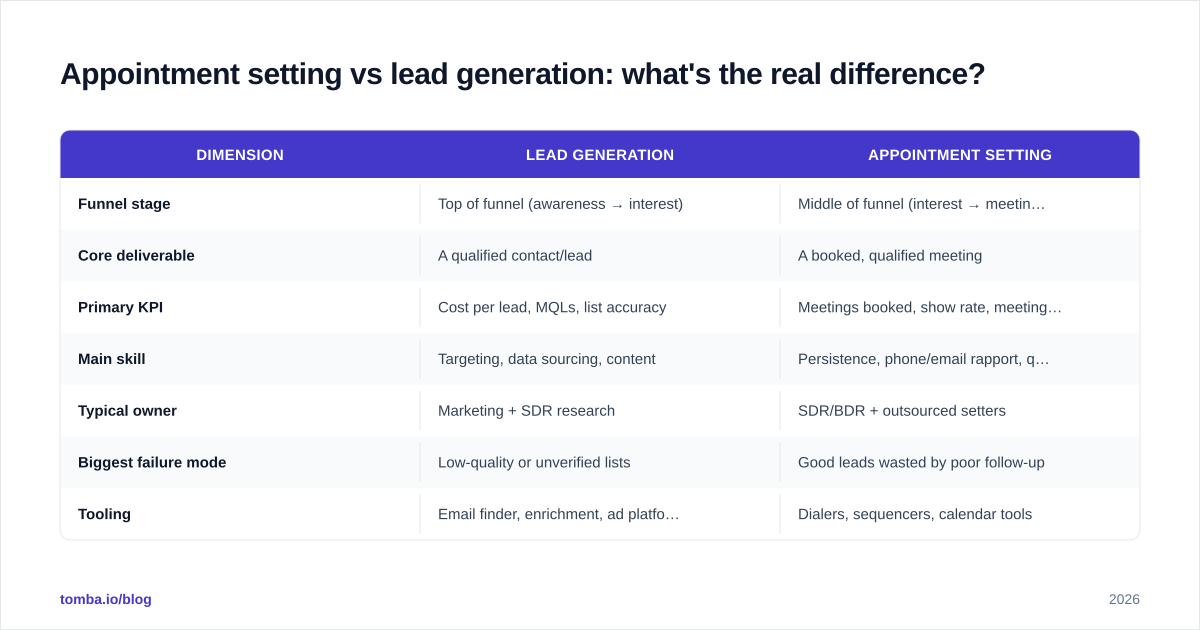
The cleanest way to see the difference is side by side. They occupy different parts of the funnel, optimize for different numbers, and fail for different reasons.
| Dimension | Lead Generation | Appointment Setting |
|---|---|---|
| Funnel stage | Top of funnel (awareness → interest) | Middle of funnel (interest → meeting) |
| Core deliverable | A qualified contact/lead | A booked, qualified meeting |
| Primary KPI | Cost per lead, MQLs, list accuracy | Meetings booked, show rate, meeting-to-opp rate |
| Main skill | Targeting, data sourcing, content | Persistence, phone/email rapport, qualifying |
| Typical owner | Marketing + SDR research | SDR/BDR + outsourced setters |
| Biggest failure mode | Low-quality or unverified lists | Good leads wasted by poor follow-up |
| Tooling | Email finder, enrichment, ad platforms | Dialers, sequencers, calendar tools |
| Time horizon | Builds the pool | Drains the pool into the calendar |
A practical rule of thumb: lead generation is a volume problem; appointment setting is a conversion problem. If your pipeline is empty, you have a lead gen gap. If your pipeline is full but your closers have no meetings, you have an appointment-setting gap. Diagnosing which one you have is the first decision — and teams frequently misdiagnose, throwing more leads at a conversion problem or hiring more setters to compensate for a data problem.

Why do teams confuse the two — and what does it cost?#
The confusion is structural. Both functions are often handled by the same SDR team, reported in the same dashboard, and sometimes performed by the same person on the same day. When one rep researches a list in the morning and dials it in the afternoon, the boundary blurs.
The cost of blurring it is real:
- You can't diagnose the bottleneck. If "leads" and "meetings" live in one bucket, you can't tell whether you need better targeting or better follow-up.
- You set the wrong quotas. Holding a pure researcher to a meetings-booked quota — or a closer-style setter to a list-volume quota — burns out good people.
- You buy the wrong tools. Lead gen problems get solved with data tools; appointment-setting problems get solved with sequencing and dialer tools. Mix them up and you overspend on both.
According to industry analysts like Gartner and peer-review platforms like G2, the highest-performing sales orgs increasingly split these into distinct roles with distinct metrics — precisely so they can optimize each independently. The split isn't bureaucracy; it's how you see the system clearly.
Which one does your business need first?#
Conclusion first: fix data accuracy before you scale either function. Both lead generation and appointment setting sit on top of contact data, and both degrade in lockstep when that data is wrong. A 2026 list decays faster than ever — people change jobs, companies rebrand, and catch-all domains hide invalid addresses. Start there.
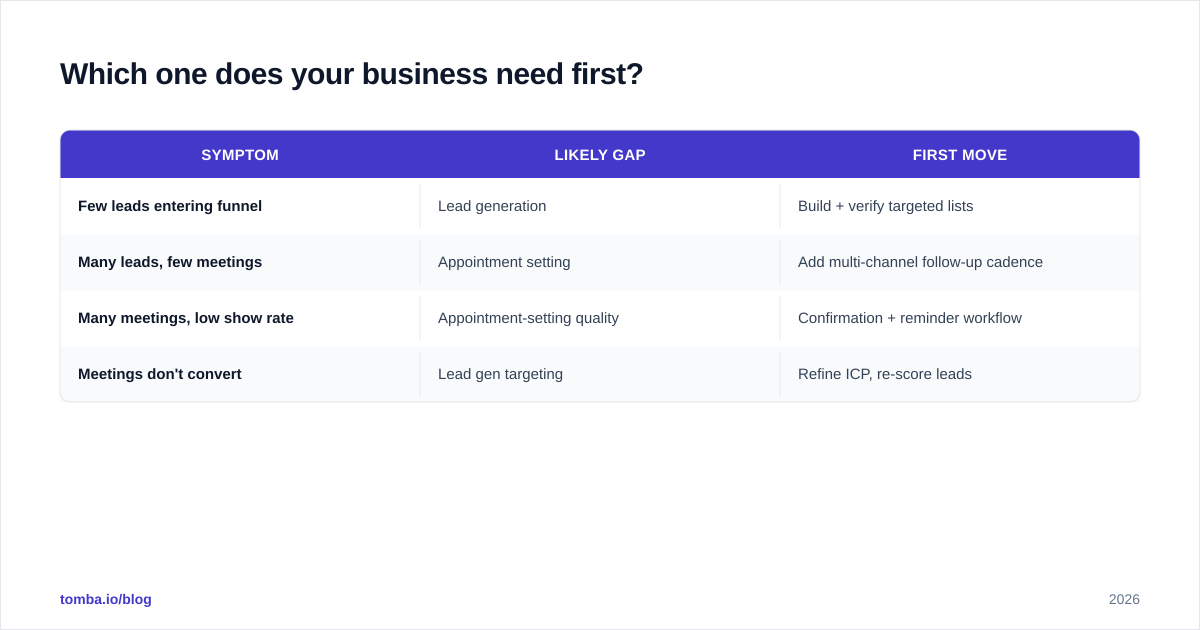
Once your data foundation is solid, sequence your investment by symptom:
- Empty pipeline, no inbound → invest in lead generation. Build targeted lists with a domain search to map every reachable contact at your ICP accounts, then enrich and verify.
- Full pipeline, few meetings → invest in appointment setting. Your leads exist; you need persistent multi-channel follow-up and tighter qualifying.
- Meetings booked, low show rate → this is an appointment-setting quality problem, usually fixed with better confirmation workflows and stronger qualification, not more leads.
- Meetings happen but never become deals → your lead gen targeting is off; you're booking the wrong people. Go back to ICP and list quality.
Here is a simple decision frame:
| Symptom | Likely gap | First move |
|---|---|---|
| Few leads entering funnel | Lead generation | Build + verify targeted lists |
| Many leads, few meetings | Appointment setting | Add multi-channel follow-up cadence |
| Many meetings, low show rate | Appointment-setting quality | Confirmation + reminder workflow |
| Meetings don't convert | Lead gen targeting | Refine ICP, re-score leads |
Notice that two of the four symptoms trace back to lead generation quality. That's not a coincidence — when appointment setting "fails," the root cause is often upstream: bad targeting or bad data dressed up as a conversion problem.
How does contact data sit underneath both?#
Both functions are only as good as the contact record they act on. This is the quiet truth that vendors selling dialers and content engines rarely lead with.
For lead generation, data accuracy determines whether your list is a real audience or a deliverability liability. Sending cold email to unverified addresses spikes your bounce rate, which damages your sender reputation, which lowers inbox placement for every future send — including the good addresses. Verifying contacts and screening risky domains with a catch-all verifier protects the asset you spent money to build.
For appointment setting, data accuracy determines whether the setter ever reaches a human. A setter working a list with wrong phone numbers and bounced emails will post terrible numbers that look like a skill problem but are actually a data problem. Give that same setter verified mobile numbers and confirmed inboxes and their booked-meeting rate often doubles without any change in talent.
This is why the smartest 2026 teams treat data enrichment as shared infrastructure for both functions. A single enriched, verified record — name, role, verified email, direct phone, LinkedIn — serves the lead gen team building the list and the appointment setter working it. Tools like data enrichment and a bulk email finder let you build and clean that record at scale rather than one painful lookup at a time.
A useful way to think about it: data quality is the soil. You can plant lead generation seeds and appointment-setting crops in it, but neither grows in poisoned ground.
In-house vs outsourced: how should you staff each?#
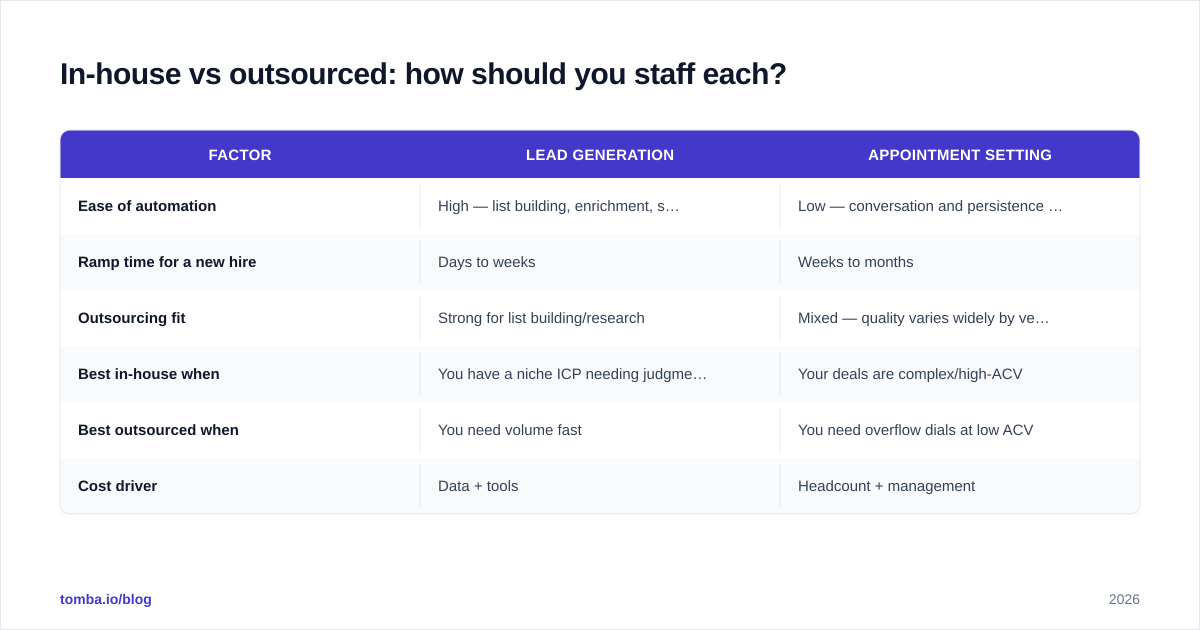
Staffing decisions differ for the two functions because the skills differ. Lead generation research can be partly automated and is relatively easy to train; appointment setting is human-intensive, rapport-driven, and harder to outsource well.
| Factor | Lead Generation | Appointment Setting |
|---|---|---|
| Ease of automation | High — list building, enrichment, scoring | Low — conversation and persistence are human |
| Ramp time for a new hire | Days to weeks | Weeks to months |
| Outsourcing fit | Strong for list building/research | Mixed — quality varies widely by vendor |
| Best in-house when | You have a niche ICP needing judgment | Your deals are complex/high-ACV |
| Best outsourced when | You need volume fast | You need overflow dials at low ACV |
| Cost driver | Data + tools | Headcount + management |
A common 2026 pattern: keep appointment setting in-house for high-value deals (where a booked meeting is worth thousands and rapport matters), while using tools and lighter automation to scale the lead generation and data layer underneath. This keeps your most human-dependent function close and your most automatable function efficient.
If you do outsource appointment setting, judge the vendor on show rate and meeting-to-opportunity rate, not raw meetings booked. A vendor can hit a meetings quota by booking anyone with a pulse; only show rate and conversion reveal whether those meetings are real. Reference checks on platforms like HubSpot's ecosystem and G2 reviews help separate the genuine performers from the meeting-spammers.
What metrics actually matter for each in 2026?#
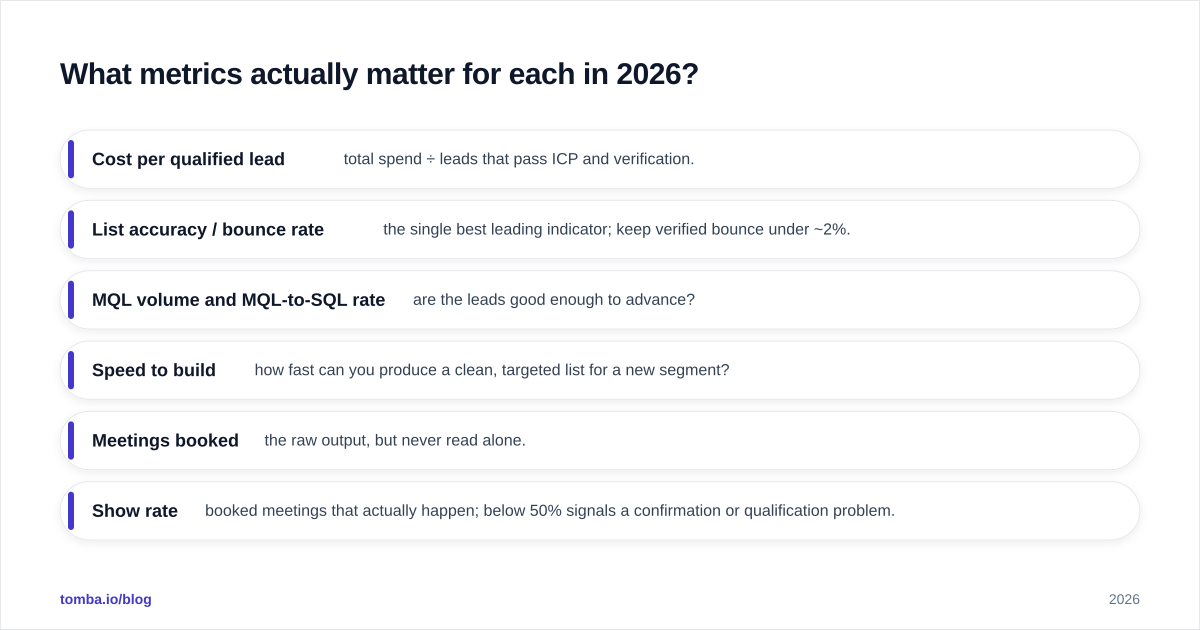
Measure each function by its own deliverable, never by a blended number. Here is the scorecard that keeps the two honest.
Lead generation scorecard
- Cost per qualified lead — total spend ÷ leads that pass ICP and verification.
- List accuracy / bounce rate — the single best leading indicator; keep verified bounce under ~2%.
- MQL volume and MQL-to-SQL rate — are the leads good enough to advance?
- Speed to build — how fast can you produce a clean, targeted list for a new segment?
Appointment setting scorecard
- Meetings booked — the raw output, but never read alone.
- Show rate — booked meetings that actually happen; below 50% signals a confirmation or qualification problem.
- Meeting-to-opportunity rate — meetings that become real pipeline.
- Touches per meeting — how much effort each booking costs; rising touches with flat bookings means your data or messaging is decaying.
The relationship between these two scorecards is the whole game. If lead gen's list accuracy is high but appointment setting's touches-per-meeting is climbing, your messaging or targeting is off. If appointment setting's show rate is healthy but meeting-to-opportunity is low, your lead gen is booking the wrong personas. Reading the two scorecards together — rather than collapsing them into one "leads" number — is how you find the actual leak. You can dig deeper into benchmarks like email response rate in the Tomba glossary.
A final word on attribution: resist the urge to credit a closed deal to a single function. Lead generation found the account, appointment setting earned the meeting, and the closer won the deal. Reward the chain, not one link — otherwise your team optimizes for whichever number gets them paid, and the other function quietly atrophies.
Putting it together: a simple operating model#
To run both functions without confusing them, hold three things separate:
- The data layer — shared, verified, enriched contact records that feed everything. Invest here first; it multiplies the return on the other two.
- The lead generation engine — owns volume and targeting, measured by cost per qualified lead and list accuracy.
- The appointment-setting motion — owns conversion, measured by show rate and meeting-to-opportunity rate.
When all three are distinct and instrumented, you can finally answer the question that started this article — why did those leads produce no meetings? — with a real diagnosis instead of a guess. Usually the answer is one of two things: the leads were never verified, or the follow-up was never persistent enough. Both are fixable once you stop treating them as the same job.
Start with the layer that makes both work#
Appointment setting and lead generation will both stall on bad data, so the highest-leverage first move is fixing the contact layer underneath them. Use the Tomba Email Finder to build accurate, targeted lists by name, company, or domain — and verify them before your SDRs ever dial or send. Whether you're filling the funnel or filling the calendar, starting with verified contacts means every lead your team generates and every meeting your setters book rests on data you can trust. Spin up a free account (25 searches a month), and when you're ready to scale, Tomba pricing starts at $49/mo for Starter — a fraction of the cost of one wasted SDR week chasing dead contacts.
// get started
Find, verify and enrich your first contacts today
Start on the free plan with 25 searches a month, then scale when your team is ready.
Free plan · No credit card required · GDPR & CCPA
// about the author