Archetype Data Alternatives: 8 Best B2B Tools for 2026
Outgrown Archetype's pricing or coverage? Here are the 8 best Archetype Data alternatives for 2026, compared on accuracy, pricing, and real-world fit.
Archetype Data promises clean, structured B2B records on tap. But once your team scales outreach, the cracks show: per-record pricing that balloons, coverage gaps in regions you actually sell into, and enrichment that feels stale by the time it hits your CRM. If any of that sounds familiar, you are not alone — and you have options.
This guide breaks down the 8 best Archetype Data alternatives for 2026, scored on the things that actually move pipeline: data accuracy, pricing transparency, coverage, and how cleanly each one fits into an existing stack.
TL;DR#
- Best overall value: Tomba combines an email finder, verifier, and enrichment under one transparent plan starting at $49/mo — no per-record surprises.
- Best for enterprise firmographics: Clearbit (now part of HubSpot) if budget is not the constraint.
- Best free tier to test with: Tomba's free plan gives you 25 searches/mo before you commit.
- Watch the hidden cost: "Per-enriched-record" pricing models (Archetype included) get expensive fast at scale — flat-rate or credit pooling usually wins.
- Accuracy beats volume: A smaller, verified dataset outperforms a huge stale one every time. Always test bounce rates before you switch.
What is Archetype Data and why look for alternatives?#
Archetype Data is a B2B data and enrichment platform that supplies contact and company records — firmographics, technographics, and contact details — usually consumed through an API or a CRM sync. Teams use it to fill in missing fields on leads, build target lists, and power outbound at scale.
It does that job. So why do teams shop around? Three recurring reasons:
- Pricing that scales the wrong way. Many enrichment platforms charge per enriched record. That is fine at 500 records a month and painful at 50,000. Costs grow linearly with your ambition, which punishes the exact teams that succeed.
- Coverage gaps. No single provider has every contact. If your ICP skews toward a region, industry, or company size that a vendor under-indexes, your match rate quietly tanks — and you only notice when reply rates drop.
- Decay. B2B data rots at roughly 22–30% per year as people change jobs. A dataset's freshness matters more than its raw size, and not every vendor refreshes aggressively.
Think of B2B data like fresh produce. A warehouse stacked to the ceiling means nothing if half of it spoiled last quarter. What you want is a supplier with fast turnover, honest labeling, and a price that does not change every time you fill a bigger basket.

What should you compare when evaluating alternatives?#
Before you look at logos, lock down your evaluation criteria. The teams that switch tools and regret it usually optimized for the wrong number (often raw database size).
Here is the checklist that actually predicts success:
- Verified accuracy / bounce rate. Ask for the verification method and a guaranteed bounce ceiling. A finder that returns "guessed" emails costs you sender reputation. Pair any finder with email verification so you never send to a dead inbox.
- Match rate on your ICP. A 90% global match rate is meaningless if it is 40% for your specific segment. Always run a sample of your real list through a free trial.
- Pricing model. Flat-rate or pooled credits beat per-record billing for most scaling teams. Read the Tomba pricing page as a benchmark for what transparent looks like.
- Coverage depth. Emails only, or emails plus phone, LinkedIn, and firmographics? Consolidating reduces tool sprawl.
- Integration surface. Native CRM sync, a clean API, a Chrome extension, spreadsheet add-ons. Friction here kills adoption.
- Compliance. GDPR/CCPA posture and clear data sourcing. Check how each vendor documents where its data comes from.
What are the 8 best Archetype Data alternatives in 2026?#
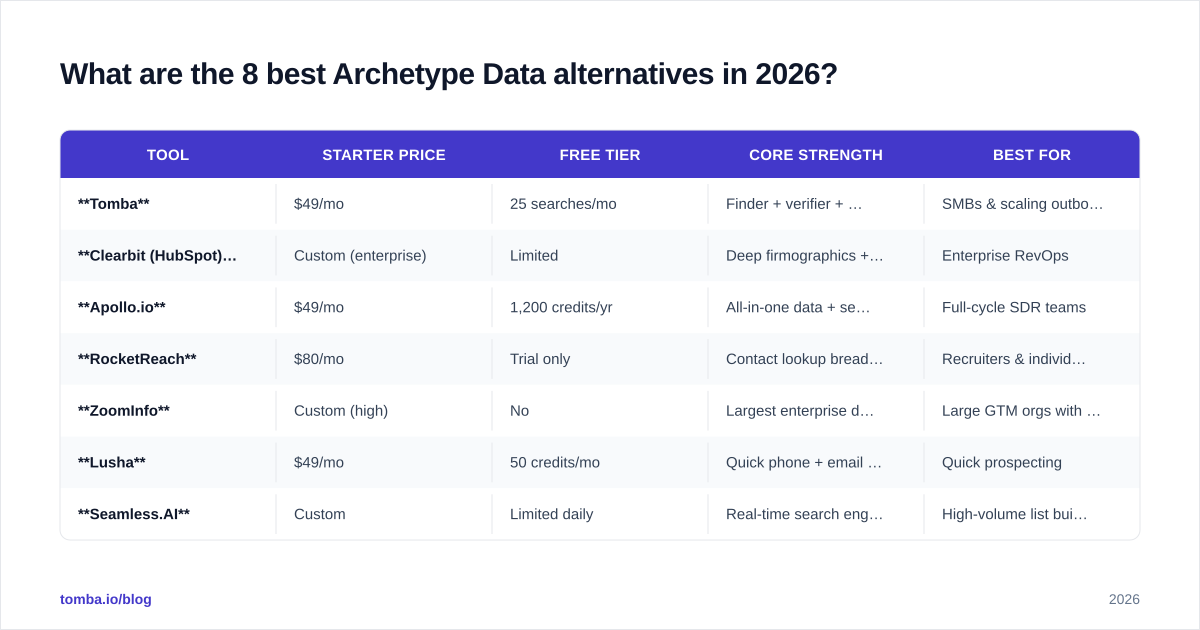
Here is the head-to-head. Pricing reflects entry-level paid plans at the time of writing; always confirm on the vendor's site since tiers shift.
| Tool | Starter price | Free tier | Core strength | Best for |
|---|---|---|---|---|
| Tomba | $49/mo | 25 searches/mo | Finder + verifier + enrichment in one | SMBs & scaling outbound teams |
| Clearbit (HubSpot) | Custom (enterprise) | Limited | Deep firmographics + HubSpot-native | Enterprise RevOps |
| Apollo.io | $49/mo | 1,200 credits/yr | All-in-one data + sequencing | Full-cycle SDR teams |
| RocketReach | $80/mo | Trial only | Contact lookup breadth | Recruiters & individual reps |
| ZoomInfo | Custom (high) | No | Largest enterprise database | Large GTM orgs with budget |
| Lusha | $49/mo | 50 credits/mo | Quick phone + email lookup | Quick prospecting |
| Seamless.AI | Custom | Limited daily | Real-time search engine | High-volume list building |
| Hunter | $49/mo | 25 searches/mo | Simple domain search | Lightweight email finding |
A few honest notes on the field:
- Clearbit is excellent if you already live inside HubSpot and have enterprise budget. Outside that ecosystem, the value drops. See the breakdown on Clearbit alternatives if that is your starting point.
- ZoomInfo has the deepest enterprise database, but pricing and annual contracts put it out of reach for most SMBs.
- Apollo and Seamless.AI bundle data with sequencing, which is great if you want one tool — but you trade some data precision for the convenience.
- Hunter and Lusha are clean, simple finders, but lighter on enrichment and bulk workflows.
Why does Tomba lead the value comparison?#
Short answer: it folds finding, verifying, and enriching into one transparent subscription, so your cost per usable contact stays predictable as you scale.
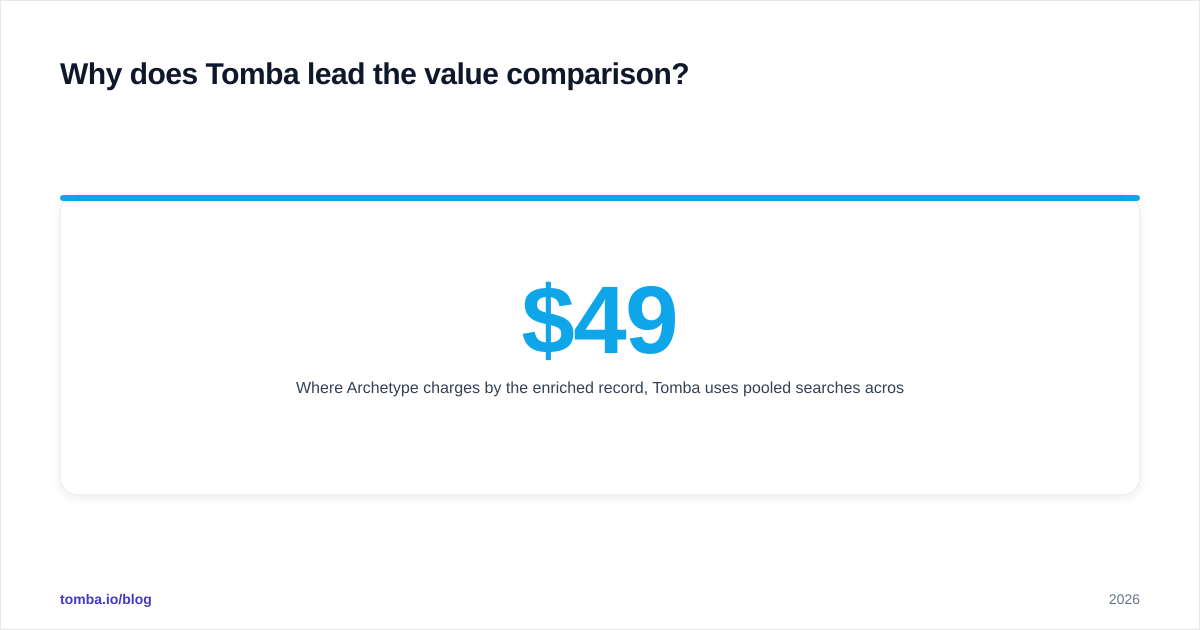
Where Archetype charges by the enriched record, Tomba uses pooled searches across plans — Free (25/mo), Starter ($49/mo), Growth ($99/mo), Pro ($249/mo), and Enterprise. You are not penalized for a good month.
The product surface covers most of what teams cobble together from three vendors:
- The email finder locates professional addresses by name, domain, or company.
- The data enrichment layer fills firmographic and contact fields on existing records.
- The Tomba API, CLI, Chrome extension, and Google Sheets add-on mean you can wire it into whatever you already run.
Crucially, every email runs through verification before it reaches you, which keeps bounce rates low and protects sender reputation — the thing that actually determines whether your cold email lands in the inbox.

How do the pricing models actually compare?#
This is where switching pays off, so it deserves its own look. The headline number is rarely the real cost — the model is.
| Pricing model | How it scales | Risk | Typical fit |
|---|---|---|---|
| Per enriched record (Archetype-style) | Cost rises 1:1 with volume | Budget shock at scale | Low, steady volume |
| Pooled credits / searches (Tomba) | Predictable monthly ceiling | Right-sizing the tier | Scaling outbound |
| Enterprise annual contract (ZoomInfo, Clearbit) | Negotiated, high floor | Lock-in, overpay if usage dips | Large orgs |
| Bundled platform (Apollo, Seamless) | Tiered seats + credits | Paying for unused features | Full-cycle teams |
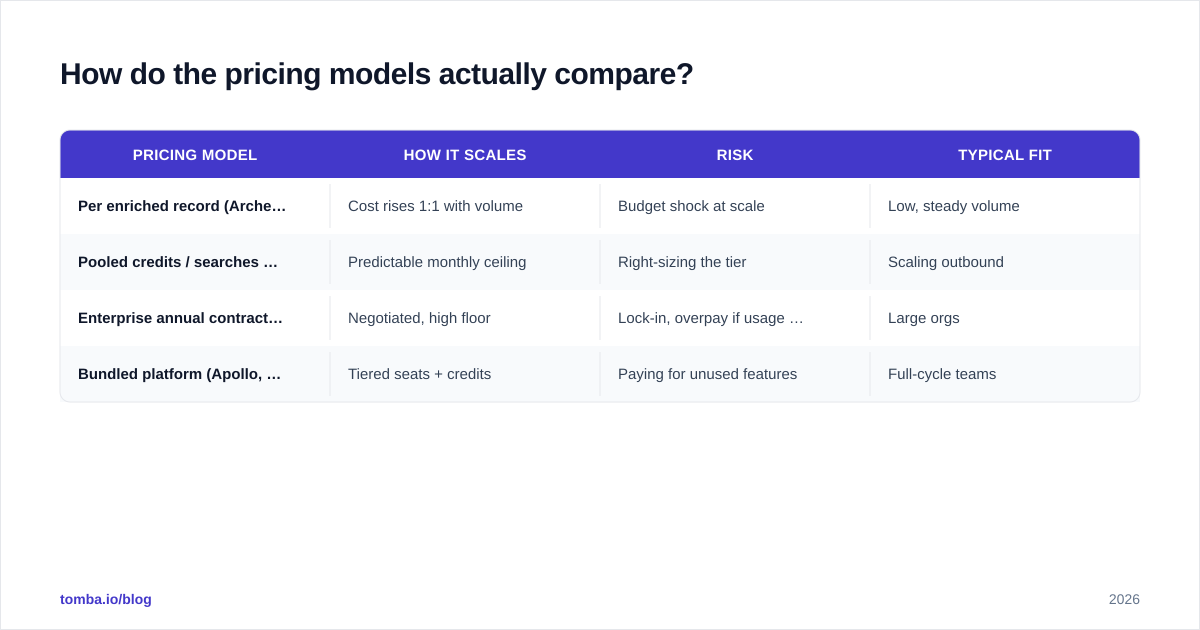
The pattern: if your volume is growing, a flat or pooled model protects you. Run the math on your real monthly enrichment count against each model before you sign anything. For high-volume needs, a bulk email finder workflow on a pooled plan almost always beats per-record billing.
What about data accuracy and freshness?#
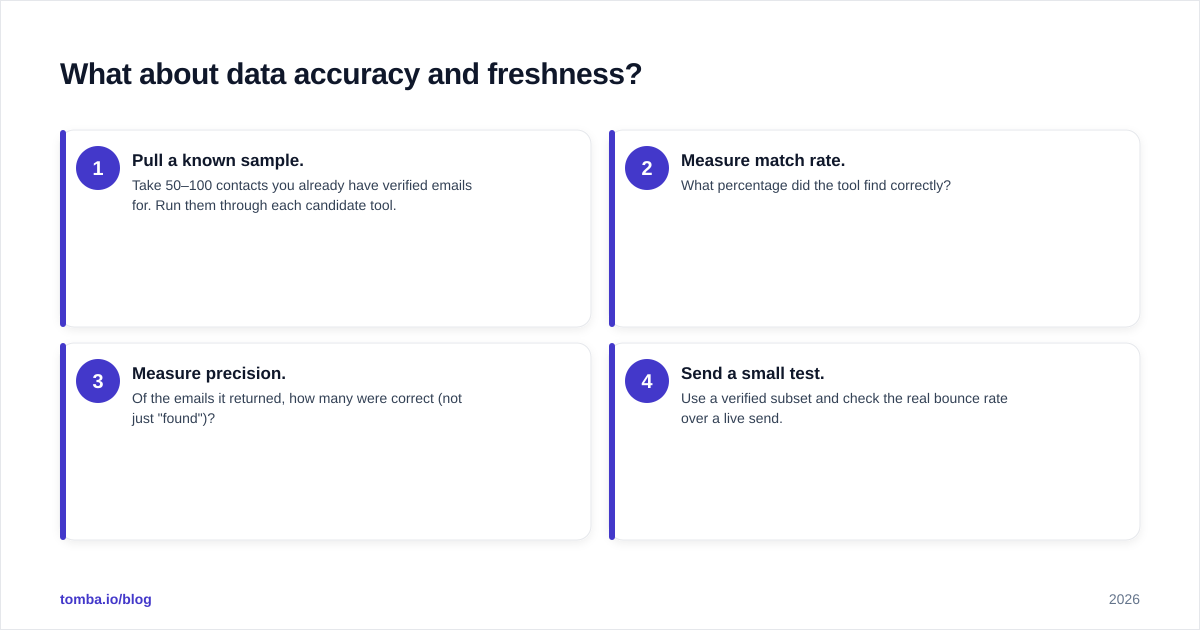
Accuracy is the quiet differentiator, and it is hard to judge from a marketing page. Here is how to test it honestly during a trial:
- Pull a known sample. Take 50–100 contacts you already have verified emails for. Run them through each candidate tool.
- Measure match rate. What percentage did the tool find correctly?
- Measure precision. Of the emails it returned, how many were correct (not just "found")?
- Send a small test. Use a verified subset and check the real bounce rate over a live send.
A tool that returns fewer emails but at higher precision will outperform a high-volume tool with a 12% bounce rate — because bounces damage your domain and shrink your future reach. Independent reviews on G2 and Capterra are useful for sniffing out which vendors quietly struggle with freshness, since reviewers tend to flag stale data loudly.
If you are unsure how data quality compounds, the concept of data decay is worth understanding: records degrade continuously, so a vendor's refresh cadence matters as much as its starting accuracy.
Which alternative is right for your team?#
Match the tool to your situation rather than chasing the biggest database:
- You are an SMB or scaling startup and want predictable costs across finding, verifying, and enriching → Tomba. The free tier lets you validate match rate on your ICP before paying.
- You are deep in the HubSpot ecosystem with enterprise budget → Clearbit.
- You run a full-cycle SDR motion and want data plus sequencing in one tool → Apollo.io.
- You are a large GTM org that needs the deepest database and can absorb annual contracts → ZoomInfo.
- You need fast, lightweight lookups for individual prospecting → Lusha or Hunter.
For most teams leaving Archetype because of cost or coverage, the decisive factor is consolidation: replacing two or three point tools (finder + verifier + enrichment) with one transparent plan. That is the lane where the math tilts hardest in your favor.
How do you switch without disrupting your pipeline?#
Switching data vendors sounds scary; it does not have to be. Run a parallel test:
- Keep Archetype live for one billing cycle.
- Run the new tool in parallel on the same lists via its API or Chrome extension.
- Compare match rate, precision, and bounce rate on identical inputs.
- Cut over only once the new tool meets or beats your baseline on your real data.
This costs you one overlapping month and removes nearly all the risk. No team should switch on a vendor's claimed numbers alone — switch on your numbers.
Frequently asked questions#
Is there a free Archetype Data alternative? Yes. Tomba's free tier includes 25 searches per month, and Hunter offers a comparable free allowance. Both let you validate accuracy on your own list before paying.
What is the cheapest reliable alternative? Tomba, Lusha, Hunter, and Apollo all start at $49/mo. The deciding factor is what you get for that price — Tomba bundles verification and enrichment, which others charge extra for.
Do I need a separate email verifier? Only if your finder does not verify. Tomba verifies inline; if your tool does not, add a dedicated email verifier to protect deliverability.
The bottom line#
Archetype Data is a capable platform, but per-record pricing and coverage gaps push many growing teams to look elsewhere. The best alternative is the one that matches your ICP at high precision, prices predictably as you scale, and consolidates the finder–verifier–enrichment workflow you are probably paying three vendors for today.
Ready to test a cleaner, flat-rate option? Start with the Tomba Email Finder — find and verify professional emails by name, domain, or company, run your real ICP through the free 25-search tier, and see your true match and bounce rates before you spend a dollar. If the numbers beat your current setup, scaling up is a single transparent plan away.
Ready to find emails that actually work?
Join 150,000+ professionals who stopped guessing and started sending. Free credits on signup — no credit card required.
Get the Tomba newsletter
Practical outbound tactics and product updates — once every two weeks.
About the author