Archetype Data Pricing, Reviews, Pros and Cons (2026)
An independent breakdown of Archetype data: what it costs, how real users rate it, where it shines, and where it falls short for B2B prospecting teams in 2026.
Archetype positions itself as a B2B data and signal platform: contact records, firmographics, and buying-intent signals stitched into one workspace so revenue teams can find and prioritize accounts. The harder question — the one that brings you to a page titled "Archetype data pricing reviews pros and cons" — is whether it earns its price relative to what you actually need.
This is a neutral teardown. No vendor talking points dressed up as analysis. Here is what Archetype costs, what real reviewers say, the genuine strengths, the genuine weaknesses, and where a leaner email-and-enrichment stack does the same job for less.
TL;DR#
- Pricing is quote-based. Archetype does not publish transparent self-serve tiers; most teams land on annual contracts negotiated by seat and data volume, which makes side-by-side budgeting hard.
- Reviews are solid but thin. Ratings cluster in the 4.2–4.6 range on the major review sites, with praise for intent signals and complaints about onboarding and contract rigidity.
- Best for: mid-market and enterprise GTM teams that want intent + firmographics in one place and have budget to match.
- Weak for: SMBs, founders, and lean outbound teams who mainly need accurate emails and on-demand enrichment without an annual lock-in.
- The honest alternative: a transparent email finder plus pay-as-you-go enrichment covers 80% of the prospecting job at a fraction of the cost.
What is Archetype data?#
Archetype is a B2B data intelligence platform. The core promise is consolidation: instead of buying contacts from one vendor, intent from another, and firmographics from a third, you get a single record that combines who a person is, where they work, and whether their company is showing buying behavior.
In practice that means three layers stacked together:
- Contact and company data — names, titles, emails, phone numbers, employee counts, revenue bands, tech stack.
- Intent and signals — topic surges, hiring activity, funding events, and other triggers meant to tell you when an account is in-market.
- Workflow tooling — list building, segmentation, and CRM sync so the data lands where reps work.
If you have used Apollo, ZoomInfo, or Clearbit, the category is familiar. Archetype's pitch is that its signal layer is sharper and its records are cleaner. Whether that holds up depends entirely on your territory and ICP, which is exactly why pricing transparency matters so much — you cannot validate the value without testing it first.
How much does Archetype data cost in 2026?#
Short answer: Archetype does not publish a clean public price list, and that is the single biggest friction point in evaluating it. Pricing is quote-based and negotiated per organization, which typically means an annual commitment scaled by the number of seats, the volume of records you export or enrich, and which signal modules you switch on.
That model is standard for the enterprise data category —
ZoomInfo, 6sense, and Demandbase all do the same. It is also the model buyers complain about most, because you cannot benchmark a number that only appears after a sales call.
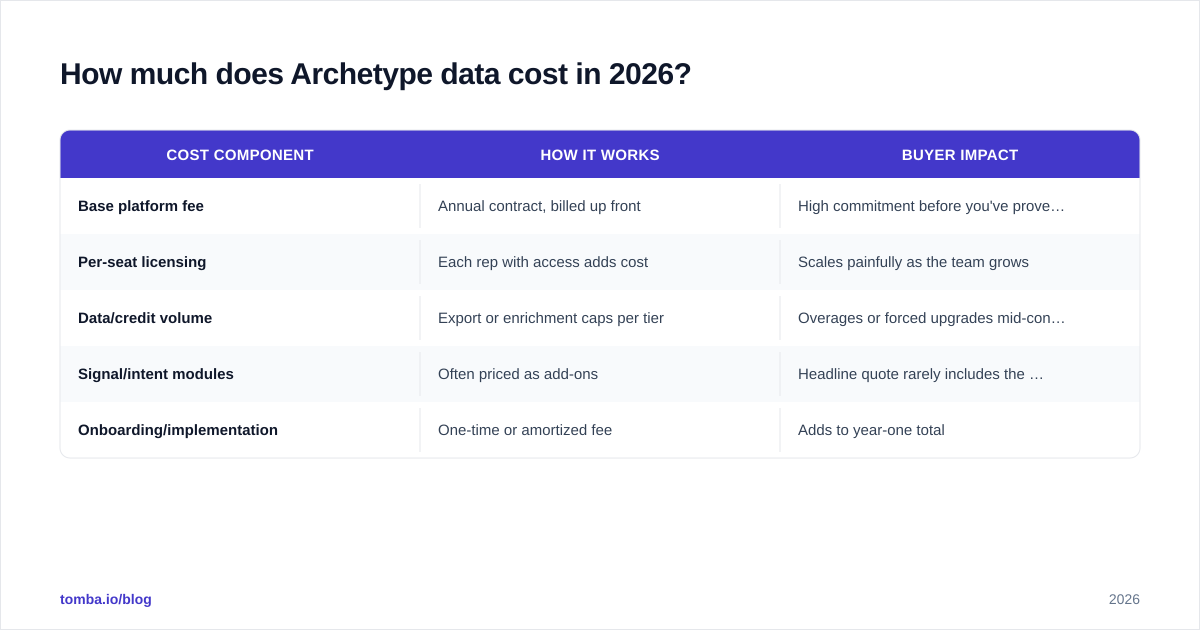
Here is how the cost structure generally breaks down for platforms in this tier:
| Cost component | How it works | Buyer impact |
|---|---|---|
| Base platform fee | Annual contract, billed up front | High commitment before you've proven ROI |
| Per-seat licensing | Each rep with access adds cost | Scales painfully as the team grows |
| Data/credit volume | Export or enrichment caps per tier | Overages or forced upgrades mid-contract |
| Signal/intent modules | Often priced as add-ons | Headline quote rarely includes the part you wanted |
| Onboarding/implementation | One-time or amortized fee | Adds to year-one total |
Compare that to a transparent, self-serve model. Tomba pricing is published on the page: a free tier with 25 searches per month, Starter at $49/mo, Growth at $99/mo, Pro at $249/mo, and custom Enterprise. You can do the math before you ever talk to anyone — which is the opposite of the quote-based experience.
The takeaway is not that quote-based pricing is automatically bad. For a 200-rep org consuming millions of records, negotiated enterprise pricing can be efficient. For everyone smaller, the lack of a published entry price is a real cost in time, leverage, and budget predictability.
What do Archetype reviews actually say?#
Aggregate sentiment is positive but not effusive. Across the major directories — G2 and Capterra — platforms in this category tend to land in the 4.2 to 4.6 star range, and Archetype sits comfortably in that band. The pattern in the written reviews is more instructive than the star average.
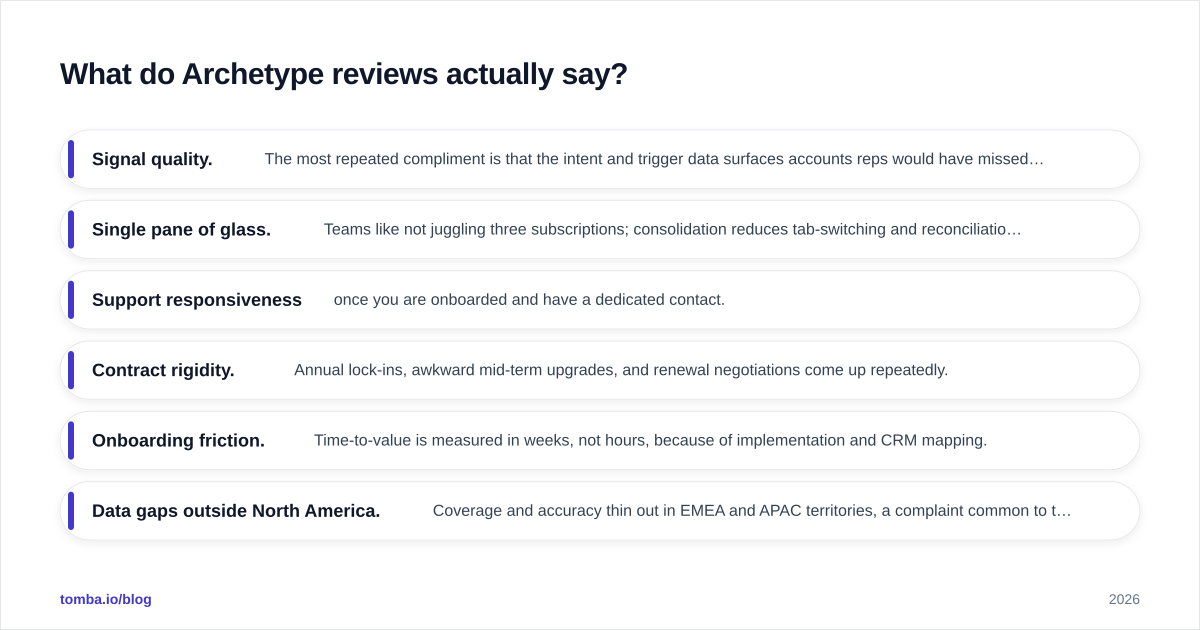
What reviewers consistently praise:
- Signal quality. The most repeated compliment is that the intent and trigger data surfaces accounts reps would have missed, and that timing matters more than raw volume.
- Single pane of glass. Teams like not juggling three subscriptions; consolidation reduces tab-switching and reconciliation work.
- Support responsiveness once you are onboarded and have a dedicated contact.
What reviewers consistently criticize:
- Contract rigidity. Annual lock-ins, awkward mid-term upgrades, and renewal negotiations come up repeatedly.
- Onboarding friction. Time-to-value is measured in weeks, not hours, because of implementation and CRM mapping.
- Data gaps outside North America. Coverage and accuracy thin out in EMEA and APAC territories, a complaint common to the whole category.
- Price opacity — the same theme as above, surfacing in reviews as "great product, wish I knew what I was signing up for."
Read reviews with the usual caveat: vendors curate their happiest customers toward review sites, and the negative reviews are often the most honest signal about what breaks at scale. If accuracy in a specific region is your make-or-break, run a paid pilot on your own list rather than trusting any aggregate score.
What are the pros and cons of Archetype data?#
Here is the balanced ledger, stripped of marketing language.
| Archetype data | |
|---|---|
| Pros | Combined contact + intent + firmographics in one platform |
| Strong buying-signal layer for account prioritization | |
| Mature CRM sync and segmentation workflows | |
| Good fit for mid-market and enterprise GTM motions | |
| Cons | No transparent self-serve pricing; quote-based only |
| Annual contracts with limited flexibility | |
| Onboarding overhead before value appears | |
| Coverage weaker outside North America | |
| Overkill for teams that mainly need verified emails |
The honest summary: Archetype is a capable platform for a specific buyer — a funded revenue team running account-based motions that genuinely uses intent signals to sequence outreach. The strengths are real. The weaknesses are mostly about fit and commitment, not about the data being bad.
The trap is buying enterprise tooling for an SMB problem. If your actual job is "find the right person's email and confirm it's deliverable," you are paying for a signal engine you will never fully use.
Is Archetype worth it, or is there a leaner alternative?#
It depends on which job you are hiring the tool to do. Break your need into two buckets:
- "I need to know which accounts to chase and when." That is the intent/signal job. Archetype and the enterprise data platforms earn their keep here — if you have the budget and a team that operationalizes signals.
- "I need accurate contact details and clean records to run outreach." That is the find-and-verify job. You do not need a six-figure platform for it.
Most teams over-index on bucket one and underinvest in bucket two — then wonder why their deliverability and reply rates are mediocre. The expensive signal data is worthless if the email bounces.

For the find-and-verify job, a focused stack is dramatically cheaper and faster to deploy. An email finder locates the right professional address by name and domain, an email verifier confirms it is deliverable before you send, and on-demand data enrichment fills in the firmographic fields you need for routing and personalization. No annual lock-in, no implementation project, and a published price you can sanity-check in thirty seconds.
Archetype vs. a transparent find-and-verify stack#
| Feature | Archetype (signal platform) | Tomba (find + verify + enrich) |
|---|---|---|
| Pricing model | Quote-based, annual contract | Published self-serve tiers |
| Entry price | Custom (sales call required) | Free (25 searches/mo), then $49/mo |
| Time to first value | Weeks (onboarding) | Minutes |
| Email finder + verifier | Bundled in broader suite | Core product, purpose-built |
| Intent/buying signals | Strong, native | Not the focus |
| Best fit | Enterprise ABM teams | SMBs, founders, lean outbound |
| Commitment risk | High (lock-in) | Low (cancel anytime) |
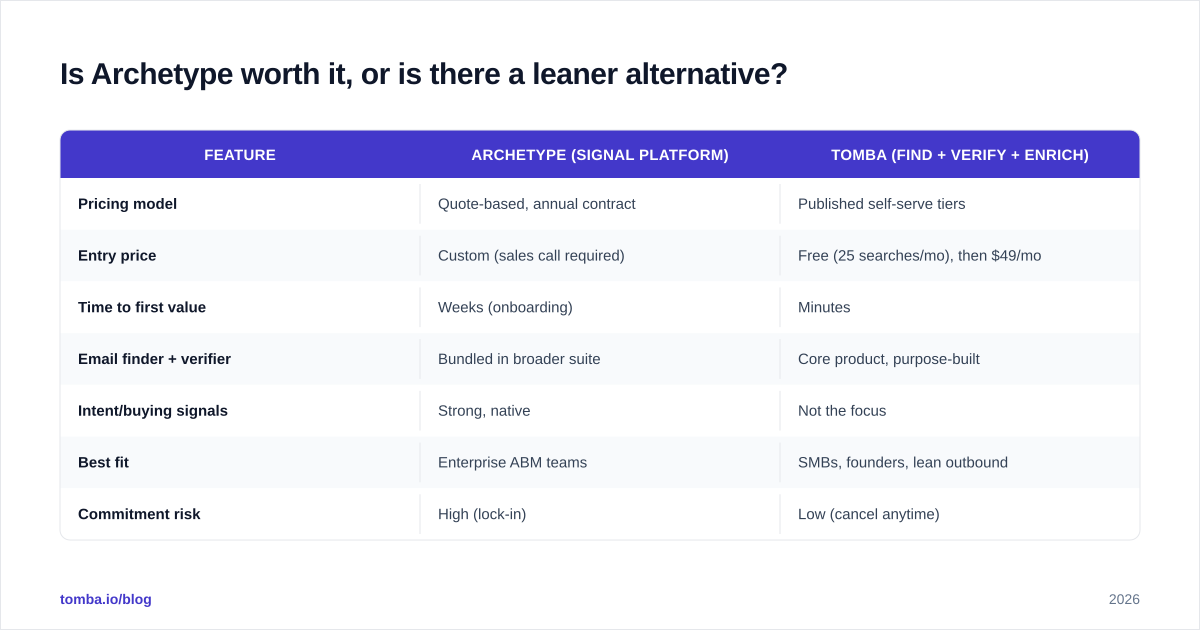
This is not "Tomba beats Archetype." They are built for different buyers. If you run a true account-based motion with a team that lives inside intent dashboards, Archetype's category is the right category. If your bottleneck is getting verified contacts into sequences without a procurement cycle, the leaner stack wins on every axis that matters to you.
How should you evaluate Archetype before you buy?#
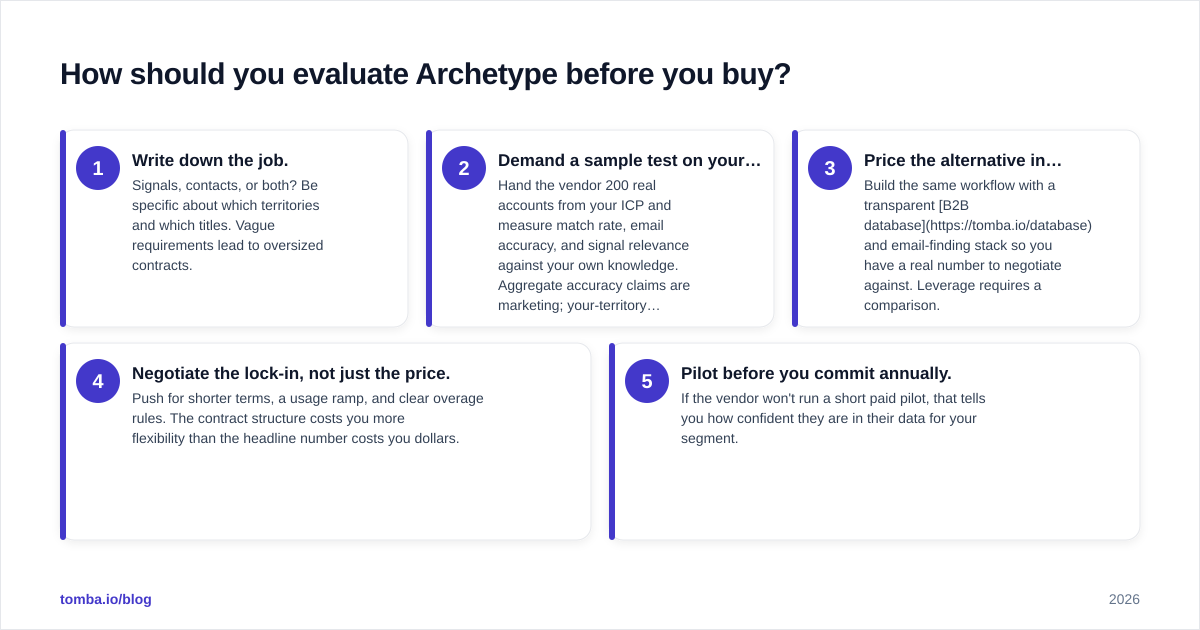
Treat any quote-based data platform like a software procurement, not an impulse purchase. A simple process protects you from buying capacity you won't use.
- Write down the job. Signals, contacts, or both? Be specific about which territories and which titles. Vague requirements lead to oversized contracts.
- Demand a sample test on your list. Hand the vendor 200 real accounts from your ICP and measure match rate, email accuracy, and signal relevance against your own knowledge. Aggregate accuracy claims are marketing; your-territory accuracy is truth.
- Price the alternative in parallel. Build the same workflow with a transparent B2B database and email-finding stack so you have a real number to negotiate against. Leverage requires a comparison.
- Negotiate the lock-in, not just the price. Push for shorter terms, a usage ramp, and clear overage rules. The contract structure costs you more flexibility than the headline number costs you dollars.
- Pilot before you commit annually. If the vendor won't run a short paid pilot, that tells you how confident they are in their data for your segment.
Run that process and you will either get a fair Archetype deal or discover you never needed the full platform in the first place. Both outcomes are wins.
The bottom line on Archetype data pricing, reviews, pros and cons#
Archetype is a legitimate B2B data and signal platform with real strengths — particularly its intent layer and consolidated workflow — and real friction, mostly around opaque, quote-based pricing and annual commitments. Reviews back this up: good ratings, recurring complaints about cost transparency and onboarding. It is a strong fit for funded mid-market and enterprise teams running account-based motions, and a poor fit for anyone whose core need is simply accurate, deliverable contact data.
If your real bottleneck is finding and verifying the right people — not deciphering a custom quote — start with a tool built for exactly that. Tomba's Email Finder locates professional emails by name, domain, or company, pairs with a built-in verifier to kill bounces before they happen, and runs on a published price that starts free. You can validate it against your own list today, no sales call required — and decide for yourself whether you ever needed the enterprise platform at all.
// get started
Find, verify and enrich your first contacts today
Start on the free plan with 25 searches a month, then scale when your team is ready.
Free plan · No credit card required · GDPR & CCPA
// about the author