Archetype Data vs Apollo.io 2026: B2B Data Tools Compared
Archetype Data vs Apolloio: which B2B data engine actually finds verified, deliverable contacts in 2026? A neutral breakdown of accuracy, pricing, coverage, and fit.
TL;DR
- Archetype Data is a newer, AI-first B2B data layer focused on intent signals and account-level enrichment; Apollo.io is an all-in-one prospecting platform with a 270M+ contact database, sequencing, and a dialer bolted on.
- If you want a CRM-replacing workflow (database + email + calls + sequences in one tab), Apollo wins on breadth. If you want clean, model-scored account and contact data piped into an existing stack, Archetype Data is the lighter, more surgical pick.
- Both struggle with the same thing every database struggles with: email accuracy decays. Neither bulk export is "verified" until you run it through a dedicated verifier.
- Pricing diverges fast at scale: Apollo's per-seat credits get expensive for data-heavy teams; Archetype Data leans toward usage/API pricing.
- For teams that just need accurate, real-time email and phone lookups feeding their own sequences, a focused tool like the Tomba Email Finder often beats paying for an entire suite you won't use.
What are Archetype Data and Apollo.io?#
Think of it like buying a kitchen versus buying the one knife you actually cook with. Apollo.io is the whole kitchen — database, email sequencing, a built-in dialer, LinkedIn extension, deal management, and AI writing all under one login. Archetype Data is the precision knife — a focused B2B data and signal layer designed to enrich accounts and contacts and feed them into the systems you already run.
Apollo.io (apollo.io) has been around long enough to become a default for SMB and mid-market sales teams. Its pitch is "find, engage, close without leaving the tab." Its 270M+ contact claim and aggressive free tier made it the category's volume leader.
Archetype Data positions itself differently: an AI-driven data engine that scores accounts, surfaces buying intent, and keeps enrichment fresh through API-first delivery. It is less about being your daily prospecting cockpit and more about being the clean data source underneath it.
That difference in philosophy — all-in-one suite vs. composable data layer — is the entire decision. Everything below is downstream of it.
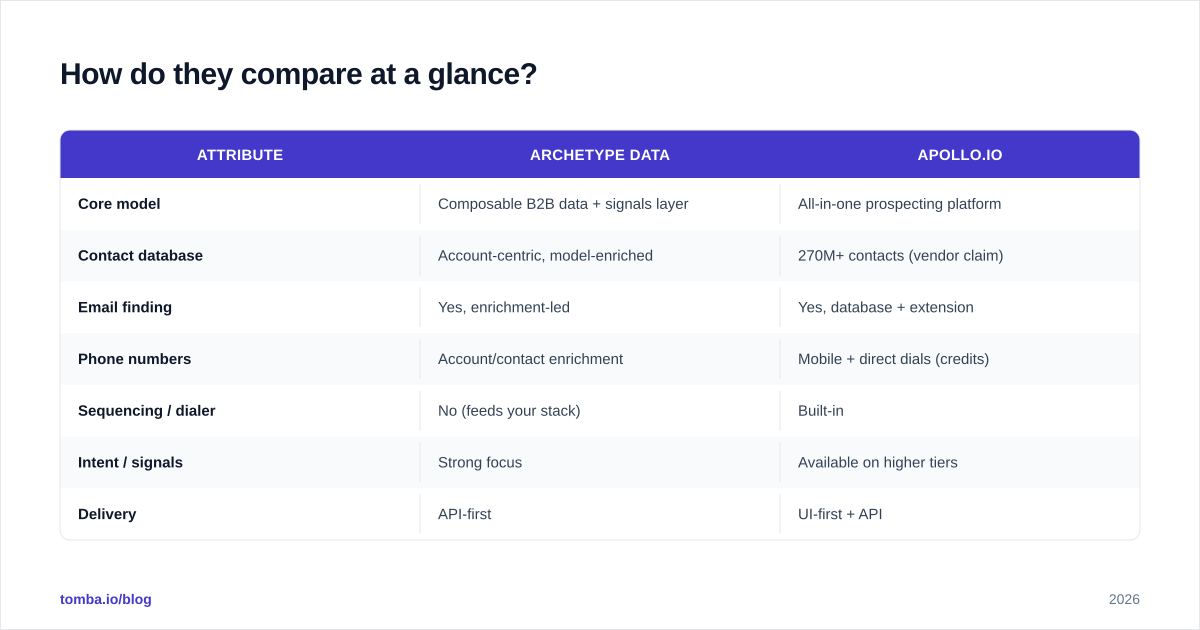
How do they compare at a glance?#
Here is the honest side-by-side. Treat vendor-published numbers (database size, "accuracy") as marketing claims until you test them on your own ICP.
| Attribute | Archetype Data | Apollo.io |
|---|---|---|
| Core model | Composable B2B data + signals layer | All-in-one prospecting platform |
| Contact database | Account-centric, model-enriched | 270M+ contacts (vendor claim) |
| Email finding | Yes, enrichment-led | Yes, database + extension |
| Phone numbers | Account/contact enrichment | Mobile + direct dials (credits) |
| Sequencing / dialer | No (feeds your stack) | Built-in |
| Intent / signals | Strong focus | Available on higher tiers |
| Delivery | API-first | UI-first + API |
| Free tier | Limited / trial-based | Generous free plan |
| Best for | RevOps / data teams | SMB & mid-market reps |
The pattern: Apollo wins on surface area, Archetype Data wins on data discipline. If your reps live inside one tool all day, breadth matters. If a RevOps or growth team is assembling a pipeline of enrichment → CRM → outreach, a clean source that plays nicely with data enrichment workflows matters more.

Which one has more accurate data?#
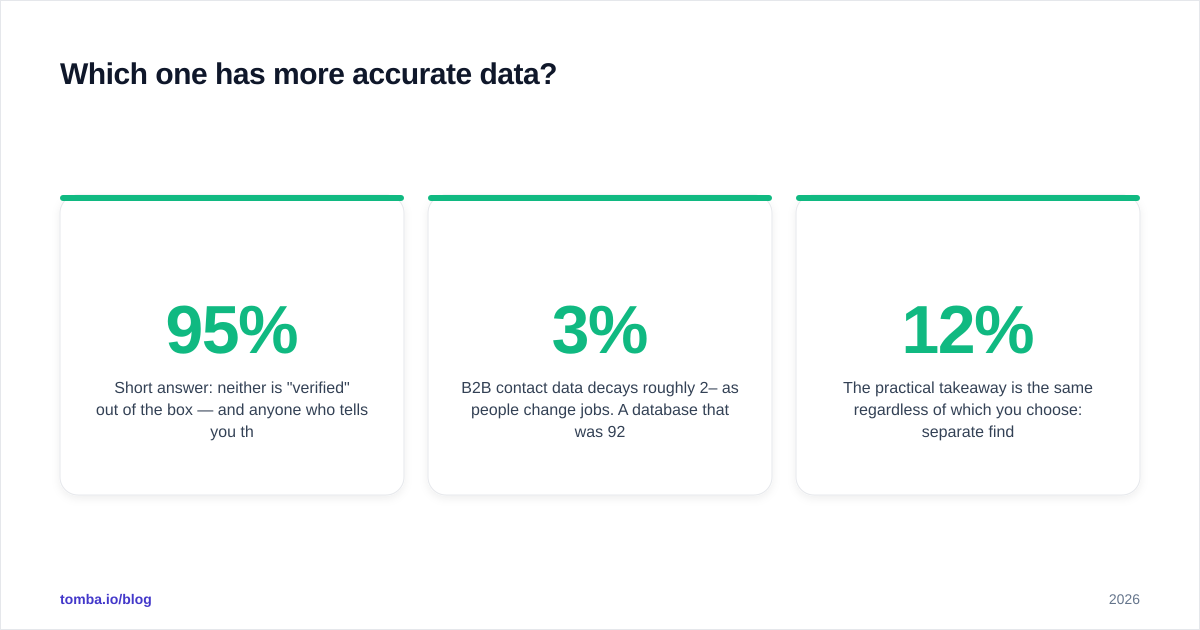
Short answer: neither is "verified" out of the box — and anyone who tells you their database is 95% accurate is quoting a lab number, not your Tuesday-morning export.
B2B contact data decays roughly 2–3% per month as people change jobs. A database that was 92% accurate in January is materially worse by June. Apollo's scale is a double-edged sword: more records means more coverage but also more stale rows, catch-all domains, and role accounts (info@, sales@) that pass a syntax check but bounce. Archetype Data's smaller, model-scored approach can look cleaner on a niche ICP but may simply lack the record at all for long-tail companies.

The practical takeaway is the same regardless of which you choose: separate finding from verifying. A finder's job is to surface a likely address. A verifier's job is to prove it's deliverable. Treating those as one step is how you end up with a 12% bounce rate and a burned sending domain. Run any bulk list — from Apollo, Archetype Data, or anywhere — through a dedicated email verifier before it touches your outbound. Pay special attention to catch-all domains, which most platforms mark "valid" when they actually can't confirm anything; a real catch-all verifier is the only way to score those.
For a structural view of why deliverability — not raw database size — should drive your choice, the framework below maps the path from raw record to inbox-safe contact.
How does pricing compare?#
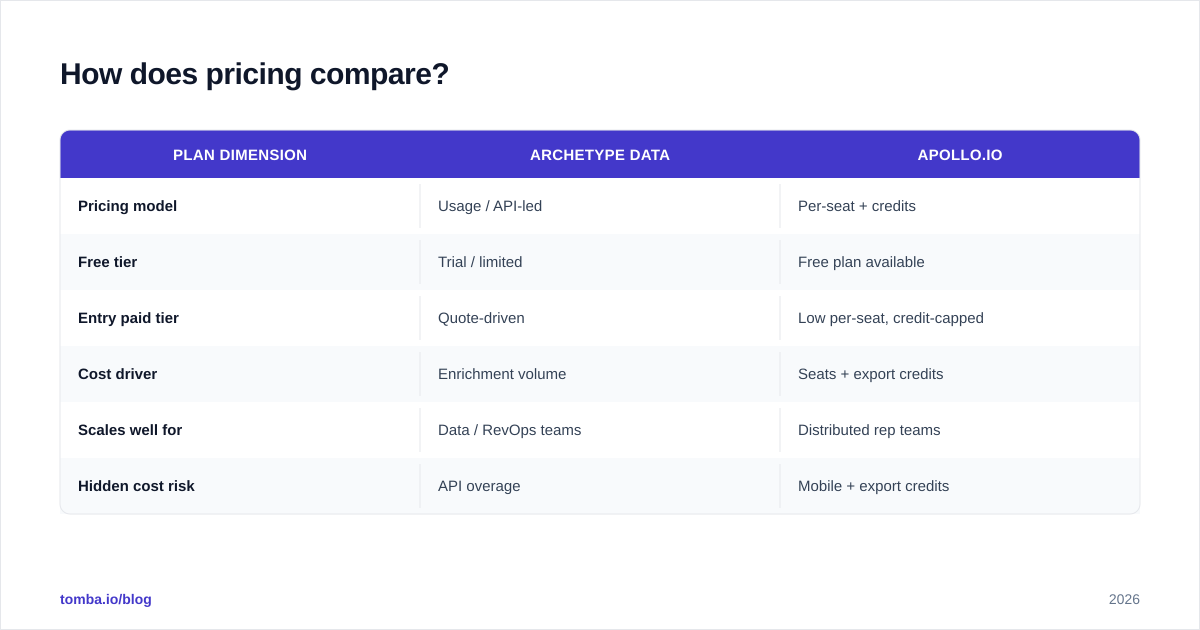
Pricing is where the two diverge hardest, because they charge for different things.
Apollo.io uses per-seat plans plus a credit system for email and phone exports. The free plan is genuinely usable for solo founders, but the moment you add reps and start exporting in volume, mobile-number credits and "advanced" data gates push you up tiers fast. Teams routinely underestimate how quickly export-heavy prospecting eats credits.
Archetype Data leans toward usage and API-based pricing — you pay for enrichment volume and signal access rather than per-seat. For a small data team enriching at scale, that can be cheaper than buying ten Apollo seats; for a 15-rep floor that wants everyone in one UI, it can be the opposite.
| Plan dimension | Archetype Data | Apollo.io |
|---|---|---|
| Pricing model | Usage / API-led | Per-seat + credits |
| Free tier | Trial / limited | Free plan available |
| Entry paid tier | Quote-driven | Low per-seat, credit-capped |
| Cost driver | Enrichment volume | Seats + export credits |
| Scales well for | Data / RevOps teams | Distributed rep teams |
| Hidden cost risk | API overage | Mobile + export credits |
Compare either against a transparent, no-seat-tax option. Tomba pricing runs Free (25 searches/mo), Starter at $49/mo, Growth at $99/mo, and Pro at $249/mo — credit-based finding and verification without forcing you to buy a sequencer or dialer you already have elsewhere. If your real need is "find and verify contacts," paying suite prices for one feature is the most common overspend we see.
When should you pick Apollo.io?#
Pick Apollo.io when consolidation beats precision for your team. It's the stronger choice if:
- You're an SMB or early mid-market team that wants database, email, calls, and sequences in one login.
- Your reps are non-technical and live inside a single UI all day.
- You're price-sensitive at the entry level and the free/low tiers cover your volume.
- You value the LinkedIn extension and in-app AI writing for ad-hoc prospecting.
The trade-off is data freshness and credit math. Apollo's breadth is real, but you'll still want an independent verification step, and heavy exporters should model credit costs before committing a year. If Apollo is already your sequencer but its data quality frustrates you, the cleaner path is often to keep the workflow and swap the data source — see how teams use an Apollo alternative for finding while keeping outreach where it lives.
When should you pick Archetype Data?#
Pick Archetype Data when you have a stack and you want a clean signal layer feeding it, not another cockpit. It's the stronger choice if:
- You run a RevOps, growth, or data function that pipes enrichment into a CRM and warehouse via API.
- Intent signals and account scoring matter as much as raw contact records.
- Your ICP is well-defined enough that model-scored, account-centric data beats brute-force volume.
- You'd rather pay for usage than per-seat licenses for occasional users.
The trade-off is coverage and self-sufficiency. A composable layer assumes you have somewhere to send the data and the technical muscle to wire it up. For long-tail or international companies, a leaner database may simply miss records that Apollo's scale would catch.
What about a focused middle path?#
Most teams asking "Archetype Data vs Apolloio" are really asking a narrower question: how do I get accurate, deliverable contact data into my existing outreach without overbuying?
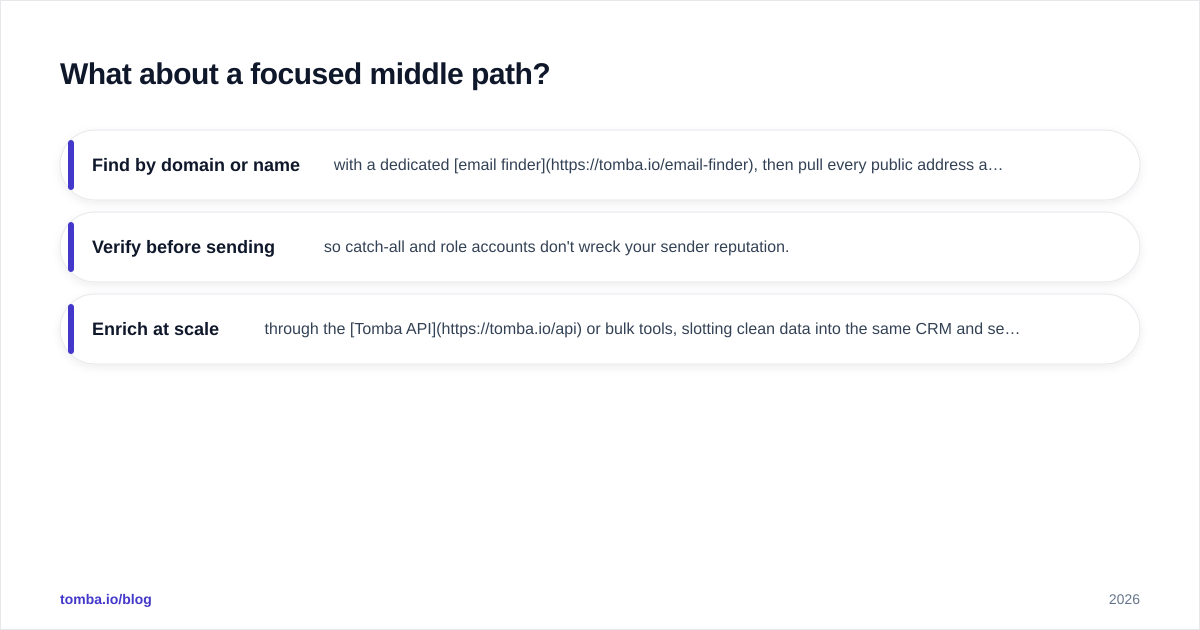
You don't always need a 270M-row suite or a full signal platform to do that. A focused finder-and-verifier covers the core job:
- Find by domain or name with a dedicated email finder, then pull every public address at a company via domain search.
- Verify before sending so catch-all and role accounts don't wreck your sender reputation.
- Enrich at scale through the Tomba API or bulk tools, slotting clean data into the same CRM and sequencer you already pay for.
This composable approach mirrors what Archetype Data does philosophically — be the clean source, not the whole machine — while staying transparent on price. It also sidesteps Apollo's biggest hidden cost: paying seat-by-seat for a sequencer and dialer half your team never opens. Cross-reference vendor claims on a neutral marketplace like G2 and validate against your own test list before signing anything.
Frequently asked questions#
Is Archetype Data better than Apollo.io? Neither is universally better. Archetype Data fits API-first data and RevOps teams; Apollo.io fits reps who want one all-in-one tool. Match the tool to where the work happens, not to a leaderboard.
Is Apollo's data accurate enough to send without verifying? No database is. Plan to verify every bulk export — Apollo, Archetype Data, or otherwise — through an independent verifier to keep bounce rates under control and protect email deliverability.
Can I use one of these just for data and keep my own outreach tools? Yes, and that's often the cheapest setup. A focused finder plus verifier feeds your existing CRM and sequencer without paying for a second sequencer you won't use.
Which is cheaper at scale? It depends on your cost driver. Seat-heavy rep teams often pay less with Apollo's entry tiers; data-heavy enrichment is usually cheaper on usage/API pricing. Model your real export volume first.
The bottom line#
Apollo.io is the broad, do-everything suite; Archetype Data is the disciplined, composable data layer. Your answer to "Archetype Data vs Apolloio" comes down to one question — do you want a cockpit, or do you want clean fuel for the cockpit you already fly?
If it's the latter, start narrow. Use the Tomba Email Finder to pull verified, deliverable contacts by name, company, or domain, run them through verification before they hit your sequencer, and skip the suite tax entirely. You can test it free with 25 searches a month and only scale up when the data proves itself on your own ICP — which is exactly how every data-tool decision should be made.
// get started
Find, verify and enrich your first contacts today
Start on the free plan with 25 searches a month, then scale when your team is ready.
Free plan · No credit card required · GDPR & CCPA
// about the author