Archetype Data vs Datanyze: B2B Data Tools Compared (2026)
A neutral, hands-on breakdown of Archetype Data vs Datanyze — coverage, technographics, contact accuracy, pricing, and which B2B data tool fits your GTM stack in 2026.
Comparing Archetype Data vs Datanyze? This guide gives you the short answer first. Then it digs into coverage, accuracy, pricing, and fit.
TL;DR
- Archetype Data leans into modern, API-first firmographic and intent enrichment with a focus on fresh records; Datanyze is the long-running technographics pioneer best known for its Chrome extension and tech-stack lookups.
- If your motion is technographic targeting (sell to companies running Shopify, HubSpot, Snowflake, etc.), Datanyze still has the more mature signal. If you want broad enrichment piped into a CRM via API, Archetype Data is the more flexible build.
- Neither tool is a dedicated email-finder. Both attach contact data, but contact accuracy and verification are where most teams get burned — budget for a verification layer.
- Pricing differs in shape: Datanyze sells seat-based packages with monthly contact caps; Archetype Data trends toward usage/API-based pricing. Total cost depends on volume, not sticker price.
- For teams who mainly need accurate, verified emails by domain or name, a focused tool like the Tomba Email Finder is cheaper and more precise than paying data-platform prices for contact discovery.
What are Archetype Data and Datanyze?#
Short version: both are B2B data providers, but they were built for different jobs.
Think of it like buying a vehicle. Datanyze is the established pickup truck. It has hauled technographic signals — what software a company runs — since the early 2010s. Reps love its browser extension for grabbing a contact on a company's site. Archetype Data is the newer electric SUV. It is API-first and built for enrichment at scale. It drops firmographic and contact fields straight into your data warehouse or CRM.
Datanyze (owned by ZoomInfo) is documented on its official site. SDRs use it most often for quick contact and tech-stack context while prospecting. Archetype Data positions itself as a developer- and RevOps-friendly enrichment source. Its value is programmatic access, not a point-and-click UI.
Want the textbook definition of the broader category? See Tomba's primer on B2B data and intelligence and the glossary entry on revenue operations. That's the team that usually owns these tools.
Archetype Data vs Datanyze: how they compare at a glance#
Here is the head-to-head on the attributes that actually change a buying decision. Treat the data-volume and pricing rows as directional. Both vendors negotiate and repackage frequently.
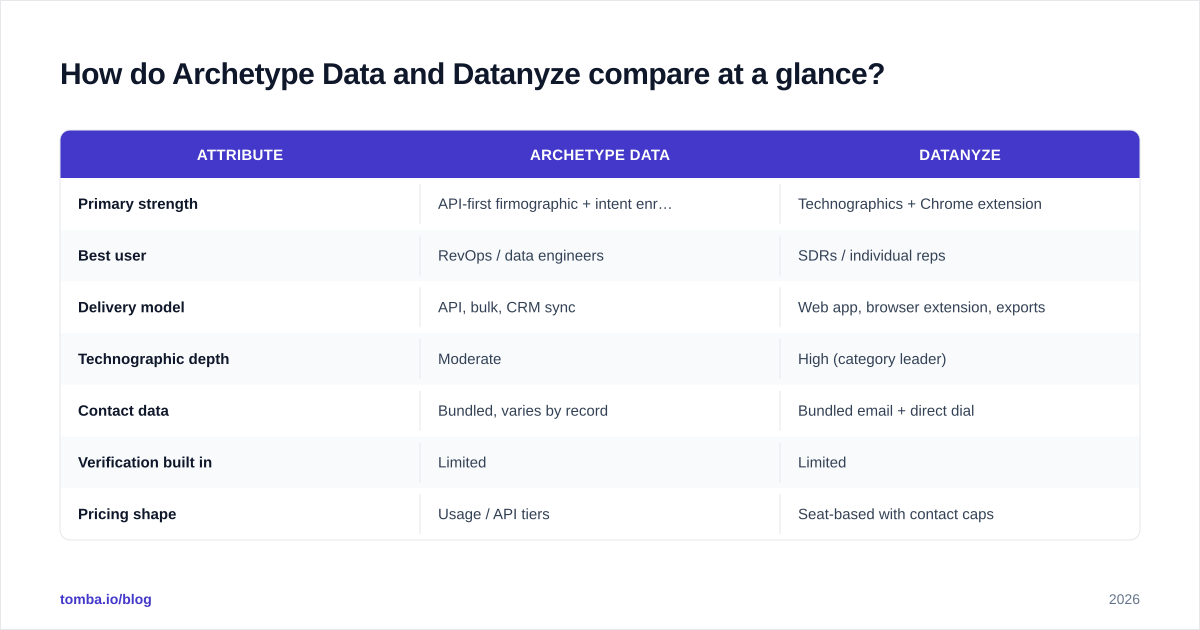
| Attribute | Archetype Data | Datanyze |
|---|---|---|
| Primary strength | API-first firmographic + intent enrichment | Technographics + Chrome extension |
| Best user | RevOps / data engineers | SDRs / individual reps |
| Delivery model | API, bulk, CRM sync | Web app, browser extension, exports |
| Technographic depth | Moderate | High (category leader) |
| Contact data | Bundled, varies by record | Bundled email + direct dial |
| Verification built in | Limited | Limited |
| Pricing shape | Usage / API tiers | Seat-based with contact caps |
| Free option | Trial / limited | Limited free credits historically |
| Ownership | Independent |
ZoomInfo |
The pattern in the Archetype Data vs Datanyze matchup: Datanyze wins on technographics and rep-level convenience; Archetype Data wins on programmatic enrichment and pipeline flexibility. Neither is a clear winner on contact accuracy, which is the part most teams care about most.
Which has better data coverage and accuracy?#
Conclusion first: Datanyze is stronger on technographic coverage. Archetype Data is more flexible on firmographic breadth. But pair either with independent verification before you send a single email.
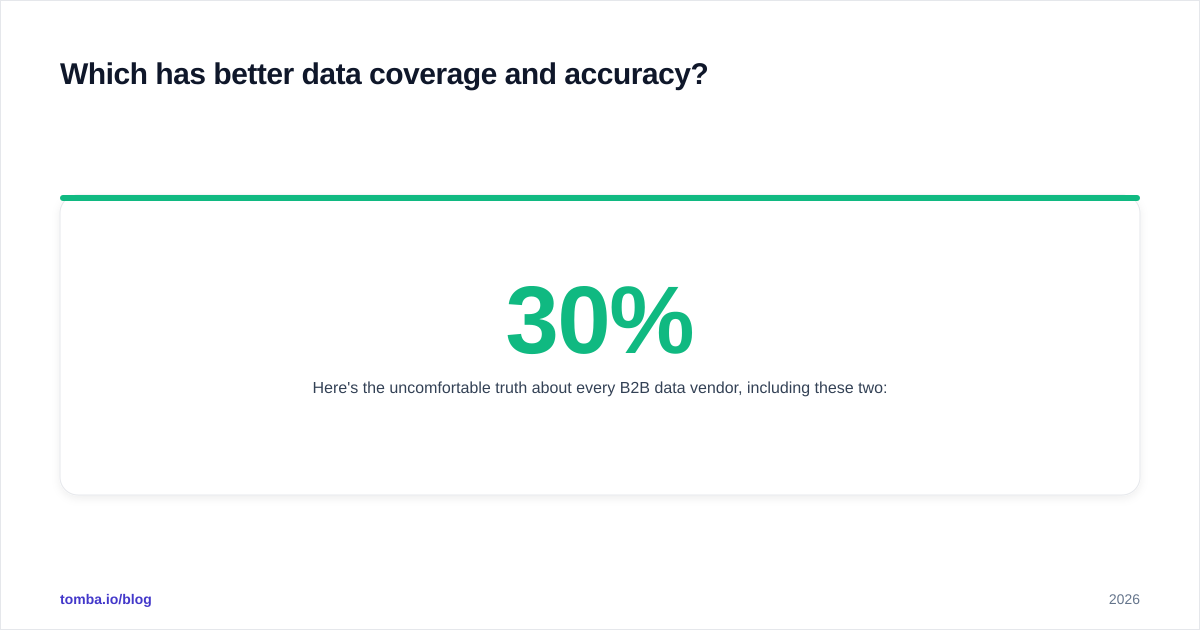
When people research Archetype Data vs Datanyze, accuracy is the real question. Here's the uncomfortable truth about every B2B data vendor, including these two. Coverage claims are marketing, and accuracy decays fast. Contact records go stale at roughly 25–30% per year as people change jobs. Analysts like Gartner and many G2 reviews cite that number. A database that was 95% accurate at ingestion can be 70% accurate a year later.
Datanyze's technographic data is genuinely useful. Tech-stack signals change less often than job titles. If a company runs Salesforce today, it probably still runs it next quarter. That makes Datanyze a reliable targeting input.
Archetype Data's firmographic enrichment covers company size, industry, revenue, and location. These fields are relatively stable. That's why API-based enrichment of company-level data tends to perform well. Where both stumble is the same place everyone does: person-level email and phone. That's the volatile layer.
This is why mature GTM teams treat data tools as two separate problems:
- Discovery — finding the right accounts and contacts (Datanyze/Archetype Data territory).
- Verification — confirming the email actually exists and is safe to send to.
For step two, route discovered contacts through an email verifier and, if you're targeting domains that accept everything, a catch-all verifier. Skipping this step is the single fastest way to wreck your sender reputation.
How do their use cases differ?#
The Archetype Data vs Datanyze choice depends on who's holding the tool.
Choose Datanyze if:
- Your reps prospect company-by-company and want a browser extension that surfaces tech stack + a contact in two clicks.
- Your ICP is defined by software a company uses (you sell a Shopify app, a Salesforce add-on, an integration, etc.).
- You're already in the ZoomInfo ecosystem and want technographic depth without a second contract.
Choose Archetype Data if:
- You run an automated enrichment pipeline — leads come in, you append firmographic fields via API, scoring happens downstream.
- Your RevOps team owns data and prefers programmatic control over a point-and-click UI.
- You need to enrich large lists in bulk rather than one record at a time.
Choose neither (use a focused finder) if:
- Your real need is "I have names and companies, give me verified emails." That's an email finder job, not a data-platform job, and you'll pay far less for far higher precision.
A common winning setup mixes layers: use technographics for targeting, an enrichment API for firmographics, and a dedicated finder + verifier for the actual contact. Many teams wire this together with a HubSpot integration or Zapier so enriched, verified records land in the CRM automatically.
What about pricing — which is more cost-effective?#
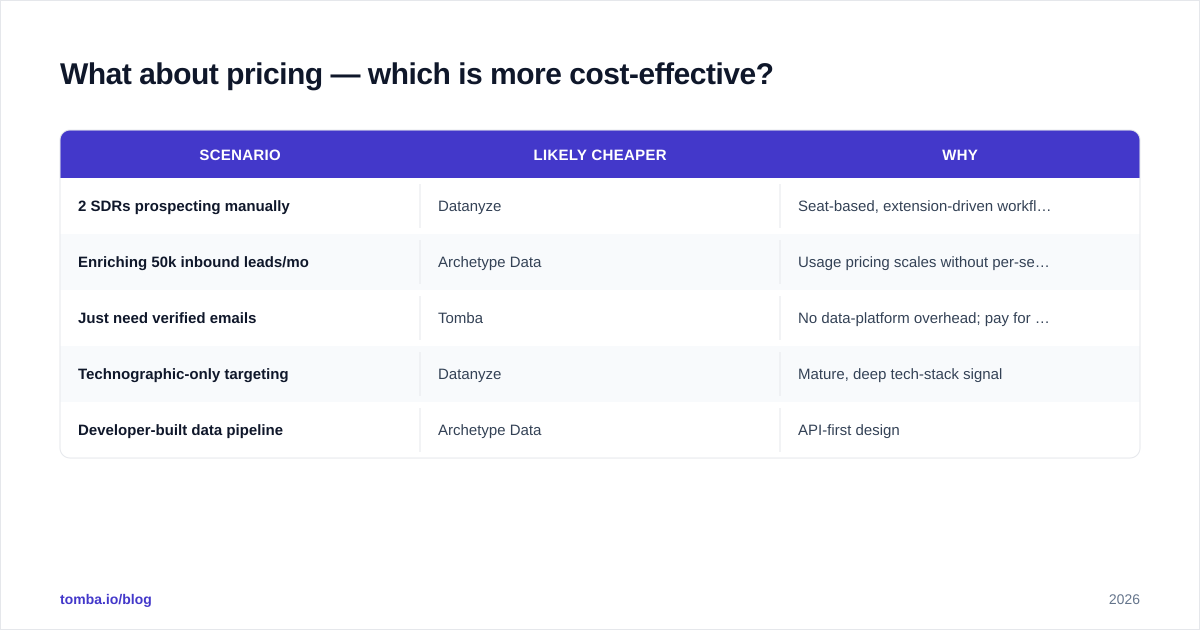
Conclusion first: on price, the Archetype Data vs Datanyze answer has no universal winner. Cost depends on whether you buy by seat or by volume. Datanyze's seat-based model rewards small teams of heavy individual users. Archetype Data's usage model rewards automated, high-volume enrichment where you don't want to pay per seat.
Here's how the cost logic typically breaks down. (Always confirm current numbers directly with each vendor — pricing pages change often, and these are illustrative tiers, not quotes.)
| Scenario | Likely cheaper | Why |
|---|---|---|
| 2 SDRs prospecting manually | Datanyze | Seat-based, extension-driven workflow |
| Enriching 50k inbound leads/mo | Archetype Data | Usage pricing scales without per-seat cost |
| Just need verified emails | Tomba | No data-platform overhead; pay for finds |
| Technographic-only targeting | Datanyze | Mature, deep tech-stack signal |
| Developer-built data pipeline | Archetype Data | API-first design |
For comparison on the focused-finder end, Tomba pricing runs a Free tier (25 searches/mo), Starter at $49/mo, Growth at $99/mo, and Pro at $249/mo. That's a different category of spend than enterprise data platforms — which is exactly the point. If contact discovery is your main need, paying platform prices for it is overkill.
One more cost factor people forget: wasted sends. Say 20% of the contacts you pull are invalid. You're not just wasting credits. You're burning domain reputation and inflating bounce rates. That quietly tanks deliverability across your whole program. So run the math on bad-data cost, not just license cost.

Which integrates better with your stack?#
Both tools assume they're part of a larger system, but they meet you at different points.
Datanyze, as part of the ZoomInfo family, integrates cleanly with major CRMs and sales-engagement platforms. Its extension works inside the browser where reps already live. The trade-off is that you're somewhat steered toward the broader ecosystem.
Archetype Data's API-first design is its integration story. If your team can call an endpoint, you can put enriched data anywhere — warehouse, CRM, lead-scoring model, or a custom app. That flexibility is a strength for engineering-led RevOps and a non-starter for teams without technical resources.
If you want the same API-first flexibility specifically for contact discovery and verification, the Tomba API and bulk email finder cover the find-and-verify layer. There are native connectors for Salesforce, Pipedrive, and Google Sheets so non-developers aren't locked out.
A quick integration sanity check before you buy either platform:
- Does it write back to your CRM, or only export CSVs?
- Can it enrich on a trigger (new lead created) rather than on demand?
- Does it expose a verification status field, or do you need a separate tool?
- What's the rate limit, and does it fit your real volume?
Is Archetype Data or Datanyze the right choice for you?#
Here's the honest verdict.
Pick Datanyze when technographics drive your targeting and your reps want a fast, in-browser way to grab tech stack plus a contact. It's the more proven tool for that specific job, and the extension workflow is hard to beat for manual prospecting.
Pick Archetype Data when you're building an automated, API-driven enrichment pipeline and you'd rather pay for usage than seats. It fits RevOps teams that treat data as infrastructure.
Pick neither when what you actually need is accurate, verified email addresses at a sane price. Both platforms bundle contact data, but contact discovery is not their core competency. You'll pay platform prices for a middling result. Tools that specialize in finding and verifying contacts will out-perform a general data platform on precision, every time, for that one task.
Whatever you choose, separate the two jobs in your head: targeting/enrichment is one problem, contact accuracy is another. The best stacks use the right tool for each and connect them through automation — not a single platform that does everything at 70%.
The bottom line#
In the Archetype Data vs Datanyze decision, both tools solve overlapping but distinct problems. Datanyze is your technographics-plus-extension workhorse for reps. Archetype Data is your API-first enrichment engine for RevOps. Both attach contact data, and both leave the same gap: person-level email accuracy that decays the moment you stop verifying it.
If your real goal is to turn a name and a company into a verified, ready-to-send email without paying enterprise data-platform prices, start with the Tomba Email Finder. Find emails by domain, name, or company, verify them in the same flow, and push clean records straight into your CRM — so the contacts your Archetype Data or Datanyze targeting surfaces actually land in the inbox. Try it free with 25 searches a month and see your bounce rate drop before you commit to a bigger data contract.
// get started
Find, verify and enrich your first contacts today
Start on the free plan with 25 searches a month, then scale when your team is ready.
Free plan · No credit card required · GDPR & CCPA
Get the Tomba newsletter
Product and data updates
// about the author