Archetype Data vs DealSignal: B2B Data Compared (2026)
Archetype Data and DealSignal both promise accurate B2B contact data and buying signals — but they serve different teams. Here's the honest breakdown for 2026.
Choosing a B2B data vendor is like hiring a research assistant who never sleeps. The good ones hand you a clean list of the right people, at the right companies, with phone numbers that actually ring. The bad ones bury you in stale rows and "verified" emails that bounce on send. Archetype Data and DealSignal both pitch themselves as the good assistant. This post sorts out which one earns the title — and where a focused tool beats both.
TL;DR#
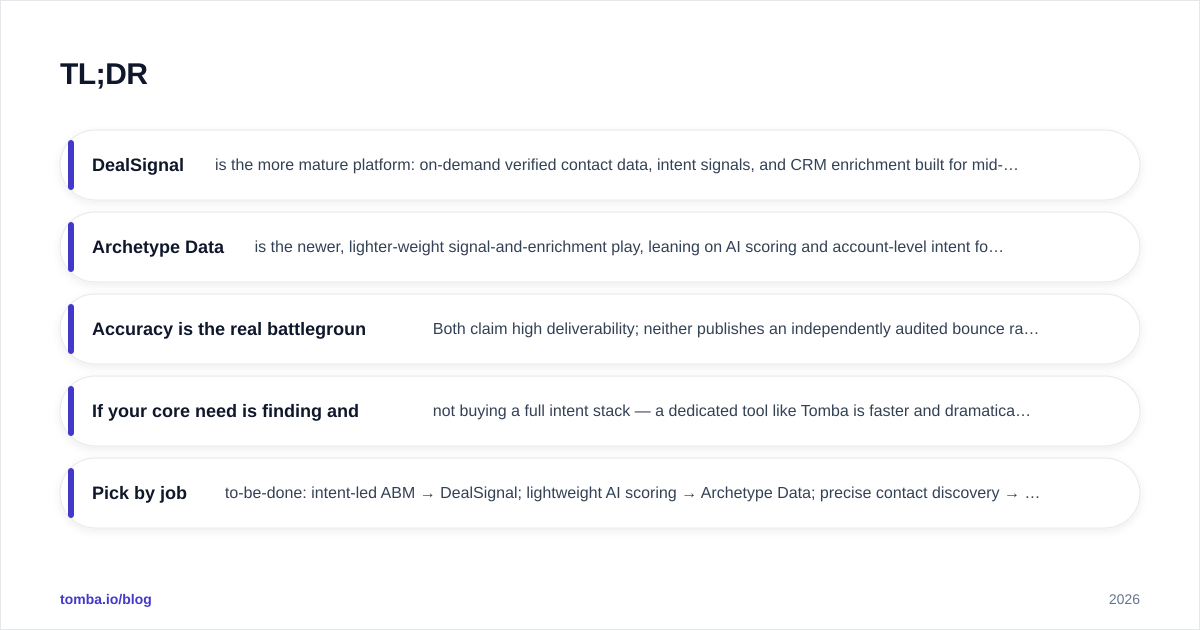
- DealSignal is the more mature platform: on-demand verified contact data, intent signals, and CRM enrichment built for mid-market and enterprise RevOps teams. Pricing is custom and lands in the four-figures-per-year range.
- Archetype Data is the newer, lighter-weight signal-and-enrichment play, leaning on AI scoring and account-level intent for fast-moving outbound teams. It's cheaper to start but thinner on coverage depth.
- Accuracy is the real battleground. Both claim high deliverability; neither publishes an independently audited bounce rate, so verify a sample before you commit budget.
- If your core need is finding and verifying emails — not buying a full intent stack — a dedicated tool like Tomba is faster and dramatically cheaper.
- Pick by job-to-be-done: intent-led ABM → DealSignal; lightweight AI scoring → Archetype Data; precise contact discovery → a purpose-built email finder.
What is Archetype Data?#
Archetype Data is a B2B data-intelligence platform that combines contact and company records with AI-driven account scoring and buying-intent signals. The pitch is speed: instead of a heavy data warehouse, you get a streamlined layer that tells outbound teams who to contact and when the timing looks right, then hands over enriched contact details to act on.
It targets startups and growth-stage sales teams that want signal-based prioritization without the procurement cycle of a legacy data giant. Think of it as a smart filter on top of a contact database — it's less about the deepest possible coverage and more about surfacing the accounts most likely to convert this quarter.
The trade-off: newer platforms have less time to build and clean their underlying data. Coverage gaps and patchy phone data are common in younger vendors, which is why a sample test matters more here than with an established provider.
What is DealSignal?#
DealSignal is an established B2B data provider focused on on-demand, verified contact and account data. Rather than serving a static database that decays the moment it's exported, DealSignal refreshes records at the point of request — re-verifying emails, direct dials, and firmographics so the data you pull is current.
Its feature set skews enterprise: large total addressable market coverage, intent data, technographics, org charts, and native enrichment for Salesforce, HubSpot, Marketo, and Outreach. RevOps and demand-gen teams use it to keep CRM records fresh and to build targeted lists for account-based marketing.
The cost of that depth is, well, cost. DealSignal is a considered purchase with custom contracts, minimums, and an onboarding motion. It rewards teams that will use the volume; it punishes the solo rep who just needs a few hundred good emails a month.

Archetype Data vs DealSignal: how do they compare?#
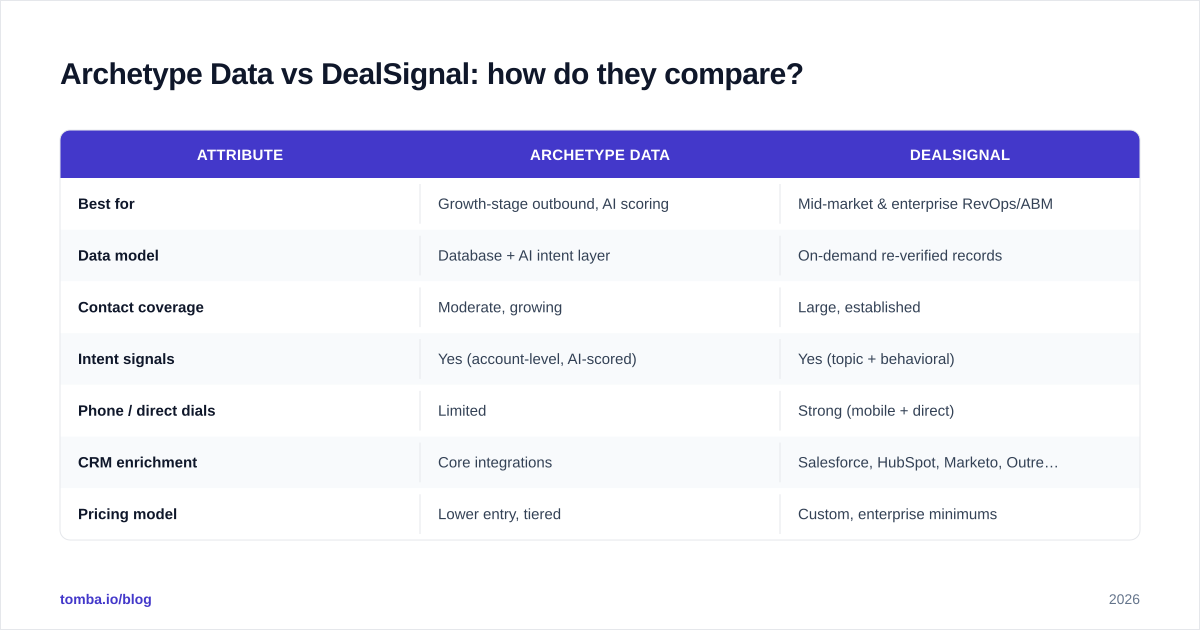
Here's the side-by-side on the attributes that actually drive a buying decision. Treat vendor-published accuracy numbers as marketing until you've run your own sample.
| Attribute | Archetype Data | DealSignal |
|---|---|---|
| Best for | Growth-stage outbound, AI scoring | Mid-market & enterprise RevOps/ABM |
| Data model | Database + AI intent layer | On-demand re-verified records |
| Contact coverage | Moderate, growing | Large, established |
| Intent signals | Yes (account-level, AI-scored) | Yes (topic + behavioral) |
| Phone / direct dials | Limited | Strong (mobile + direct) |
| CRM enrichment | Core integrations | Salesforce, HubSpot, Marketo, Outreach |
| Pricing model | Lower entry, tiered | Custom, enterprise minimums |
| Free trial / sample | Often available | Sample on request |
| Setup effort | Low | Medium (onboarding) |
The pattern is clear: Archetype Data optimizes for time-to-value and price; DealSignal optimizes for depth, freshness, and enterprise workflow fit. Neither is "better" in the abstract — they're tuned for different buyers.
Which has more accurate data?#
Accuracy is decided by your sample, not their homepage. That said, the architectures point in different directions.
DealSignal's on-demand re-verification gives it a structural edge on freshness. Because records are validated when you request them, you avoid the classic problem of exporting a list that was accurate six months ago and is now 25% wrong. B2B data decays fast — people change jobs constantly — so a re-verify-on-pull model genuinely matters for deliverability.
Archetype Data leans on AI to score and prioritize, which is excellent for targeting but doesn't inherently solve contact-level accuracy. A perfectly scored account is worthless if the email bounces.
The honest move before signing either contract:
- Pull 100 contacts from each vendor for the same target segment.
- Run them through an independent email verifier so you're not grading their homework with their own pen.
- Spot-check 20 phone numbers by hand.
- Compare valid-rate, catch-all rate, and bounce rate side by side.
This 30-minute exercise tells you more than any G2 badge. Speaking of which, cross-reference real reviews on G2 and Capterra — filter for reviewers whose company size matches yours, since enterprise and SMB experiences with the same vendor diverge wildly.
How does pricing compare?#
Pricing is where the two platforms separate most sharply.
Archetype Data uses a lower entry point with tiered plans, making it accessible to smaller teams that want to test signal-based outbound without a big commitment. You can typically get started for a monthly subscription rather than an annual contract.
DealSignal is enterprise-priced with custom quotes, credit-based volume, and annual minimums. For a team enriching tens of thousands of records and running ABM at scale, the per-record economics can be reasonable. For a five-person sales team, it's overkill.
A simple budgeting rule:
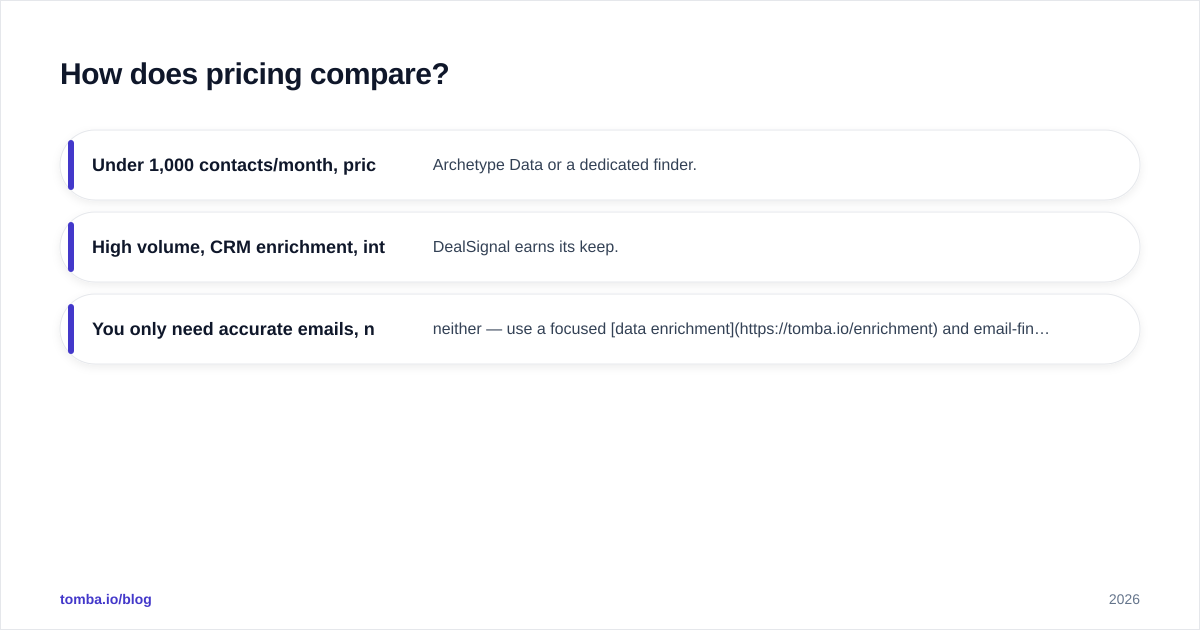
- Under 1,000 contacts/month, price-sensitive: Archetype Data or a dedicated finder.
- High volume, CRM enrichment, intent-led ABM: DealSignal earns its keep.
- You only need accurate emails, not a full data suite: neither — use a focused data enrichment and email-finding tool and pocket the difference.
When should you skip both and use an email finder?#
Skip the full data-intelligence platform when your bottleneck is simply getting valid contact details for known prospects — not discovering net-new accounts or scoring intent.
A huge share of "we need a data vendor" requests are really "we need emails for this list of companies and people we already identified on LinkedIn." That's a finder-and-verifier job, and paying enterprise data prices for it is a waste.
Here's where a purpose-built stack wins:
| Job to be done | Best fit |
|---|---|
| Net-new account discovery + intent | DealSignal |
| Lightweight AI scoring on a budget | Archetype Data |
| Find emails for a known target list | Email finder |
| Verify a list before a campaign | Email verifier |
| Enrich existing CRM rows | Enrichment API |
Tomba's domain search pulls every public email pattern at a target company, the bulk email finder handles a list of thousands, and the catch-all and verification layers keep your bounce rate down. You can read about where the data comes from before trusting it — transparency that's harder to get from black-box intent vendors.
For teams that already maintain their own B2B database of target accounts, the finder-plus-verifier approach often replaces a five-figure data contract with a sub-$100/month subscription.
What do the pros and cons look like?#
A quick gut-check on each platform.
Archetype Data — pros: low entry price, fast setup, AI-driven account prioritization, good fit for lean outbound teams. Archetype Data — cons: younger dataset, thinner phone coverage, accuracy varies by segment, fewer enterprise integrations.
DealSignal — pros: on-demand re-verified data, deep coverage, strong direct dials, mature CRM/MAP integrations, real intent + technographics. DealSignal — cons: enterprise pricing and minimums, onboarding overhead, overkill for small teams, custom-quote opacity.
Dedicated email finder — pros: cheapest path to accurate emails, transparent verification, pay for what you use, no procurement cycle. Dedicated email finder — cons: not a full intent/ABM platform; you bring your own targeting.
How do you choose between them?#
Decide in three questions:
- What's your real bottleneck — targeting or contact accuracy? If you don't know who to chase, you need intent (DealSignal, or Archetype Data on a budget). If you know who and just need to reach them, you need a finder.
- What's your monthly volume and budget? High volume with CRM enrichment justifies DealSignal. Low volume or price sensitivity points to Archetype Data or a finder.
- Can you prove the accuracy yourself? Always run the 100-contact sample test through an independent verifier before signing. Whichever vendor wins your sample wins your budget.
Most teams discover that they've conflated two separate jobs — finding intent and finding emails — and bought one expensive tool to do both poorly. Splitting the jobs usually costs less and performs better.
The bottom line#
DealSignal is the stronger choice for enterprise RevOps and intent-led ABM where data freshness and depth justify the price. Archetype Data is the lighter, cheaper option for growth-stage teams that want AI scoring without a procurement cycle. But if your actual need is accurate, verified contact data for prospects you've already identified, a focused email-finding tool will beat both on speed and cost.
Try Tomba's Email Finder before you commit to a five-figure data contract. Start free with 25 searches a month, then scale into a Starter plan at $49/mo — and check the full Tomba pricing to see how it compares to the enterprise quotes you'd get from a full data platform. Run the sample test, verify the results, and let the bounce rate decide.
// get started
Find, verify and enrich your first contacts today
Start on the free plan with 25 searches a month, then scale when your team is ready.
Free plan · No credit card required · GDPR & CCPA
// about the author