Archetype Data vs Kipplo (2026): B2B Data & Email Finder Showdown
A neutral, hands-on comparison of Archetype Data vs Kipplo for B2B contact data, email finding, and enrichment in 2026 — accuracy, pricing, and the best-fit alternative.
Choosing a B2B data provider in 2026 is less about who has "more contacts" and more about whose records survive contact with a real inbox. Archetype Data and Kipplo both promise clean company and people data, email discovery, and enrichment that feeds your CRM. They take different routes to get there, and the gap shows up in your bounce rate, not their marketing pages.
This is a neutral breakdown of how the two stack up — where each is genuinely strong, where they fall short, and which type of team should pick which. We'll also be honest about where a focused tool like Tomba beats both on the one job most teams actually care about: turning a name and a domain into a verified email that lands.
TL;DR: Archetype Data vs Kipplo at a glance#
- Archetype Data leans toward intent and account intelligence — good for marketing and RevOps teams who want signals layered on top of firmographics.
- Kipplo leans toward prospecting workflows — list building, contact discovery, and outreach handoff for SDR teams.
- Accuracy is the real battleground. Both publish high coverage numbers; both degrade on catch-all domains and smaller companies. Always verify before you send.
- Pricing favors annual commitments on both sides, which makes a free or low-friction tier valuable for testing real data quality first.
- If your core need is a verified email from a name + domain, a dedicated email finder like Tomba is cheaper and more accurate than buying a broad platform you'll half-use.

What is Archetype Data?#
Archetype Data positions itself as a B2B intelligence layer: company firmographics, technographics, and buyer-intent signals bundled with contact records. The pitch is that you don't just get a list of people — you get context about which accounts are in-market, what tech they run, and who the likely decision-makers are.
That makes it attractive to demand-gen and revenue operations teams who score and route leads. The trade-off is that intent platforms are only as good as their signal sourcing, and signal data is notoriously noisy. You pay a premium for the intelligence layer whether or not your team has the maturity to act on it.
What is Kipplo?#
Kipplo is built around the prospecting motion. Its core loop is: define an ideal customer profile, build a list, surface contacts with emails and phone numbers, and push them into your sequencer or CRM. It competes more directly with sales-prospecting tools than with pure data brokers.
For an SDR team that lives in list-building and outreach, that workflow focus is the selling point — fewer tabs, faster handoff. The risk is the same one every prospecting tool faces: coverage and email accuracy vary wildly by region and company size, and a slick UI doesn't fix a stale record.
Archetype Data vs Kipplo: full comparison table#
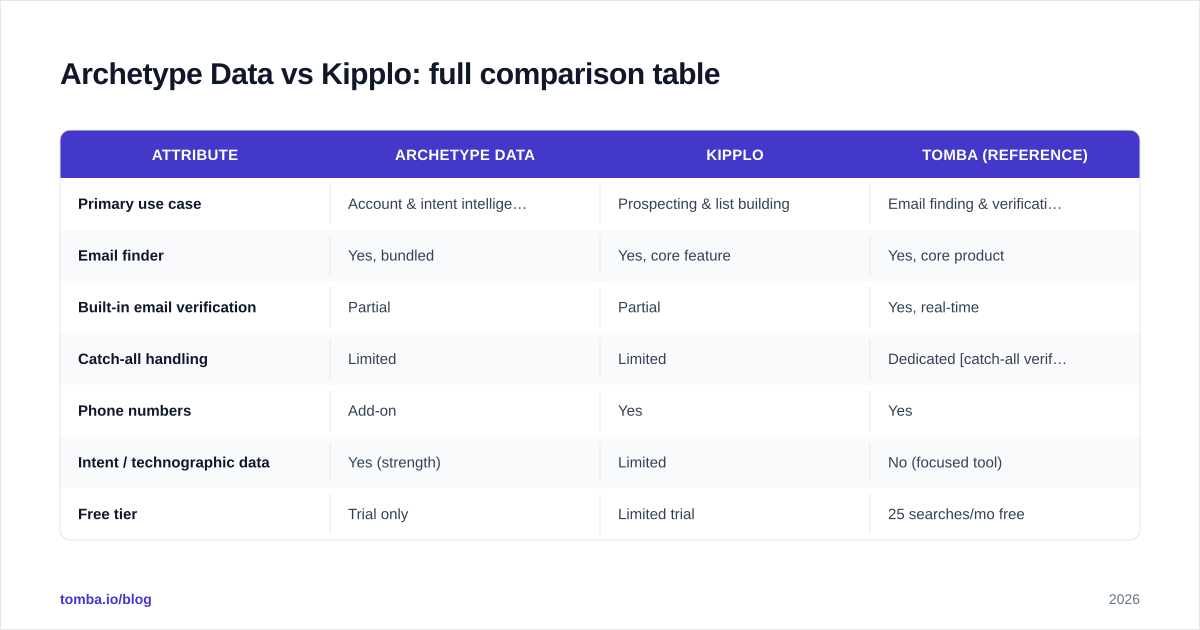
Here is the side-by-side on the attributes that actually change your results. Treat vendor-published accuracy claims as optimistic ceilings, not averages.
| Attribute | Archetype Data | Kipplo | Tomba (reference) |
|---|---|---|---|
| Primary use case | Account & intent intelligence | Prospecting & list building | Email finding & verification |
| Email finder | Yes, bundled | Yes, core feature | Yes, core product |
| Built-in email verification | Partial | Partial | Yes, real-time |
| Catch-all handling | Limited | Limited | Dedicated catch-all verifier |
| Phone numbers | Add-on | Yes | Yes |
| Intent / technographic data | Yes (strength) | Limited | No (focused tool) |
| Free tier | Trial only | Limited trial | 25 searches/mo free |
| Entry paid price | Custom / annual | Mid-tier monthly | $49/mo Starter |
| Best for | RevOps & demand gen | SDR prospecting teams | Anyone needing verified emails |
| API access | Yes | Yes | Yes, email finder API |
The pattern is clear: Archetype Data and Kipplo are broad platforms with email finding as one feature among many, while a dedicated tool treats deliverability as the whole point.
How accurate is the data from each tool?#
Accuracy is where the buying decision should be made, and it's the hardest thing to judge from a website. Both Archetype Data and Kipplo cite coverage figures in the high tens of millions of contacts. Coverage is not accuracy. A record can exist and still be three jobs out of date.
Three failure modes hit every broad platform, including these two:
- Catch-all domains. When a mail server accepts every address, naive verifiers mark guesses as "valid." You only learn the truth when it bounces. This is why a true catch-all finder matters more than raw database size.
- SMB and non-US coverage. Both tools skew toward mid-market and enterprise US accounts. Smaller companies and EMEA/APAC records thin out fast.
- Decay. B2B data rots at roughly 2-3% per month as people change roles. A database is only as fresh as its last re-verification pass.
The defensive move is the same regardless of which platform you choose: never trust a raw export. Run every address through a real-time email verifier before it touches your sending domain. This single habit protects your sender reputation more than any vendor's accuracy badge.

How does the decision framework work?#
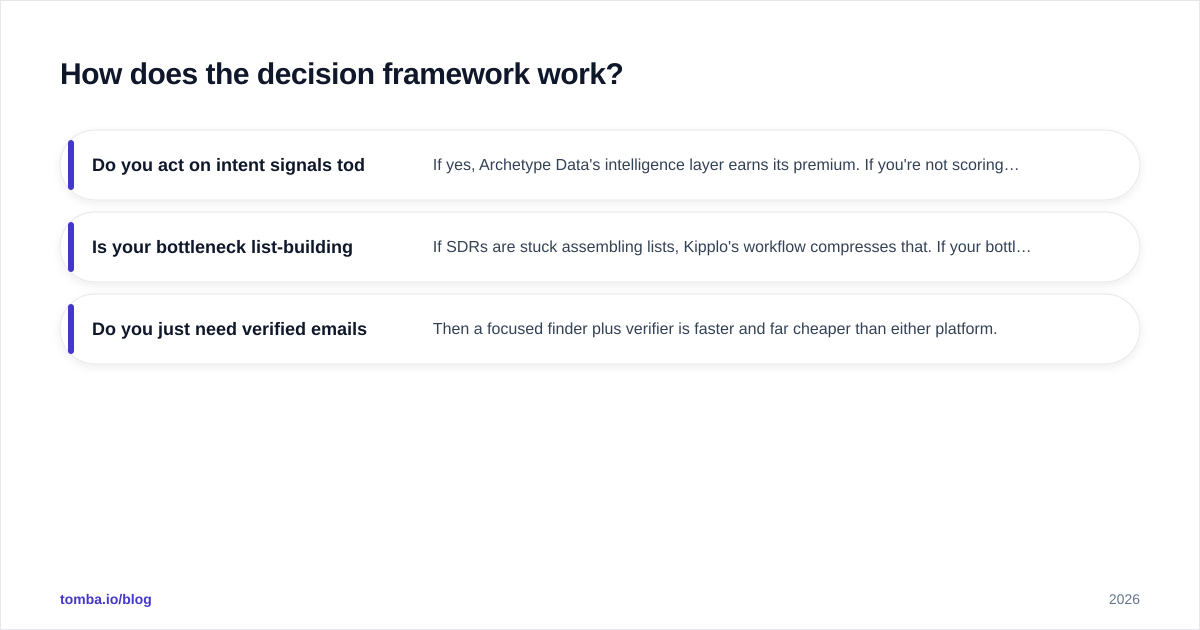
Rather than asking "which tool is better," ask "which job am I buying for." The two platforms optimize for different jobs, and mismatching them to your motion is how teams overpay. Use this framework to map your need to the right tool tier.
The logic runs in three steps:
- Do you act on intent signals today? If yes, Archetype Data's intelligence layer earns its premium. If you're not scoring accounts yet, you're paying for a feature you won't touch.
- Is your bottleneck list-building speed? If SDRs are stuck assembling lists, Kipplo's workflow compresses that. If your bottleneck is deliverability, no list builder fixes it.
- Do you just need verified emails at volume? Then a focused finder plus verifier is faster and far cheaper than either platform.
For teams in the third bucket — which is most outbound teams — the workflow looks like this from start to send.
You start from a domain or a name, find the address, verify it in real time, enrich the surrounding context only if you need it, then hand a clean record to your sequencer. Notice that "buy a giant database" is not a required step.
Is Archetype Data or Kipplo better for cold outreach?#
For pure cold outreach, Kipplo's workflow orientation gives it a slight edge over Archetype Data — it's built to get contacts into a sequence quickly. But "better for outreach" is a low bar if the underlying emails bounce. The single biggest lever on cold-email results is not which platform sourced the contact; it's whether the address is deliverable and your domain is warmed.
That's why many teams run a hybrid stack: use a platform for discovery and context, then route everything through a dedicated verification step. You can also skip the platform entirely for the discovery part. Tomba's domain search pulls every public email pattern for a company in one call, and bulk email finder handles list-scale enrichment without an enterprise contract. Pair that with proper warmup and your response rate climbs regardless of which big platform you did or didn't buy.
What about pricing and contracts?#
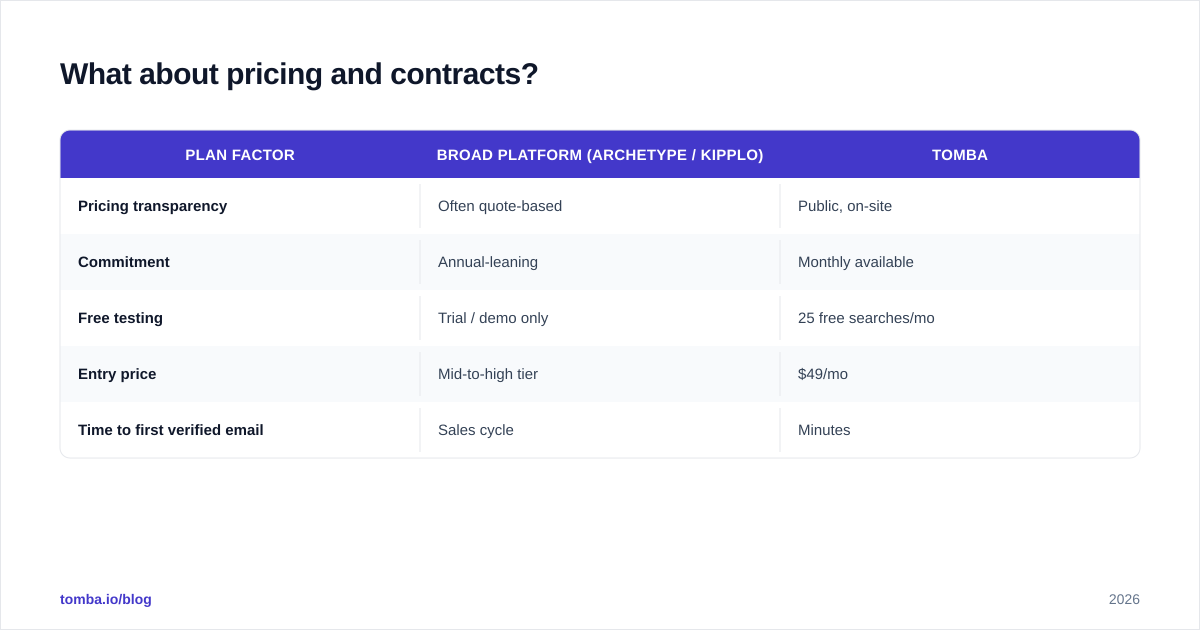
Both Archetype Data and Kipplo follow the enterprise-data playbook: pricing is often quote-based, weighted toward annual commitments, and gated behind a sales call. That's fine if you've already validated the data on your exact target market. It's a problem if you're committing before you've tested whether the records actually cover your accounts.
This is the strongest practical argument for a transparent, self-serve tool as your baseline. Tomba's pricing is public and monthly: a free tier with 25 searches, Starter at $49/mo, Growth at $99/mo, Pro at $249/mo, and custom Enterprise. You can validate real data quality against your own list this afternoon, with no call, before you ever consider a six-figure platform.
| Plan factor | Broad platform (Archetype / Kipplo) | Tomba |
|---|---|---|
| Pricing transparency | Often quote-based | Public, on-site |
| Commitment | Annual-leaning | Monthly available |
| Free testing | Trial / demo only | 25 free searches/mo |
| Entry price | Mid-to-high tier | $49/mo |
| Time to first verified email | Sales cycle | Minutes |
Which tool should you choose?#
Here's the honest verdict, conclusion first:
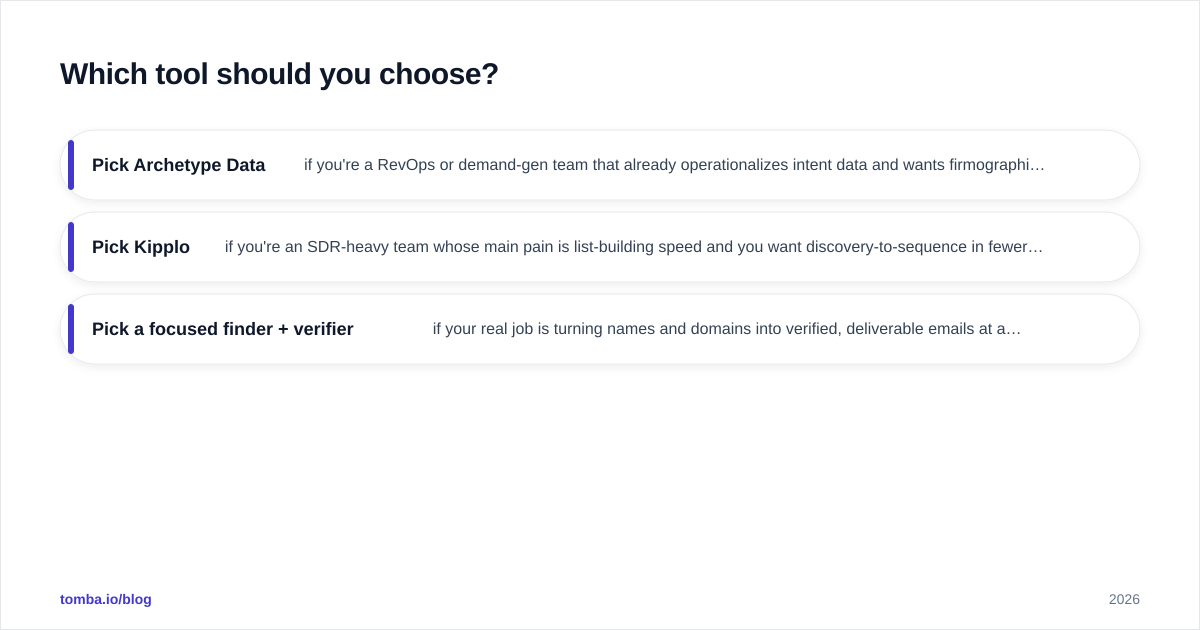
- Pick Archetype Data if you're a RevOps or demand-gen team that already operationalizes intent data and wants firmographics, technographics, and signals in one place — and you have budget for an annual platform.
- Pick Kipplo if you're an SDR-heavy team whose main pain is list-building speed and you want discovery-to-sequence in fewer tabs.
- Pick a focused finder + verifier if your real job is turning names and domains into verified, deliverable emails at a predictable cost. This describes most outbound and lead-gen teams, and it's where broad platforms quietly overcharge.
For a deeper look at how vendors source records, compare each tool's data sources and methodology — the companies that re-verify continuously beat the ones selling a big static dump. You can also sanity-check any provider against third-party reviews on G2 before you commit.

The bottom line#
Archetype Data and Kipplo are legitimate tools for the jobs they're built for — intent intelligence and prospecting workflows, respectively. Neither is a scam, and neither is a magic accuracy machine. The deciding factor is matching the tool to your actual motion and refusing to trust any raw export without verification.
If what you really need is the simplest, most reliable path from "I know the company" to "I have a verified email that lands," start with the Tomba Email Finder. It's the focused, transparently priced piece that makes whatever else you buy work better — find the address, verify it in real time, and protect your sending reputation from day one. Try it free with 25 searches before you sign anyone's annual contract.
For more on tooling tradeoffs, browse Tomba's guides on data enrichment and credible alternatives like an Apollo alternative when you're scoping the broader stack. And if you're benchmarking platforms generally, Gartner's research on sales tech is a useful neutral reference for category definitions.
// get started
Find, verify and enrich your first contacts today
Start on the free plan with 25 searches a month, then scale when your team is ready.
Free plan · No credit card required · GDPR & CCPA
// about the author