Archetype Data vs Salesbot: Best B2B Data Tool 2026
Archetype Data vs Salesbot, compared head-to-head for 2026: data accuracy, enrichment depth, pricing, and integrations. See which B2B data platform actually fits your pipeline.
Choosing between Archetype Data and Salesbot usually comes down to a single question your team keeps avoiding: do you need a data warehouse or a data worker? One ships you raw, structured B2B records to enrich your own systems. The other tries to act on that data inside your sales motion. They overlap enough to confuse a buyer and differ enough to waste a budget if you pick wrong.
This breakdown compares both on accuracy, coverage, enrichment depth, workflow fit, and price — then tells you where a focused tool like Tomba quietly beats both for the one job most teams actually need: clean, verified contact data.
TL;DR — Archetype Data vs Salesbot#
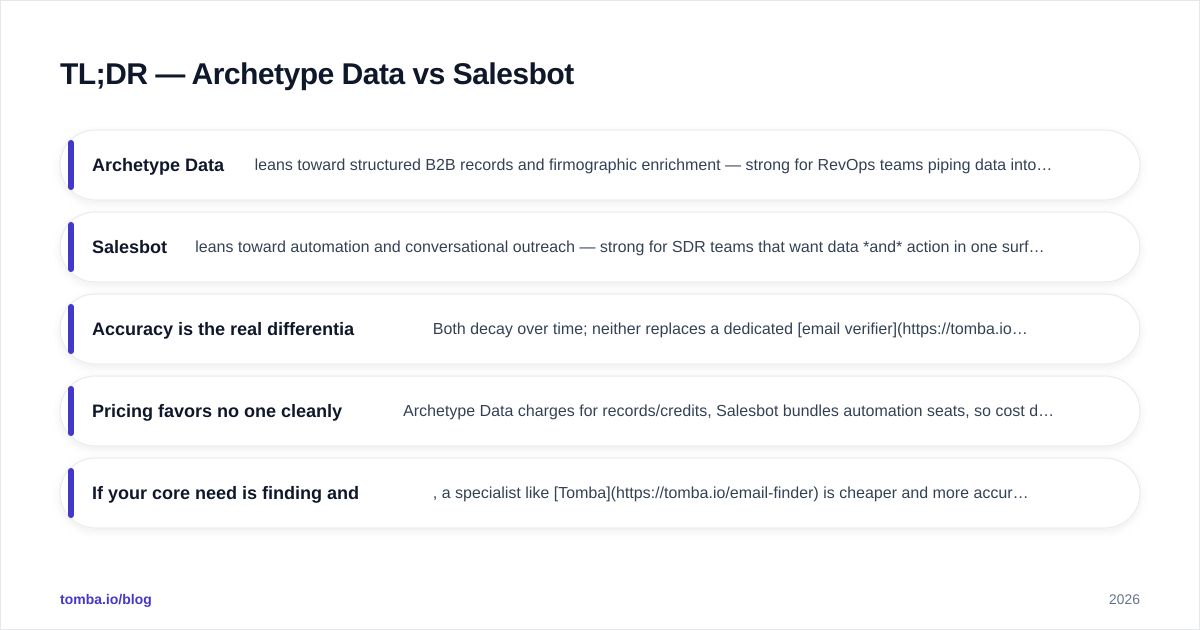
- Archetype Data leans toward structured B2B records and firmographic enrichment — strong for RevOps teams piping data into a CRM or warehouse.
- Salesbot leans toward automation and conversational outreach — strong for SDR teams that want data and action in one surface.
- Accuracy is the real differentiator. Both decay over time; neither replaces a dedicated email verifier before you send.
- Pricing favors no one cleanly — Archetype Data charges for records/credits, Salesbot bundles automation seats, so cost depends entirely on volume vs. seat count.
- If your core need is finding and verifying business emails, a specialist like Tomba is cheaper and more accurate than buying a full platform for one feature.
What is Archetype Data?#
Archetype Data positions itself as a B2B data provider: company and contact records, firmographics, technographics, and enrichment APIs you wire into your existing stack. Think of it less like a tool your reps open every morning and more like a utility line feeding your CRM, your data warehouse, and your scoring models.
The typical buyer is a RevOps or data team that already owns the workflow and just needs a reliable supply of structured records — account hierarchies, employee counts, industry codes, and contact-level attributes. You enrich a list, append missing fields, and keep your B2B database from going stale.
Its strength is breadth of attributes per record. Its weakness is the same as every static database: the moment a record is delivered, it starts decaying. People change jobs, companies restructure, and email patterns shift. A provider's "95% accurate" claim is a snapshot, not a guarantee.
What is Salesbot?#
Salesbot sits on the other end of the spectrum. It's built to act — combining contact data with automation: sequences, conversational outreach, and bot-driven follow-ups that fire based on rules or replies. Where Archetype Data hands you a clean spreadsheet, Salesbot wants to run the play.
The typical buyer is an SDR-heavy team that values speed-to-touch over data engineering. You search for prospects, drop them into an automated cadence, and let the bot handle routing, replies, and basic qualification. Data is a means to an end here; the product is the motion.
The tradeoff is predictable. Bundling data and automation into one tool means you rarely get best-in-class on either. The data layer is "good enough to send," and the automation layer is "good enough to book." For some teams that's exactly right. For others it's two mediocre tools wearing one logo.
How do Archetype Data and Salesbot compare side by side?#
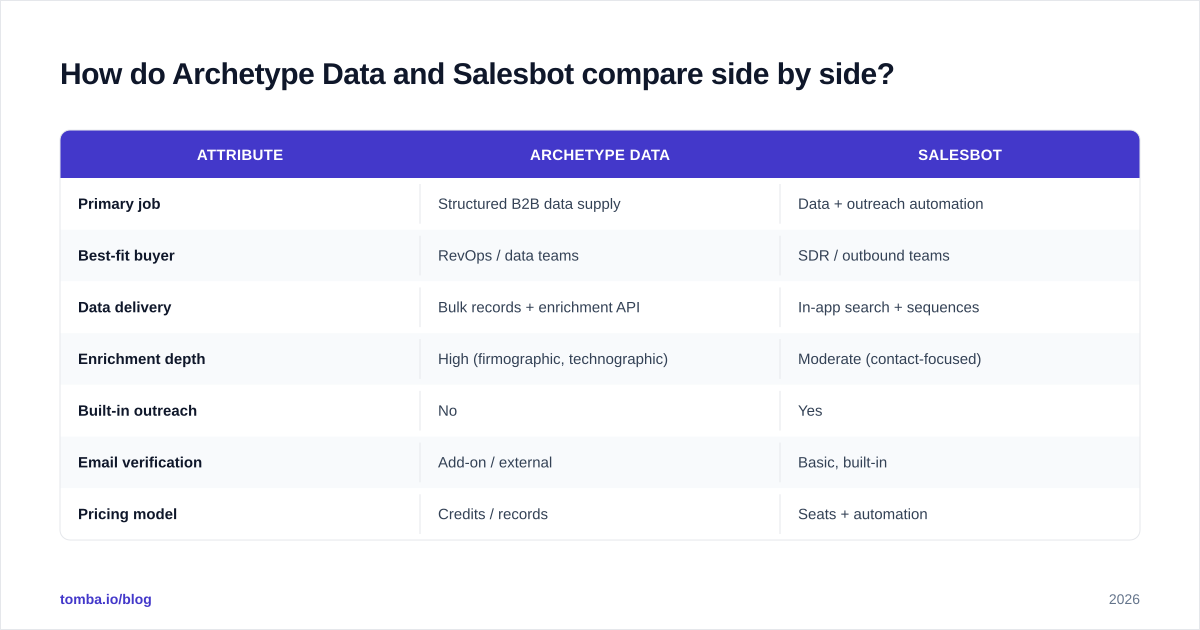
Here's the honest head-to-head. Treat vendor accuracy numbers as directional, not gospel — the only accuracy that matters is what survives verification on your list.
| Attribute | Archetype Data | Salesbot |
|---|---|---|
| Primary job | Structured B2B data supply | Data + outreach automation |
| Best-fit buyer | RevOps / data teams | SDR / outbound teams |
| Data delivery | Bulk records + enrichment API | In-app search + sequences |
| Enrichment depth | High (firmographic, technographic) | Moderate (contact-focused) |
| Built-in outreach | No | Yes |
| Email verification | Add-on / external | Basic, built-in |
| Pricing model | Credits / records | Seats + automation |
| CRM fit | Strong (warehouse-friendly) | Strong (workflow-native) |
| Learning curve | Higher (technical setup) | Lower (rep-friendly) |
The pattern is clear: Archetype Data optimizes for data quality and integration; Salesbot optimizes for speed and action. Neither is "better" in the abstract — they answer different questions.
Which has better data accuracy?#
Neither wins this outright, and that's the point most comparison posts miss. Data accuracy is not a fixed property of a vendor — it's a function of how fresh the record is, how the email was validated, and whether the domain is a catch-all.
Archetype Data tends to carry richer firmographic detail, which makes account-level scoring more reliable. But a perfect firmographic profile with a bounced email still costs you a sequence slot. Salesbot's built-in verification is convenient but shallow — it catches the obvious invalids and waves through the risky ones.
This is exactly where a verification step pays for itself. Running any purchased list through a dedicated email verification pass — including a catch-all verifier for the domains that silently accept everything — routinely strips 10-30% dead weight off a "clean" file. If you care where the records originate, vendor transparency about data sources matters more than any single accuracy percentage.
A practical rule: trust no vendor's number above ~90% on contact-level email accuracy without testing a sample yourself. The honest providers expect you to verify; the rest hope you won't.
Is Archetype Data better than Salesbot for enrichment?#
For pure enrichment, Archetype Data has the edge. If your goal is to take a list of company domains and append employee count, industry, tech stack, and contact attributes, a data-first provider will out-resolve an automation-first one almost every time.
But enrichment without a workflow is just a bigger spreadsheet. This is the trap RevOps teams fall into — buying deep data and then lacking the pipes to activate it. Before you commit, map the path from "enriched record" to "rep takes action." If that path runs through your CRM, Archetype Data's warehouse-friendly model fits. If it runs through a sequence tool, you'll bolt one on anyway.
For most teams, a leaner approach wins: use a focused data enrichment and email finder layer to fill the contact gaps, keep your CRM as the source of truth, and avoid paying platform prices for fields you never query. You can append the same firmographics by domain search without buying an entire data suite.
Which is better for outbound automation?#
Salesbot, clearly — it's the entire reason the product exists. If your bottleneck is touches per rep per day rather than data quality, Salesbot's bundled sequences and bot-driven follow-ups remove friction Archetype Data simply doesn't address.
The catch is the same one that haunts every all-in-one: when the automation engine and the data engine share a roadmap, neither gets the focus a standalone leader brings. Compare Salesbot's sequencing to a dedicated outreach platform and you'll usually find fewer deliverability controls, weaker reply detection, and thinner reporting.
A common stack that beats both extremes: pull verified contacts from a specialist finder, push them into a purpose-built sequencer, and let your CRM track the rest. You get best-in-class data and best-in-class outreach instead of two compromises. For teams already living in HubSpot or Salesforce, that modular path also avoids vendor lock-in — see how independent reviewers frame the tradeoff on G2 and Gartner Peer Insights.
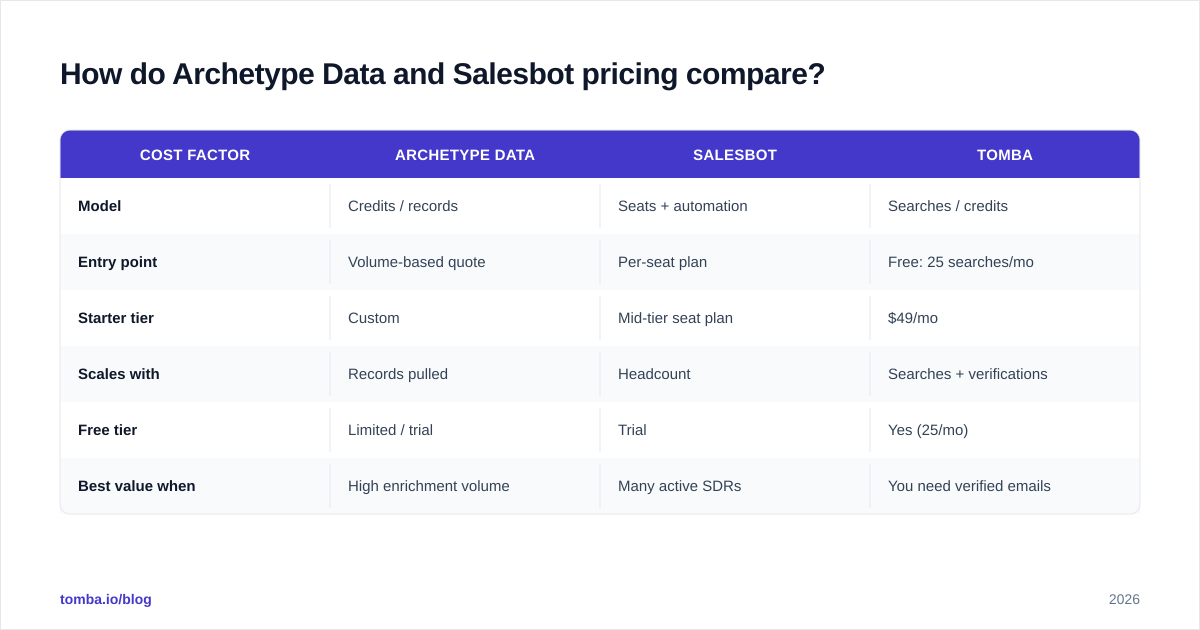
How do Archetype Data and Salesbot pricing compare?#
This is where blanket recommendations fall apart, because the two tools bill on different axes.
| Cost factor | Archetype Data | Salesbot | Tomba |
|---|---|---|---|
| Model | Credits / records | Seats + automation | Searches / credits |
| Entry point | Volume-based quote | Per-seat plan | Free: 25 searches/mo |
| Starter tier | Custom | Mid-tier seat plan | $49/mo |
| Scales with | Records pulled | Headcount | Searches + verifications |
| Free tier | Limited / trial | Trial | Yes (25/mo) |
| Best value when | High enrichment volume | Many active SDRs | You need verified emails |
Archetype Data gets expensive as your record volume climbs. Salesbot gets expensive as your team grows, whether or not every seat is active. Neither is wrong — but both can quietly outgrow their value if you're paying for capacity you don't use.
If your real need is contact discovery and verification rather than a full platform, the math shifts hard. Tomba's pricing starts free at 25 searches per month and moves to $49/mo Starter, $99/mo Growth, and $249/mo Pro — a fraction of an enterprise data contract or a seat-based automation suite. You pay for the one job that drives pipeline instead of a bundle you half-use.
When should you choose a focused tool instead?#
Choose a specialist when one capability dominates your need. And for most sales and marketing teams, that capability is the same: getting accurate, verified email addresses for the right people.
You don't need a data warehouse to do that. You don't need an automation suite either. You need:
- A way to find the email — by name, company, or domain.
- A way to verify it before you send, including catch-all domains.
- A way to enrich the gaps without re-buying your whole database.
- A clean handoff into your existing CRM and sequencer.
That's a finder, a verifier, and an enrichment layer — not a platform. Buying Archetype Data for deep enrichment you won't query, or Salesbot for automation you could rent better elsewhere, is how data budgets balloon. Reviewers on Capterra repeatedly flag the same thing: teams over-buy platforms and under-use them.
Archetype Data vs Salesbot: the verdict#
Pick Archetype Data if you're a RevOps or data team that owns the workflow and needs rich, structured records flowing into a warehouse or CRM. Its enrichment depth and warehouse-friendly delivery are its genuine strengths.
Pick Salesbot if you're an SDR-led team whose bottleneck is touches, not data quality, and you'll trade best-in-class for one-surface convenience.
Pick neither as your data layer if your honest need is finding and verifying business emails at a sane price. That's a specialist's job, and paying platform rates for it is the most common money leak in the B2B data stack.
The smartest stacks in 2026 are modular: a focused finder for contacts, a real sequencer for outreach, and your CRM as the spine — each best-in-class, none of them locking you in.
Get verified contact data without the platform tax#
If the goal underneath "Archetype Data vs Salesbot" is simply reach the right people with emails that land, start with the tool built for exactly that. Tomba Email Finder finds professional email addresses by name, company, or domain, pairs them with a built-in verifier and catch-all checks, and exports clean into HubSpot, Salesforce, Pipedrive, Sheets, and your sequencer. Begin free with 25 searches a month, scale to Starter at $49/mo when you're ready, and pay only for the job that drives pipeline. Try the Tomba Email Finder and skip the platform tax.
Ready to find emails that actually work?
Join 150,000+ professionals who stopped guessing and started sending. Free credits on signup — no credit card required.
Get the Tomba newsletter
Practical outbound tactics and product updates — once every two weeks.
About the author