Archetype Data vs SalesIntel: B2B Data Compared (2026)
Archetype Data and SalesIntel both promise accurate B2B contact and account data, but they win in different places. Here's a neutral, side-by-side breakdown for 2026.
Choosing between Archetype Data and SalesIntel comes down to one question: do you need deep, human-verified contact accuracy, or do you need broad coverage with buyer-intent signals layered on top? Both vendors sell "accurate B2B data," but that phrase hides very different trade-offs. This breakdown walks through what each platform actually delivers in 2026, where each one is worth paying for, and how to plug either into a working go-to-market motion without overpaying for seats you don't use.
TL;DR — Archetype Data vs SalesIntel at a glance#
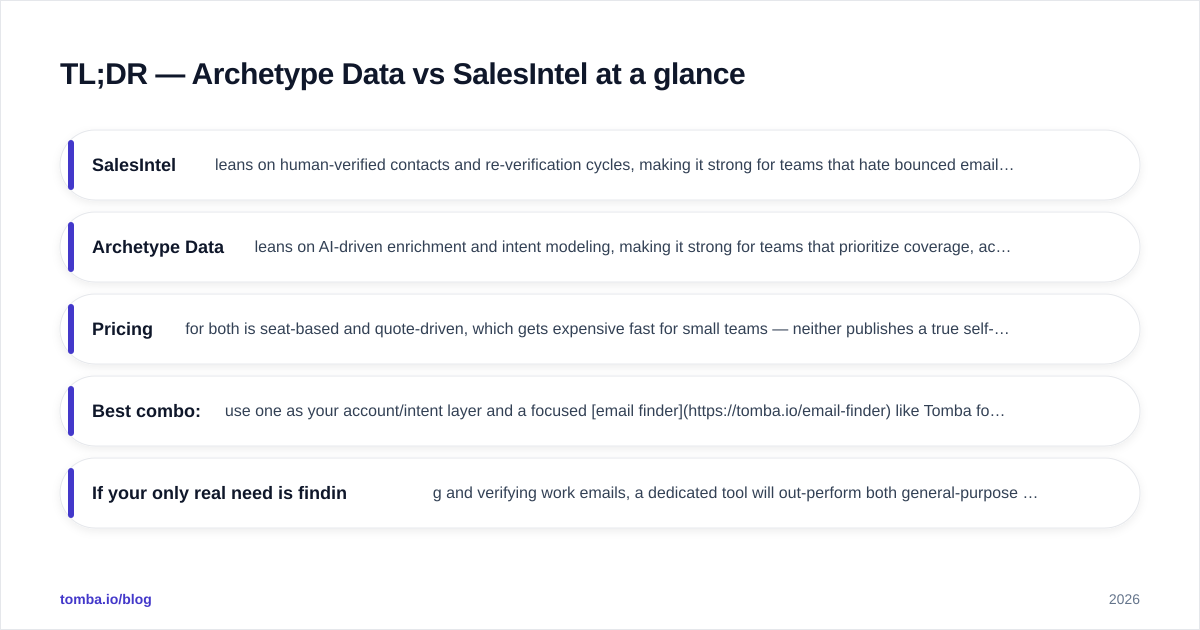
- SalesIntel leans on human-verified contacts and re-verification cycles, making it strong for teams that hate bounced emails and stale direct dials.
- Archetype Data leans on AI-driven enrichment and intent modeling, making it strong for teams that prioritize coverage, account scoring, and timing.
- Pricing for both is seat-based and quote-driven, which gets expensive fast for small teams — neither publishes a true self-serve free tier.
- Best combo: use one as your account/intent layer and a focused email finder like Tomba for high-accuracy contact discovery at a fraction of the per-seat cost.
- If your only real need is finding and verifying work emails, a dedicated tool will out-perform both general-purpose platforms on cost per valid contact.
What is Archetype Data?#
Archetype Data is a B2B data enrichment and sales-intelligence platform built around AI modeling. Instead of relying primarily on a research team to confirm each record, it ingests signals from across the web — firmographics, technographics, hiring trends, and behavioral intent — and predicts which accounts are likely in-market.
The pitch is timing and scale. You don't just get a contact list; you get an account-scoring layer that tells you who to call this week. For revenue teams running an account-based motion, that prioritization is the headline feature. Coverage tends to be wide because AI inference fills gaps that manual research can't reach at volume.
The trade-off is the one every AI-first data vendor faces: inferred data is a probability, not a fact. A predicted email pattern or a modeled job title is right often enough to be useful, but you still need a verification step before you send. Treat Archetype's output as a high-quality starting point, not gospel.
What is SalesIntel?#
SalesIntel built its reputation on human-verified data. Its research team re-verifies contacts on a rolling cycle (the marketing term you'll see is "re-verification"), which is meant to keep direct dials and emails from rotting the way purchased lists usually do. SalesIntel also offers research-on-demand: if a contact you need isn't in the database, you can request it and their team sources it.
That human layer is the whole value proposition. If your SDRs burn hours on disconnected numbers and hard bounces, a verified-first provider pays for itself in reclaimed selling time. SalesIntel also folds in intent data (through partnerships) and technographics, so it isn't purely a contact database — but verification is the center of gravity.
The cost of that approach is coverage and price. Human verification doesn't scale as cheaply as inference, so the database is deep in some segments and thinner in others, and pricing reflects the labor involved.
)
How do Archetype Data and SalesIntel compare on features?#
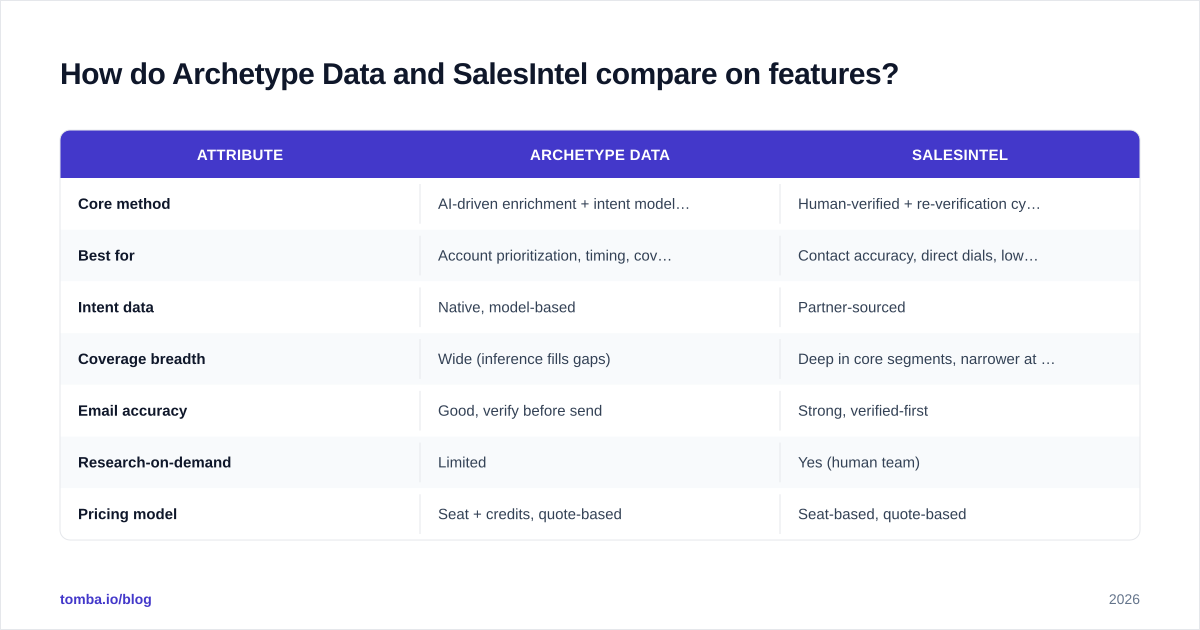
Here's the side-by-side. Treat published accuracy numbers from any vendor with healthy skepticism — they're measured under favorable conditions — but the shape of each platform's strengths is consistent across reviews on G2 and Capterra.
| Attribute | Archetype Data | SalesIntel |
|---|---|---|
| Core method | AI-driven enrichment + intent modeling | Human-verified + re-verification cycle |
| Best for | Account prioritization, timing, coverage | Contact accuracy, direct dials, low bounce |
| Intent data | Native, model-based | Partner-sourced |
| Coverage breadth | Wide (inference fills gaps) | Deep in core segments, narrower at edges |
| Email accuracy | Good, verify before send | Strong, verified-first |
| Research-on-demand | Limited | Yes (human team) |
| Pricing model | Seat + credits, quote-based | Seat-based, quote-based |
| Free self-serve tier | No | No |
| Typical buyer | RevOps / ABM teams | SDR / outbound teams |
The pattern is clear: Archetype optimizes for who and when, SalesIntel optimizes for is this contact real. Neither is strictly better — they answer different questions in your pipeline.
Which one is more accurate?#
Accuracy depends on what you're measuring. For email and phone validity at the moment of outreach, SalesIntel's verified-first model has the structural edge — a human checked it, and the re-verification cycle is designed to catch decay. For account-level signals (is this company hiring, expanding, or showing intent), Archetype's modeling is built for exactly that and will surface opportunities a static verified database won't.
The honest caveat: no provider stays 100% accurate, because people change jobs constantly. Industry estimates put B2B data decay at roughly 25–30% per year, which means any list you buy today is meaningfully wrong within months. That's why the smartest teams don't trust a single source. They run a verification pass at send time regardless of where the data came from — using an email verifier to catch bounces before they hit a mailbox and damage sender reputation.
How does pricing compare?#
Both Archetype Data and SalesIntel use seat-based, quote-driven pricing — you talk to sales, you get a number tied to seats and credit volume, and that number scales up quickly as you add reps. Neither publishes a genuine free self-serve tier, which is the friction point for small teams and solo founders who just want to start finding contacts today.
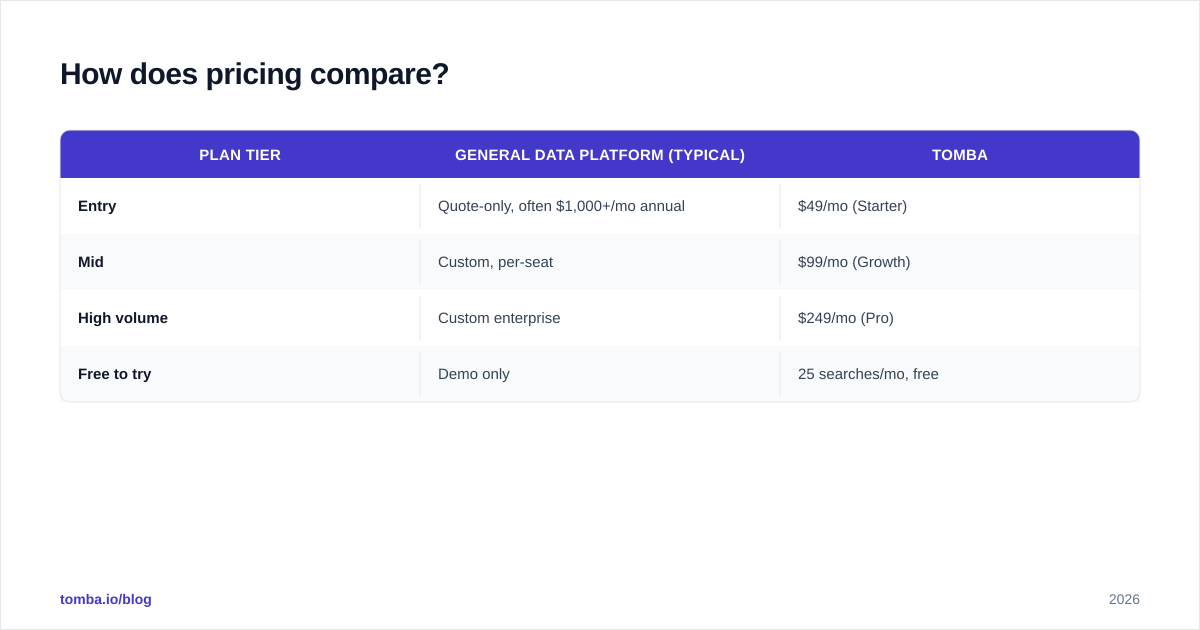
This is where a focused tool changes the math. Compare the structure:
| Plan tier | General data platform (typical) | Tomba |
|---|---|---|
| Entry | Quote-only, often $1,000+/mo annual | $49/mo (Starter) |
| Mid | Custom, per-seat | $99/mo (Growth) |
| High volume | Custom enterprise | $249/mo (Pro) |
| Free to try | Demo only | 25 searches/mo, free |
You can see full Tomba pricing for the exact credit allotments. The point isn't that Tomba replaces an intent platform — it's that if 80% of your spend is going toward finding and verifying emails, you're overpaying when you route that through a $1,000+/mo seat license.
)
When should you pick Archetype Data?#
Choose Archetype Data if:
- You run an account-based marketing (ABM) or RevOps motion and need to score and prioritize accounts, not just dial contacts.
- Timing matters — you want to reach buyers while they're showing intent, not after.
- You value coverage breadth and are comfortable adding a verification step before outreach.
- Your team already has a process to validate inferred data before it goes into a sequence.
Archetype is the better fit when the bottleneck is deciding who to target, not finding their email.
When should you pick SalesIntel?#
Choose SalesIntel if:
- Your reps waste time on disconnected dials and bounced emails, and verified-first data would directly reclaim selling hours.
- You need research-on-demand for niche contacts that automated databases miss.
- You sell into well-covered segments where SalesIntel's database is deep.
- You'd rather pay more for confidence than chase down bad records yourself.
SalesIntel is the better fit when the bottleneck is data quality at the point of contact.
What's the smarter way to build your data stack in 2026?#
Stop thinking "one vendor for everything." The teams getting the best cost-per-meeting in 2026 layer their stack:
- Account/intent layer — Archetype Data, SalesIntel, or a comparable platform to decide which accounts deserve attention. This is your strategy layer and it's worth paying for if ABM is your motion.
- Contact discovery layer — a dedicated, high-accuracy email finder to pull verified work emails for the people inside those target accounts. This is the highest-volume, most repetitive task, so cost-per-lookup matters most here.
- Verification layer — a real-time check before every send, because decay never stops.
This is exactly where Tomba slots in cheaply. Use domain search to pull every contact at a target account in one query, then verify in bulk. You get the precision of a contact-finding specialist without paying enterprise-platform per-seat rates for it. If you're evaluating broader platforms, our breakdowns of an Apollo alternative and a Clearbit alternative show how the layered approach plays out against the big names.
For teams that live in spreadsheets, the Google Sheets add-on and the Tomba API let you wire contact discovery directly into whatever account list your intent platform produces — no copy-paste, no per-seat tax on every analyst who touches the data.
How do Archetype Data and SalesIntel handle compliance?#
Both vendors position themselves as compliant with major data regulations like GDPR and CCPA, and both expose data-source documentation on request. If you sell into the EU or operate in regulated industries, make the compliance conversation part of your evaluation — ask each vendor directly how they source records, how opt-outs are honored, and how quickly suppression requests propagate. Don't take a marketing page at face value; get it in the contract.
For broader context on how vendors describe their methods, the official sites — salesforce.com for CRM integration standards and hubspot.com for inbound-data norms — are useful reference points for what "good" data governance looks like across the industry.
Final verdict: Archetype Data vs SalesIntel#
There's no single winner — there's a winner for your motion:
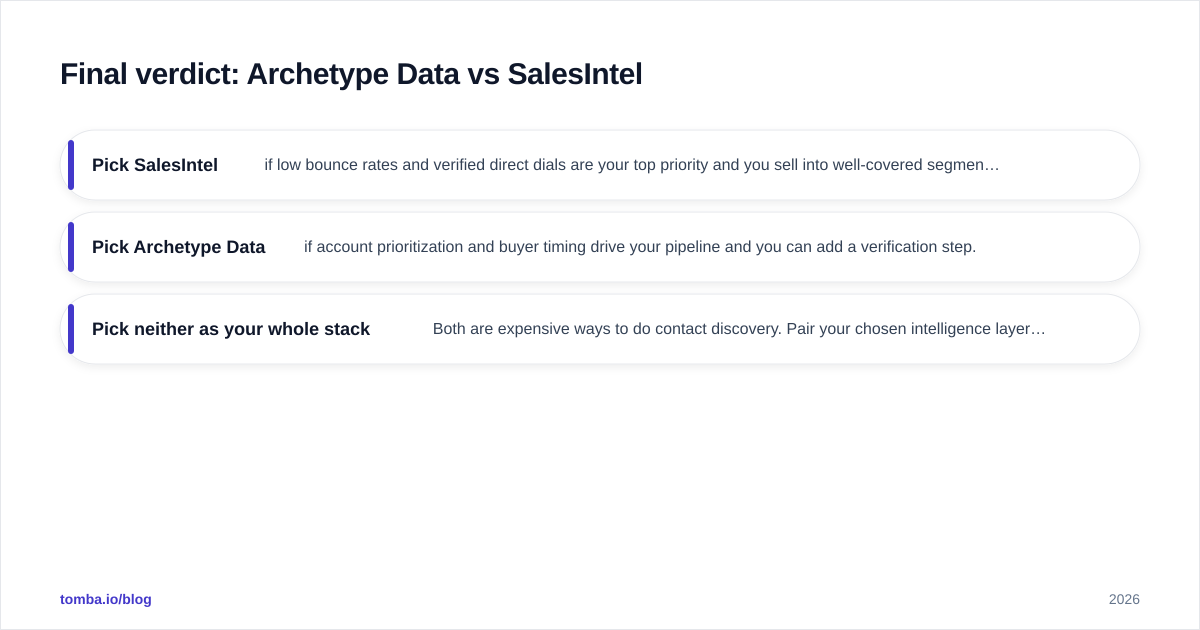
- Pick SalesIntel if low bounce rates and verified direct dials are your top priority and you sell into well-covered segments.
- Pick Archetype Data if account prioritization and buyer timing drive your pipeline and you can add a verification step.
- Pick neither as your whole stack. Both are expensive ways to do contact discovery. Pair your chosen intelligence layer with a specialist tool for the high-volume work.
The mistake to avoid is paying enterprise platform prices for a job a focused tool does better and cheaper. Most of your daily data work is finding a real email for a real person at a target company — that's a solved problem, and you shouldn't be billing it to a $1,000-a-month seat.
Get started with the right contact layer#
If your goal is accurate, affordable contact discovery to sit underneath whichever intelligence platform you choose, start with the Tomba Email Finder. Find professional email addresses by domain, name, or company, verify them before you send, and keep your bounce rate low without burning through enterprise seats. There's a free tier with 25 searches a month to test accuracy on your own target accounts, and Tomba plans start at $49/mo when you're ready to scale. Try it on your next account list and compare the cost-per-valid-contact against your current platform — the math usually speaks for itself.
// get started
Find, verify and enrich your first contacts today
Start on the free plan with 25 searches a month, then scale when your team is ready.
Free plan · No credit card required · GDPR & CCPA
// about the author