Archetype Data vs UpLead 2026: B2B Data Tool Comparison
A neutral, side-by-side breakdown of Archetype Data vs UpLead — data freshness, accuracy, pricing, and which B2B data tool fits your prospecting stack in 2026.
Choosing between Archetype Data vs UpLead comes down to one question: do you want a broad, self-serve B2B database with verified emails baked in, or a newer real-time intelligence layer that prioritizes freshness over raw volume? This guide breaks both down without the marketing gloss so you can pick the right engine for your pipeline.
TL;DR#
- UpLead is the established, self-serve B2B contact database — ~155M+ contacts, real-time email verification at export, and predictable per-credit pricing. Best for SDR teams that want volume plus a verification safety net.
- Archetype Data is the newer, freshness-first intelligence platform — leaner database, stronger emphasis on recently-validated records and intent signals. Best for teams that hate stale data more than they love big counts.
- On accuracy, both claim 90%+ deliverable rates; in practice your results depend on the niche and how aggressively you re-verify before sending.
- On price, UpLead is transparent and credit-based; Archetype leans toward custom/seat-based deals that reward heavier usage but cost more to start.
- If you already have a sending stack and just need clean, verifiable contact data, a focused email finder plus a dedicated email verifier often beats paying for a full platform you'll half-use.
What is Archetype Data?#
Archetype Data positions itself as a real-time B2B data and intelligence provider. Instead of leading with the largest possible contact count, it emphasizes record freshness — how recently a given email, title, or company attribute was confirmed — alongside enrichment and buying-intent signals.
The pitch is straightforward: a smaller database of recently validated contacts beats a giant database where a third of the records have quietly gone stale. People change jobs, companies restructure, and email patterns shift. Archetype's angle is to surface the contacts whose data was touched most recently, which matters a lot for email deliverability when you're sending cold.
What is UpLead?#
UpLead is a self-serve B2B prospecting database that's been around long enough to earn a deep review trail on G2. Its core promise is a large contact pool (155M+ contacts across 200+ countries), 50+ search filters, and — its signature feature — real-time email verification at the moment you export, so you only burn a credit on a contact whose email just passed an SMTP check.
That verify-on-export model is why UpLead built its reputation around a 95% data-accuracy guarantee. You filter, you preview, you export, and the platform re-checks the email before charging you. For an SDR running high-volume outbound, that single feature removes a lot of bounce risk before a message ever leaves your outbox.
Archetype Data vs UpLead: how do they compare head-to-head?#
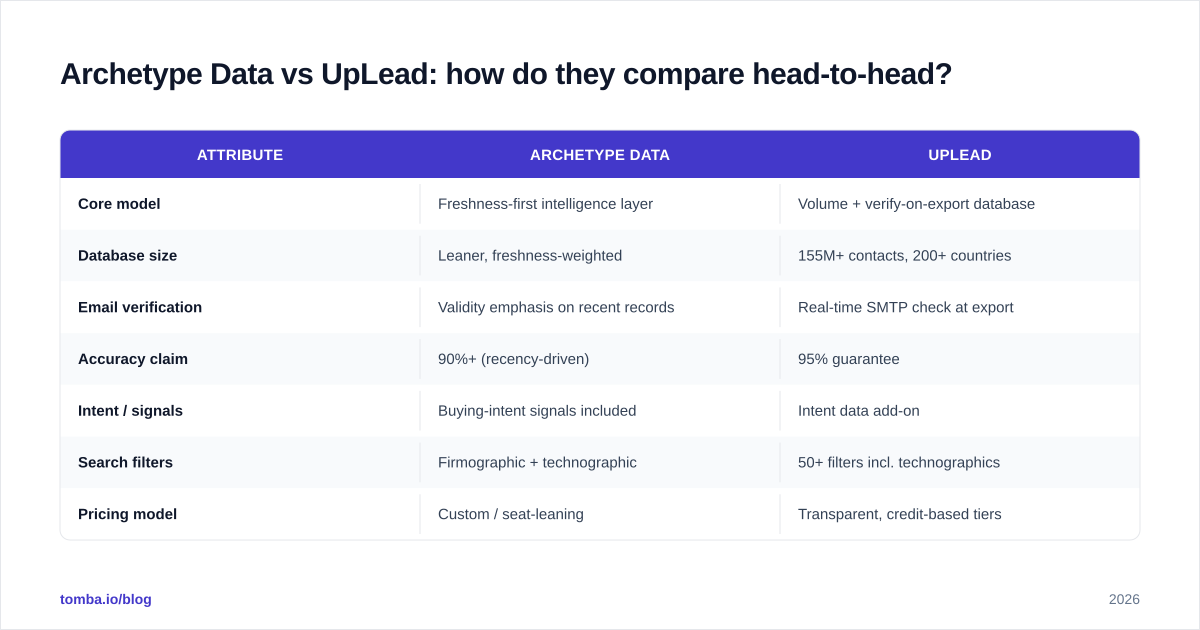
Here's the side-by-side on the attributes that actually change your numbers. Treat vendor-published accuracy figures as marketing claims until you've run your own test batch.
| Attribute | Archetype Data | UpLead |
|---|---|---|
| Core model | Freshness-first intelligence layer | Volume + verify-on-export database |
| Database size | Leaner, freshness-weighted | 155M+ contacts, 200+ countries |
| Email verification | Validity emphasis on recent records | Real-time SMTP check at export |
| Accuracy claim | 90%+ (recency-driven) | 95% guarantee |
| Intent / signals | Buying-intent signals included | Intent data add-on |
| Search filters | Firmographic + technographic | 50+ filters incl. technographics |
| Pricing model | Custom / seat-leaning | Transparent, credit-based tiers |
| Free trial | Limited / demo-gated | Free credits to test |
| Best for | Teams that prioritize fresh data | SDR teams that want volume + safety net |
The honest read: UpLead wins on transparency and out-of-the-box volume, while Archetype Data competes on freshness and signal richness. Neither is a universal "better." The right pick depends on whether your bottleneck is not enough contacts or too many dead contacts.

Which one is more accurate?#
Accuracy is where most of these comparisons go sideways, because "95% accurate" means nothing without knowing how and when it's measured.
UpLead's number comes from its verify-at-export step — the email is checked right before you receive it, which is the most useful moment to check. Archetype's freshness model attacks the same problem from a different direction: keep records recent so they're less likely to have decayed in the first place.
In real campaigns, three things move your actual deliverable rate more than the vendor's badge:
- Niche coverage. Both platforms are stronger in North American tech and SaaS than in, say, regional manufacturing or non-English markets. Test your exact ICP before committing.
- Catch-all domains. A huge share of B2B domains accept all mail, so no provider can fully confirm those addresses at SMTP time. You'll want a dedicated catch-all verifier to score them separately.
- Time-to-send. Even a perfectly verified email decays. Export, then send within days — not weeks.
The practical move regardless of which tool you choose: re-verify the list with an independent email verification pass right before loading it into your sequencer. Two verification layers from different sources catch more bad addresses than either alone. See how data sourcing affects this on Tomba's data sources page.

How does pricing compare?#
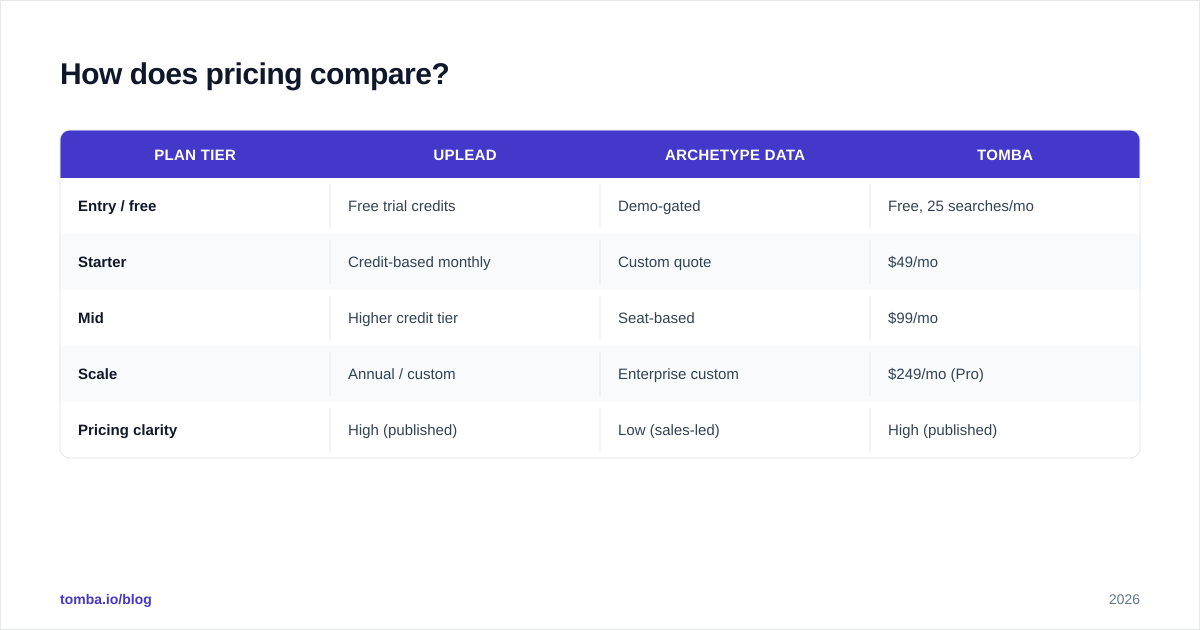
UpLead's pricing is its friendliest feature: published, credit-based tiers with a free trial that hands you real credits to test export quality before paying. You always know what an exported contact costs.
Archetype Data leans toward custom and seat-based arrangements. That structure rewards heavy, ongoing usage — the per-record cost can drop at scale — but it raises the entry price and makes a quick, no-commitment test harder. If you want to kick the tires for a week, UpLead's model is less friction.
For comparison, a focused tooling stack can come in well under either platform. Tomba's pricing runs a Free tier (25 searches/mo), Starter at $49/mo, Growth at $99/mo, and Pro at $249/mo — so you can pair an email finder, verifier, and domain search without buying a full prospecting suite you'll only partly use.
| Plan tier | UpLead | Archetype Data | Tomba |
|---|---|---|---|
| Entry / free | Free trial credits | Demo-gated | Free, 25 searches/mo |
| Starter | Credit-based monthly | Custom quote | $49/mo |
| Mid | Higher credit tier | Seat-based | $99/mo |
| Scale | Annual / custom | Enterprise custom | $249/mo (Pro) |
| Pricing clarity | High (published) | Low (sales-led) | High (published) |
When should you pick Archetype Data?#
Pick Archetype Data if:
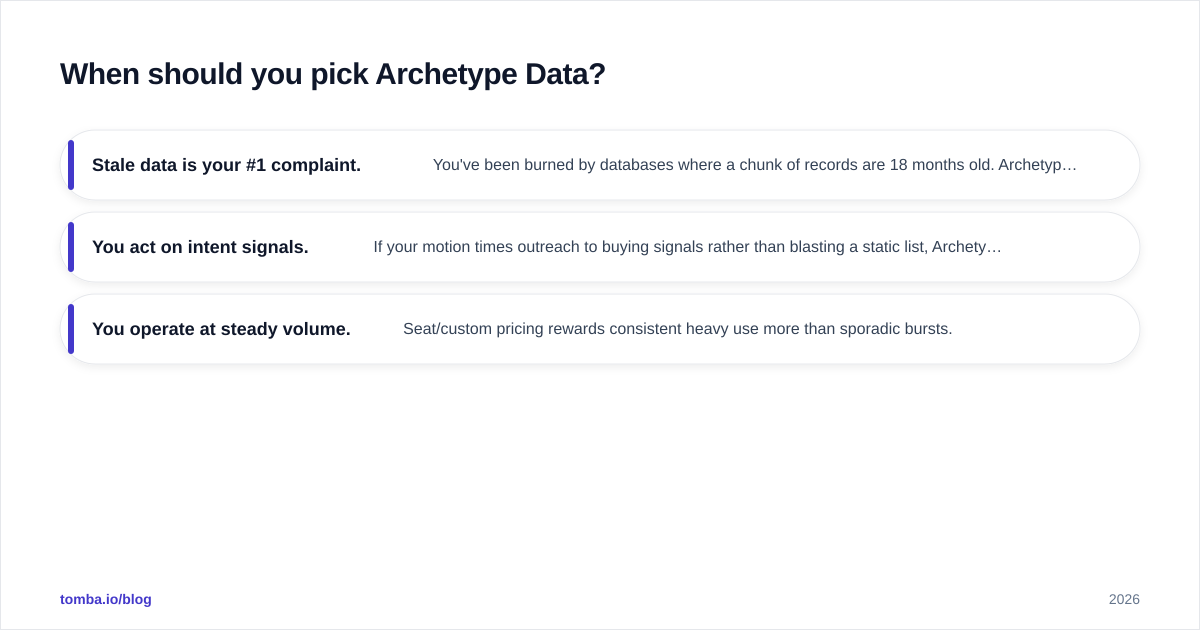
- Stale data is your #1 complaint. You've been burned by databases where a chunk of records are 18 months old. Archetype's freshness weighting is built for exactly this pain.
- You act on intent signals. If your motion times outreach to buying signals rather than blasting a static list, Archetype's signal layer earns its keep.
- You operate at steady volume. Seat/custom pricing rewards consistent heavy use more than sporadic bursts.
When should you pick UpLead?#
Pick UpLead if:
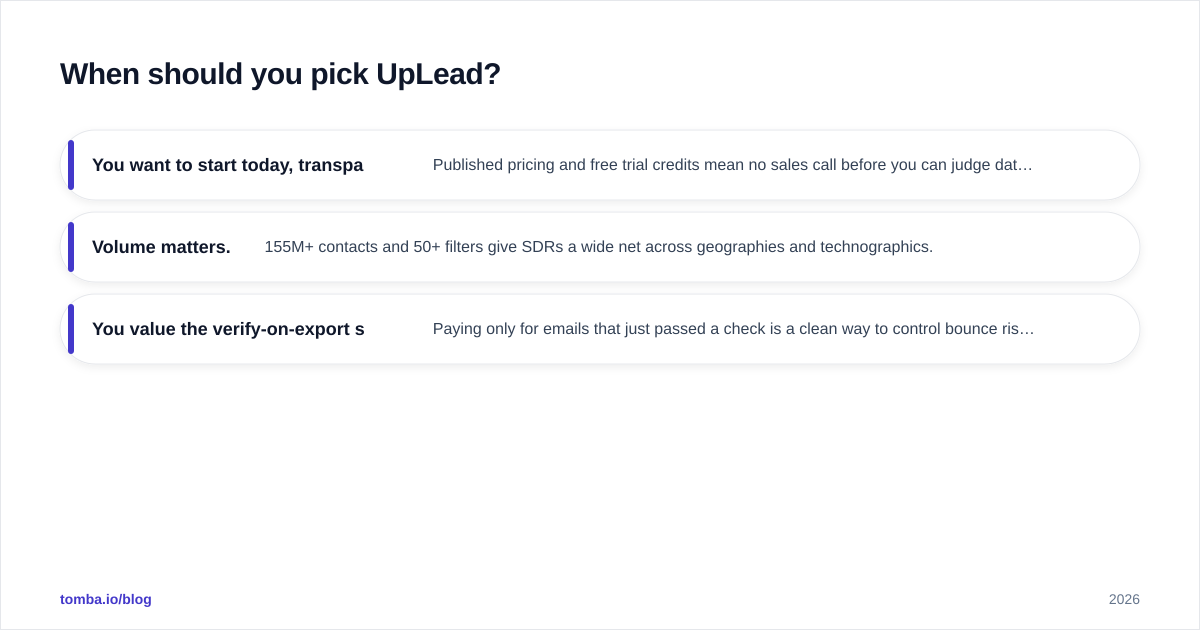
- You want to start today, transparently. Published pricing and free trial credits mean no sales call before you can judge data quality.
- Volume matters. 155M+ contacts and 50+ filters give SDRs a wide net across geographies and technographics.
- You value the verify-on-export safety net. Paying only for emails that just passed a check is a clean way to control bounce risk.
UpLead and Archetype aren't your only options — if either feels like overkill, browse focused Apollo alternatives and Clearbit alternatives that unbundle data, finding, and enrichment so you pay only for the piece you need.
Do you even need a full platform?#
This is the question most "X vs Y" posts skip. A lot of teams buy a heavyweight database when their real need is narrow: find verified emails for a known list of companies and people.
If that's you, the lean stack looks like:
- A precise email finder to resolve names + domains into addresses.
- A standalone email verifier to confirm them before sending.
- Bulk lead generation when you need to process a CSV of hundreds of accounts at once.
- A data enrichment step to fill in titles, companies, and socials.
This à la carte approach typically costs less than a full prospecting platform and avoids paying for filters, dashboards, and seats you won't touch. The trade-off is you assemble the workflow yourself — but with an email finder API and native integrations into HubSpot and Salesforce, that assembly is mostly clicks, not code.

What do the experts say about B2B data decay?#
Independent research consistently shows B2B contact data decays fast — commonly cited at roughly 30% per year as people change roles and companies churn. Both Archetype's freshness model and UpLead's verify-on-export step are answers to the same underlying reality. Vendor directories like Capterra and analyst coverage from firms such as Gartner are useful for cross-checking claims before you sign anything — read the verified reviews, not just the feature grid.
The takeaway that holds across every tool: verification is not a one-time event. Whichever platform you choose, build a re-verification step into your pipeline and measure your own bounce rate as the real scorecard.
Final verdict: Archetype Data vs UpLead#
For most teams in 2026, UpLead is the safer first pick — transparent pricing, a free trial, real volume, and verify-on-export remove guesswork. Archetype Data is the sharper pick when data freshness and intent signals are your core constraint and you have the budget for a sales-led, usage-rewarding contract.
But before you commit a year to either, run a small test against your exact ICP and judge by bounce rate, not by the badge on the homepage. And if your real need is just clean, verifiable contact data without the platform overhead, you can get there faster and cheaper with focused tools.
Start free with the Tomba Email Finder — find professional emails by name, company, or domain search, verify them in the same workflow, and only scale up to a full database once you've proven the data quality your campaigns actually need. The Free tier gives you 25 searches a month to test it against your own list before spending a cent.
// get started
Find, verify and enrich your first contacts today
Start on the free plan with 25 searches a month, then scale when your team is ready.
Free plan · No credit card required · GDPR & CCPA
// about the author