Are AI SDRs Worth It in 2026? An Honest Cost-Benefit Look
AI SDRs promise pipeline on autopilot, but the bills and bounce rates tell a messier story. Here's when they pay off in 2026 — and when a human plus good data wins.

TL;DR
- AI SDRs are worth it when your offer is high-volume, your ICP is broad, and your data layer is clean — they fail fast on niche, high-ACV motions where buyers smell automation.
- The sticker price ($1,000–$2,000/mo per "AI rep") is the small number. The hidden cost is domain reputation, list quality, and the human time spent fixing what the bot got wrong.
- In 2026 the realistic outcome is a hybrid: AI handles research, list-building, and first-touch drafting; humans handle judgment, objection-handling, and anything that touches revenue.
- Garbage data sinks every AI SDR. Verified contact data is the single biggest lever on reply rate — bigger than the model writing the email.
- Run a 90-day pilot with one clear control group before you replace a single human seat. Most "AI SDR failed" stories are really "we skipped the pilot" stories.
What is an AI SDR, actually?#
An AI SDR is software that does the repetitive parts of a sales development rep's job: building target lists, researching accounts, drafting and sending first-touch emails, and booking replies into a calendar. Think of it less like hiring a junior rep and more like hiring a very fast intern who never sleeps, never improvises, and only knows what you told it.
That distinction matters. A human SDR can read a room, notice a trigger event you never programmed, and decide to skip a bad-fit account. An AI SDR executes the playbook you gave it at scale — including the parts of the playbook that are wrong. Speed amplifies whatever you point it at, good or bad.
The category exploded after 2024 (Artisan's "Ava," 11x's "Alice," Relevance AI, and a wave of copycats), and by 2026 the marketing has cooled into something more honest. Vendors stopped promising "fire your sales team" and started promising "give your sales team leverage." That's the right frame for deciding whether they're worth it.
How much does an AI SDR cost in 2026?#
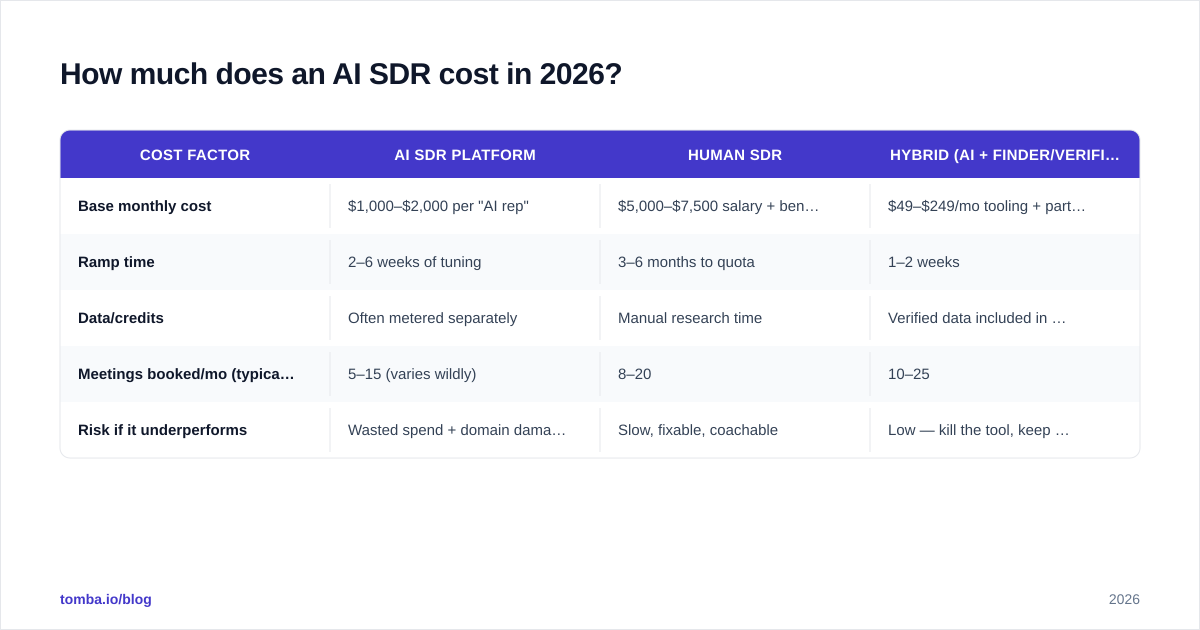
The honest answer: more than the price page says. Most vendors charge a flat monthly "per AI rep" fee, then meter you on contact credits, email-sending volume, and enrichment lookups on top. Here's a realistic comparison of the dominant pricing shapes you'll see.
| Cost factor | AI SDR platform | Human SDR | Hybrid (AI + finder/verifier stack) |
|---|---|---|---|
| Base monthly cost | $1,000–$2,000 per "AI rep" | $5,000–$7,500 salary + benefits | $49–$249/mo tooling + part-time human |
| Ramp time | 2–6 weeks of tuning | 3–6 months to quota | 1–2 weeks |
| Data/credits | Often metered separately | Manual research time | Verified data included in tool plan |
| Meetings booked/mo (typical) | 5–15 (varies wildly) | 8–20 | 10–25 |
| Risk if it underperforms | Wasted spend + domain damage | Slow, fixable, coachable | Low — kill the tool, keep the rep |
Two things jump out. First, the AI SDR is cheaper than a human on paper but not dramatically so once you add metered credits and the sending infrastructure to support volume. Second, the hybrid column — a human using a focused email finder plus an email verifier and an automation layer — often beats both on cost-per-meeting because it pairs cheap tooling with human judgment.
For your own numbers, build a real cost-per-meeting model. A $1,500/mo AI SDR that books 6 meetings costs $250 per meeting. A human at $6,000 who books 15 costs $400. But if the AI SDR's meetings convert at half the rate because the targeting was off, the human wins on cost-per-closed-deal — the only number that actually matters.
Are AI SDRs better than human SDRs?#
No — and yes. They're better at different things, and pretending otherwise is how teams waste a quarter.
AI SDRs win on volume, consistency, and tirelessness. They'll research 5,000 accounts overnight, draft 5,000 lightly-personalized openers, and never get demoralized after 40 no-replies. For a top-of-funnel, broad-ICP, transactional motion, that's genuinely valuable.
Humans win on judgment, trust, and nonlinear moves. When a prospect replies "we're mid-reorg, talk in Q3," a human knows to file it and follow up in Q3 with a relevant insight. The AI SDR either drops it or fires a generic sequence that reads as tone-deaf. For complex, high-ACV deals where a single relationship is worth six figures, the AI's mistakes are expensive.
The data backs the nuance. Industry analysts at Gartner have repeatedly noted that B2B buyers spend only a small fraction of their journey talking to any sales rep — which cuts both ways. It means low-touch automation can cover more ground, but it also means the few human conversations carry disproportionate weight. You don't want a bot fumbling the moment that actually matters.
A useful mental model: AI SDRs are a forklift, not a replacement worker. A forklift lets one person move what used to take ten. It doesn't decide what to ship.
When are AI SDRs worth it?#
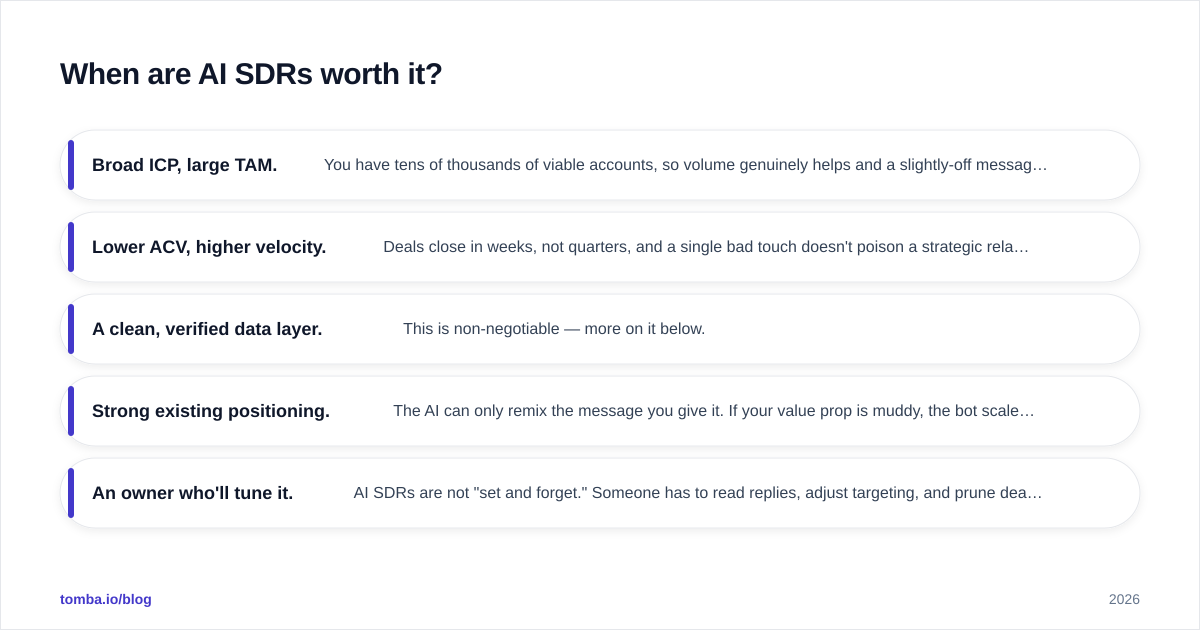
They're worth it when most of these are true:
- Broad ICP, large TAM. You have tens of thousands of viable accounts, so volume genuinely helps and a slightly-off message still hits enough good-fit buyers.
- Lower ACV, higher velocity. Deals close in weeks, not quarters, and a single bad touch doesn't poison a strategic relationship.
- A clean, verified data layer. This is non-negotiable — more on it below.
- Strong existing positioning. The AI can only remix the message you give it. If your value prop is muddy, the bot scales the confusion.
- An owner who'll tune it. AI SDRs are not "set and forget." Someone has to read replies, adjust targeting, and prune dead segments weekly.
They're not worth it when you sell into a small named-account list, run a relationship-driven enterprise motion, or have a brand-new domain you can't afford to burn. In those cases the downside (deliverability damage, reputation hits, annoyed buyers) outweighs the volume upside.
What's the hidden cost nobody mentions?#
Your sending domain. This is the line item that turns a "worth it" calculation into a disaster.
AI SDRs are built to send volume, and volume is exactly what wrecks email deliverability when the underlying list is dirty. Every email you send to an invalid address, a spam trap, or a long-dead inbox tells mailbox providers your sender reputation is sloppy. Do it at AI scale and you don't just lose this campaign — you poison your domain for months, including the human reps' replies.
This is why the "cheap" AI SDR can be the most expensive decision you make. A blown domain costs you re-warming time, a new domain purchase, and every deal that stalls because your follow-ups landed in spam. Google and Yahoo's bulk sender requirements tightened the rules, and AI-scale sending is exactly the behavior they're watching for.
The fix is boring and it works: verify before you send. Run every address through an email verifier, handle catch-all domains with a catch-all verifier, and never let an AI SDR fire at an unverified list. The model writing the email matters far less than the quality of the addresses it's writing to.
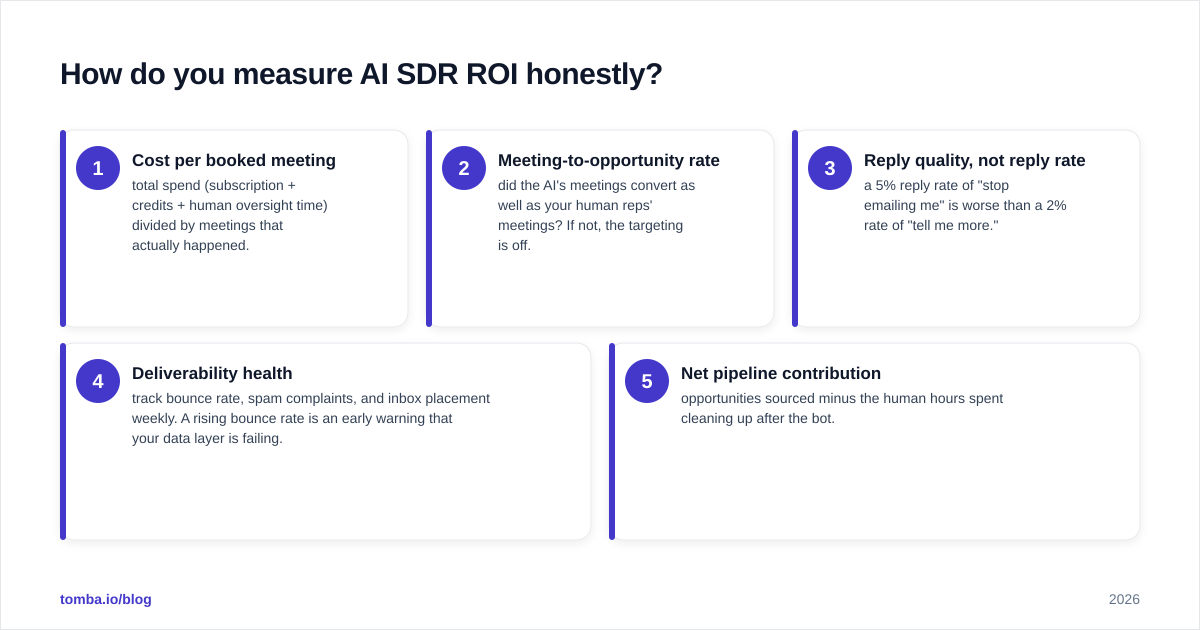
How do you measure AI SDR ROI honestly?#
Stop measuring activity. AI SDRs make activity metrics look incredible — thousands of emails, hundreds of "personalized" touches — while pipeline stays flat. Vanity metrics are the trap.
Measure these instead:
- Cost per booked meeting — total spend (subscription + credits + human oversight time) divided by meetings that actually happened.
- Meeting-to-opportunity rate — did the AI's meetings convert as well as your human reps' meetings? If not, the targeting is off.
- Reply quality, not reply rate — a 5% reply rate of "stop emailing me" is worse than a 2% rate of "tell me more."
- Deliverability health — track bounce rate, spam complaints, and inbox placement weekly. A rising bounce rate is an early warning that your data layer is failing.
- Net pipeline contribution — opportunities sourced minus the human hours spent cleaning up after the bot.
The honest ROI verdict almost always lands on hybrid. Let the AI do research and list-building; let a human approve the final send and own the conversation. That split routinely outperforms both "all human" and "all AI" because it puts each on the work it's actually good at.
What does a smart AI SDR pilot look like?#
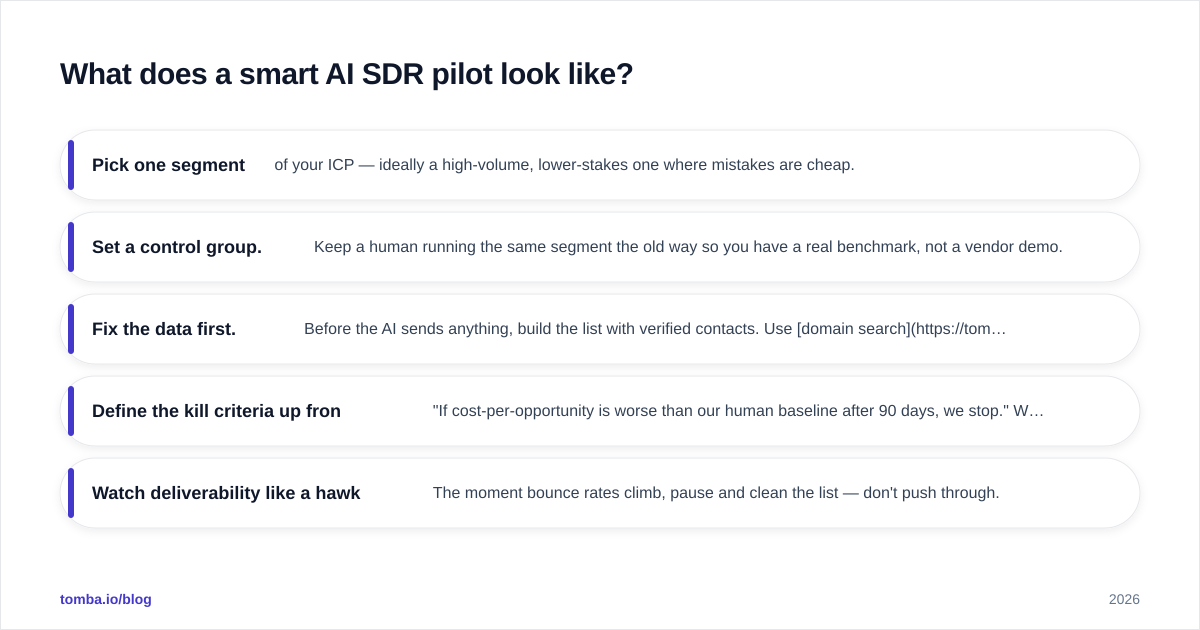
Don't replace a seat on day one. Run a controlled 90-day test:
- Pick one segment of your ICP — ideally a high-volume, lower-stakes one where mistakes are cheap.
- Set a control group. Keep a human running the same segment the old way so you have a real benchmark, not a vendor demo.
- Fix the data first. Before the AI sends anything, build the list with verified contacts. Use domain search to map accounts, the finder to get addresses, and the verifier to clean them. Garbage in, garbage out — at scale.
- Define the kill criteria up front. "If cost-per-opportunity is worse than our human baseline after 90 days, we stop." Write it down before you're emotionally invested.
- Watch deliverability like a hawk. The moment bounce rates climb, pause and clean the list — don't push through.
Most teams that follow this come out with a clear, unsentimental answer instead of a vibe. The ones who skip it are the ones writing "AI SDRs are a scam" posts six months later — usually because they fed a great tool a terrible list.
For deeper reads on the pieces of this stack, our guides on response rate benchmarks and sales automation are good companions, and review sites like G2 are useful for cross-checking vendor claims against real user reviews before you sign anything.
So — are AI SDRs worth it?#
For the right motion, with a clean data layer and a human in the loop: yes, they're worth it as leverage. For a relationship-driven enterprise sale, a tiny named-account list, or a team that can't babysit the targeting: no, they'll cost you more in domain damage and bad-fit meetings than they return.
The deciding factor isn't the AI. It's the data underneath it. An average AI SDR on verified, well-targeted contacts beats a brilliant one firing at a dirty list every single time. That's the lever most teams ignore and the one that quietly determines whether the whole experiment pays off.
If you're building toward an AI SDR motion — or just want your human reps to stop wasting touches on dead inboxes — start with the data. Tomba's Email Finder gives you verified professional email addresses by name, domain, or company, with built-in verification so your sequences hit real people instead of bounces. You can start free with 25 searches a month, and scale on the Starter plan at $49/mo once your pilot proves out. Clean data first, automation second — that's the order that makes AI SDRs actually worth it.
Ready to find emails that actually work?
Join 150,000+ professionals who stopped guessing and started sending. Free credits on signup — no credit card required.
Get the Tomba newsletter
Practical outbound tactics and product updates — once every two weeks.
About the author