Are Auto Dialers Illegal in 2026? TCPA Rules Explained
Auto dialers aren't illegal by default, but how you use them is heavily regulated. Here's what the TCPA, consent rules, and 2026 enforcement actually require.
TL;DR
- Auto dialers are not illegal on their own. What gets companies sued is how they dial: who they call, what tech they use, and whether they had consent.
- The core US law is the TCPA. It restricts automatic telephone dialing systems (ATDS) and prerecorded/artificial voice calls, especially to mobile phones.
- The 2021 Supreme Court Facebook v. Duguid ruling narrowed what counts as an "autodialer," but predictive dialers, ringless voicemail, and AI voice agents keep the risk high.
- Penalties run $500–$1,500 per call or text under the TCPA, plus state laws (Florida, Washington, Oklahoma) that are often stricter.
- B2B calls to direct business lines have more breathing room than B2C — but DNC rules, consent, and accurate data still decide whether you're safe.
Are auto dialers illegal, yes or no?#
Short answer: no, auto dialers are legal to own and use — but using one to call or text the wrong person without consent is illegal. The device isn't the crime; the call is.
Think of an auto dialer like a car. Owning a fast car is legal. Driving it 120 mph through a school zone is not. Regulators don't fine you for the engine — they fine you for where and how you drove it. The same logic runs through every auto dialer enforcement action: the technology is neutral, the conduct is what's judged.
The law that governs this in the United States is the Telephone Consumer Protection Act (TCPA) of 1991, enforced by the Federal Communications Commission. It restricts:
- Calls using an automatic telephone dialing system (ATDS) to mobile numbers
- Prerecorded or artificial-voice messages
- Calls to numbers on the National Do Not Call Registry
- Calls outside permitted hours (before 8 a.m. or after 9 p.m. local time)
If your dialing program respects consent, scrubs DNC lists, and keeps clean records, an auto dialer is a perfectly legal productivity tool. If it doesn't, every dial is a potential $1,500 liability.

What is an auto dialer, legally speaking?#
An auto dialer is software or hardware that dials phone numbers automatically instead of a human punching digits. But "auto dialer" is a bucket of very different tools, and the legal exposure changes with each type.
The 2021 Supreme Court decision in Facebook, Inc. v. Duguid narrowed the TCPA's definition of an ATDS. The Court held that to qualify, a system must use a random or sequential number generator to store or produce numbers. Many modern sales dialers pull from a curated CRM list rather than generating numbers randomly — which means they may not meet the strict ATDS definition.
That sounds like a loophole, but it isn't a free pass. Prerecorded-voice rules, DNC rules, and state laws apply regardless of whether your dialer is technically an ATDS. And courts still vary in how they read Duguid.
The main dialer types and their risk#
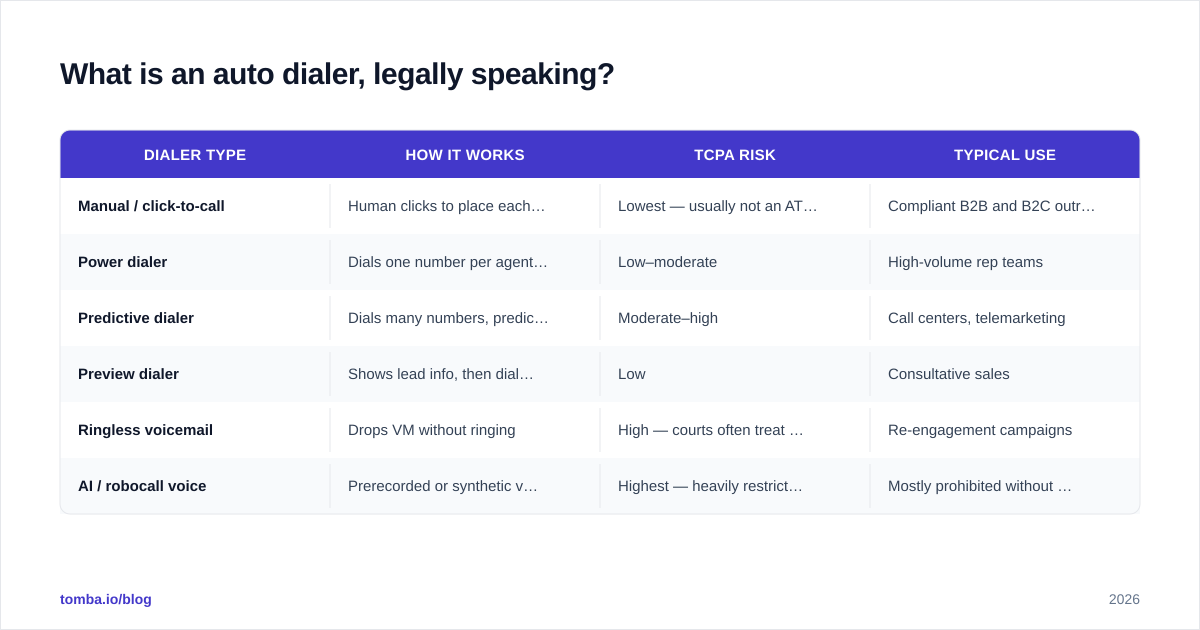
| Dialer type | How it works | TCPA risk | Typical use |
|---|---|---|---|
| Manual / click-to-call | Human clicks to place each call | Lowest — usually not an ATDS | Compliant B2B and B2C outreach |
| Power dialer | Dials one number per agent from a list | Low–moderate | High-volume rep teams |
| Predictive dialer | Dials many numbers, predicts agent availability | Moderate–high | Call centers, telemarketing |
| Preview dialer | Shows lead info, then dials on command | Low | Consultative sales |
| Ringless voicemail | Drops VM without ringing | High — courts often treat as a call | Re-engagement campaigns |
| AI / robocall voice | Prerecorded or synthetic voice | Highest — heavily restricted | Mostly prohibited without consent |
The pattern is clear: the more the human steps out of the loop, the higher the legal exposure. A rep clicking "call" on a verified business number is in a very different position than a system blasting an AI voice to 10,000 mobiles.
Is it legal to use an auto dialer for B2B sales calls?#
B2B auto dialing is generally lower-risk than B2C, but it is not exempt. The TCPA doesn't carve out a blanket business-to-business exemption for autodialed texts or prerecorded messages to wireless numbers, and the FCC's rules on consent still apply.
Here's what actually moves the needle for B2B teams:
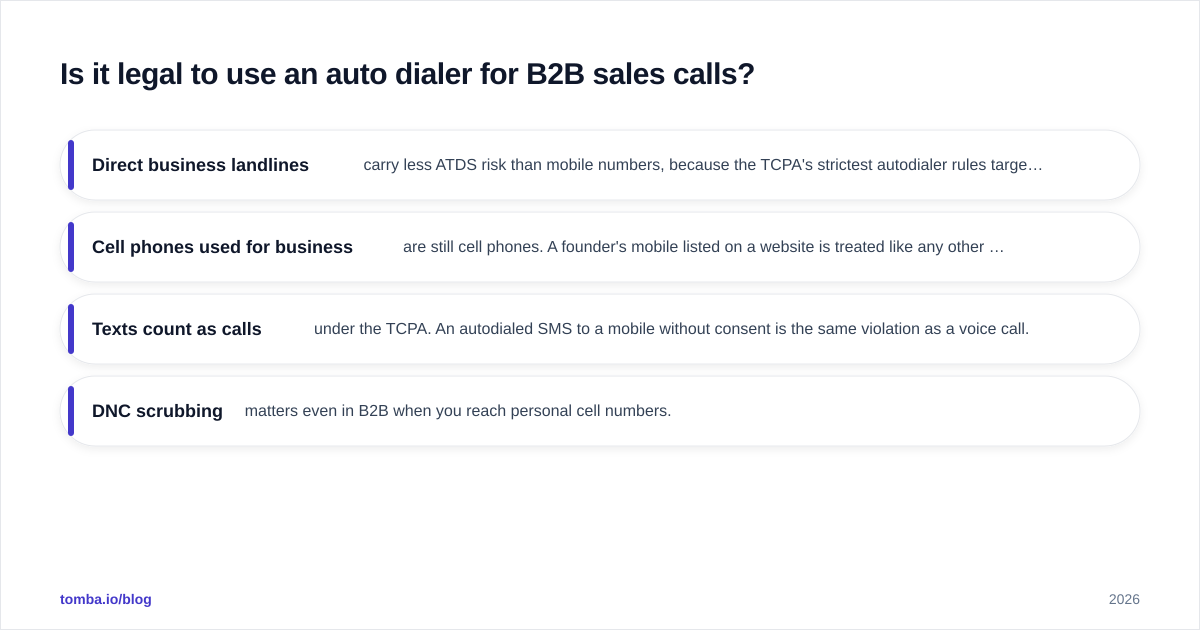
- Direct business landlines carry less ATDS risk than mobile numbers, because the TCPA's strictest autodialer rules target cell phones.
- Cell phones used for business are still cell phones. A founder's mobile listed on a website is treated like any other wireless number.
- Texts count as calls under the TCPA. An autodialed SMS to a mobile without consent is the same violation as a voice call.
- DNC scrubbing matters even in B2B when you reach personal cell numbers.
This is why data quality is a compliance issue, not just a productivity one. If you don't know whether a number is a business landline or a personal mobile, you can't assess your risk. Using a phone validator to classify line type before you dial is one of the cheapest ways to lower exposure — you route mobiles into a consent-first workflow and business lines into a standard one.
Accurate contact records also reduce wrong-number complaints, which are a common trigger for TCPA claims. Pulling verified, current B2B phone numbers instead of dialing stale lists keeps you off numbers that have been reassigned to consumers — a frequent and expensive mistake.
What are the penalties if you get it wrong?#
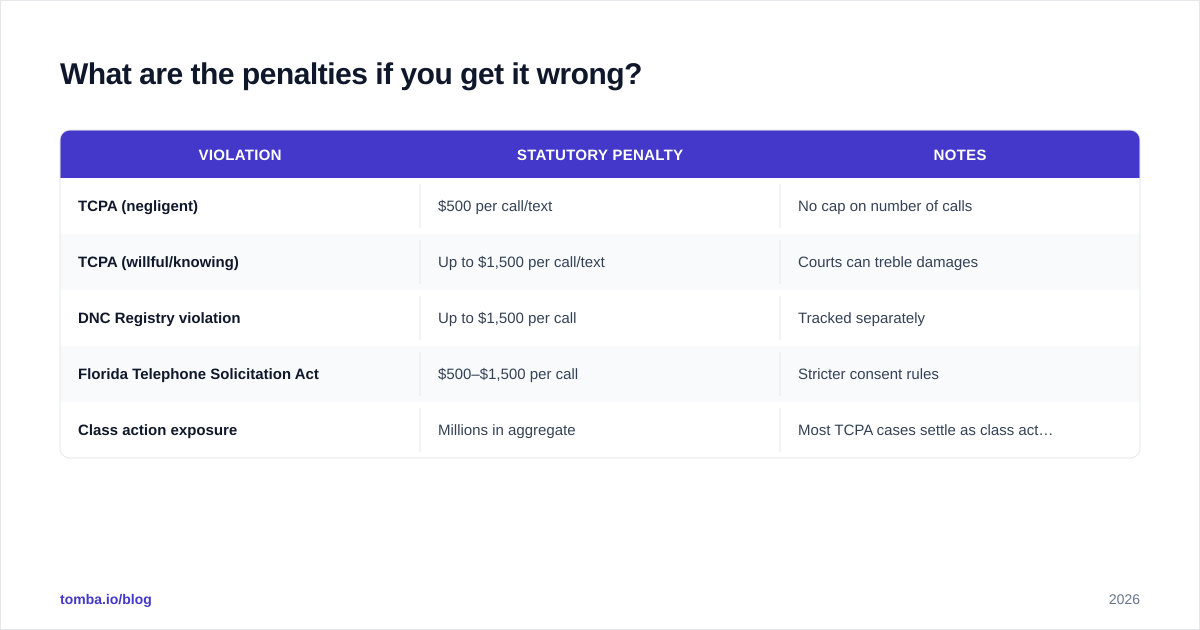
The numbers are brutal because they're per call or per text, and they stack.
| Violation | Statutory penalty | Notes |
|---|---|---|
| TCPA (negligent) | $500 per call/text | No cap on number of calls |
| TCPA (willful/knowing) | Up to $1,500 per call/text | Courts can treble damages |
| DNC Registry violation | Up to $1,500 per call | Tracked separately |
| Florida Telephone Solicitation Act | $500–$1,500 per call | Stricter consent rules |
| Class action exposure | Millions in aggregate | Most TCPA cases settle as class actions |
A single bad campaign of 5,000 autodialed texts at $500 each is $2.5 million in theoretical exposure. That's why TCPA class actions are a cottage industry, and why "we didn't know the number was a cell" is not a defense that holds up.
State laws add another layer. Florida, Oklahoma, and Washington have passed "mini-TCPA" statutes that are in some cases tougher than the federal law — narrower consent definitions, shorter calling windows, and their own private rights of action. If you dial nationally, you have to comply with the strictest applicable rule, not the federal floor.

How do you use an auto dialer legally? A compliance checklist#
You can run an aggressive, high-volume calling program and stay compliant. The teams that get sued are almost always cutting one of these corners.
1. Get and document consent. For autodialed or prerecorded calls/texts to mobiles, you generally need prior express written consent for marketing. Keep timestamped records of when, how, and what the contact agreed to.
2. Classify every number before you dial. Know which numbers are mobile vs. landline, and which are business vs. personal. This determines which rules apply. Enriching your list with reliable contact enrichment gives you the line type and ownership data you need to route calls correctly.
3. Scrub against the DNC Registry. Check the National Do Not Call list and maintain your own internal do-not-call list. Honor opt-outs immediately and permanently.
4. Respect calling hours. No calls before 8 a.m. or after 9 p.m. in the recipient's time zone — which means you need accurate location data, another reason clean records matter.
5. Identify yourself. Every call must clearly state who's calling and provide a callback number or opt-out mechanism.
6. Pick the right dialer type. If you're unsure about ATDS exposure, a preview or manual click-to-call dialer dramatically reduces risk while keeping most of the speed benefit.
7. Keep your data current. Reassigned numbers are a top source of TCPA claims. The FCC even maintains a Reassigned Numbers Database. Refresh and re-verify your lists regularly rather than dialing year-old exports.
Notice how many of these steps are really data steps. Compliance and data hygiene are the same discipline viewed from two angles — and that's where your prospecting stack and your legal posture overlap.
Are AI voice dialers and robocalls treated differently?#
Yes — and they're under the heaviest scrutiny of any dialing technology in 2026. In early 2024 the FCC ruled that AI-generated voices in calls are "artificial" under the TCPA, meaning the same prerecorded-voice consent rules apply. That came after high-profile AI robocall abuse cases.
The takeaway for sales teams experimenting with AI voice agents: an AI that places outbound calls with a synthetic voice is, for TCPA purposes, a robocall. You need the same prior express written consent you'd need for a prerecorded message — and arguably more caution, because enforcement attention is concentrated here. Vendors selling "AI SDRs" that cold-call mobiles are selling you a compliance problem unless consent is airtight.
If you want to layer AI into outreach without stepping on this landmine, keep the AI on the research and personalization side — finding the right contact, enriching it, drafting the message — and keep a human in the loop for the actual dial to a mobile. That split keeps you on the safe side of both the ATDS and the artificial-voice rules.
How does data quality reduce your legal risk?#
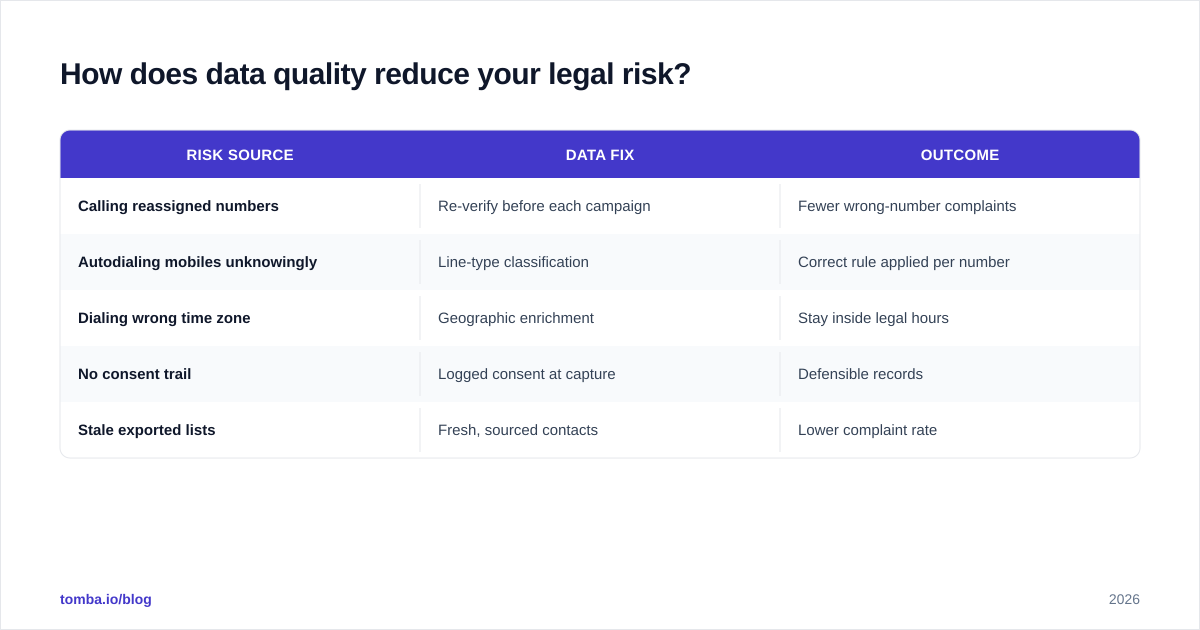
Most TCPA exposure traces back to bad data: wrong numbers, reassigned numbers, miscategorized line types, and missing consent records. Fix the data, and most of the risk evaporates.
| Risk source | Data fix | Outcome |
|---|---|---|
| Calling reassigned numbers | Re-verify before each campaign | Fewer wrong-number complaints |
| Autodialing mobiles unknowingly | Line-type classification | Correct rule applied per number |
| Dialing wrong time zone | Geographic enrichment | Stay inside legal hours |
| No consent trail | Logged consent at capture | Defensible records |
| Stale exported lists | Fresh, sourced contacts | Lower complaint rate |
This is why compliant teams treat their calling list like a living asset, not a one-time download. Verified, enriched, well-sourced contact data is the foundation — see how data accuracy and reliable phone number verification feed directly into a lower-risk dialing program. For the underlying concepts, the B2B glossary breaks down terms like consent, DNC, and ATDS in plain language.
So, are auto dialers illegal? The verdict#
Auto dialers are legal. Reckless dialing is not. The difference between a legitimate calling program and a class-action defendant comes down to three things: consent, dialer type, and data accuracy. Get those right and you can dial at scale with confidence. Get them wrong and every call is a $500–$1,500 bet against yourself.
The single highest-leverage move is starting with clean, verified, properly classified contact data — because almost every TCPA violation is, at root, a data failure. Before your reps ever pick up the phone, build your list on accurate, well-sourced contacts using Tomba's Email Finder and pair it with verified phone data, so every outreach starts compliant, current, and aimed at the right person. Start free with 25 searches a month, and scale on Tomba pricing when your pipeline does — clean data is the cheapest compliance insurance you'll ever buy.
This article is general information, not legal advice. Consult a TCPA attorney for your specific program.
// get started
Find, verify and enrich your first contacts today
Start on the free plan with 25 searches a month, then scale when your team is ready.
Free plan · No credit card required · GDPR & CCPA
// about the author