AroundDeal Pricing in 2026: Plans, Credits & Real Costs
A no-spin breakdown of AroundDeal pricing in 2026 — free plan, paid tiers, credit limits, hidden gotchas, and how the real cost per verified contact compares to the alternatives.
TL;DR
- AroundDeal runs on a credit + per-seat model: a free plan with a small monthly credit allowance, then Basic, Pro/Standard, and a custom Enterprise tier billed cheaper annually than monthly.
- The sticker price is not the real price. Your true cost is credits consumed per usable contact, multiplied by seats, minus credits wasted on stale or catch-all records.
- AroundDeal bundles email + phone + Chrome extension + intent data, which is attractive for full-funnel teams but expensive if you only need verified emails.
- For pure email finding and verification, a flat per-search tool like Tomba is usually cheaper per accurate contact because you are not paying for sales-intelligence features you won't touch.
- Read the credit fine print before you commit annually — rollover rules, per-seat minimums, and export caps are where budgets quietly leak.
If you are evaluating AroundDeal pricing in 2026, the question is not "how much is the plan." It's "how much does one verified, deliverable contact actually cost me once seats, credits, and waste are accounted for." This guide answers that.
What is AroundDeal and who is it for?#
AroundDeal is a B2B sales-intelligence platform: a contact database, an email and phone finder, a Chrome extension for prospecting on LinkedIn, and layers of company and intent data on top. Think of it as a competitor in the same arena as Apollo, Lusha, and RocketReach rather than a single-purpose email finder.
That positioning matters for pricing. You are not buying one tool — you are buying a suite. The analogy: it's the difference between buying a chef's knife and buying the full 15-piece block. If you cook one dish, the block is overkill and you pay for slots you never fill.
AroundDeal fits teams that want database access, contact data, and outreach signals in one subscription. It's a weaker fit if your only job-to-be-done is "find and verify emails for a list I already have."
How does AroundDeal pricing actually work?#
Conclusion first: AroundDeal pricing is driven by three multipliers, not one number — plan tier × seats × credit consumption. Miss any one and your budget forecast is wrong.
Here is how the model breaks down:
1. The plan tier. AroundDeal publishes a free plan plus paid tiers (commonly labeled Basic, Pro/Standard, and Enterprise). Each tier raises your monthly credit allowance and unlocks features like bulk export, advanced filters, and integrations. Annual billing is meaningfully cheaper than month-to-month — the typical SaaS 20–30% annual discount applies.
2. Credits. Almost every action that returns data costs credits — revealing an email, a phone number, or exporting a record. This is the part that surprises buyers. A plan that looks affordable can run dry mid-month if your reps reveal contacts aggressively. Phone numbers often cost more credits than emails.
3. Seats. AroundDeal is priced per user. A five-person SDR team pays roughly five times the per-seat rate, and some tiers carry seat minimums. This is standard for sales-intelligence tools but it's the line item that turns a "$99/mo" impression into a four-figure monthly invoice.
Because exact published numbers change, treat any figure you see in a blog (including dates on this one) as a starting point and confirm on the official AroundDeal pricing page before you buy. What does not change is the structure: tier, seats, and credits compound.
What do the AroundDeal plans include?#
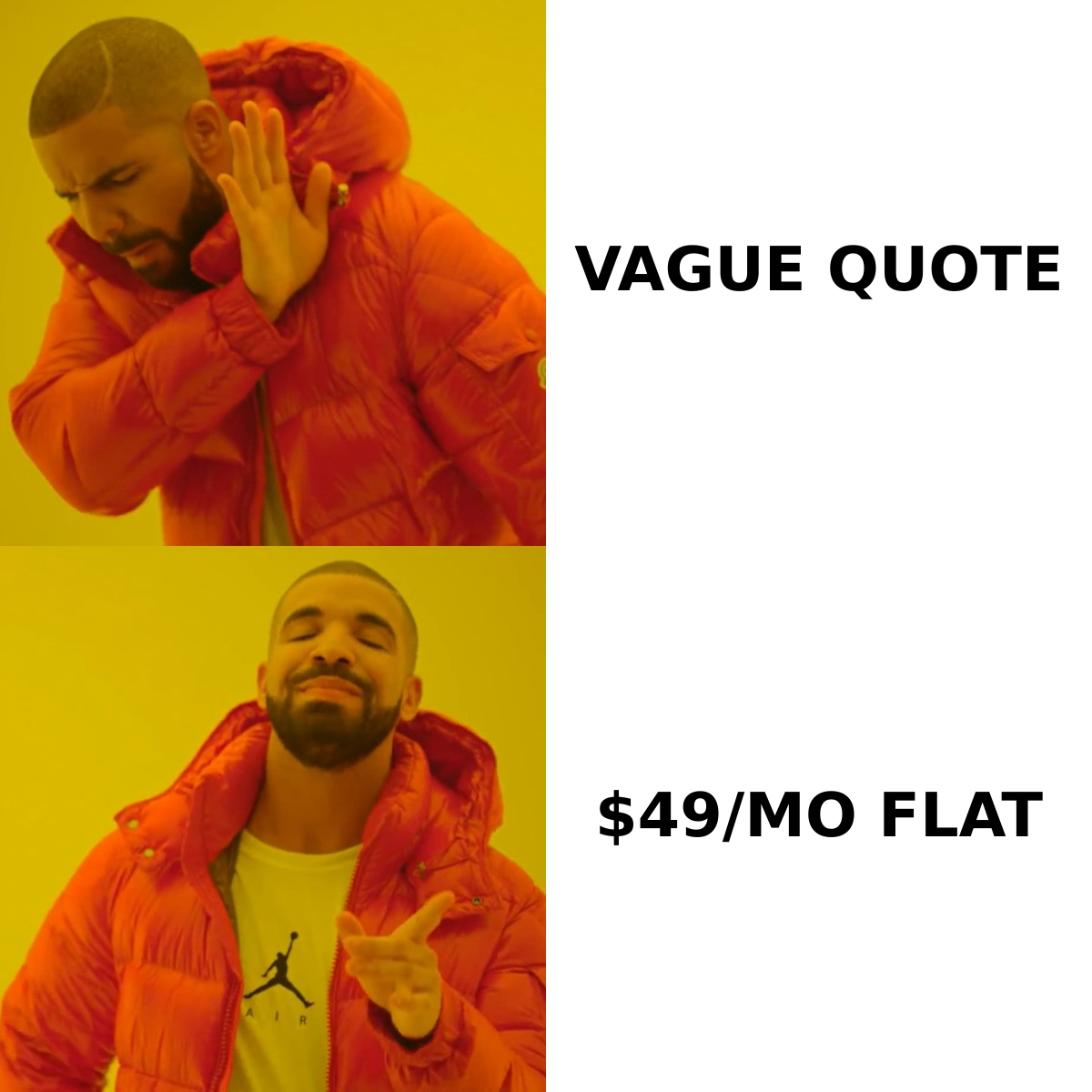
The table below summarizes the typical shape of AroundDeal's tiers in 2026. Use it to understand relative positioning, not as a price quote — verify live figures before purchase.
| Attribute | Free | Basic | Pro / Standard | Enterprise |
|---|---|---|---|---|
| Monthly cost (annual billing) | $0 | ~$59/seat/mo | ~$99–$199/seat/mo | Custom |
| Credits / month | Small starter pool | Moderate | High | Negotiated |
| Email finding | Yes (limited) | Yes | Yes | Yes |
| Phone numbers | Limited | Higher cost in credits | Included up to cap | Volume rates |
| Bulk export | No / minimal | Limited | Yes | Yes |
| Intent data | No | Add-on / limited | Yes | Yes |
| CRM integrations | Basic | Yes | Yes | Yes + API |
| Seat minimums | 1 | Low | May apply | Yes |
Two things to read between the lines. First, the free plan is a trial, not a workflow — the credit pool is designed to get you hooked, not to run a campaign. Second, the jump from Basic to Pro is where the real features (bulk export, intent, full integrations) live, so most serious users end up on the higher tier whether they planned to or not.
What is the real cost per verified contact?#
This is the only number that matters for budgeting, and it's almost never on the pricing page.
Work it out like a unit-economics problem:
- Take your monthly plan cost (tier × seats).
- Divide by usable credits, accounting for the fact that some reveals return no data, stale data, or catch-all addresses.
- The result is your effective cost per deliverable contact — usually 1.5–2× the naive "plan ÷ credits" figure once waste is included.
The waste factor is the silent killer. If 20% of revealed emails bounce or are role-based catch-alls, you paid full credit price for contacts you can't safely email. That's why pairing any database tool with a real email verifier — or using a catch-all verifier before you send — protects both your budget and your sender reputation. (If deliverability is new to you, the basics of email deliverability are worth ten minutes.)
For an honest cross-tool view of how accuracy differs, independent benchmarks like the ones aggregated on G2 are a better signal than any single vendor's self-reported number.

How does AroundDeal pricing compare to alternatives?#
AroundDeal sits in the mid-tier of sales-intelligence pricing — cheaper than enterprise platforms like
ZoomInfo, comparable to Lusha and RocketReach, and more expensive per email than a dedicated finder.
The fork in the road is simple: suite vs. specialist.
- If you need database browsing, intent signals, and phone numbers alongside emails, a suite like AroundDeal earns its price by replacing three tools.
- If you primarily need to find and verify emails — from a domain, a name, or a list you already own — you are overpaying for the suite, and a focused email finder gets you the same deliverable contacts for less.
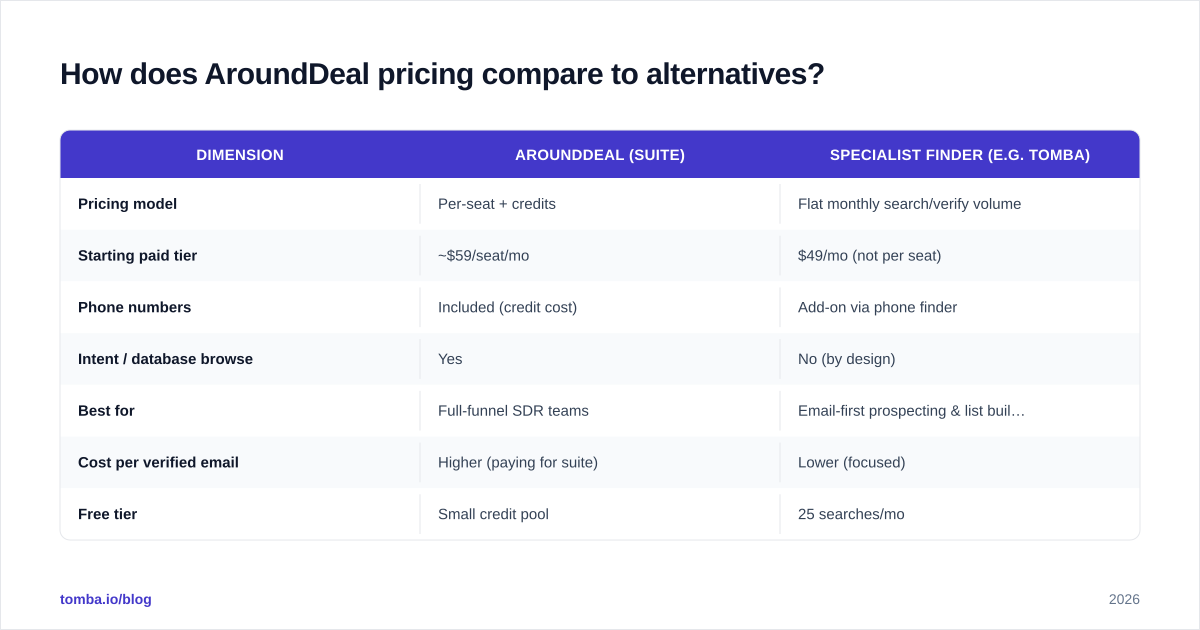
Here is how the two philosophies compare on the dimensions that drive cost:
| Dimension | AroundDeal (suite) | Specialist finder (e.g. Tomba) |
|---|---|---|
| Pricing model | Per-seat + credits | Flat monthly search/verify volume |
| Starting paid tier | ~$59/seat/mo | $49/mo (not per seat) |
| Phone numbers | Included (credit cost) | Add-on via phone finder |
| Intent / database browse | Yes | No (by design) |
| Best for | Full-funnel SDR teams | Email-first prospecting & list building |
| Cost per verified email | Higher (paying for suite) | Lower (focused) |
| Free tier | Small credit pool | 25 searches/mo |
For specific head-to-head budgeting, Tomba maintains breakdowns against the usual suspects — see the Apollo alternative and RocketReach alternative comparisons, which cover the same suite-vs-specialist tradeoff you face with AroundDeal.


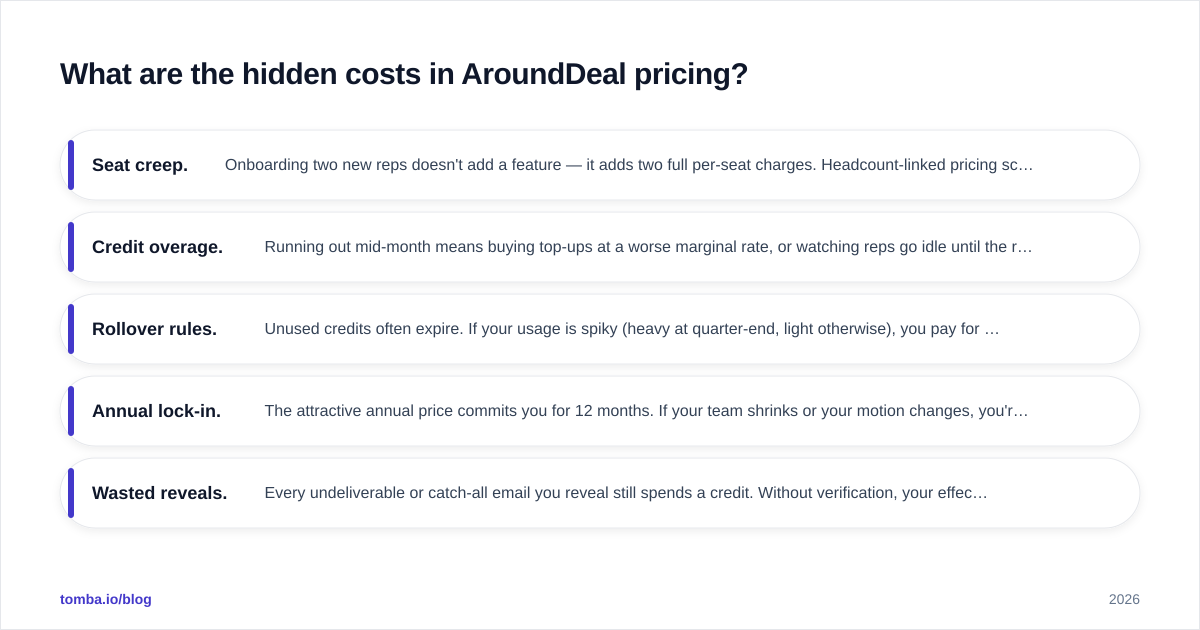
What are the hidden costs in AroundDeal pricing?#
The plan price is the part you see. These are the parts you feel later:
- Seat creep. Onboarding two new reps doesn't add a feature — it adds two full per-seat charges. Headcount-linked pricing scales your bill linearly with hiring.
- Credit overage. Running out mid-month means buying top-ups at a worse marginal rate, or watching reps go idle until the reset.
- Rollover rules. Unused credits often expire. If your usage is spiky (heavy at quarter-end, light otherwise), you pay for capacity you never use.
- Annual lock-in. The attractive annual price commits you for 12 months. If your team shrinks or your motion changes, you're stuck.
- Wasted reveals. Every undeliverable or catch-all email you reveal still spends a credit. Without verification, your effective price per usable contact climbs.
None of these are unique to AroundDeal — they're the standard mechanics of credit-and-seat SaaS. But they are the reason a "$99" impression becomes a real-world invoice several times larger.
Is AroundDeal worth the price in 2026?#
Conclusion first: AroundDeal is worth it if you genuinely use the suite — database browsing, phone numbers, and intent data — across a team that needs all three. The bundle then replaces multiple subscriptions and the per-seat math pencils out.
It is not worth it if your real workflow is email-first. In that case you are funding features your reps never open. The cleaner play is a flat-rate finder for emails plus, when needed, a focused add-on for phone data.
A practical decision rule:
- Choose AroundDeal when ≥3 of these are true: you browse the database to build lists, you need verified phone numbers regularly, you act on intent signals, you have a multi-rep team, and you want one vendor.
- Choose a specialist when your job is mostly: take a domain or a name list → get verified, deliverable emails → push to your CRM or sequencer. Here, predictable flat pricing wins, and you sidestep seat-based scaling entirely.
Whichever way you go, compare on cost per deliverable contact, not headline plan price. That single metric — and verifying before you send — is what keeps the budget honest. Side-by-side details for Tomba live on the Tomba pricing page.
How do you reduce your AroundDeal bill without losing coverage?#
If you stay on AroundDeal, three moves cut cost immediately:
- Verify before you reveal at scale. Run domains through a domain search and validate addresses so you only spend credits on contacts you'll actually email.
- Right-size seats quarterly. Audit who logs in. Dormant seats are pure waste on a per-seat model.
- Cap reveals per rep. Treat credits like a budget, not a buffet. A simple weekly ceiling stops month-end droughts and top-up surcharges.
And if the audit shows your team mostly uses AroundDeal to find and check emails, that's your signal to split the workflow: a dedicated finder for emails, the suite only where it's truly used — or dropped entirely.
The bottom line on AroundDeal pricing#
AroundDeal prices like the sales-intelligence suite it is: per seat, per credit, cheaper annually, and best value only when you use the whole toolbox. The trap is paying suite prices for an email-finding job a specialist does for less.
If your real need is verified, deliverable email addresses — by domain, by name, or in bulk — start with the Tomba Email Finder. You get a free tier of 25 searches a month, flat pricing that starts at $49/mo (not per seat), and a built-in verifier so you never pay for a contact you can't reach. Run a list through it, compare your cost per deliverable contact against your current AroundDeal invoice, and let the unit economics make the call.
// get started
Find, verify and enrich your first contacts today
Start on the free plan with 25 searches a month, then scale when your team is ready.
Free plan · No credit card required · GDPR & CCPA
Get the Tomba newsletter
Product and data updates
// about the author