AroundDeal Reviews 2026: Pricing, Accuracy & Alternatives
An honest, hands-on look at AroundDeal in 2026 — data accuracy, real pricing, GDPR questions, and the alternatives worth testing before you commit budget.
TL;DR
- AroundDeal is a B2B contact-data and sales-intelligence platform (emails, phones, company data, a Chrome extension) competing with Apollo, Lusha, and RocketReach — strong in APAC coverage, average on email verification.
- Pricing starts with a small free tier and paid plans that scale by credits; the catch is that low-tier credit caps and catch-all handling can inflate your real cost-per-valid-contact.
- Reviewers on G2 and Capterra praise the Chrome extension and ease of use but flag stale records, billing friction, and inconsistent EU data.
- If your main job is finding and verifying email addresses, a focused tool with transparent verification (like Tomba) often beats an all-in-one on cost-per-valid-email.
- Use the evaluation framework below to score AroundDeal against alternatives on accuracy, coverage, compliance, and total cost before you buy.
What is AroundDeal?#
AroundDeal is a B2B sales-intelligence platform that sells access to a contact database — work emails, direct-dial phone numbers, job titles, and company firmographics — plus a Chrome extension that surfaces those details on LinkedIn and company sites. In practice it sits in the same category as Apollo, Lusha, ZoomInfo, and RocketReach: you search or browse, the tool reveals contact data, and you spend credits to unlock it.
The platform leans on a few core jobs: prospecting (build lists by title, industry, geography), enrichment (fill gaps in records you already own), and engagement (basic outreach and CRM sync on higher tiers). Its standout reputation is geographic — AroundDeal is frequently cited for stronger coverage across Asia-Pacific markets than US-centric rivals, which matters if your ICP lives in Singapore, India, or Australia rather than just North America.
That positioning is the whole story when you read AroundDeal reviews: people who sell into APAC tend to rate it higher, and people who expected ZoomInfo-grade North American depth tend to rate it lower. Your mileage depends heavily on where your buyers are.
How accurate is AroundDeal data?#
Accuracy is the only metric that matters for a data tool, because every wrong record costs you twice — once in wasted send and once in deliverability damage. Here AroundDeal lands in the middle of the pack.
The honest read from aggregated user feedback: email accuracy is acceptable but not best-in-class, and it degrades on two predictable fronts. First, catch-all domains — many providers, AroundDeal included, mark catch-all addresses as "valid" when they really mean "the server won't tell us." Second, record freshness — titles and company moves lag, so you'll hit people who changed jobs months ago.
This is where independent verification earns its keep. Whatever database you pull from, you should re-verify before you send. A dedicated email verifier catches the dead addresses a database optimistically passes through, and a proper catch-all verifier resolves the gray-area records that quietly inflate your bounce rate.

If you want to pressure-test any vendor's accuracy claim, do this: pull 100 contacts, run them through a neutral verifier, and measure the real valid rate. Marketing pages quote 95%+; your sample will tell you the truth.

What do AroundDeal reviews say (pros and cons)?#
Pulling together patterns from G2 and Capterra, the sentiment clusters cleanly.
What users like:
- The Chrome extension is fast and genuinely useful on LinkedIn — most positive AroundDeal reviews mention it by name.
- The interface is approachable; new reps get productive without a long onboarding.
- APAC coverage is a real differentiator versus US-first competitors.
- Entry pricing is friendlier than enterprise-only platforms like ZoomInfo.
What users complain about:
- Stale or incorrect records, especially job titles after role changes.
- Catch-all emails reported as valid, leading to surprise bounces.
- Credit limits on lower tiers run out faster than expected.
- Billing and cancellation friction shows up repeatedly in negative reviews.
- EU/GDPR data quality and consent questions for privacy-sensitive buyers.
None of these are disqualifying on their own, but together they shape the verdict: AroundDeal is a competent mid-market data tool with a great extension and a soft underbelly on verification and billing transparency.
How much does AroundDeal cost in 2026?#
AroundDeal uses a freemium, credit-based model: a limited free plan to try it, then paid tiers that scale credits and feature access (CRM sync, bulk export, team seats, API). Exact published numbers shift, so confirm on their pricing page before buying — but the structure matters more than the sticker.
The trap with any credit model is cost per valid contact, not cost per credit. If 20% of unlocked emails bounce or are catch-alls, your effective price is 25% higher than advertised. Always do the division on verified records.
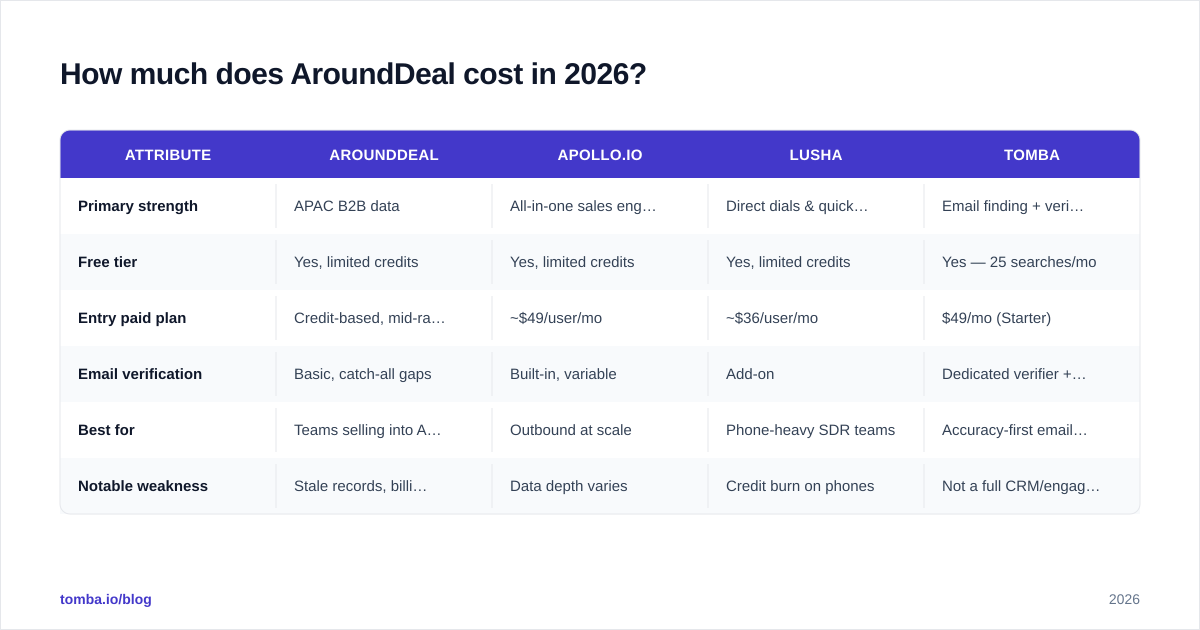
Here's how AroundDeal compares structurally to common alternatives, including a focused email-finding option:
| Attribute | AroundDeal | Apollo.io | Lusha | Tomba |
|---|---|---|---|---|
| Primary strength | APAC B2B data | All-in-one sales engagement | Direct dials & quick reveals | Email finding + verification |
| Free tier | Yes, limited credits | Yes, limited credits | Yes, limited credits | Yes — 25 searches/mo |
| Entry paid plan | Credit-based, mid-range | ~$49/user/mo | ~$36/user/mo | $49/mo (Starter) |
| Email verification | Basic, catch-all gaps | Built-in, variable | Add-on | Dedicated verifier + catch-all |
| Best for | Teams selling into Asia | Outbound at scale | Phone-heavy SDR teams | Accuracy-first email outreach |
| Notable weakness | Stale records, billing | Data depth varies | Credit burn on phones | Not a full CRM/engagement suite |
For Tomba's own numbers, the Tomba pricing page lists Free (25 searches), Starter $49/mo, Growth $99/mo, and Pro $249/mo — useful as a clean reference point when AroundDeal's credit math gets fuzzy.
How should you evaluate AroundDeal against alternatives?#
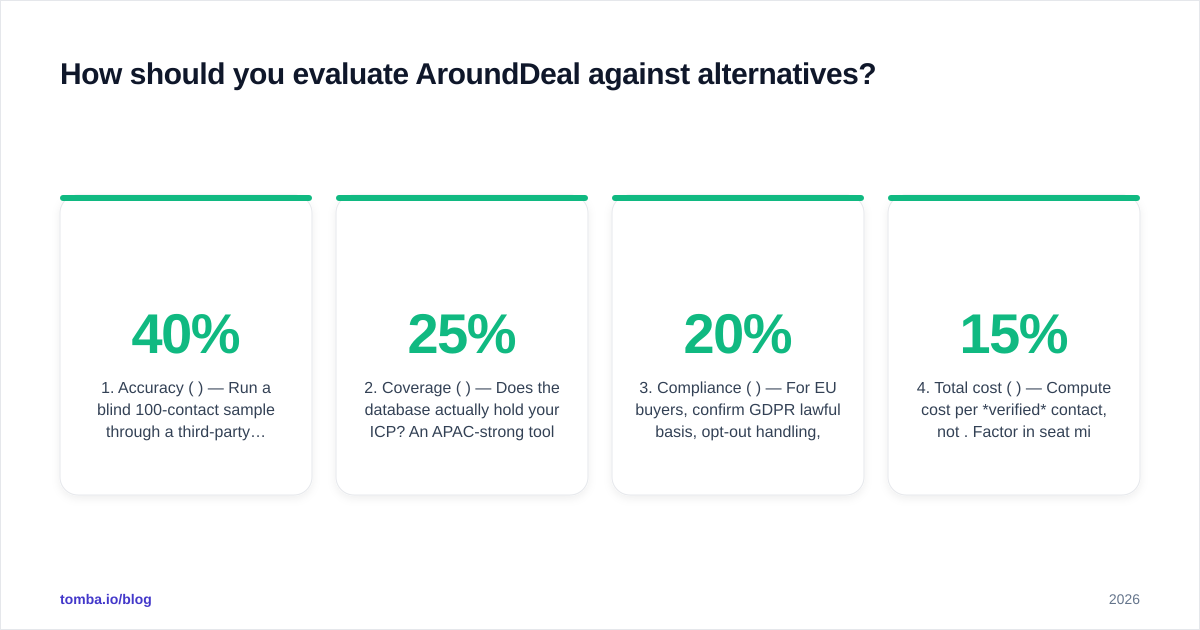
Don't compare on feature checklists — compare on outcomes. Score each tool across four weighted dimensions and let the numbers decide. The framework below is the one we'd hand any RevOps lead running a vendor bake-off.
- Accuracy (40%) — Run a blind 100-contact sample through a third-party verifier. Measure valid rate, catch-all rate, and bounce rate. This single test outweighs every marketing claim.
- Coverage (25%) — Does the database actually hold your ICP? An APAC-strong tool is wasted on a North America-only motion, and vice versa. Test with 20 real target accounts.
- Compliance (20%) — For EU buyers, confirm GDPR lawful basis, opt-out handling, and data sourcing. Ask vendors to put it in writing. Privacy-sensitive industries should treat this as a gate, not a tiebreaker.
- Total cost (15%) — Compute cost per verified contact, not per credit. Factor in seat minimums, annual lock-in, and the friction of cancellation that AroundDeal reviewers repeatedly mention.
If accuracy and email volume dominate your weighting, a specialized stack tends to win. You can pair a high-accuracy email finder with domain search for company-wide prospecting and skip paying for engagement features you won't use. If you live in the LinkedIn sidebar, evaluate the extension experience directly — AroundDeal's is good, but so are the alternatives.

Is AroundDeal better than Apollo, Lusha, or RocketReach?#
It depends on the job, and anyone who says otherwise is selling something.
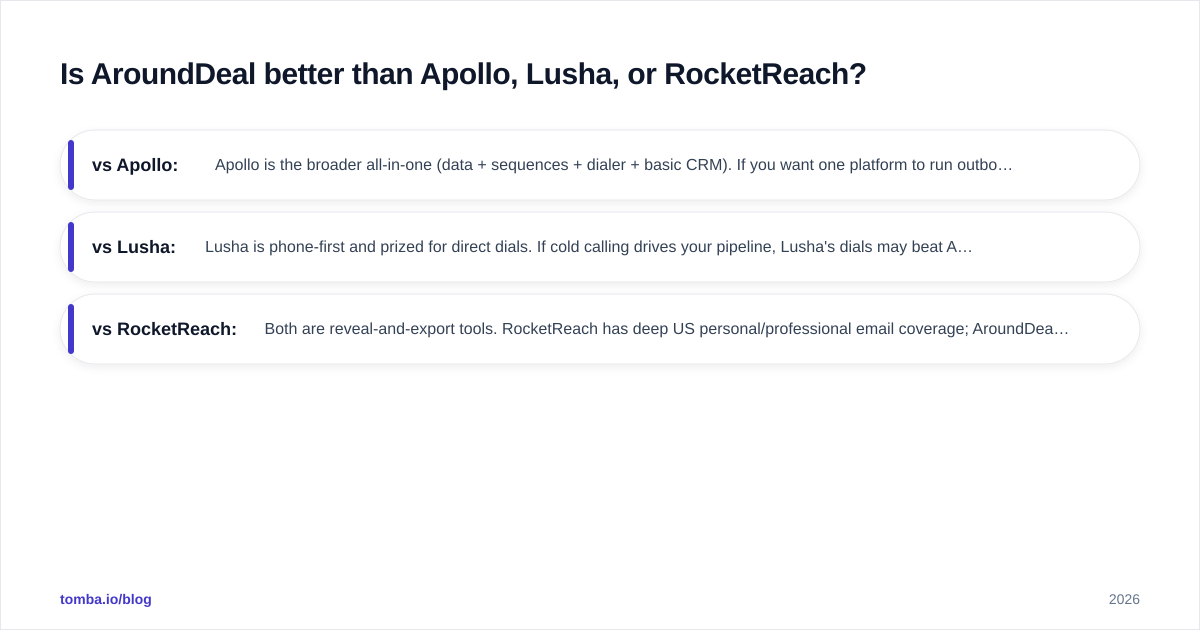
- vs Apollo: Apollo is the broader all-in-one (data + sequences + dialer + basic CRM). If you want one platform to run outbound, Apollo usually wins on breadth. AroundDeal wins if your value is APAC contact data and you don't need the engagement suite. See the practical tradeoffs in this Apollo alternative breakdown.
- vs Lusha: Lusha is phone-first and prized for direct dials. If cold calling drives your pipeline, Lusha's dials may beat AroundDeal's. For email-led outbound, the gap narrows.
- vs RocketReach: Both are reveal-and-export tools. RocketReach has deep US personal/professional email coverage; AroundDeal counters with APAC and a slicker extension. Compare with this RocketReach alternative overview.
The pattern across all three: AroundDeal is rarely the worst choice and rarely the obvious best. It's the safe mid-tier pick whose ranking flips entirely based on geography and whether you need engagement built in.

Who should actually use AroundDeal?#
Good fit:
- Teams selling into Asia-Pacific markets where US-centric databases thin out.
- Small-to-mid SDR teams that want an easy Chrome extension over a heavy platform.
- Budget-conscious buyers who find ZoomInfo overkill and want a free tier to start.
Poor fit:
- North America-only teams needing maximum depth — Apollo or ZoomInfo likely outperform.
- Compliance-strict EU operations until you've audited their GDPR sourcing.
- Accuracy-obsessed email senders who'd rather pay per verified address than per optimistic credit.
For that last group, the unbundled approach wins: find emails with a tool built for it, verify everything before send, and enrich the survivors. That's where pairing a finder with data enrichment and a verification step beats a single database that grades its own homework.
What's the verdict on AroundDeal?#
AroundDeal earns a solid-but-conditional recommendation in 2026. It's an easy-to-use, fairly priced sales-intelligence tool with a standout Chrome extension and genuine strength in APAC data. The recurring knocks — stale records, catch-alls passed as valid, credit burn, and billing friction — are real and show up too often in reviews to ignore.
Treat it like any data vendor: trust nothing, verify a sample, and compute your true cost per valid contact before committing to an annual plan. Run the four-dimension framework above against two alternatives and let the verified valid-rate be the tiebreaker. If AroundDeal wins on your sample, buy with confidence. If it doesn't, you'll have saved yourself a year of bouncing emails and a frustrating cancellation flow.
Find and verify emails without the guesswork#
If your bottleneck is getting clean, verified email addresses into your sequences, start with a tool built for exactly that. The Tomba Email Finder locates professional emails by name, domain, or company, then lets you verify them in the same workflow — so you pay for valid contacts, not optimistic credits. Spin up the free tier (25 searches a month), run a head-to-head sample against AroundDeal, and let your real bounce rate decide. When accuracy is the metric that matters, measure it before you commit budget.
Ready to find emails that actually work?
Join 150,000+ professionals who stopped guessing and started sending. Free credits on signup — no credit card required.
Get the Tomba newsletter
Practical outbound tactics and product updates — once every two weeks.
About the author