Arounddeal vs Apollo.io 2026: Which B2B Data Tool Wins?
Arounddeal and Apollo.io both promise accurate B2B contacts and email finding. Here is an honest 2026 breakdown of data quality, pricing, and which one fits your outbound stack.
Choosing between AroundDeal and Apollo.io usually comes down to one question: which platform gives you contacts you can actually email without torching your sender reputation? Both sell the same dream — a giant B2B database, built-in email finding, and outreach baked in. But they target different buyers, price very differently, and disagree on what "verified" means.
This is a neutral breakdown for 2026. No fluff, no fake winner declared in the first line. By the end you'll know which tool fits your team, where each one quietly falls short, and how to plug the data-accuracy gap that affects both.
TL;DR — Arounddeal vs Apollo.io in 30 seconds#
- Apollo.io is the heavier all-in-one: a ~275M+ contact database, sequences, dialer, and CRM-style workflows. Best for full-cycle SDR teams that live inside one tool.
- AroundDeal is the lighter, APAC-strong contender: solid LinkedIn enrichment, a Chrome extension, and friendlier entry pricing. Best for lean teams and recruiters who prospect mostly on LinkedIn.
- Pricing: AroundDeal undercuts Apollo at the low end; Apollo's free tier is more generous on email credits but throttles exports.
- Accuracy is the real battleground — both ship stale and catch-all emails, so verification before send is non-negotiable.
- If you only need clean emails (not a whole sales OS), a dedicated email finder plus email verifier often beats paying for features you won't touch.
What is AroundDeal?#
AroundDeal is a B2B contact-data and sales-intelligence platform with a strong footprint in Asia-Pacific markets. Its core is a contact and company database you query by name, domain, or filters, paired with a Chrome extension that surfaces emails and phone numbers while you browse LinkedIn.
The pitch is simplicity. You're not buying a sprawling revenue platform — you get prospecting, enrichment, and basic outreach in a package that's quick to learn. Recruiters, founders, and small sales teams gravitate to it because the learning curve is short and the entry price is low. Its APAC coverage is genuinely better than most Western-built competitors, which matters if you sell into China, Japan, Singapore, or India.
Where it lags: the outreach engine is basic next to dedicated sequencing tools, and the database, while decent, is smaller and thinner on enrichment fields than the biggest players.
What is Apollo.io?#
Apollo.io is an all-in-one sales intelligence and engagement platform. It combines one of the largest B2B databases (Apollo cites 275M+ contacts and 70M+ companies) with sequences, a dialer, email tracking, and lightweight CRM features. You can, in theory, run an entire outbound motion — find, enrich, sequence, call, and track — without leaving it.
That breadth is the draw and the catch. Full-cycle teams love having one login. But you pay for the surface area: pricing scales fast, the UI is dense, and a lot of buyers end up using maybe 40% of what they bought. Apollo's data is broad, but breadth and accuracy aren't the same thing — its public, crowd-sourced enrichment means email quality varies a lot by region and seniority.
For a deeper teardown of where Apollo's data and pricing pinch, see our Apollo alternative breakdown.

How do AroundDeal and Apollo.io compare head-to-head?#
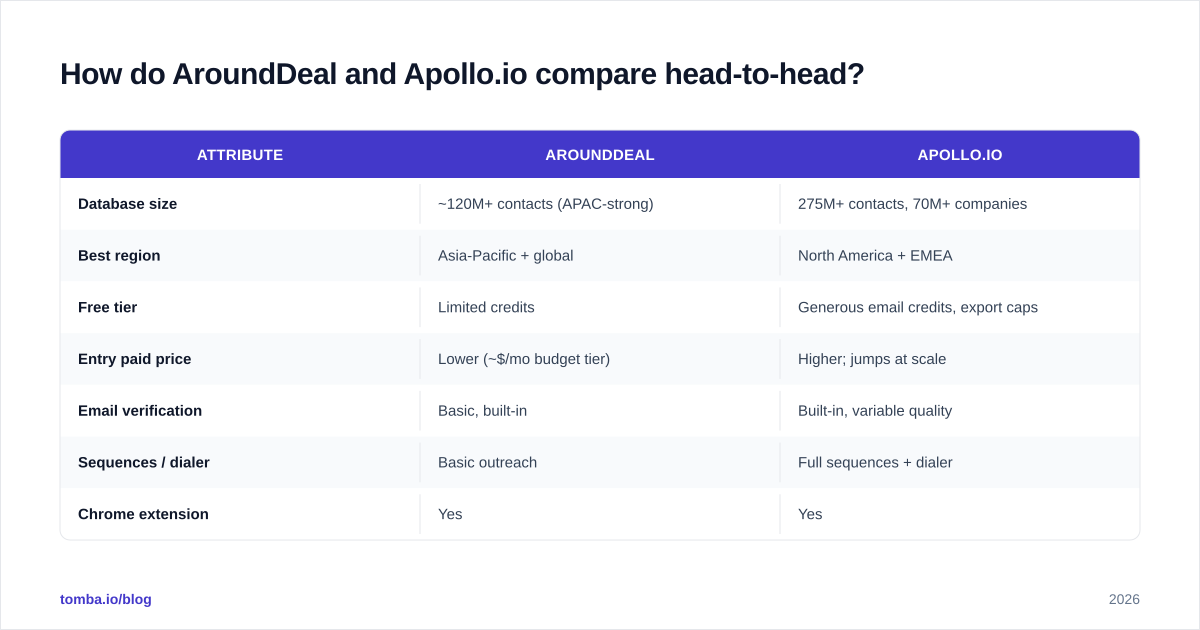
Here's the side-by-side. Numbers reflect publicly listed 2026 plans and published database figures; always confirm current pricing on each vendor's site before you buy.
| Attribute | AroundDeal | Apollo.io |
|---|---|---|
| Database size | ~120M+ contacts (APAC-strong) | 275M+ contacts, 70M+ companies |
| Best region | Asia-Pacific + global | North America + EMEA |
| Free tier | Limited credits | Generous email credits, export caps |
| Entry paid price | Lower (~$/mo budget tier) | Higher; jumps at scale |
| Email verification | Basic, built-in | Built-in, variable quality |
| Sequences / dialer | Basic outreach | Full sequences + dialer |
| Chrome extension | Yes | Yes |
| CRM features | Light | Moderate (CRM-style) |
| Best for | Lean teams, recruiters, APAC | Full-cycle SDR/AE teams |
The honest summary: Apollo wins on raw breadth and workflow depth; AroundDeal wins on price-to-value for focused prospecting and on APAC reach. Neither wins on guaranteed deliverability — that depends on what you do after the export.
Which has better data accuracy?#
Neither tool is "accurate" in the way the marketing implies, and you should plan around that.
Both platforms blend public web crawling, user-contributed data, and pattern guessing. That produces two recurring problems. First, stale records — people change jobs constantly, and a database snapshot decays roughly 2-3% per month. Second, catch-all domains, where the mail server accepts every address so a finder can't confirm whether jane@company.com actually exists. Send to enough of those and your bounce rate climbs, which drags down sender reputation and lands future mail in spam.
Independent reviews on G2 show both tools clustering in the same "good but inconsistent" band — strong on common roles at mid-market companies, weaker on senior titles, niche industries, and non-Western regions. AroundDeal tends to edge ahead in APAC; Apollo tends to edge ahead in North American mid-market.

The practical takeaway: treat any all-in-one's "verified" label as a starting point, not a guarantee. Run exports through a dedicated email verifier and a catch-all verifier before they hit your sequencer. The few minutes it costs is far cheaper than a domain reputation rebuild.
How should you choose? A simple decision framework#
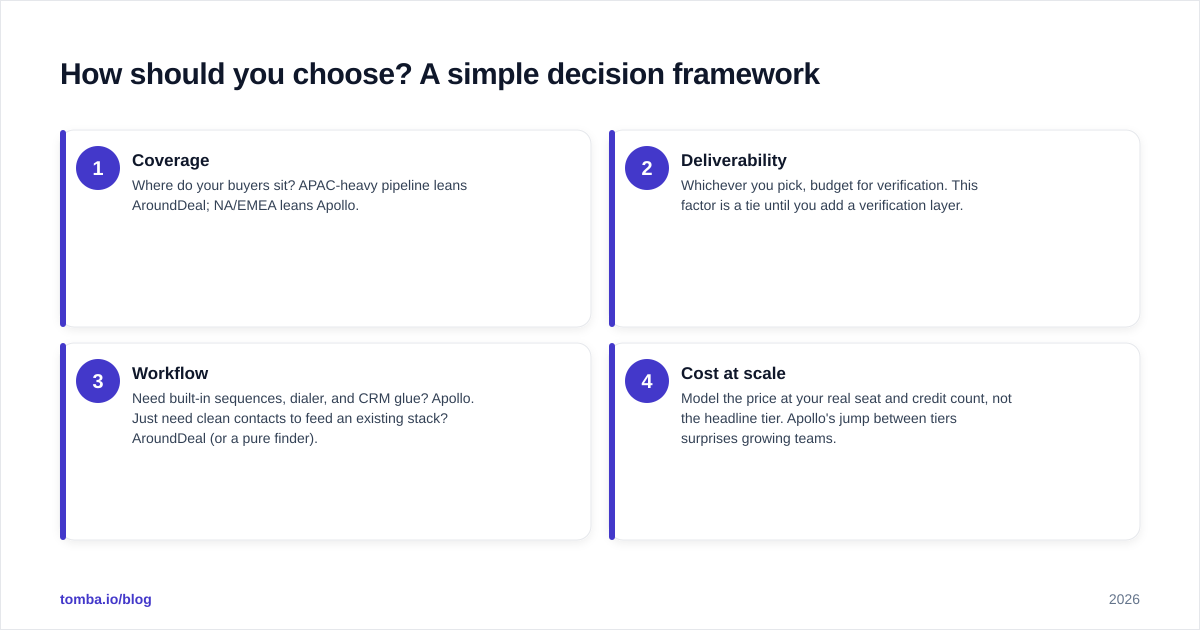
Don't pick on database size alone. Score each tool against the four factors that actually drive outbound ROI: regional coverage for your market, real deliverability (not advertised accuracy), workflow fit, and total cost at your seat count.
Walk it top to bottom:
- Coverage — Where do your buyers sit? APAC-heavy pipeline leans AroundDeal; NA/EMEA leans Apollo.
- Deliverability — Whichever you pick, budget for verification. This factor is a tie until you add a verification layer.
- Workflow — Need built-in sequences, dialer, and CRM glue? Apollo. Just need clean contacts to feed an existing stack? AroundDeal (or a pure finder).
- Cost at scale — Model the price at your real seat and credit count, not the headline tier. Apollo's jump between tiers surprises growing teams.
If two factors tie, let cost break it. If deliverability is your bottleneck, fix that first — no database upgrade compensates for sending to dead addresses.
What does each one cost in 2026?#
Both use credit-plus-seat pricing, which makes apples-to-apples hard. AroundDeal positions itself as the budget option with a lower entry point and straightforward credit packs. Apollo offers a notably generous free tier (good for testing) but meters exports and gates its best data behind higher plans, and its per-seat cost climbs once you add dialer minutes and advanced filters.
A few buying tips that apply to either:
- Annual locks the discount but locks you in — pilot monthly first.
- Credits expire. Don't overbuy a year of credits for a quarter of prospecting.
- Watch export caps, not just search caps — finding a contact you can't export is useless.
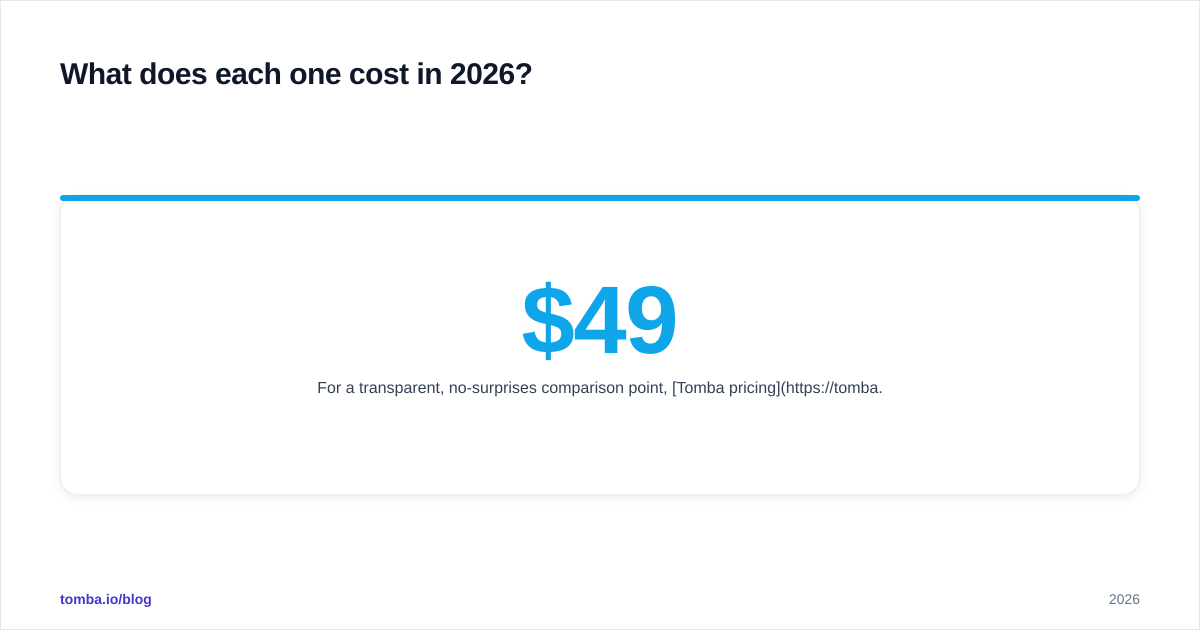
For a transparent, no-surprises comparison point, Tomba pricing runs a Free tier (25 searches/mo), Starter at $49/mo, Growth at $99/mo, and Pro at $249/mo — credits cover finding and verification, so you're not stitching two bills together.
When is a dedicated email finder the smarter buy?#
When you don't need the rest of the suite. A large share of teams buy Apollo or AroundDeal for the database, then ignore the dialer, the CRM, and half the sequences — yet pay for all of it. If your actual job is "turn a list of companies and names into clean, sendable emails," an all-in-one is overkill.
That's the gap a focused finder fills. With Tomba you can run a domain search to pull every public address at a company, use the email finder for specific name-plus-domain lookups, batch a list through the bulk email finder, and verify everything in the same workflow. You feed the clean output into whatever sequencer, CRM, or Google Sheets you already run — no rip-and-replace.
The math is simple: you pay for accurate contacts, not for features you'll never open. And because verification is built into the same credits, you sidestep the catch-all and stale-record problems that quietly cap results on both AroundDeal and Apollo.
Arounddeal vs Apollo.io: the verdict#
There's no universal winner — there's a best fit.
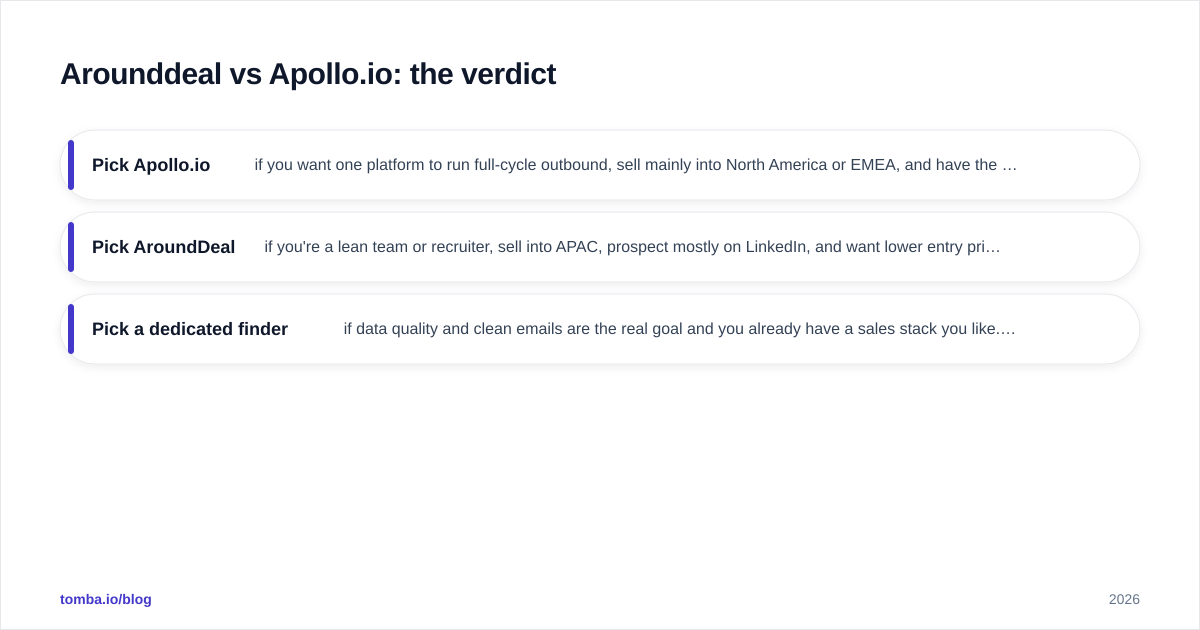
- Pick Apollo.io if you want one platform to run full-cycle outbound, sell mainly into North America or EMEA, and have the budget to grow into the tiers. Its breadth and built-in engagement are genuinely useful for SDR/AE teams.
- Pick AroundDeal if you're a lean team or recruiter, sell into APAC, prospect mostly on LinkedIn, and want lower entry pricing without a steep learning curve.
- Pick a dedicated finder if data quality and clean emails are the real goal and you already have a sales stack you like. Pair it with verification and you'll out-deliver either all-in-one's default output.

Whatever you choose, remember the part both vendors gloss over: the database is only step one. Deliverability is won or lost in verification, and that's a layer you control regardless of which platform holds your contacts. You can cross-check vendor claims directly on the AroundDeal site and Apollo.io before committing.
Get cleaner contacts than either default export#
If your bottleneck is bounce rates and dead addresses rather than database size, start at the source. The Tomba Email Finder finds professional emails by name, domain, or company and verifies them in the same flow — so the addresses that reach your sequencer are ones you can actually send to. Run a free batch, compare the deliverability against your current AroundDeal or Apollo export, and let the bounce rate decide. Start free at tomba.io and only upgrade when the results have already paid for the plan.
// get started
Find, verify and enrich your first contacts today
Start on the free plan with 25 searches a month, then scale when your team is ready.
Free plan · No credit card required · GDPR & CCPA
// about the author