AroundDeal vs Archetype Data: B2B Data Compared (2026)
AroundDeal vs Archetype Data, compared on coverage, accuracy, pricing, and workflow fit so you can pick the right B2B data provider in 2026 without overpaying.
Choosing a B2B data provider is less about who has the biggest logo wall and more about who returns accurate, deliverable records for your territory. AroundDeal and Archetype Data both promise contact and company intelligence, but they sit at different points on the price-to-precision curve. This guide breaks down where each one wins, where each one leaks budget, and how to decide without a three-month pilot.
TL;DR#
- AroundDeal is a mature, Chrome-extension-first contact database with broad APAC coverage and self-serve credit pricing — strong for individual reps and small teams prospecting LinkedIn.
- Archetype Data positions as an enrichment-and-intent layer aimed at RevOps teams who want firmographic depth and API-driven workflows over manual lookups.
- Neither is a verification specialist — budget for an independent email verifier before you launch any send.
- If your core need is finding and confirming work emails by domain or name, a dedicated finder like Tomba often beats a bundled database on cost-per-valid-contact.
- Pick on three axes: coverage in your region, accuracy after verification, and how the data enters your stack (extension vs API vs CRM sync).
What are AroundDeal and Archetype Data?#
AroundDeal is a B2B sales-intelligence platform built around a contact and company database, a browser extension that pulls details off LinkedIn profiles, and an enrichment API. It is widely used by SDRs and recruiters who live inside LinkedIn Sales Navigator and want to grab a phone number or email without leaving the tab. You can see how the market rates it on G2.
Archetype Data leans toward the data-operations side of the house. Instead of optimizing for one-record-at-a-time grabbing, it focuses on bulk enrichment, firmographic and technographic attributes, and pushing clean records into a CRM or data warehouse. Think of AroundDeal as the field rep's pocket knife and Archetype Data as the back-office data pipeline. One is optimized for speed at the point of prospecting; the other for consistency across a whole database.
A useful analogy: AroundDeal is the convenience store on your corner — fast, close, exactly what you need for one purchase. Archetype Data is the wholesale supplier — you place a larger order, it shows up structured and palletized, and it feeds everything downstream.
How should you compare B2B data providers?#
Most teams compare the wrong things. List size is a vanity metric; a vendor can claim 100M+ contacts and still miss your 200 named accounts. Use this framework instead, and score each tool 1–5 on every axis before you look at price.
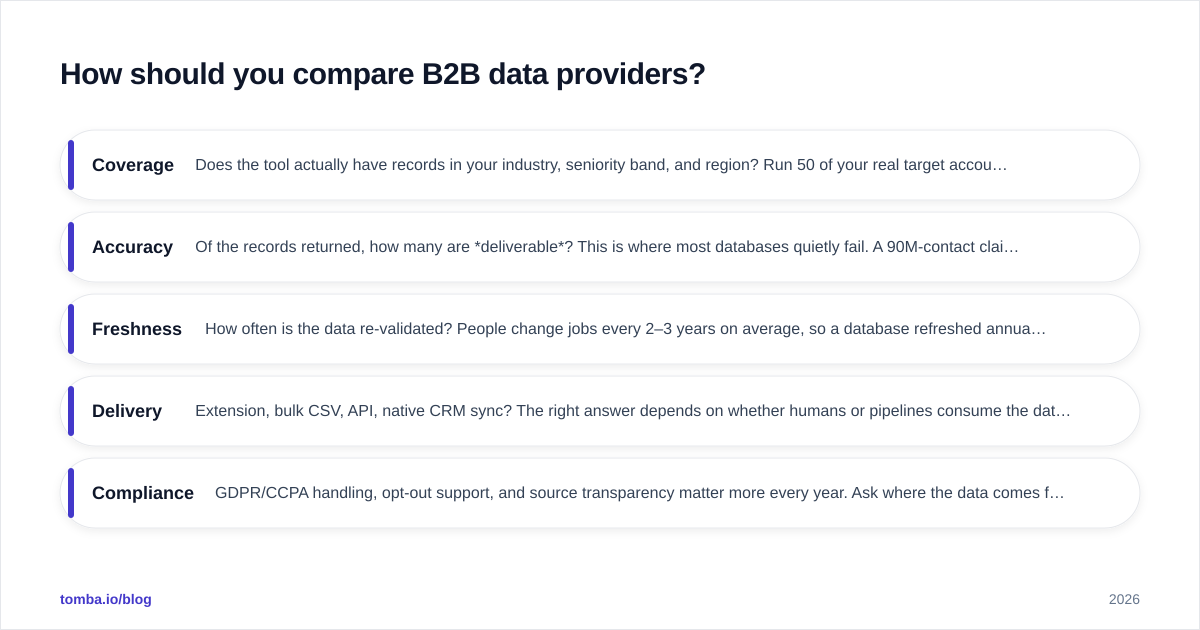
- Coverage — Does the tool actually have records in your industry, seniority band, and region? Run 50 of your real target accounts through a trial and measure hit rate.
- Accuracy — Of the records returned, how many are deliverable? This is where most databases quietly fail. A 90M-contact claim means nothing if a third of the emails bounce.
- Freshness — How often is the data re-validated? People change jobs every 2–3 years on average, so a database refreshed annually is decaying faster than you can use it.
- Delivery — Extension, bulk CSV, API, native CRM sync? The right answer depends on whether humans or pipelines consume the data.
- Compliance — GDPR/CCPA handling, opt-out support, and source transparency matter more every year. Ask where the data comes from.
Run that scoring exercise and the "which is better" question usually answers itself — because the winner depends entirely on whether you're equipping reps or feeding a warehouse.
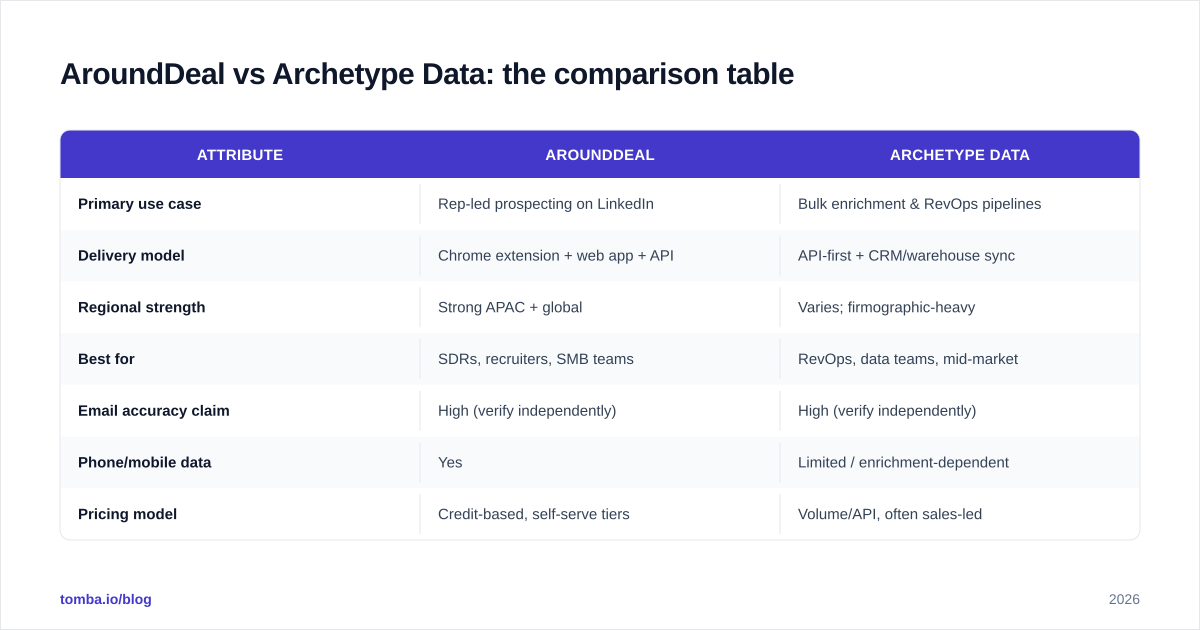
AroundDeal vs Archetype Data: the comparison table#
The table below maps both tools across the axes that change the buying decision. Treat vendor-published numbers (especially database size and accuracy) as marketing until your own trial proves them.
| Attribute | AroundDeal | Archetype Data |
|---|---|---|
| Primary use case | Rep-led prospecting on LinkedIn | Bulk enrichment & RevOps pipelines |
| Delivery model | Chrome extension + web app + API | API-first + CRM/warehouse sync |
| Regional strength | Strong APAC + global | Varies; firmographic-heavy |
| Best for | SDRs, recruiters, SMB teams | RevOps, data teams, mid-market |
| Email accuracy claim | High (verify independently) | High (verify independently) |
| Phone/mobile data | Yes | Limited / enrichment-dependent |
| Pricing model | Credit-based, self-serve tiers | Volume/API, often sales-led |
| Free entry point | Free credits monthly | Trial / demo-gated |
| Learning curve | Low (grab-and-go) | Medium (setup + mapping) |
| Verification built in | Basic | Basic |
Two things stand out. First, the delivery model is the real fork in the road: AroundDeal optimizes for a human clicking through profiles, while Archetype Data optimizes for records flowing into systems. Second, neither tool replaces dedicated verification — both surface contacts, but confirming deliverability is a separate discipline.
Which one is more accurate?#
Accuracy is the wrong question until you define it. There are two numbers: match rate (did the tool find a contact at all?) and deliverability (will the email actually land?). Vendors love quoting the first and staying quiet on the second.
In practice, broad databases like these return plenty of records, but a meaningful slice are stale — someone left the company, the catch-all domain accepts everything, or the address was guessed and never validated. That's why experienced teams treat any database export as raw material, not a finished list.
The fix is cheap and non-negotiable: pipe every export through an independent verifier before it touches your sequencer. Catch-all domains in particular need special handling — a normal verifier returns "accept-all" and you're flying blind, which is exactly the gap a catch-all verifier is built to close. Skip this step and you pay twice: once for the data, and again in sender-reputation damage when the bounces stack up.
If your workflow is fundamentally find an email by name and domain, then confirm it's real, a purpose-built email finder frequently delivers a better cost-per-valid-contact than a general database, because the finder is engineered around that single job instead of bundling it into a broad intelligence suite.
How do they price, and which is cheaper?#
Pricing structure tells you who each tool is for. AroundDeal uses transparent, credit-based self-serve tiers — you can sign up, burn free credits, and upgrade without a sales call. That suits individual reps and small teams who want predictable, capped spend. Archetype Data leans toward volume and API pricing that's often quoted through a sales conversation, which fits larger enrichment commitments but adds procurement friction for a small team.
Here's the trap with credit models: a "credit" can mean one reveal, and if half your reveals are unverified or stale, your effective cost per usable contact doubles. Always compute price per verified record, not price per credit.
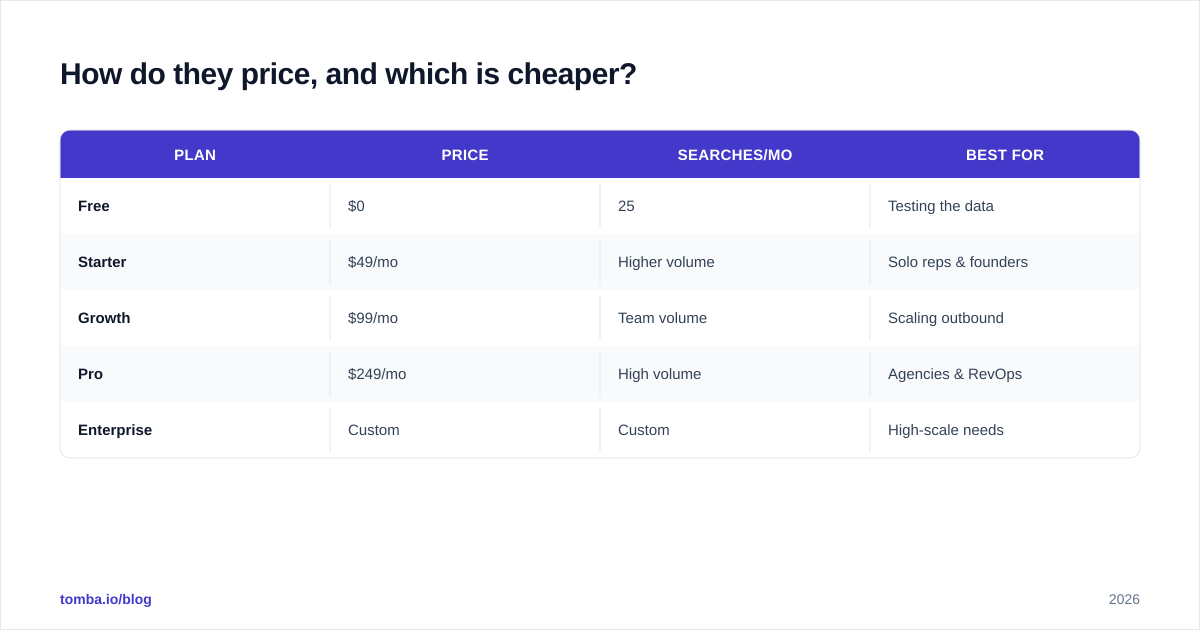
For reference on how a finder-first vendor structures this, Tomba's plans are flat and public:
| Plan | Price | Searches/mo | Best for |
|---|---|---|---|
| Free | $0 | 25 | Testing the data |
| Starter | $49/mo | Higher volume | Solo reps & founders |
| Growth | $99/mo | Team volume | Scaling outbound |
| Pro | $249/mo | High volume | Agencies & RevOps |
| Enterprise | Custom | Custom | High-scale needs |
You can see full Tomba pricing for current limits. The point isn't that one number beats another in isolation — it's that a flat, finder-focused plan makes cost-per-valid-contact easy to forecast, whereas bundled database credits hide it.
Which fits your stack and workflow?#
Map the tool to who touches the data and where it needs to end up.
Choose AroundDeal if reps are prospecting one account at a time inside LinkedIn, you want a low learning curve, and you value self-serve, capped spend. It shines for SDRs and recruiters who need a name, title, and contact in seconds without breaking flow. APAC coverage is a genuine differentiator if that's your market.
Choose Archetype Data if your bottleneck is database hygiene at scale — you have thousands of records that need firmographic and technographic attributes appended, and you want that happening through an API or warehouse sync rather than humans clicking buttons. It rewards teams with the technical maturity to wire it in.
But there's a third path many teams miss. If your actual need is clean, verified contact discovery by domain or name — feeding a sequencer, not a BI dashboard — a finder-plus-verifier combo is leaner than either platform. Run a domain search to pull every public email pattern at a target company, enrich what you keep, and verify before you send. You skip paying for intelligence features you'll never open.
For RevOps teams that do need attributes, layering dedicated data enrichment on top of a verified contact base often produces cleaner records than relying on a single database's self-reported fields, because each layer is doing the one thing it's best at.
What about data sourcing and compliance?#
Ask every vendor — AroundDeal, Archetype Data, or anyone else — three questions before you sign: Where does the data originate? How often is it re-verified? How do you handle opt-outs and deletion requests under GDPR and CCPA? A vendor that can't answer cleanly is a liability you're inheriting. The regulatory direction is one-way; treat sourcing transparency as a hard requirement, not a nice-to-have. The data protection baseline keeps rising, and "we bought a list" is not a defense.
Transparency also correlates with accuracy. Vendors that publish their methodology and refresh cadence tend to have less decay, because they're accountable to it. Opaque "we have 200M contacts" claims usually hide a long tail of dead records.
Frequently asked questions#
Is AroundDeal better than Archetype Data? Neither is universally better. AroundDeal wins for rep-led, LinkedIn-centric prospecting with self-serve pricing; Archetype Data wins for API-driven bulk enrichment in a RevOps pipeline. Score both on coverage, accuracy, and delivery for your use case.
Do I still need a separate email verifier? Yes. Both tools surface contacts but neither is a verification specialist. Verify every export — especially catch-all domains — before sending to protect deliverability.
What's the cheapest way to get verified B2B emails? Compute price per verified contact, not per credit. A finder-first tool with flat pricing is often cheaper per valid record than a bundled database, because you don't pay for unused intelligence features.
Can I use a finder instead of a full database? If your goal is finding and confirming work emails rather than building a BI layer, yes — a finder plus a verifier covers the core outbound workflow at lower cost.
The bottom line#
AroundDeal and Archetype Data solve adjacent problems: one equips reps at the point of prospecting, the other feeds clean records into systems. Decide by scoring coverage, accuracy-after-verification, and delivery model against your real workflow — then compute cost per verified contact, not per credit.
If what you actually need is to find a decision-maker's email by name or domain and confirm it's deliverable before you hit send, start with the Tomba Email Finder. It's built for that exact job, the free tier gives you 25 searches to test the data against your own accounts, and pairing it with verification gives you a cleaner, cheaper outbound base than bolting verification onto a general database after the fact. Test it on your toughest 50 accounts and let the hit rate make the decision for you.
Ready to find emails that actually work?
Join 150,000+ professionals who stopped guessing and started sending. Free credits on signup — no credit card required.
Get the Tomba newsletter
Practical outbound tactics and product updates — once every two weeks.
About the author