Arounddeal vs Biscred 2026: B2B Data Tools Compared
Arounddeal and Biscred solve different B2B data problems. This 2026 breakdown compares coverage, accuracy, pricing, and the right use case for each.
Arounddeal vs Biscred: Which B2B Data Platform Fits Your Pipeline in 2026?
Picking between Arounddeal vs Biscred feels like a head-to-head, but it's closer to comparing a Swiss Army knife to a scalpel. One is a broad B2B contact and sales-intelligence platform; the other is a focused commercial real estate (CRE) intelligence tool. The "winner" depends entirely on who you sell to.
This guide breaks down what each tool actually does, where their data comes from, how pricing works in 2026, and how to decide — without the marketing gloss.
TL;DR#
- Arounddeal is a horizontal B2B sales-intelligence platform: emails, direct dials, company data, and a Chrome extension for LinkedIn prospecting across most industries.
- Biscred is a vertical tool built for commercial real estate — it maps CRE firms, professionals, and asset/sector specializations that general databases miss.
- If you sell to any industry, Arounddeal's breadth wins. If you sell into CRE, Biscred's depth wins.
- Both have data-freshness gaps; pairing either with a dedicated email verifier before sending is the practical fix.
- Budget-conscious teams often run a focused email finder like Tomba alongside or instead of a heavyweight seat-based platform.
What is Arounddeal?#
Arounddeal is a B2B sales-intelligence and contact-data platform. Think of it as a general-purpose "find anyone's work contact" engine: you search by person, company, or job title and get back business emails, phone numbers, and firmographic data. Its Chrome extension pulls contact details while you browse LinkedIn, which is the workflow most reps actually live in.
Its strength is horizontal coverage. Whether you're targeting SaaS founders, hospital procurement leads, or manufacturing ops managers, Arounddeal aims to have a record. It competes in the same lane as Apollo, RocketReach, and Lusha — broad databases with prospecting tooling layered on top.
The tradeoff with breadth is depth. A platform covering every industry rarely models the nuances of any single one. That's exactly the gap Biscred exists to fill.
What is Biscred?#
Biscred is a B2B data platform built specifically for commercial real estate. Instead of generic firmographics, it categorizes companies and professionals by CRE-specific dimensions: asset classes (office, industrial, multifamily, retail), service lines (brokerage, lending, investment, property management), and role specializations that a general database flattens into "real estate."
That vertical modeling is the whole point. If you sell PropTech software, CRE lending, construction services, or insurance into real estate, a generic database returns thousands of loosely-tagged "real estate" contacts. Biscred returns the industrial acquisitions analyst at a specific fund you actually want.
The cost of that focus is obvious: outside CRE, Biscred isn't the tool. You wouldn't use it to prospect dentists or DevOps engineers.
Arounddeal vs Biscred: the core difference#
Here's the mental model. Arounddeal optimizes for reach. Biscred optimizes for relevance within one industry. Reach gets you more total records; relevance gets you fewer, better-qualified ones in a niche.
Neither approach is universally "better." A horizontal platform with mediocre CRE tagging wastes a CRE seller's time; a CRE-only tool is useless to a generalist SDR team. Match the tool to your ICP, not to a feature checklist.
)
How do Arounddeal and Biscred compare on features and pricing?#
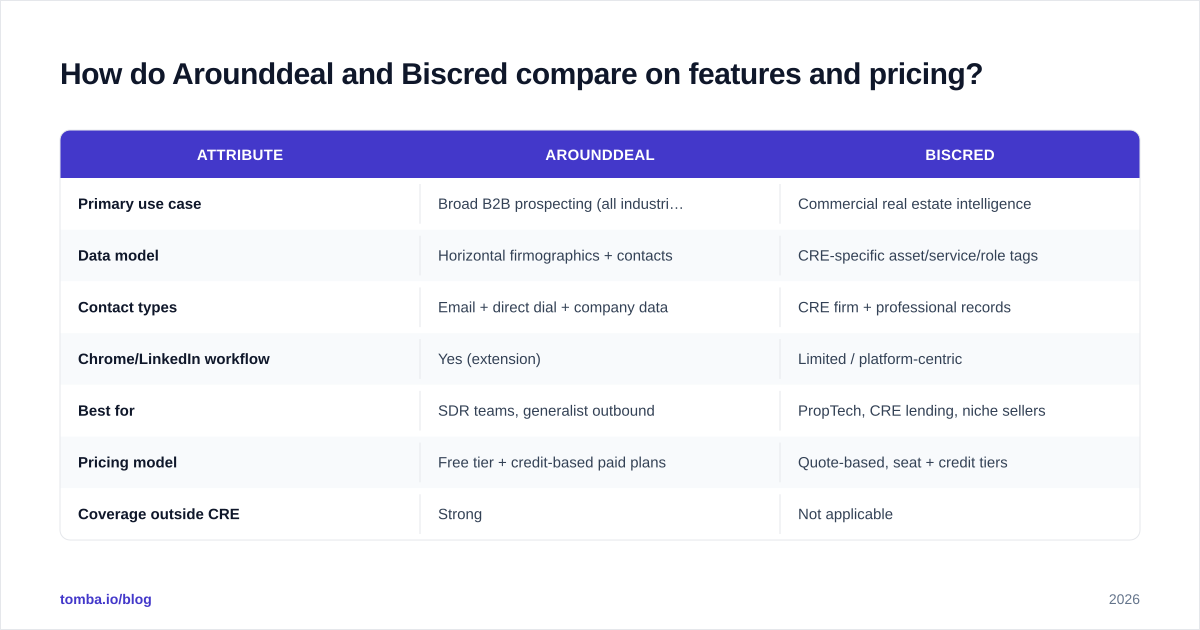
Pricing for both platforms is largely quote-based and tier-gated by credits and seats, so treat published figures as directional. The table below reflects positioning and typical structure rather than guaranteed live numbers — always confirm on each vendor's site.
| Attribute | Arounddeal | Biscred |
|---|---|---|
| Primary use case | Broad B2B prospecting (all industries) | Commercial real estate intelligence |
| Data model | Horizontal firmographics + contacts | CRE-specific asset/service/role tags |
| Contact types | Email + direct dial + company data | CRE firm + professional records |
| Chrome/LinkedIn workflow | Yes (extension) | Limited / platform-centric |
| Best for | SDR teams, generalist outbound | PropTech, CRE lending, niche sellers |
| Pricing model | Free tier + credit-based paid plans | Quote-based, seat + credit tiers |
| Coverage outside CRE | Strong | Not applicable |
| Data freshness risk | Verify before send | Verify before send |
The pattern: Arounddeal looks more flexible on paper because it does more things. Biscred looks narrower because it does one thing deliberately. For a CRE team, "narrow" is the feature.
How accurate is the data, really?#
This is where both tools — and every B2B database — get humbled. Contact data decays fast. Industry analysts and vendors consistently estimate B2B contact records degrade roughly 20–30% per year as people switch jobs, companies rebrand, and email formats change. HubSpot's research on database decay has long flagged this as a structural problem, not a vendor-specific one.
What that means in practice:
- A database "match" is a best guess, not a guarantee the email is live today.
- Catch-all domains (common in enterprise) defeat naive validation — you need a real catch-all verifier to separate deliverable from undeliverable.
- Bounce rates above ~3% start hurting your sender reputation, which quietly tanks deliverability for every campaign, not just the bad list.
Neither Arounddeal nor Biscred removes the need to verify before you hit send. The smart workflow is: pull from the database, then validate the final list with a dedicated email verification pass. It's the cheapest insurance in outbound.
)
When should you choose Arounddeal?#
Choose Arounddeal if:
- Your ICP spans multiple industries and you need one tool that covers them all.
- Your reps work primarily inside LinkedIn and want a browser extension to grab contacts inline.
- You want bundled prospecting features (lists, filters, basic enrichment) rather than just raw lookups.
- You're comparing against the broad-database crowd — it sits naturally on any Apollo alternative or RocketReach alternative shortlist.
Skip it if your entire motion is CRE — you'll spend time filtering noise that a vertical tool excludes by design.
When should you choose Biscred?#
Choose Biscred if:
- You sell into commercial real estate and need granular asset-class and service-line targeting.
- Generic databases keep returning "real estate" contacts that are actually mortgage brokers, residential agents, or facilities staff you don't want.
- Your deals are high-value enough that paying for vertical precision pays for itself in fewer wasted touches.
Skip it the moment your TAM extends meaningfully beyond CRE — its depth becomes a cage outside its lane.
Is there a third option for teams that just need accurate contacts?#
Often, yes. A lot of teams reach for a heavyweight, seat-priced platform when their real need is narrower: find a verified work email for this person at this company, fast and affordably. If that's you, a focused email-finding stack can beat both a broad database and a niche one on cost-per-good-contact.
That's the lane Tomba sits in. Instead of paying for a full sales-intelligence suite, you can:
- Run a domain search to pull every public email pattern at a target company.
- Use bulk email finder workflows to process whole lists at once.
- Wire it into your stack via the Tomba API, or pull contacts in Google Sheets and HubSpot.
- Confirm deliverability before sending with built-in verification.
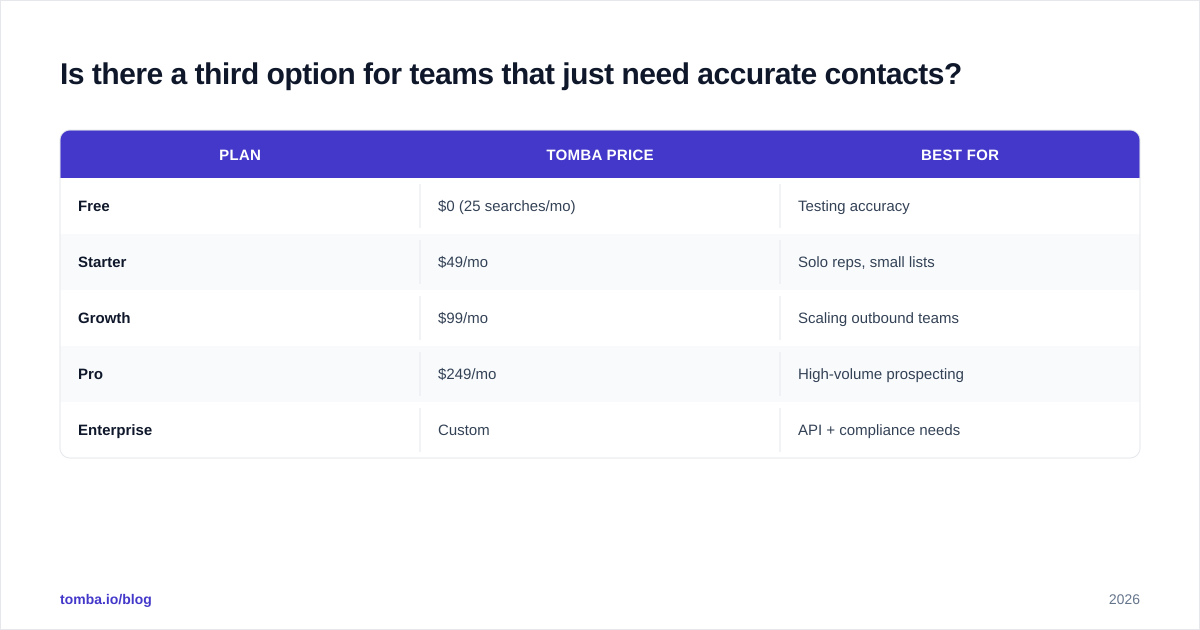
Tomba's pricing is straightforward and not seat-gated: a Free tier (25 searches/mo), Starter at $49/mo, Growth at $99/mo, Pro at $249/mo, and custom Enterprise. Full Tomba pricing is public — no quote call required to see it.
| Plan | Tomba price | Best for |
|---|---|---|
| Free | $0 (25 searches/mo) | Testing accuracy |
| Starter | $49/mo | Solo reps, small lists |
| Growth | $99/mo | Scaling outbound teams |
| Pro | $249/mo | High-volume prospecting |
| Enterprise | Custom | API + compliance needs |
This isn't an either/or with Arounddeal or Biscred. Plenty of teams use a database for discovery and a finder/verifier for accuracy — they solve adjacent problems.
How do you actually decide?#
Run this quick decision sequence:
- Define your ICP's industry spread. All-CRE → Biscred shortlist. Multi-industry → Arounddeal shortlist.
- Audit your real bottleneck. Is it finding the right accounts, or reaching known contacts? Vertical tools fix the first; finders/verifiers fix the second.
- Pilot with the same 100 target accounts in each tool. Measure match rate, then verify the results — paper accuracy claims mean nothing until you bounce-test.
- Compare cost-per-verified-contact, not sticker price. A cheaper tool with a 40% live-email rate can cost more than a pricier one at 85%.
- Check integrations. A great database that doesn't sync to your CRM creates manual work; confirm native connectors or [
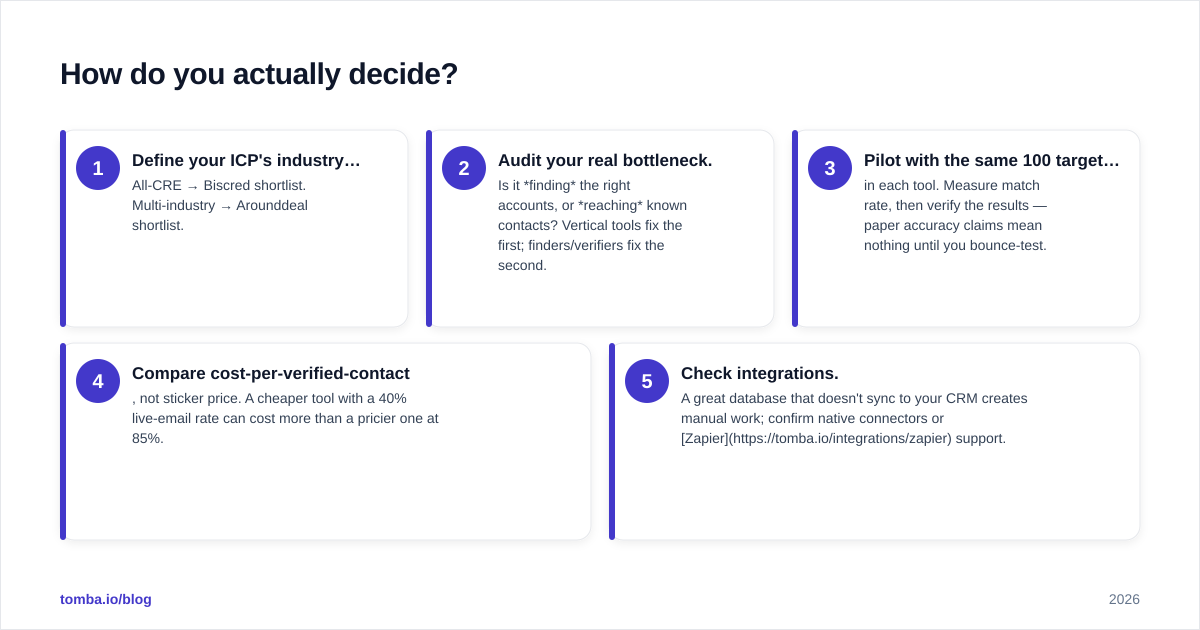
Zapier](https://tomba.io/integrations/zapier) support.
You can sanity-check vendor claims against third-party reviews on G2 before committing to any contract.
The bottom line on Arounddeal vs Biscred#
Arounddeal wins on breadth; Biscred wins on commercial-real-estate depth. They're not really competitors so much as tools for two different jobs. If your prospecting crosses industries, Arounddeal's horizontal coverage is the safer default. If you live and die by CRE, Biscred's vertical precision will save your reps from drowning in mistagged contacts.
But before you sign either contract, get honest about your core problem. If it's simply "I need verified work emails, at a predictable price, that plug into my workflow," a dedicated finder may be the highest-ROI move of the three.
Start free with the Tomba Email Finder — pull contacts by name, company, or domain, verify them in the same flow, and only pay to scale once you've proven the accuracy on your own list. No seat minimums, no quote call, and a free tier that's enough to test before you commit. That's the fastest way to find out whether you needed a full data suite at all.
Ready to find emails that actually work?
Join 150,000+ professionals who stopped guessing and started sending. Free credits on signup — no credit card required.
Get the Tomba newsletter
Practical outbound tactics and product updates — once every two weeks.
About the author