AroundDeal vs Bytemine 2026: B2B Data & Email Finder Compared
AroundDeal and Bytemine both promise accurate B2B emails, but they win at different jobs. Here's the 2026 breakdown on data, pricing, and accuracy.
You are choosing between two B2B prospecting tools, and they look interchangeable from the pricing page. They are not. AroundDeal and Bytemine solve overlapping problems with very different data engines, and picking the wrong one means paying for contacts you can't email.
This is a neutral, hands-on comparison: where each tool is strong, where it quietly fails, and how to decide based on what your pipeline actually needs in 2026.
TL;DR#
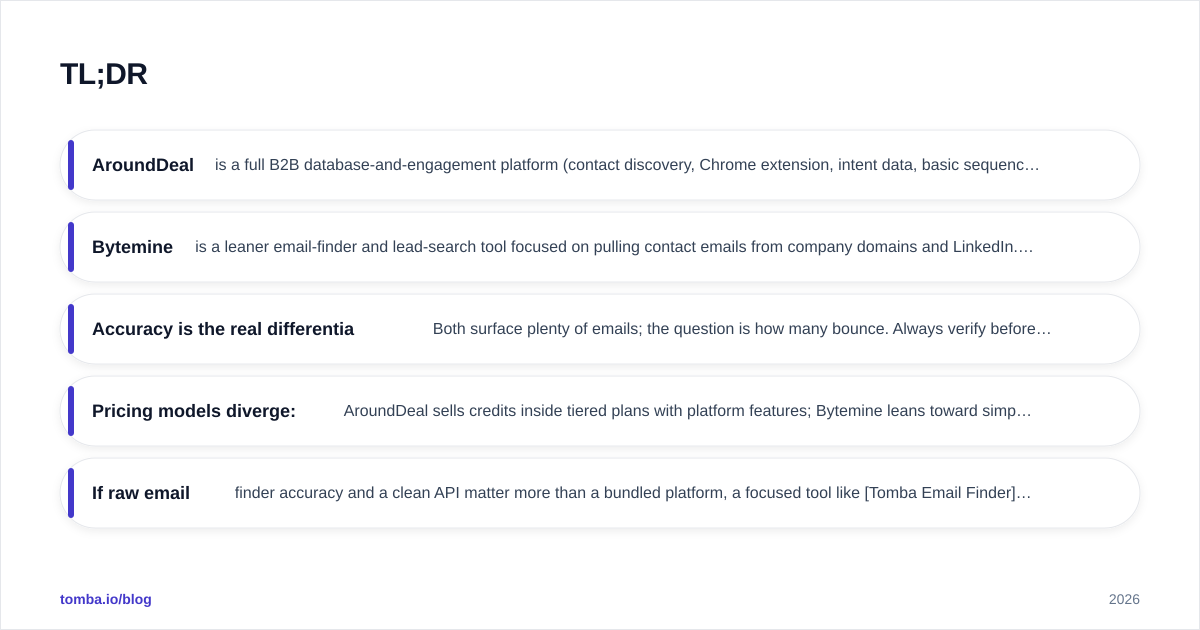
- AroundDeal is a full B2B database-and-engagement platform (contact discovery, Chrome extension, intent data, basic sequencing). Good when you want an all-in-one "find and reach" workspace.
- Bytemine is a leaner email-finder and lead-search tool focused on pulling contact emails from company domains and LinkedIn. Good when you want a no-frills finder without a heavy platform.
- Accuracy is the real differentiator. Both surface plenty of emails; the question is how many bounce. Always verify before you send, regardless of which you pick.
- Pricing models diverge: AroundDeal sells credits inside tiered plans with platform features; Bytemine leans toward simpler search-based pricing.
- If raw email-finder accuracy and a clean API matter more than a bundled platform, a focused tool like Tomba Email Finder is worth benchmarking against both.
What are AroundDeal and Bytemine?#
AroundDeal positions itself as a global B2B data platform — think contact and company database, a browser extension that pulls emails and phone numbers off LinkedIn, intent signals, and lightweight outreach. It targets sales and marketing teams that want discovery and engagement in one seat. You can read their own positioning on the AroundDeal site.
Bytemine is narrower by design. It's built around finding business email addresses from a name and company or domain, plus list-building from search filters. It appeals to founders, recruiters, and small sales teams who want to find emails fast without onboarding into a CRM-adjacent platform.
The short version: AroundDeal is a suite, Bytemine is a finder. That framing drives almost every trade-off below.
How accurate is the data?#
Accuracy is where these tools live or die, because a B2B email database decays roughly 22–30% per year as people change jobs. A contact found in January can be dead by Q3.
Neither vendor publishes an independently audited bounce rate, so treat marketing claims with skepticism and run your own sample test. In practice:
- AroundDeal benefits from a larger aggregated database and intent layer, which helps coverage — you'll get a result more often. The trade-off is that aggregated data includes stale and pattern-guessed addresses that need verification.
- Bytemine tends to return fewer results but is more transparent about when it's guessing a pattern versus returning a confirmed address.

The non-negotiable workflow with either tool: pipe every address through an email verifier before it touches your sequence. A found email is a hypothesis; a verified email is a lead. If you skip this step you'll torch your sender reputation and land in spam — which no amount of database size can fix.
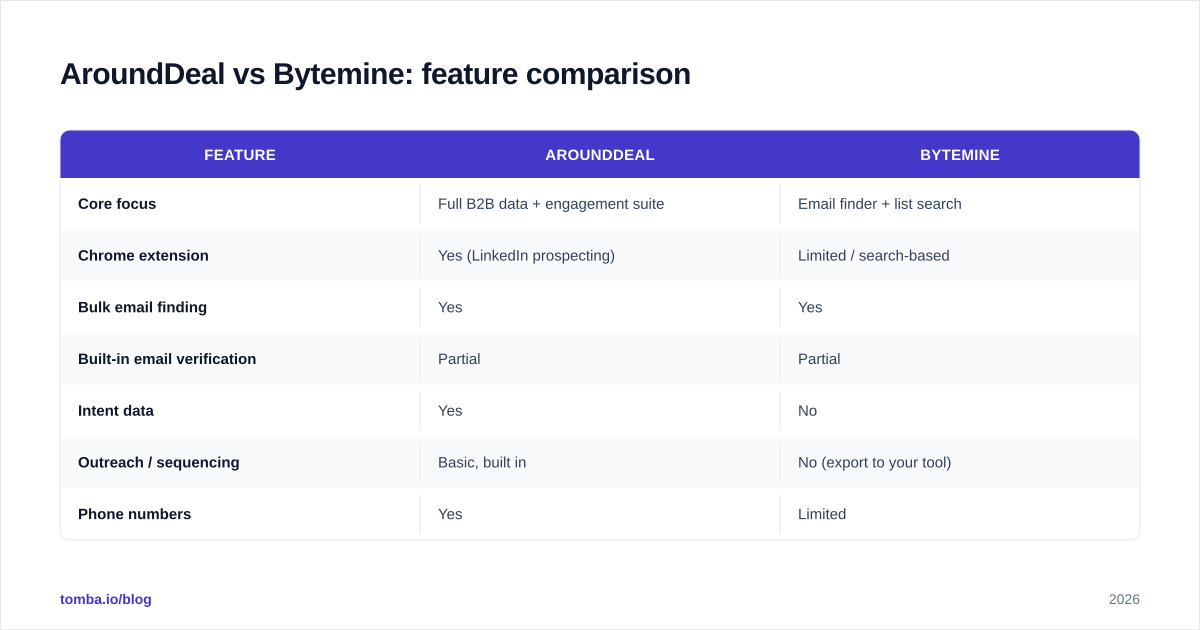
AroundDeal vs Bytemine: feature comparison#
Here's the head-to-head on the attributes that actually change your day-to-day.
| Feature | AroundDeal | Bytemine |
|---|---|---|
| Core focus | Full B2B data + engagement suite | Email finder + list search |
| Chrome extension | Yes (LinkedIn prospecting) | Limited / search-based |
| Bulk email finding | Yes | Yes |
| Built-in email verification | Partial | Partial |
| Intent data | Yes | No |
| Outreach / sequencing | Basic, built in | No (export to your tool) |
| Phone numbers | Yes | Limited |
| API access | Yes | Limited |
| Best for | All-in-one prospecting teams | Quick, focused email lookups |
| Free tier | Yes (limited credits) | Yes (limited) |
The pattern is clear: AroundDeal wins on breadth, Bytemine wins on simplicity. If you want one tool to find, enrich, and start outreach, AroundDeal covers more ground. If you already have a sequencer and a CRM and just need clean emails to feed them, Bytemine's smaller surface area is a feature, not a bug.
Which one is better for cold outreach?#
It depends on how your stack is already built.
Choose AroundDeal if you're a small team without a dedicated outreach tool and you want intent signals to prioritize accounts. The bundled sequencing won't replace a dedicated platform, but it gets you from "found a lead" to "sent an email" without a second subscription.
Choose Bytemine if you already run cold email through a specialized tool and your CRM handles the pipeline. You don't need AroundDeal's extra modules, and paying for them is waste. Bytemine plugs a single hole — finding the address — and stays out of the way.
One caveat for both: neither is a deliverability tool. Finding the email is step one. Warming your domain, authenticating with SPF and DKIM, and pacing your volume are separate disciplines. Use a dedicated SPF checker and warm up properly before scaling either tool's output.
How does pricing compare?#
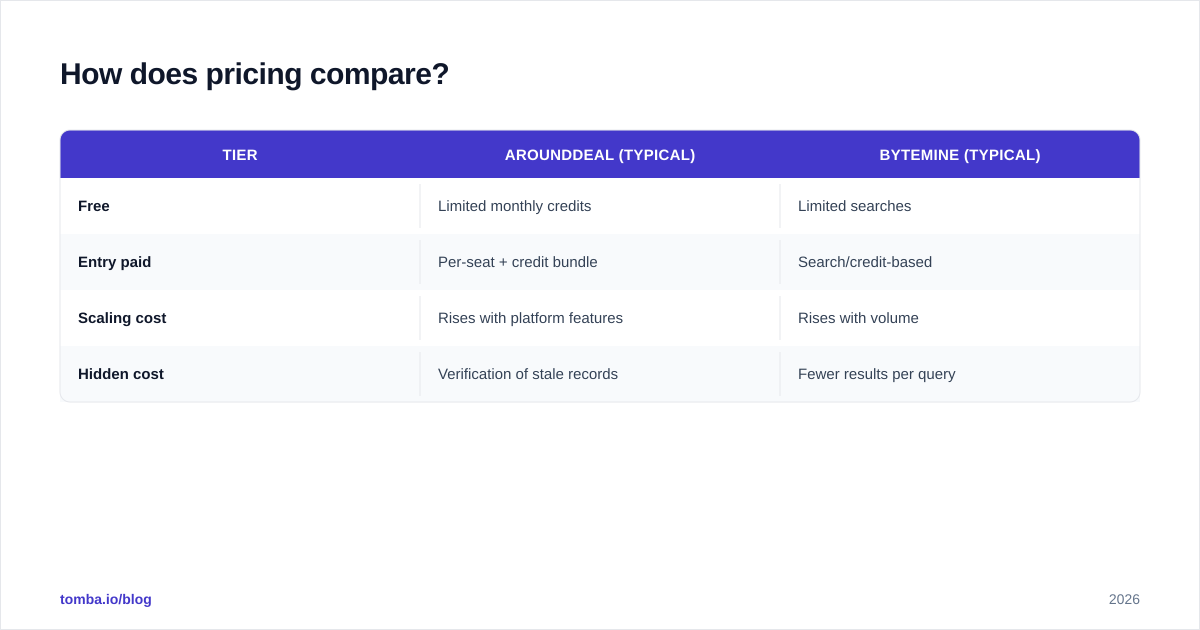
Both tools use a freemium-to-paid model, but the unit economics differ.
| Tier | AroundDeal (typical) | Bytemine (typical) |
|---|---|---|
| Free | Limited monthly credits | Limited searches |
| Entry paid | Per-seat + credit bundle | Search/credit-based |
| Scaling cost | Rises with platform features | Rises with volume |
| Hidden cost | Verification of stale records | Fewer results per query |
The honest take: AroundDeal's price reflects the whole platform, so you're paying for intent data and sequencing whether or not you use them. Bytemine's price reflects the finder alone, so heavy users pay mostly for search volume.
Always model cost per verified, usable email, not cost per credit. A cheaper credit that returns a stale address is more expensive than a pricier credit that returns a deliverable one once you factor in bounce damage. Compare both against transparent Tomba pricing — Free (25 searches/mo), Starter $49/mo, Growth $99/mo, Pro $249/mo — to see where each lands on real accuracy-adjusted value. You can validate vendor claims against third-party reviews on G2 before committing.
Where do both tools fall short?#
Three gaps show up regardless of which you choose:
- Catch-all domains. Many B2B companies use catch-all servers that accept any address, so standard verification can't confirm a specific mailbox. You need a dedicated catch-all verifier to score these, or you'll send into a void that looks valid.
- Verification depth. Bundled verification in finder tools is usually a quick syntax-and-MX check, not a full SMTP handshake. Treat it as a first pass, not a final answer.
- API and automation. If you want to enrich records inside your own product or workflow, finder-first tools often have thin APIs. A purpose-built email finder API gives you deterministic enrichment at scale.
These aren't reasons to avoid AroundDeal or Bytemine — they're reasons to pair whichever you choose with proper verification rather than trusting raw output.
Is there a stronger alternative for accuracy?#
If your single biggest priority is deliverable emails with a clean API, it's worth benchmarking both against a focused email-finder before you commit a budget.

Tomba is built around the finder-and-verifier core rather than a sprawling platform, which means the accuracy work happens upfront:
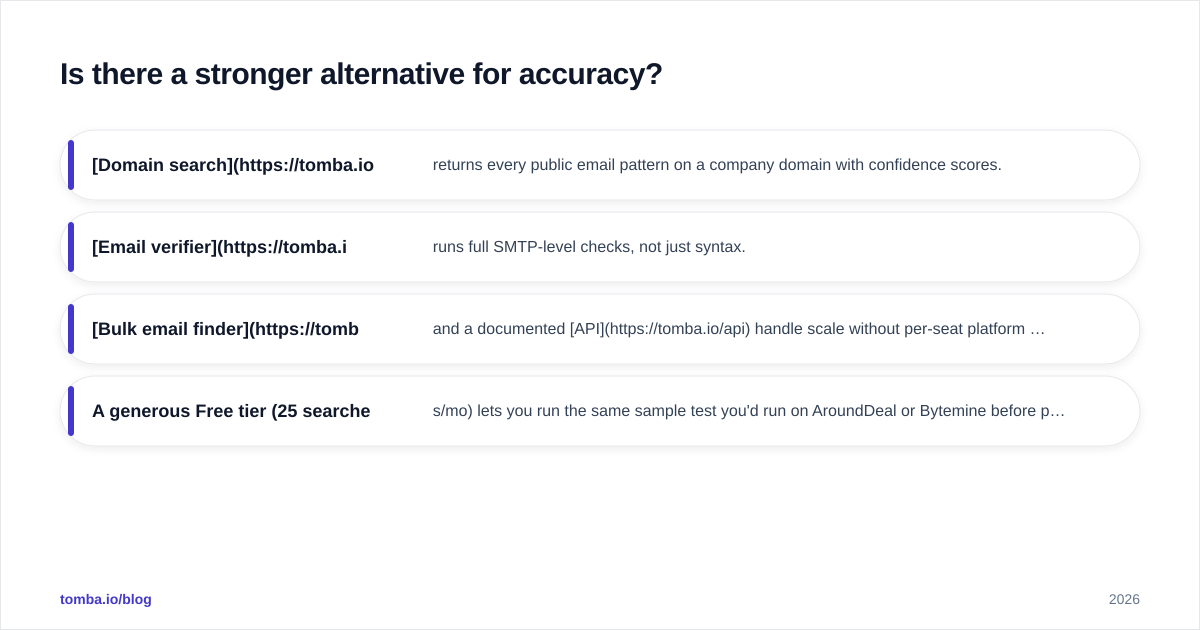
- Domain search returns every public email pattern on a company domain with confidence scores.
- Email verifier runs full SMTP-level checks, not just syntax.
- Bulk email finder and a documented API handle scale without per-seat platform overhead.
- A generous Free tier (25 searches/mo) lets you run the same sample test you'd run on AroundDeal or Bytemine before paying.
The point isn't that one tool wins every scenario — it's that you should decide based on a head-to-head accuracy test against your target accounts, not a feature list.
How should you decide?#
Run this 20-minute test before you buy anything:
- Pull 50 target contacts you already know are valid (current colleagues, past customers).
- Search those same contacts in AroundDeal, Bytemine, and one alternative on their free tiers.
- Verify every returned address with an independent email verifier.
- Score each tool on match rate (did it find the person) and accuracy rate (was the email deliverable).
- Multiply accuracy by your real monthly volume to get cost-per-usable-email.
The tool with the best accuracy-adjusted cost wins for your specific market — which may differ from the verdict for someone selling into a different segment.
Final verdict#
Pick AroundDeal if you want an all-in-one suite with intent data and built-in outreach, and you're willing to verify aggressively to offset database staleness.
Pick Bytemine if you want a lean, focused finder that feeds an existing stack without paying for modules you won't use.
Benchmark both against a finder-first tool if accuracy and a real API are your top priorities — that's exactly the gap a dedicated solution closes.
Ready to see how a finder-first engine stacks up against your AroundDeal or Bytemine sample? Start free with the Tomba Email Finder — 25 searches a month, full SMTP verification, and a documented API — and run the same 50-contact test on all three. Let the deliverable-email count, not the marketing page, make the decision for you.
// get started
Find, verify and enrich your first contacts today
Start on the free plan with 25 searches a month, then scale when your team is ready.
Free plan · No credit card required · GDPR & CCPA
// about the author