Arounddeal vs Capitalconnectorai: B2B Data Tools Compared (2026)
AroundDeal is an established B2B contact database; CapitalConnectorAI is an AI-first prospecting newcomer. Here's how they actually differ on data, workflow, and price in 2026.
Choosing between AroundDeal and CapitalConnectorAI comes down to one question: do you want a broad, proven contact database you drive yourself, or an AI layer that tries to decide who to contact for you? Both promise faster pipeline, but they solve different halves of the prospecting problem. This breakdown cuts through the positioning so you can match the tool to how your team actually sells.
TL;DR#
- AroundDeal is a mature B2B contact and company database with a Chrome extension, intent signals, and bulk export — best when you already know your ICP and need volume of accurate contacts.
- CapitalConnectorAI is an AI-first prospecting tool that leans on automated targeting and outreach suggestions — best for small teams that want the software to narrow the list for them.
- Data freshness and verification matter more than raw record counts; neither tool replaces an independent email verification step.
- For most teams, the smart move is a dedicated email finder plus verifier feeding your CRM, rather than betting your whole funnel on one all-in-one suite.
- Pricing models differ: AroundDeal sells credits and seats; AI-first tools often bundle outreach, which can hide the true cost per verified contact.
What is AroundDeal?#
AroundDeal is a B2B sales intelligence platform built around a global contact and company database. You search by company, title, industry, location, or technology, then pull emails, phone numbers, and firmographic details into a list. Its Chrome extension surfaces contact data while you browse LinkedIn or a company site, and it offers intent data and enrichment so you can prioritize accounts showing buying signals.
The product is aimed at SDRs, recruiters, and founders who run outbound at scale. You're in control of the targeting: you define the filters, you decide who lands in the export, and you push the results into your sequencer or CRM. That self-serve control is the core of AroundDeal's value — and also where it asks the most of you. Garbage filters in, garbage list out.
You can see how the market positions it through third-party reviews on G2, where users tend to praise coverage and the extension while flagging the usual data-decay complaints that affect every database vendor.
What is CapitalConnectorAI?#
CapitalConnectorAI is a newer, AI-first entrant that positions itself less as a raw database and more as an intelligent prospecting assistant. The pitch: instead of building filters by hand, you describe who you want to reach and the system proposes accounts, contacts, and even outreach angles. It folds targeting, scoring, and message suggestions into one workflow.
That convenience cuts both ways. AI-assisted targeting can save a junior rep hours of list building, but it also abstracts away the decisions you most need to control in B2B — which segment, which persona, which trigger. When a model picks your list, you inherit its blind spots. For teams without a tightly defined ICP, that guidance is genuinely useful. For teams that already know exactly who they sell to, it can feel like a layer between you and the data you actually want.
Because CapitalConnectorAI is a smaller and less-documented platform than AroundDeal, treat its coverage and accuracy claims the way you'd treat any vendor's first-party numbers: verify with a trial against your own target accounts before committing budget.
How do AroundDeal and CapitalConnectorAI compare?#
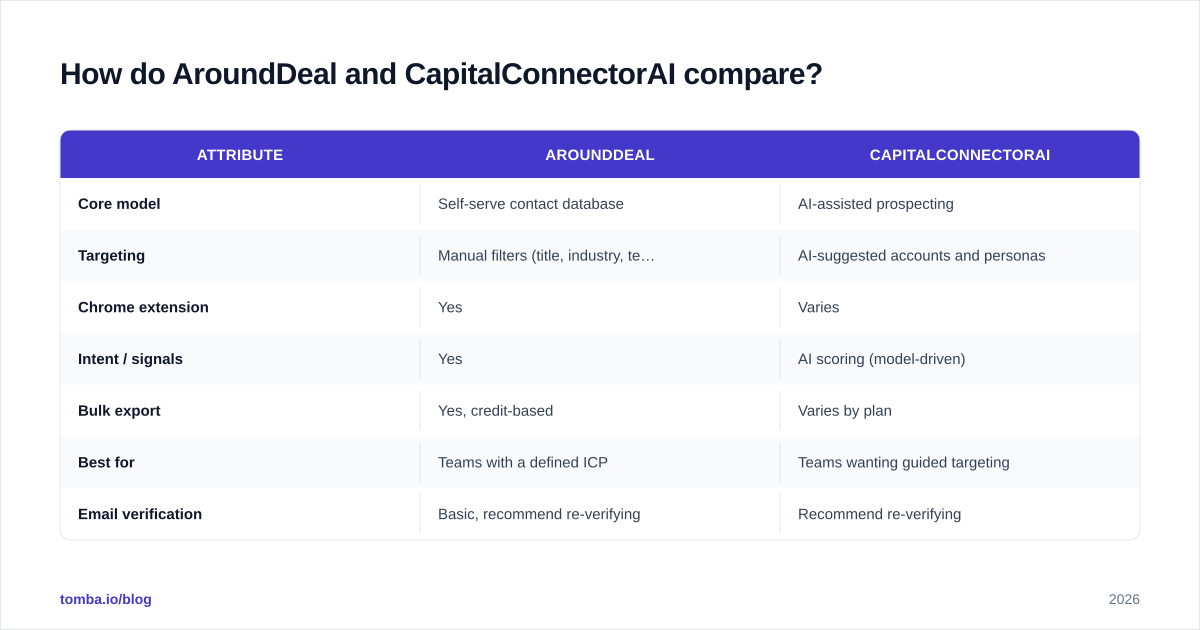
Here's the head-to-head on the attributes that actually change your results. Where a vendor doesn't publish firm numbers, the honest answer is "varies" — and you should confirm it in a trial.
| Attribute | AroundDeal | CapitalConnectorAI |
|---|---|---|
| Core model | Self-serve contact database | AI-assisted prospecting |
| Targeting | Manual filters (title, industry, tech, intent) | AI-suggested accounts and personas |
| Chrome extension | Yes | Varies |
| Intent / signals | Yes | AI scoring (model-driven) |
| Bulk export | Yes, credit-based | Varies by plan |
| Best for | Teams with a defined ICP | Teams wanting guided targeting |
| Email verification | Basic, recommend re-verifying | Recommend re-verifying |
| Pricing model | Credits + seats | Often bundled with outreach |
| Transparency of data sources | Documented | Less documented |
The pattern: AroundDeal gives you control and volume; CapitalConnectorAI gives you guidance and automation. Neither removes your obligation to confirm that the emails actually land. That's why serious outbound teams run every list through an independent email verifier before the first send, regardless of which platform sourced the contacts.
Which has better data accuracy?#
Accuracy is the only metric that survives contact with a real campaign — and it's where both tools deserve scrutiny. A database with 100 million records is worthless if a third of the emails bounce, because bounces wreck your sender reputation and quietly throttle everything you send afterward.
AroundDeal, as an established database, has the advantage of scale and time: more sources, more cross-referencing, and a track record you can check through public reviews. The trade-off is that large static databases decay. People change jobs roughly every two to three years, so any record older than a few months carries real risk. CapitalConnectorAI's AI scoring can help prioritize who's worth contacting, but model confidence is not the same as a verified, deliverable mailbox.
The practical takeaway is the same for both: never trust a single source's verification status as final. Build a two-step habit — source the contact, then verify it with a tool whose entire job is deliverability. Tomba's catch-all verifier handles the trickiest case, the catch-all domain that accepts every address and tells you nothing, which is exactly where naive verification quietly fails.

Which is better for your workflow?#
Your workflow, not the feature list, should decide this. Map your situation to the column that fits.
Choose AroundDeal if:
- You have a clear ICP and want to pull volume fast.
- Your reps live in LinkedIn and want an extension that surfaces data inline.
- You export to a sequencer or CRM and want credit-based predictability.
- You value documented data sources and a body of third-party reviews.
Choose CapitalConnectorAI if:
- Your ICP is still fuzzy and you want the tool to propose targets.
- You're a small team without a dedicated list-builder.
- You prefer an all-in-one feel over assembling a stack.
- You're comfortable trialing a less-established vendor.
Choose a focused stack instead if:
- Your priority is the highest possible deliverability per contact.
- You want to control cost per verified email rather than pay for bundled features you won't use.
- You already have a sequencer and CRM you like, and just need clean data feeding them.
That third path is where many teams land after a year of all-in-one fatigue. A dedicated email finder plus a verifier, wired into your existing CRM through native integrations, often beats a do-everything suite on the one number that matters: deliverable contacts per dollar.
How does pricing compare?#
Pricing is where "all-in-one" gets expensive in ways that aren't obvious upfront. AroundDeal uses a credit-and-seat model: you pay for the records you reveal and the seats you assign, which makes cost reasonably predictable once you know your monthly volume. AI-first tools like CapitalConnectorAI frequently bundle outreach, scoring, and data into a single subscription — convenient, but it can obscure your true cost per verified contact because you're paying for the bundle whether or not you use every part.
When you evaluate either, ignore the headline price and calculate this instead:
- Cost per verified, deliverable contact — not per record revealed.
- Wasted credits on duplicates, role accounts, and bounces.
- Seat minimums that force you to over-buy for a small team.
- Lock-in from outreach features that make leaving painful.
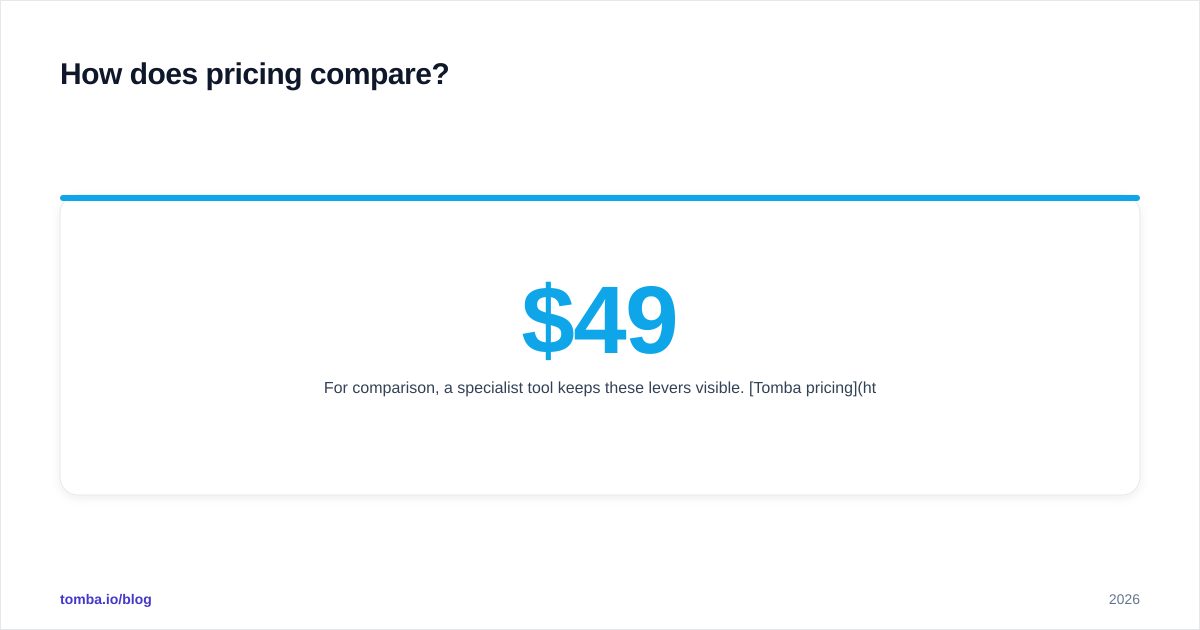
For comparison, a specialist tool keeps these levers visible. Tomba pricing runs a Free tier with 25 searches per month, Starter at $49/mo, Growth at $99/mo, Pro at $249/mo, and custom Enterprise — so you can size spend to actual finder-and-verifier usage rather than a bundled suite. Whatever you pick, model the cost against your real monthly volume, not the vendor's example numbers.
Can you use them together?#
Yes, and sometimes that's the sharpest play. There's no rule that says you pick one vendor and marry it. A common, effective pattern looks like this:
- Use CapitalConnectorAI to surface accounts when your ICP is still forming — let the AI widen your view of who might fit.
- Use AroundDeal to pull volume against the segments that prove out, exploiting its database depth and extension.
- Run every sourced contact through an independent verifier before sending, so neither tool's bounce rate becomes your problem.
- Push verified contacts into your CRM and sequencer, and enrich missing fields with data enrichment so reps open every record fully informed.
This stack treats each tool as a component, not a religion. You get AI guidance where you're uncertain, database depth where you're confident, and verification as the constant that protects deliverability across both. For broader vendor context as you assemble a stack, analyst resources like Gartner and the vendors' own sites — for example arounddeal.com — are useful sanity checks against marketing claims.
What about bulk and API workflows?#
If you're running outbound at any real scale, manual list-pulling becomes the bottleneck. AroundDeal supports bulk export, and AI tools automate parts of the build, but throughput and clean data delivery are what separate a stack that scales from one that stalls.
This is worth testing in your trial: push a few hundred target accounts through each tool and measure how many usable, verified contacts come out the other end. If you operate programmatically, a bulk email finder and a documented email finder API let you wire sourcing and verification directly into your data pipeline — no copy-paste, no stale CSVs sitting in someone's downloads folder. The teams with the best response rate almost always have the cleanest, freshest data feeding their sequences, and automation is how they keep it that way.
The bottom line#
AroundDeal wins on database depth, control, and a proven track record; CapitalConnectorAI wins on AI-guided targeting for teams still finding their footing. But the decision that moves your numbers isn't really "which suite" — it's whether your contacts are actually deliverable when you hit send. Pick the sourcing tool that fits your workflow, then make verification non-negotiable.
If your priority is finding accurate, deliverable B2B emails without paying for a bundled suite you'll half-use, start with the Tomba Email Finder. Search by domain, name, or company, pair it with the built-in verifier, and feed clean contacts straight into your CRM — so the only emails you send are the ones that land. Try it free with 25 searches a month and benchmark it against whatever else is on your shortlist.
Ready to find emails that actually work?
Join 150,000+ professionals who stopped guessing and started sending. Free credits on signup — no credit card required.
Get the Tomba newsletter
Practical outbound tactics and product updates — once every two weeks.
About the author