AroundDeal vs Csvgo (2026): Which B2B Email Finder Wins?
AroundDeal and Csvgo both promise B2B contact data, but they win at different jobs. Here's a neutral 2026 breakdown of accuracy, pricing, and fit.
AroundDeal vs Csvgo: Which B2B Email Finder Actually Fits Your Workflow in 2026?
You are probably here because both tools showed up on the same shortlist, and the marketing pages read almost identically: "find verified B2B emails, enrich your pipeline, close more deals." That sameness is the problem. AroundDeal and Csvgo solve overlapping problems in genuinely different ways, and picking wrong costs you either money or deliverability.
This is a neutral teardown. Where one tool is clearly stronger, we say so. Where Tomba is the better third option, we say that too — honestly, not as filler.
TL;DR#
- AroundDeal is a full B2B contact database with a Chrome extension, intent data, and CRM-style workflows. Best if you want to browse and prospect inside a platform.
- Csvgo is a leaner, bulk-first email finder built around uploading lists and getting enriched CSVs back. Best if you already have a list and just need contacts appended.
- Accuracy is close but use-case-dependent: AroundDeal wins on company firmographics; Csvgo wins on fast bulk turnaround with lower per-credit cost.
- Neither verifies catch-all domains well out of the box — budget for a dedicated email verifier if your bounce tolerance is tight.
- If you want database depth and a strict accuracy guarantee, a third tool like Tomba is worth pricing against both.
What is AroundDeal?#
AroundDeal is a B2B data and sales intelligence platform. Think of it less as a single-purpose tool and more as a workspace: a searchable database of companies and contacts, a browser extension that surfaces emails on LinkedIn, intent signals, and basic engagement tracking. You log in, you search by title, industry, geography, or technology, and you build lists inside the product.
Its center of gravity is discovery. You do not need to already know who you are looking for. You describe an ideal customer profile and AroundDeal hands you a list of matching people with contact details attached. That makes it attractive to SDR teams doing top-of-funnel prospecting from scratch. You can read more about how it positions itself on the AroundDeal homepage.
The tradeoff: platforms that do everything tend to charge platform prices, and credits get consumed across multiple features (search reveals, enrichment, exports), so it is easy to burn through a plan faster than you expect.
What is Csvgo?#
Csvgo is built around a single, blunt promise: give it a CSV, get a richer CSV back. You upload a list of names and companies (or domains), and it appends emails, and depending on the plan, phone numbers and basic firmographics. It is a bulk enrichment tool first and a discovery tool a distant second.
That focus is its strength. There is very little to learn. If your motion is "I scraped or exported 5,000 rows and need emails on them," Csvgo gets you there with minimal clicks and a lower per-credit price than most full platforms. For an analogy: AroundDeal is a supermarket where you wander the aisles; Csvgo is a vending machine where you already know the code.
The weakness is the flip side. If you do not already have a list, Csvgo gives you less help building one. Its database browsing and filtering are thinner than AroundDeal's, and there is less in the way of intent data or engagement features.
AroundDeal vs Csvgo: How do they compare head-to-head?#
Here is the side-by-side. Prices and credit models shift, so treat the figures as directional and confirm on each vendor's current pricing page before you buy.
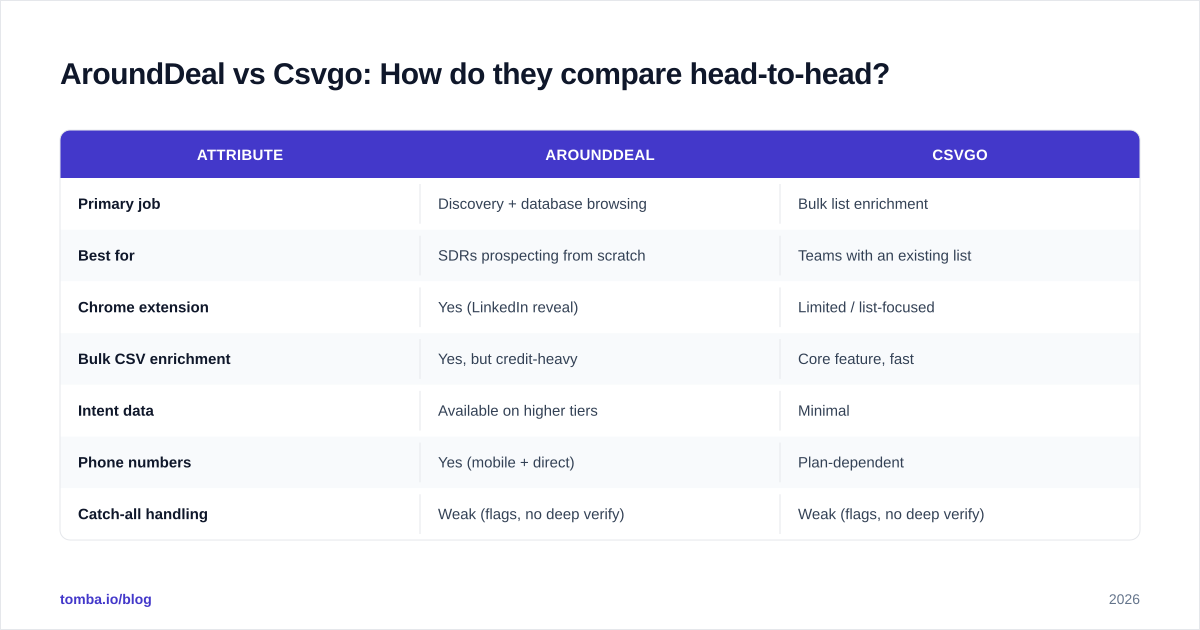
| Attribute | AroundDeal | Csvgo |
|---|---|---|
| Primary job | Discovery + database browsing | Bulk list enrichment |
| Best for | SDRs prospecting from scratch | Teams with an existing list |
| Chrome extension | Yes (LinkedIn reveal) | Limited / list-focused |
| Bulk CSV enrichment | Yes, but credit-heavy | Core feature, fast |
| Intent data | Available on higher tiers | Minimal |
| Phone numbers | Yes (mobile + direct) | Plan-dependent |
| Catch-all handling | Weak (flags, no deep verify) | Weak (flags, no deep verify) |
| Free tier | Limited monthly credits | Limited trial credits |
| Pricing model | Per-credit, multi-feature drain | Per-credit, enrichment-focused |
| Learning curve | Moderate (full platform) | Low (upload-and-go) |
The honest summary: these are not really the same product wearing different logos. AroundDeal is competing with the Apollos and
ZoomInfos of the world on database breadth. Csvgo is competing with focused enrichment APIs on speed and cost-per-row.
)
Is AroundDeal or Csvgo more accurate?#
Accuracy is the question that actually matters, because a cheap email that bounces is more expensive than an expensive one that lands. Bounces hurt your sender reputation, and a damaged reputation drags down every campaign after it.
In practical testing patterns reported across review sites like G2 and Capterra, both tools land in a similar band — roughly the mid-to-high range for standard corporate domains, with accuracy dropping sharply on:
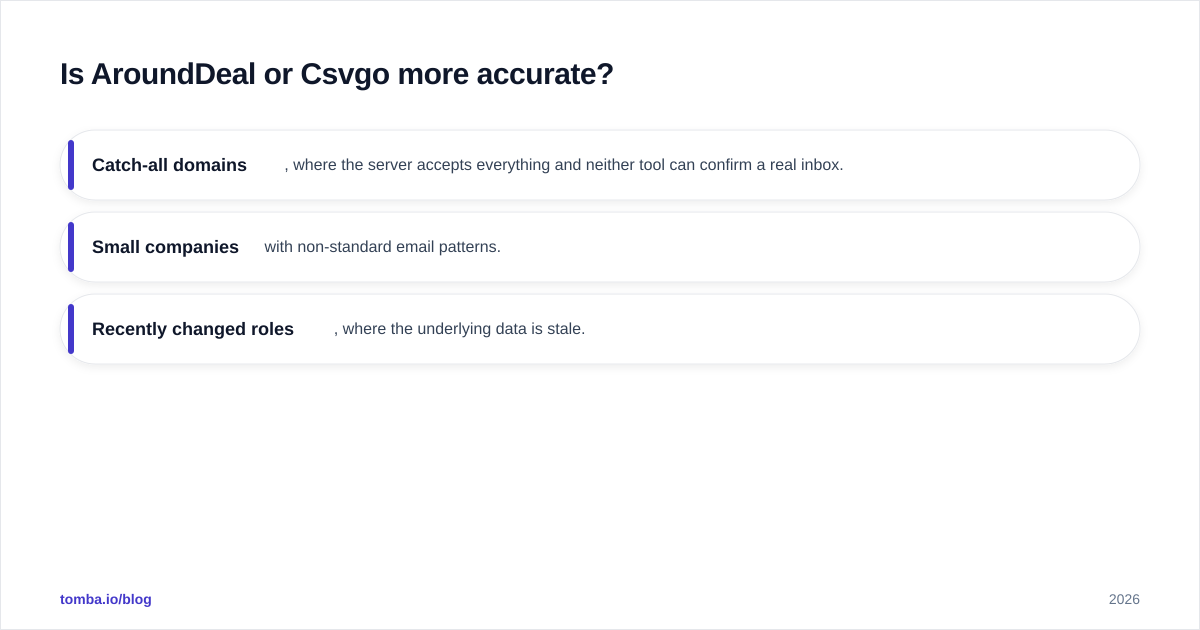
- Catch-all domains, where the server accepts everything and neither tool can confirm a real inbox.
- Small companies with non-standard email patterns.
- Recently changed roles, where the underlying data is stale.
AroundDeal tends to edge ahead on firmographic accuracy — company size, industry, tech stack — because its database is richer. Csvgo tends to edge ahead on throughput: it returns large batches faster, which matters when you are enriching tens of thousands of rows on a deadline.

The non-obvious takeaway: raw "accuracy percentage" from any vendor is close to meaningless unless you know how they count catch-alls. Some tools mark catch-all hits as "valid" (inflating the number), others mark them "risky" (deflating it). Always run a representative sample through an independent email verifier before trusting a headline figure from either AroundDeal or Csvgo.
Which one is better for bulk lead generation?#
If bulk is your whole reason for buying, Csvgo has the cleaner design for it. Upload, map columns, run, download. There is less surface area to get wrong, and the per-credit economics favor large jobs.
But "better for bulk" depends on what feeds the bulk job:
- You already have the list (scraped, exported from a CRM, bought elsewhere): Csvgo is the more natural fit. You are paying only for enrichment, not for a database you will not browse.
- You need to build the list first: AroundDeal earns its keep here. The discovery layer means you are not stitching together a separate scraper plus an enrichment tool.
A common mature setup splits the work: discover with a database tool, then verify and dedupe with dedicated utilities. If you go that route, a bulk email finder with built-in verification removes a step, and a remove-duplicates pass before you import keeps your CRM clean and your credit spend honest.
)
What about pricing and value?#
Both tools use credit-based pricing, which is where buyers get surprised. The headline plan price is not your real cost — your real cost is price per usable, verified contact, after bounces and after wasted credits on duplicates and catch-alls.
A few rules that hold regardless of which you choose:
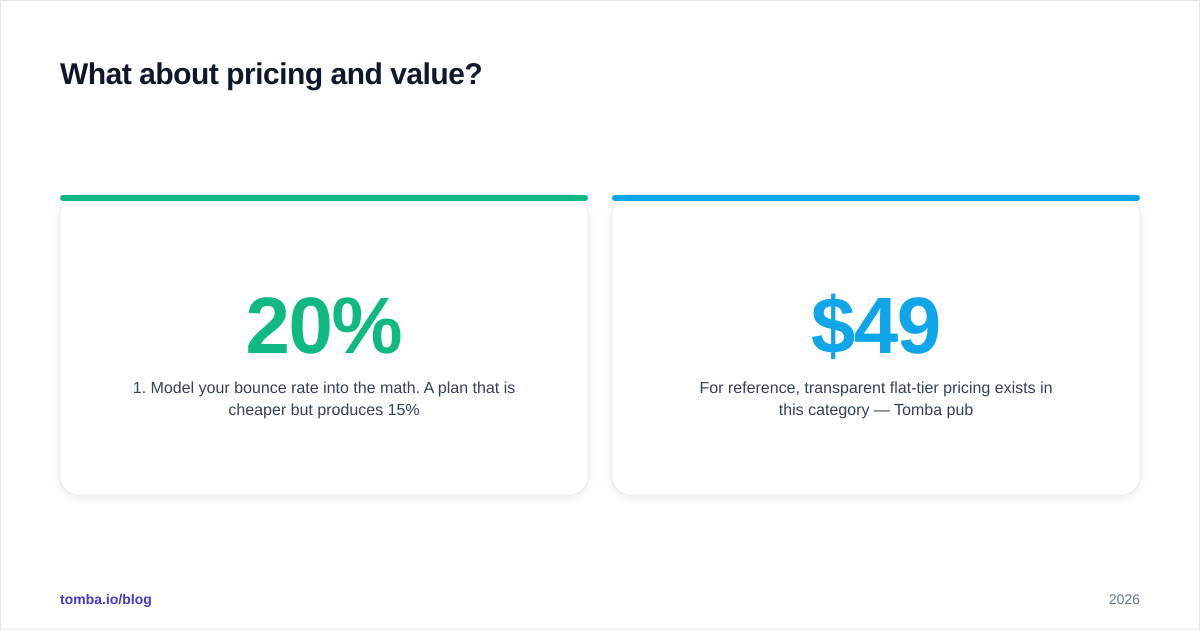
- Model your bounce rate into the math. A plan that is 20% cheaper but produces 15% more bounces is not cheaper.
- Watch multi-feature credit drain. Platforms like AroundDeal spend the same credit pool across search, reveal, and export. A bulk-only tool like Csvgo concentrates spend on the one action you care about.
- Free tiers are for testing accuracy, not production. Run the same 50 known contacts through each and check the results against reality.
For reference, transparent flat-tier pricing exists in this category — Tomba publishes its pricing openly: a free tier with 25 searches/month, Starter at $49/mo, Growth at $99/mo, and Pro at $249/mo, with the same accuracy logic applied whether you use the email finder, domain search, or the Tomba API. The point is not that one model is universally right — it is that you should compare on outcome cost, not sticker price.

When should you pick a different tool entirely?#
Sometimes the right answer to "AroundDeal vs Csvgo" is "neither, quite." Consider a third option when:
- You need an API-first workflow. If you are wiring email finding into your own product or internal tooling, you want clean, documented endpoints more than a slick dashboard. A dedicated email finder API or Google Sheets add-on often beats a platform here.
- Catch-all domains dominate your market. If you sell into industries full of catch-all setups, your buying decision should be driven by who has the best catch-all verifier, not who has the prettiest search UI.
- Compliance and data sourcing matter. Enterprise buyers increasingly ask where the data came from. Tools that publish their data sources make procurement easier.
- You want phone plus email in one pass. If multichannel is the plan, check whether the tool bundles a phone finder at a sane price rather than forcing a second subscription.
This is not a knock on either AroundDeal or Csvgo. It is a reminder that "best email finder" is always relative to your motion. The team running 100 hyper-targeted accounts and the team blasting 50,000 rows want opposite things.
How should you actually decide?#
Run a 60-minute bake-off instead of reading more comparison posts (including this one). Here is the protocol:
- Build a truth set. Pick 50 contacts you already have confirmed, working emails for. Strip the emails out.
- Run that list through both tools on their free or trial tiers.
- Score three things: match rate (did it find an email?), accuracy (did it find the right email?), and catch-all honesty (did it flag uncertainty or hide it?).
- Verify everything independently with a neutral verifier so you are not grading each tool on its own homework.
- Compute cost per verified contact, not cost per credit.
Whichever tool wins your truth set wins your business. Firmographic-heavy ICP work tends to favor AroundDeal. High-volume list enrichment tends to favor Csvgo. And if both leave gaps on accuracy or catch-alls, that gap is exactly where a verification-first tool earns its place in your stack.

The bottom line#
AroundDeal is the better discovery platform; Csvgo is the better bulk enrichment utility. Choose based on whether your bottleneck is finding people or enriching a list you already have. On pure email accuracy they are close enough that your own test set should break the tie — and either way, an independent verification pass is non-negotiable before you send.
If you want database-grade coverage and a strict, transparent accuracy standard in one place, run your truth set through the Tomba Email Finder alongside AroundDeal and Csvgo. Start on the free tier (25 searches/month), find emails by name, company, or domain, and check the results against your known-good list. Let the numbers — not the marketing pages — pick your tool.
// get started
Find, verify and enrich your first contacts today
Start on the free plan with 25 searches a month, then scale when your team is ready.
Free plan · No credit card required · GDPR & CCPA
// about the author