Arounddeal vs Datanyze: Which B2B Data Tool Wins in 2026?
Arounddeal vs Datanyze, compared head-to-head on data coverage, accuracy, pricing, and workflow fit so you can pick the right B2B contact platform in 2026.
You are choosing between two B2B data tools that look similar on a feature grid but behave very differently in daily prospecting. This guide breaks down Arounddeal vs Datanyze on the things that actually move pipeline: data coverage, accuracy, pricing transparency, and how each one fits into the way your team already works.
TL;DR#
- Arounddeal is a global B2B contact and company database with a usable free plan, Chrome extension, and mobile-number coverage. It is built for active prospecting and list-building.
- Datanyze is a lightweight sales intelligence tool best known for technographics (what tech a company runs). After its ZoomInfo acquisition, it sits as an entry-level, browser-first contact grabber.
- If you need broad contact data plus enrichment, Arounddeal generally wins on volume and value. If you specifically need technographic targeting on a tight budget, Datanyze still has a niche.
- Neither tool is a substitute for a dedicated verification step. Pair whichever you choose with a proper email verifier before you send.
- For teams that mainly want accurate emails by domain or name, a focused email finder like Tomba often beats both on cost per valid contact.
What is Arounddeal?#
Arounddeal is a B2B sales intelligence platform with a contact database covering hundreds of millions of professionals worldwide, skewed toward strong APAC and global coverage that many US-centric tools miss. Its core pieces are a searchable company/contact database, a Chrome extension that pulls contacts off LinkedIn and company sites, and enrichment plus engagement add-ons.
The practical appeal is simple: you can start on a free plan, build targeted lists by title, industry, location, and headcount, and export emails and (on paid tiers) direct-dial mobile numbers. It behaves like a prospecting workhorse rather than a research-only tool.
What is Datanyze?#
Datanyze is a sales intelligence tool that made its name on technographics — identifying the software, hosting, analytics, and widgets a company uses so you can target buyers by their tech stack. It was acquired by ZoomInfo and now operates as a low-cost, browser-extension-driven contact tool.
The strength is the technographic angle: if your value proposition depends on "companies running Shopify" or "sites using HubSpot," Datanyze can surface those signals. The weakness is that, since the acquisition, product investment has clearly shifted, and its raw contact volume and enrichment depth trail purpose-built data platforms.
)
Arounddeal vs Datanyze: how do they compare at a glance?#
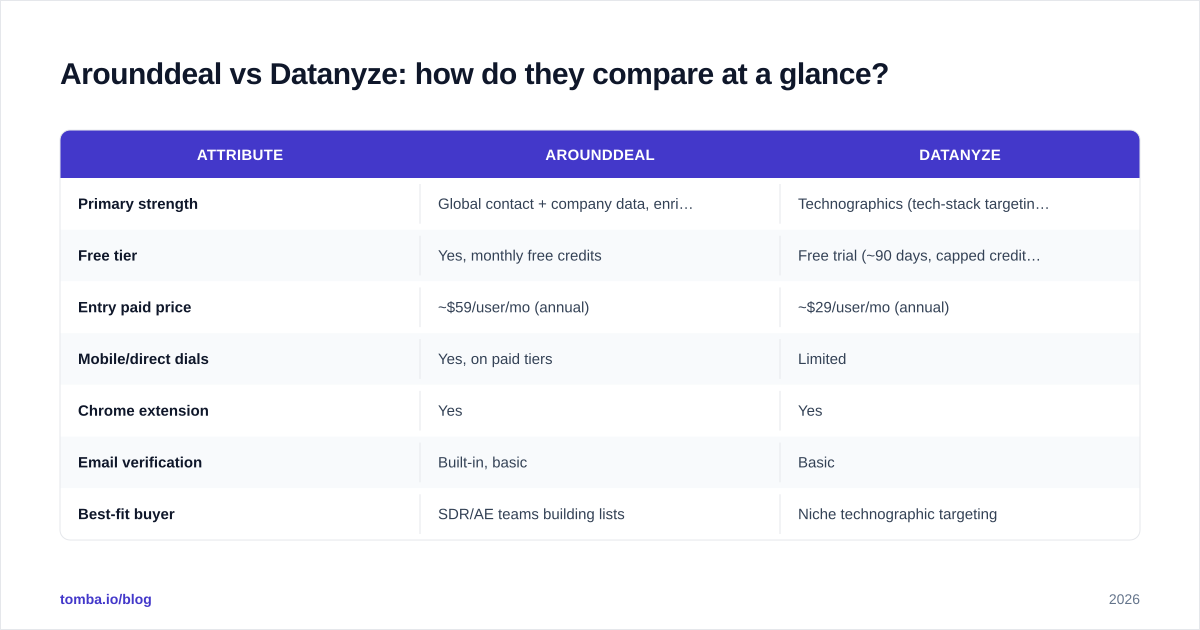
Here is the head-to-head on the attributes buyers ask about most. Treat vendor-published accuracy claims as directional, not gospel — always run your own sample test.
| Attribute | Arounddeal | Datanyze |
|---|---|---|
| Primary strength | Global contact + company data, enrichment | Technographics (tech-stack targeting) |
| Free tier | Yes, monthly free credits | Free trial (~90 days, capped credits) |
| Entry paid price | ~$59/user/mo (annual) | ~$29/user/mo (annual) |
| Mobile/direct dials | Yes, on paid tiers | Limited |
| Chrome extension | Yes | Yes |
| Email verification | Built-in, basic | Basic |
| Best-fit buyer | SDR/AE teams building lists | Niche technographic targeting |
| Data refresh cadence | Frequent | Slower since acquisition |
Which tool has better data coverage and accuracy?#
Arounddeal wins on coverage; both need verification on accuracy. Arounddeal's database is broader, with stronger international reach and direct-dial mobile numbers that Datanyze rarely matches. Datanyze's contact records are thinner and lean on the technographic layer for differentiation rather than sheer volume.
On accuracy, the honest answer is that every B2B database degrades — people change jobs roughly every two to three years, so any record is decaying the moment it is collected. That is why the smartest workflow treats any finder's output as a hypothesis. Pull the email, then confirm it with a dedicated email verification pass and a catch-all verifier for domains that accept everything. A clean 80% deliverable list beats a "98% accurate" claim you never tested.
If raw email-finding accuracy by domain is your single biggest concern, it is worth benchmarking both against a specialist domain search tool before committing budget.
Is Arounddeal or Datanyze better value for the price?#
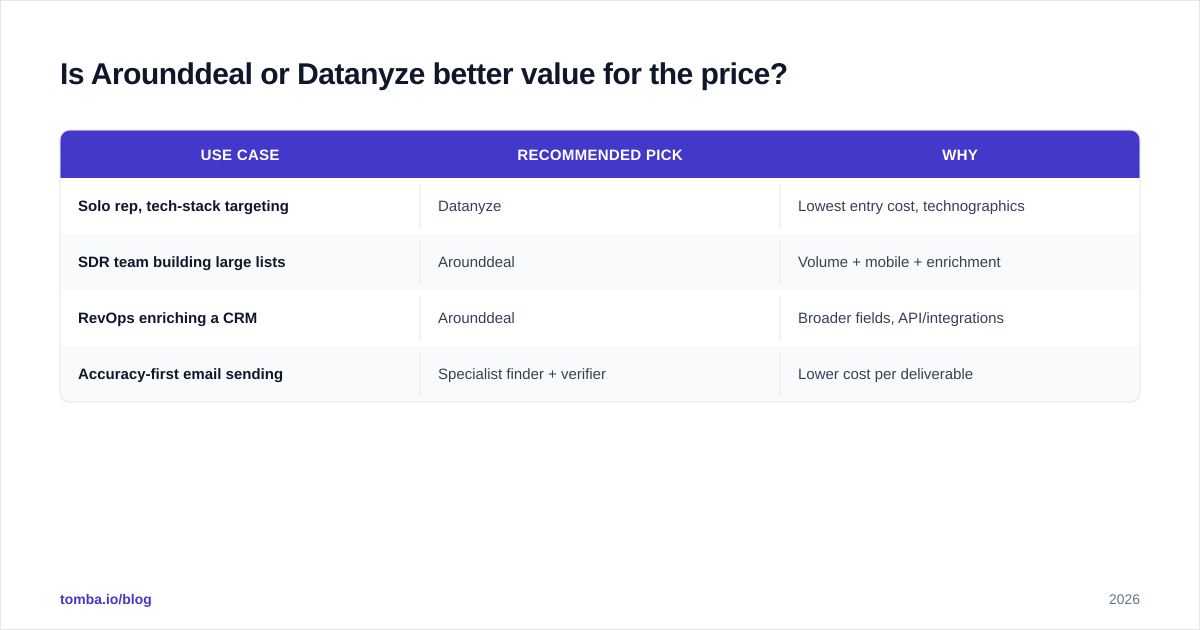
Datanyze is cheaper to start; Arounddeal delivers more per dollar at scale. Datanyze's entry tier is attractive for solo reps or very small teams who only need occasional contacts plus technographic signals. But credit caps and shallow enrichment mean you outgrow it fast.
Arounddeal costs more per seat but bundles more usable data, mobile numbers, and enrichment, so the cost per valid contact often ends up lower for an active outbound team. Map it against your real monthly volume rather than the sticker price.
| Use case | Recommended pick | Why |
|---|---|---|
| Solo rep, tech-stack targeting | Datanyze | Lowest entry cost, technographics |
| SDR team building large lists | Arounddeal | Volume + mobile + enrichment |
| RevOps enriching a CRM | Arounddeal | Broader fields, API/integrations |
| Accuracy-first email sending | Specialist finder + verifier | Lower cost per deliverable |
How do the workflows and integrations differ?#
Both ship Chrome extensions, which is where most reps actually live. Arounddeal's extension is the more complete prospecting surface: capture from LinkedIn, reveal mobile numbers, push to lists, and enrich on the fly. Datanyze's extension is lighter and centered on grabbing a contact while you browse, with the technographic readout as the headline feature.
For data enrichment and CRM syncing, Arounddeal exposes more fields and an API path, which matters if you are pushing records into Salesforce, HubSpot, or a sequencer. Datanyze integrations exist but feel maintenance-mode compared to actively developed platforms.
The decision framework below sums up how to route a buyer to the right tool based on what they actually need.
When should you choose Datanyze?#
Pick Datanyze when technographics are central to your targeting and budget is tight. If your pitch is "we help companies running [specific software]," the ability to filter by tech stack is a genuine edge that broad contact databases do not replicate as cleanly. It also makes sense as a low-commitment way to test browser-based prospecting before investing in a heavier platform.
Be realistic about the trade-offs: smaller contact pool, limited mobile coverage, and slower data refresh. Validate a sample of records against your own known-good list before you trust it for volume outreach. You can sanity-check individual addresses fast with a free email checker.
When should you choose Arounddeal?#
Pick Arounddeal when you need a single source for broad contact data, mobile numbers, and enrichment — especially if you sell internationally. For an SDR or AE team running daily outbound, the larger database and direct dials translate into more conversations per hour, and the free plan lets you trial it without procurement friction.
It is the stronger generalist of the two. The only caution is the same one that applies to every database tool: budget for a verification layer so your bounce rate stays low and your domain reputation stays intact.
Where does a dedicated email finder fit in?#
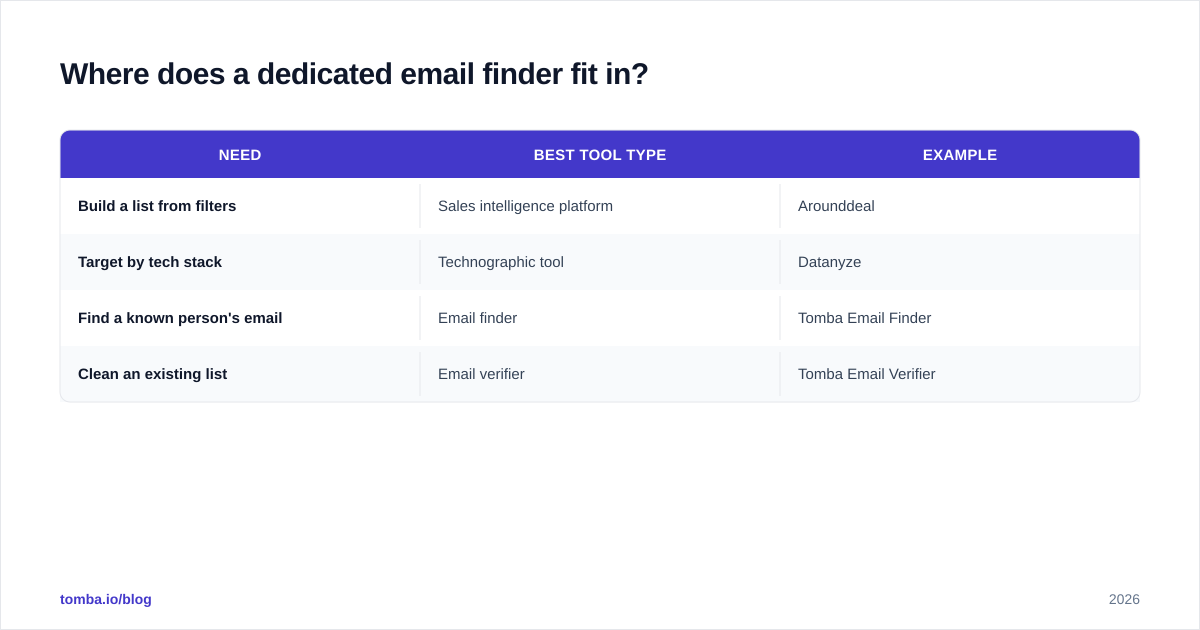
Here is the part the two-tool framing hides: a comparison platform and a precision email finder solve different problems. Arounddeal and Datanyze are discovery tools — they help you build a list from filters and signals. A dedicated finder is a precision tool — you already know the person or domain and need the correct, verified address fast.
| Need | Best tool type | Example |
|---|---|---|
| Build a list from filters | Sales intelligence platform | Arounddeal |
| Target by tech stack | Technographic tool | Datanyze |
| Find a known person's email | Email finder | Tomba Email Finder |
| Clean an existing list | Email verifier | Tomba Email Verifier |
In practice, many teams run both layers: a database for discovery and a finder/verifier for precision and hygiene. If you mostly need the second layer — accurate emails by name or domain, plus bulk verification — paying full sales-intelligence pricing is overkill. Compare the Tomba pricing tiers (Free 25 searches/mo, Starter $49/mo, Growth $99/mo, Pro $249/mo) against per-seat Arounddeal or Datanyze plans and the math often favors the focused tool.
You can read independent user feedback on all three categories on G2 before you decide.
Frequently asked questions#
Is Arounddeal better than Datanyze? For most active outbound teams, yes — broader coverage, mobile numbers, and a stronger free plan. Datanyze only pulls ahead when technographic targeting is your core motion.
Are these tools accurate enough to skip verification? No. Treat every database export as unverified and run it through an email verifier before sending. This protects deliverability regardless of which platform you choose.
Can I use either for catch-all domains? Both report some catch-all flags, but neither resolves them well. Use a dedicated catch-all verifier for those records.
What about phone numbers? Arounddeal offers more direct-dial coverage. If phone is central, also evaluate a dedicated phone finder.
The bottom line#
Arounddeal is the better all-around B2B data platform; Datanyze is a budget, technographics-first niche pick. Choose based on motion: list-building at scale leans Arounddeal, tech-stack targeting on a small budget leans Datanyze.
But if your real bottleneck is getting correct, verified emails for people and domains you already know, neither discovery platform is the most efficient buy. Start free with the Tomba Email Finder — find professional emails by domain, name, or company, verify them in the same workflow, and pay only for the precision layer you actually need. Run a side-by-side sample against your Arounddeal or Datanyze exports and let your bounce rate pick the winner.
Ready to find emails that actually work?
Join 150,000+ professionals who stopped guessing and started sending. Free credits on signup — no credit card required.
Get the Tomba newsletter
Practical outbound tactics and product updates — once every two weeks.
About the author