Arounddeal vs Generect: 2026 B2B Data Tool Comparison
Arounddeal vs Generect compared on data accuracy, coverage, pricing, and workflow fit — plus where a dedicated email finder beats both for cold outreach.
You are choosing between two B2B data platforms that look almost identical on a feature grid but behave very differently once your reps start prospecting with them. This guide breaks down Arounddeal vs Generect on the things that actually move pipeline: data accuracy, coverage depth, enrichment quality, integrations, and price per usable record.
TL;DR — Arounddeal vs Generect at a glance#
- Arounddeal is a broad contact-and-company database with a Chrome extension, prospecting lists, and basic engagement tooling — strongest for SDRs who want an all-in-one "find and reach" workflow inside one tab.
- Generect is an API-first lead-generation engine focused on real-time data generation and LinkedIn-sourced records — strongest for RevOps and engineering teams that want programmatic, on-demand lookups rather than a static database.
- Accuracy is the real battleground. Both quote high match rates; real-world deliverability is where the gap shows. Always verify before you send.
- Pricing models differ: Arounddeal leans on credit/seat bundles; Generect leans on API volume. Cost-per-verified-contact, not sticker price, is the number that matters.
- The honest third option: if your core problem is "find a correct, deliverable email for this person at this company," a dedicated email finder like Tomba often beats a general data suite on both accuracy and cost.
What is Arounddeal?#
Arounddeal is a B2B sales-intelligence platform built around a contact database and a browser extension. You search by company, role, or industry, build prospect lists, pull emails and phone numbers, and push them into your CRM or outreach tool. It positions itself as a single workspace where a sales development rep can discover accounts, grab contacts, and start sequences without bouncing between five tabs.
Its sweet spot is the individual prospector or small team that values workflow convenience: see a LinkedIn profile, click the extension, get a contact record. The trade-off with any database-first tool is freshness — records are stored and periodically refreshed, so a percentage are always drifting out of date between updates.
What is Generect?#
Generect takes the opposite architectural bet. Instead of serving you from a pre-built warehouse, it emphasizes real-time lead generation — you describe the audience or hand it a profile, and it assembles records on demand, with heavy reliance on LinkedIn-sourced signals. It is API-first, which makes it a natural fit for teams building their own prospecting automation, enrichment pipelines, or internal tools.
The upside of real-time generation is recency: data is pulled closer to the moment you need it. The trade-off is that programmatic, API-centric tools assume you have someone who can wire them up. A non-technical SDR will get less value out of Generect than out of a point-and-click suite.
Arounddeal vs Generect: the head-to-head table#
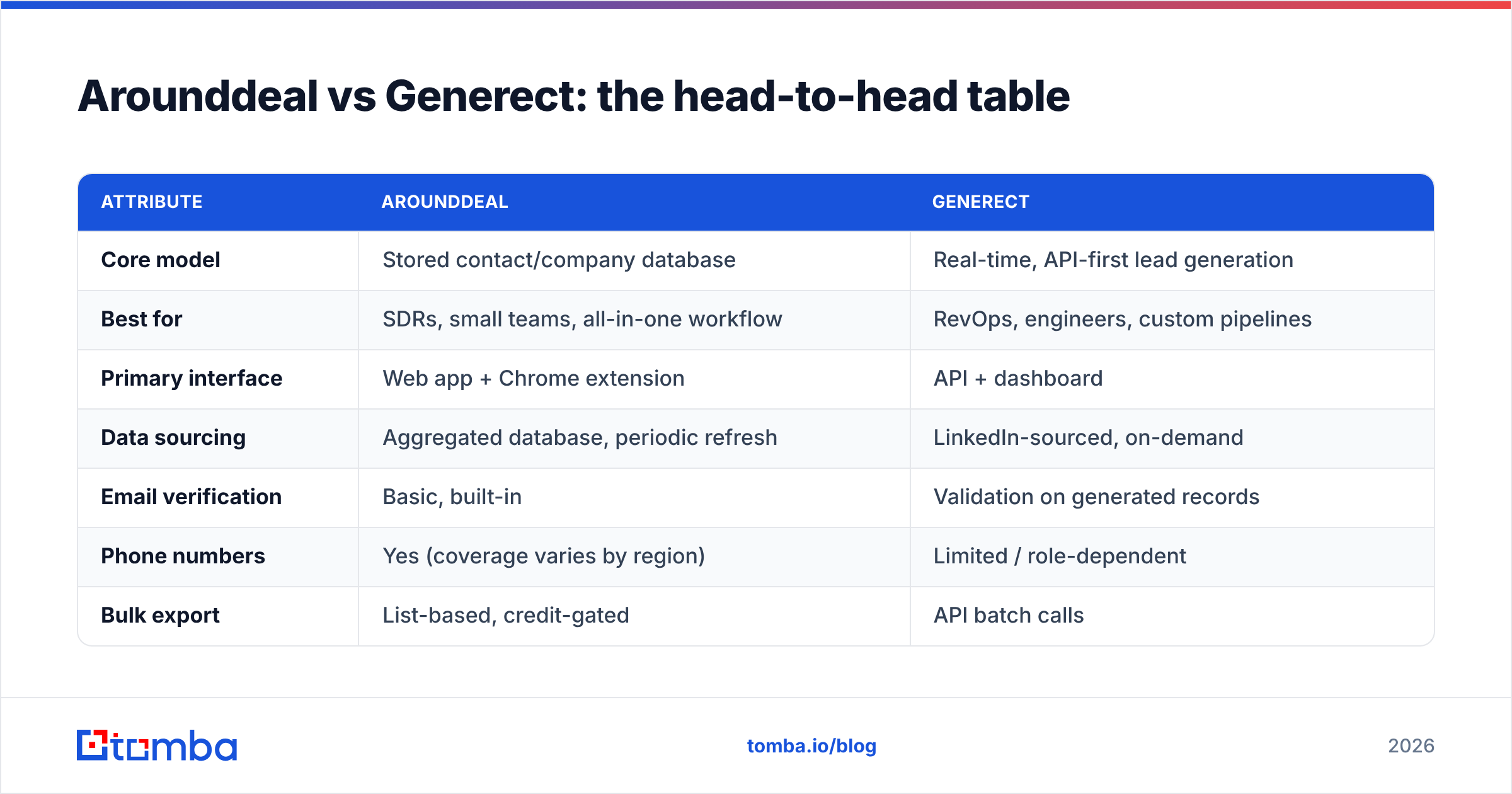
Here is the comparison most buyers actually want. Treat vendor-published accuracy figures as marketing claims until you run your own test on a sample list.
| Attribute | Arounddeal | Generect |
|---|---|---|
| Core model | Stored contact/company database | Real-time, API-first lead generation |
| Best for | SDRs, small teams, all-in-one workflow | RevOps, engineers, custom pipelines |
| Primary interface | Web app + Chrome extension | API + dashboard |
| Data sourcing | Aggregated database, periodic refresh | LinkedIn-sourced, on-demand |
| Email verification | Basic, built-in | Validation on generated records |
| Phone numbers | Yes (coverage varies by region) | Limited / role-dependent |
| Bulk export | List-based, credit-gated | API batch calls |
| Learning curve | Low | Medium–high (developer-oriented) |
| Pricing basis | Seats + credits | API volume / plan tier |
| Free option | Limited free credits | Trial / limited access |
Which has better data accuracy?#
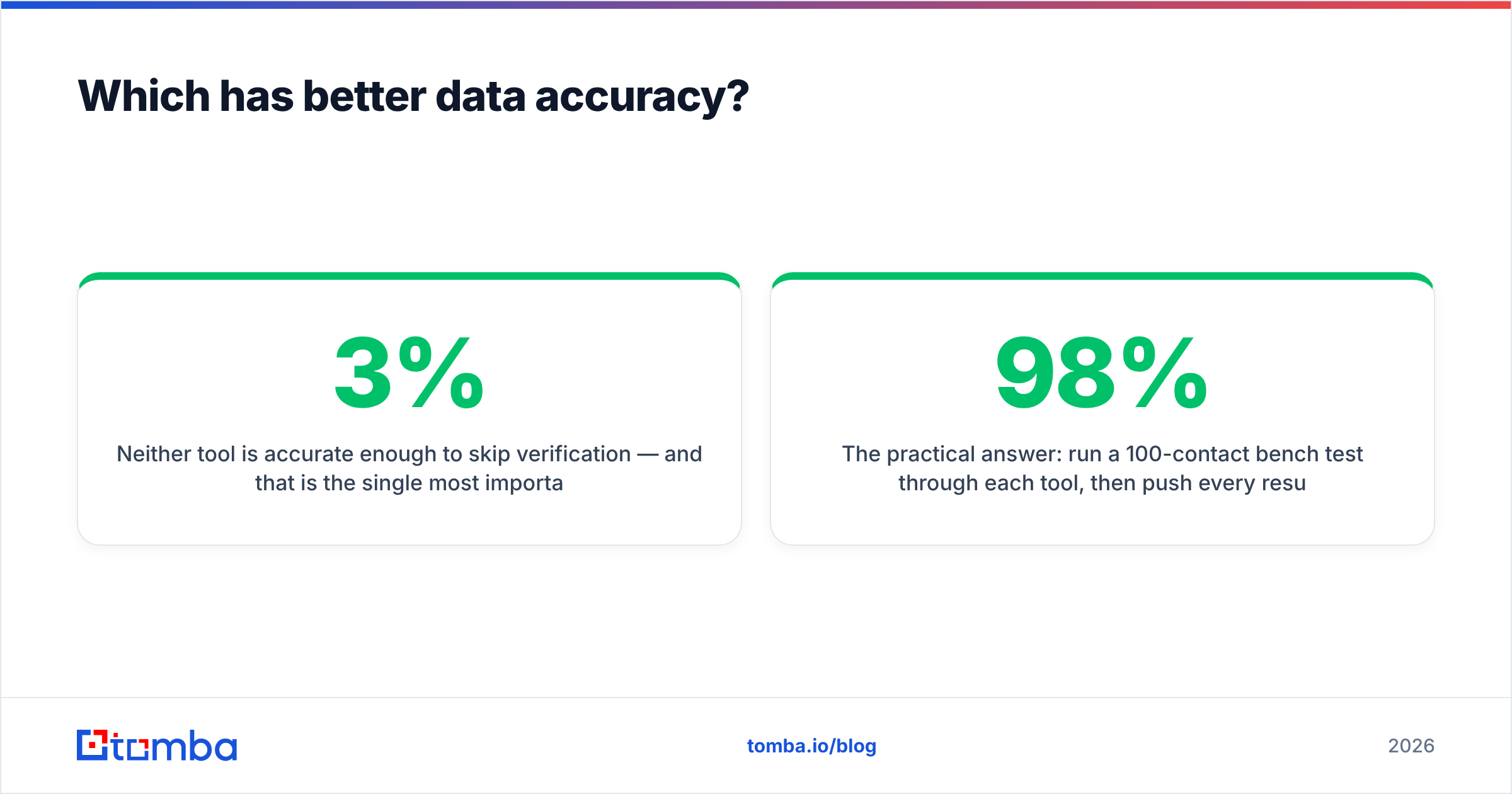
Neither tool is accurate enough to skip verification — and that is the single most important sentence in this article. B2B contact data decays at roughly 2–3% per month as people change jobs, so even a database that was 95% correct at build time is materially worse a quarter later. Generect's real-time approach mitigates some of that drift; Arounddeal's stored model is faster to query but more exposed to staleness between refresh cycles.
The practical answer: run a 100-contact bench test through each tool, then push every result through an independent email verifier and compare bounce rates. Vendor "98% accuracy" claims rarely survive contact with your real send infrastructure. If you want the methodology, our breakdown of where Tomba gets its data explains why multi-source validation beats any single feed.

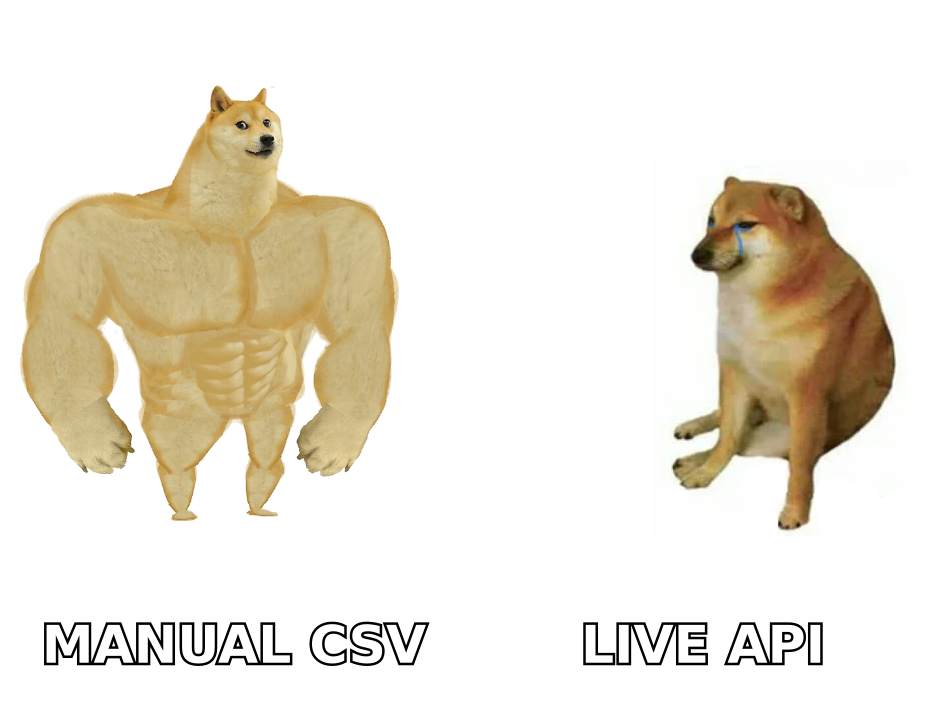
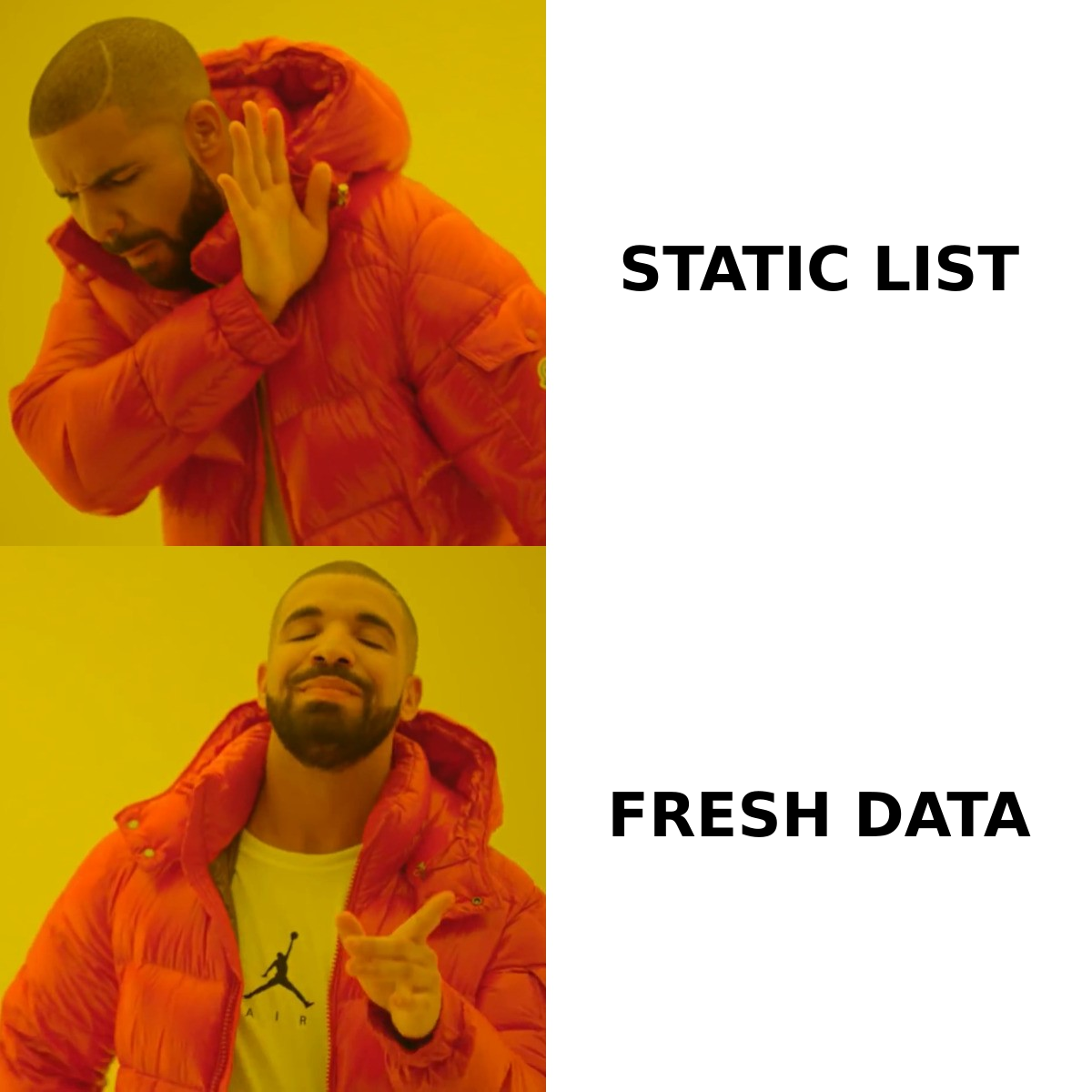
Correction: that image should render as below — a quick visual on how "grab a CSV once" ages against "pull fresh data on demand."
Which fits your workflow better?#
Match the tool to who is actually clicking the buttons.
Choose Arounddeal if:
- Your reps live in the browser and want contacts inline with LinkedIn and company pages.
- You want list-building, contact discovery, and light outreach in one place.
- Your team is non-technical and values a low learning curve over programmatic control.
Choose Generect if:
- You have engineering or RevOps capacity to integrate an API.
- You want data generated close to send-time rather than pulled from storage.
- You are building a custom enrichment or scoring pipeline and need raw, queryable access.
If you are weighing broader platforms too, it is worth scanning adjacent options like an Apollo alternative or a RocketReach alternative before you commit — the "data suite" category is crowded and feature overlap is high.
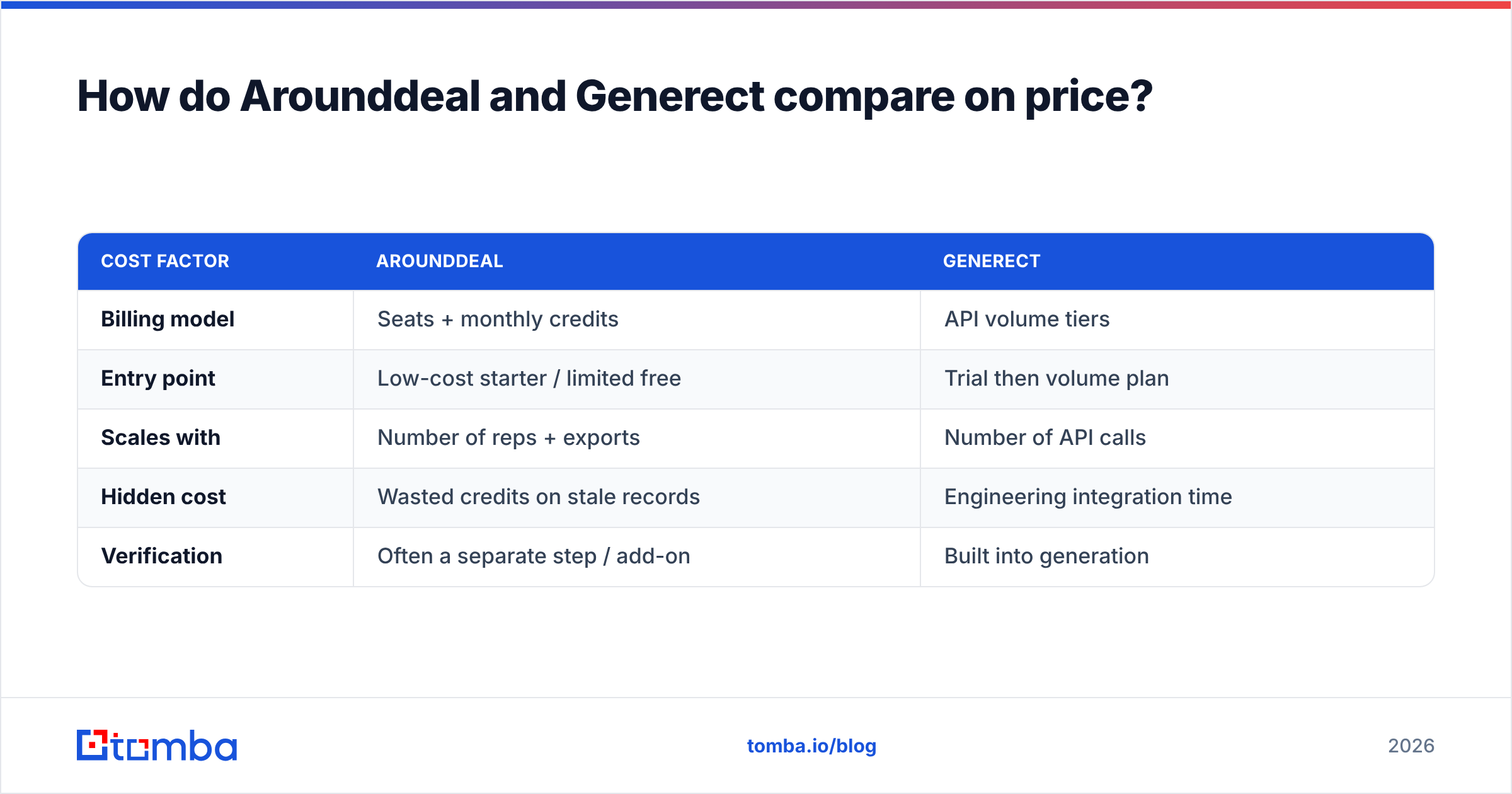
How do Arounddeal and Generect compare on price?#
Ignore the headline monthly number. The metric that controls ROI is cost per verified, deliverable contact, and you only get that by combining list price with real-world match and bounce rates.
| Cost factor | Arounddeal | Generect |
|---|---|---|
| Billing model | Seats + monthly credits | API volume tiers |
| Entry point | Low-cost starter / limited free | Trial then volume plan |
| Scales with | Number of reps + exports | Number of API calls |
| Hidden cost | Wasted credits on stale records | Engineering integration time |
| Verification | Often a separate step / add-on | Built into generation |
A plan that looks cheap but returns 20% undeliverable addresses is more expensive than a pricier plan at 5% bounce, because every bad send also damages your sender reputation. Factor deliverability into the cost equation, not just the invoice.
Where a dedicated email finder beats both#
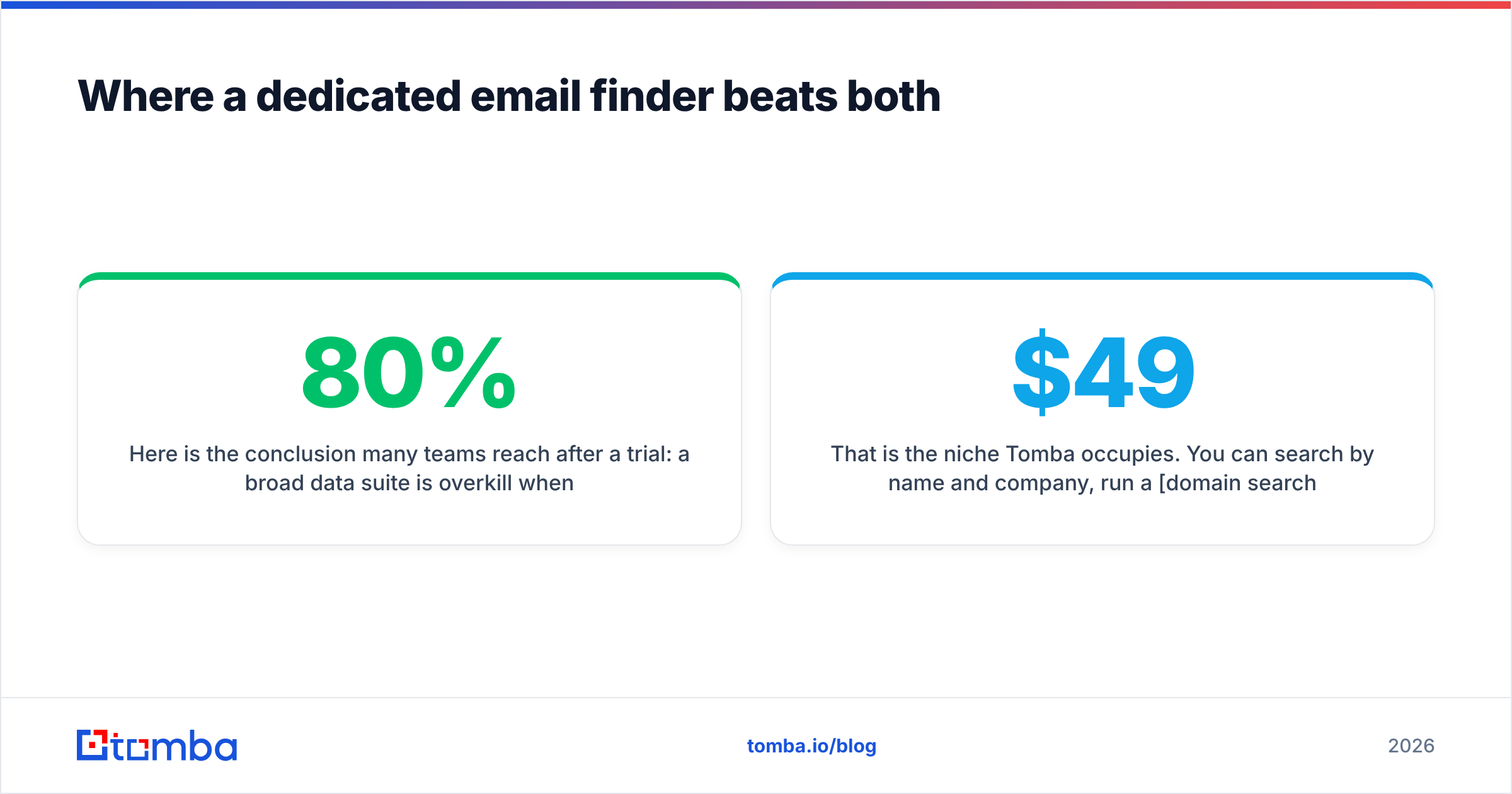
Here is the conclusion many teams reach after a trial: a broad data suite is overkill when 80% of your need is "find the right email for this specific person." General platforms spread their engineering across phones, firmographics, intent, and dashboards. A focused tool spends all of it on one job — finding and verifying professional email addresses — and tends to win on that axis.
That is the niche Tomba occupies. You can search by name and company, run a domain search to map every reachable contact at an account, verify in the same flow, and pull it all through the Tomba API if you need the programmatic control that drew you to Generect in the first place. Transparent Tomba pricing starts with a free tier of 25 searches per month, then $49/mo (Starter), $99/mo (Growth), and $249/mo (Pro) — so you can benchmark against Arounddeal and Generect on your own list before paying.
| Use case | Best fit |
|---|---|
| All-in-one SDR prospecting in-browser | Arounddeal |
| Programmatic real-time lead generation | Generect |
| High-accuracy email finding + verification | Tomba Email Finder |
| Mapping every contact at a target domain | Tomba Domain Search |
For outbound specifically, accuracy compounds: a cleaner list lifts your response rate and protects deliverability at the same time. Comparison tables on a vendor site won't tell you that — your own bounce report will.
How should you run a fair bake-off?#
Do not decide from review sites. Run a controlled test:
- Build one target list of 100 real prospects you actually want to reach.
- Run it through each tool — Arounddeal, Generect, and a dedicated finder — and record match rate and time-to-result.
- Verify every output through a single independent verifier so the goalposts don't move.
- Send a small, warmed campaign and log hard bounces per source.
- Divide total cost by deliverable contacts to get true cost-per-usable-record.
Whoever wins that table wins your budget. Industry analysts like G2 and Gartner are useful for shortlisting, but no aggregate score predicts how a tool performs on your specific accounts and regions.
The verdict on Arounddeal vs Generect#
Both are credible. Arounddeal is the friendlier all-in-one for hands-on SDR teams; Generect is the better programmatic engine for technical, real-time use cases. Neither removes the need to verify before you send, and neither is purpose-built for the single task most cold outreach actually depends on: a correct, deliverable email.
If that task is your real bottleneck, start with a focused tool. Try the Tomba Email Finder free — 25 searches a month, no card — find your next 100 prospects, verify them in the same flow, and compare the bounce rate against whatever suite you were about to buy. Let the deliverability numbers, not the feature grid, make the call.
// get started
Find, verify and enrich your first contacts today
Start on the free plan with 25 searches a month, then scale when your team is ready.
Free plan · No credit card required · GDPR & CCPA
// about the author