Arounddeal vs Prosperfleet Valgen: 2026 B2B Data Showdown
A neutral, hands-on breakdown of Arounddeal vs Prosperfleet Valgen for 2026 — accuracy, pricing, coverage, and where a focused email finder beats both.
TL;DR
- Arounddeal is a broad B2B sales-intelligence suite (contacts, intent, Chrome extension); Prosperfleet Valgen positions itself as a leaner, enrichment-first data layer for ops teams. Both sell "more data," but they win on different jobs.
- For raw contact coverage and intent signals, Arounddeal is the more complete platform. For clean enrichment pipelines and predictable per-record cost, Valgen is the simpler buy.
- Neither tool is built primarily as an email finder — and that gap is where deliverability quietly leaks. A focused finder + verifier stack usually beats a bundled "data cloud" on bounce rate.
- Pricing models differ sharply: Arounddeal sells credit tiers per seat; Valgen leans toward usage-based enrichment. Run the math on your volume before signing.
- If your real bottleneck is "find a verified work email for this person, fast," pair either platform with a dedicated email finder and email verifier.
If you are evaluating arounddeal vs prosperfleet valgen, you are almost certainly trying to answer one practical question: which one puts more accurate, reachable contacts into your sequences without inflating your bounce rate or your bill. This guide compares them on the attributes that actually move pipeline — and is honest about where a purpose-built tool does the job better than either suite.
What are Arounddeal and Prosperfleet Valgen?#
Arounddeal is a B2B sales-intelligence platform: a contact and company database, buyer-intent signals, and a browser extension that surfaces emails and phone numbers while you browse LinkedIn or company sites. It competes in the same category as Apollo, Lusha, and RocketReach — a "do most of prospecting in one place" suite. You can see how that category stacks up on independent review sites like G2.
Prosperfleet Valgen sits closer to the enrichment and data-operations end of the market. Its pitch is a cleaner pipeline: feed it a list of domains, names, or partial records, and it returns standardized, deduplicated, enriched rows. Less "browse and grab," more "process a list at volume." That makes it attractive to RevOps and lifecycle teams who care about CRM hygiene as much as net-new prospecting.
The distinction matters because the two tools optimize for different moments in the funnel. One helps a rep discover a contact; the other helps an ops team clean and complete records at scale. Calling them direct competitors is only half right.
How do Arounddeal and Prosperfleet Valgen compare head-to-head?#
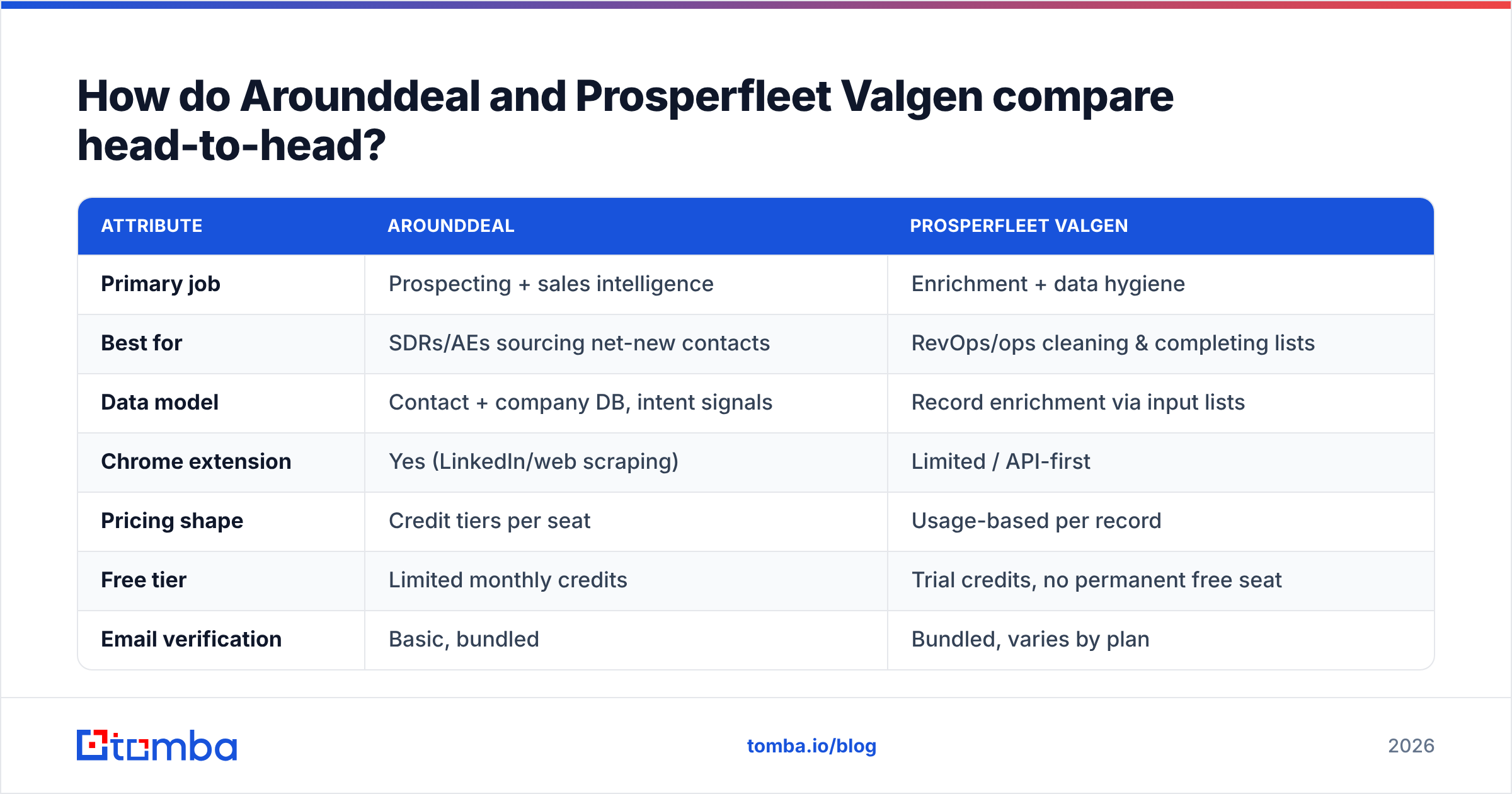
Here is the side-by-side most buyers actually want. Treat tier names and credit counts as directional — vendors reprice often, so confirm against each official site before you commit.
| Attribute | Arounddeal | Prosperfleet Valgen |
|---|---|---|
| Primary job | Prospecting + sales intelligence | Enrichment + data hygiene |
| Best for | SDRs/AEs sourcing net-new contacts | RevOps/ops cleaning & completing lists |
| Data model | Contact + company DB, intent signals | Record enrichment via input lists |
| Chrome extension | Yes (LinkedIn/web scraping) | Limited / API-first |
| Pricing shape | Credit tiers per seat | Usage-based per record |
| Free tier | Limited monthly credits | Trial credits, no permanent free seat |
| Email verification | Basic, bundled | Bundled, varies by plan |
| Phone/mobile data | Yes | Partial |
| API access | On higher tiers | Core to the product |
| Compliance posture | GDPR/CCPA stated | GDPR/CCPA stated |
The pattern: Arounddeal gives a rep more surface area (browse, find, enrich, watch intent), while Valgen gives an ops team more throughput and structure on lists they already own. If your team lives in LinkedIn tabs, Arounddeal feels native. If your team lives in a CRM and a spreadsheet, Valgen feels native.

Which tool has more accurate B2B data?#
Short answer: accuracy depends on the segment, and both will disappoint you somewhere. No database is uniformly fresh across every geography, seniority, and industry. Arounddeal tends to perform well on tech and mid-market roles where its community-sourced data is dense; Valgen's enrichment is only as good as the source feeds behind it, which can be strong on firmographics but thinner on direct-dial mobile numbers.
The number that should drive your decision is not "database size" — it is bounce rate on the emails you actually send. A platform can claim 100M+ contacts and still hand you a stale jsmith@ that hard-bounces and dings your sender reputation. That is why serious teams treat any bundled email field as a candidate, not a verified address, and run it through a dedicated verification step before it touches a live mailbox.

This is the quiet weakness of all-in-one suites: verification is a checkbox feature, not the core competency. A focused email verifier does SMTP checks, catch-all detection, and role-account filtering at a depth that bundled tools rarely match. If you are sending cold at volume, that depth is the difference between landing in the inbox and landing on a blocklist.
How do Arounddeal and Prosperfleet Valgen price out?#
Pricing is where the two diverge most, and where buyers most often overpay.
Arounddeal uses per-seat credit tiers. Each export or reveal spends a credit; more seats and more credits cost more. This is predictable for a fixed team but punishes spiky usage — a quarter-end list pull can blow through monthly credits fast.
Prosperfleet Valgen leans usage-based per enriched record. You pay for what you process, which is efficient for batch jobs but harder to forecast if your list volumes swing. Ops teams like the elasticity; finance teams sometimes don't.
| Cost factor | Arounddeal | Prosperfleet Valgen | Tomba |
|---|---|---|---|
| Model | Per-seat + credits | Usage / per record | Search-credit tiers |
| Entry paid tier | Mid (varies) | Usage-based | $49/mo Starter |
| Free option | Limited credits | Trial only | 25 searches/mo free |
| Best at volume | Predictable teams | Batch enrichment | Targeted finding + verify |
| Overage risk | Credit burn | Volume spikes | Transparent tiers |
For reference, Tomba pricing runs a permanent Free tier (25 searches/mo), Starter at $49/mo, Growth at $99/mo, and Pro at $249/mo — a search-credit model that sits between Arounddeal's seat rigidity and Valgen's usage variability. The point is not that one model is universally cheaper; it is that you should map each model to your real monthly pattern, not the demo's happy path.
When should you pick a focused email finder instead?#
Pick a focused finder when your bottleneck is "get a verified work email for this specific person or domain, now" — which, for most outbound and recruiting teams, is the actual daily job.
Suites are excellent at breadth and weak at depth on this one task. A dedicated finder is the inverse. Concretely, reach for a focused tool when:
- You need to find emails by domain for a target account list, not browse one profile at a time. That is exactly what domain search does — feed it a company, get the verified pattern and named contacts.
- You are running bulk jobs and need a clean CSV in, verified contacts out, without a per-seat tax. A bulk email finder handles that in one pass.
- You want finding and verification wired into your stack via an email finder API, CRM, or Google Sheets rather than a standalone dashboard.
- Deliverability is the metric you're judged on, so you want catch-all handling and SMTP verification built in, not bolted on.

This is not an argument against Arounddeal or Valgen — it is an argument for matching the tool to the job. Many teams run a suite for discovery and intent, then route every email through a focused finder/verifier before sending. The two approaches are complementary, not mutually exclusive.
What about compliance and data sourcing?#
Both vendors state GDPR and CCPA alignment, which is table stakes in 2026, not a differentiator. The real questions are how the data is sourced and whether you can honor a deletion request end-to-end.
Community-sourced and contributory data models (common in browser-extension suites like Arounddeal) raise legitimate-interest questions in the EU that you should review with counsel for your specific use case. Enrichment-first tools like Valgen inherit the compliance posture of their upstream data partners, which can be harder to audit because the chain is longer.
Whatever you choose, two practices protect you: keep a clear record of your lawful basis for processing, and verify before you contact so you are not emailing addresses that no longer belong to a real, reachable person. Transparency about data sources should be a hard requirement in your vendor questionnaire — if a provider can't explain where a record came from, treat that as a red flag. For the regulatory baseline, the official GDPR text is the canonical reference.
Arounddeal vs Prosperfleet Valgen: which should you choose?#
Here is the decision in plain terms:
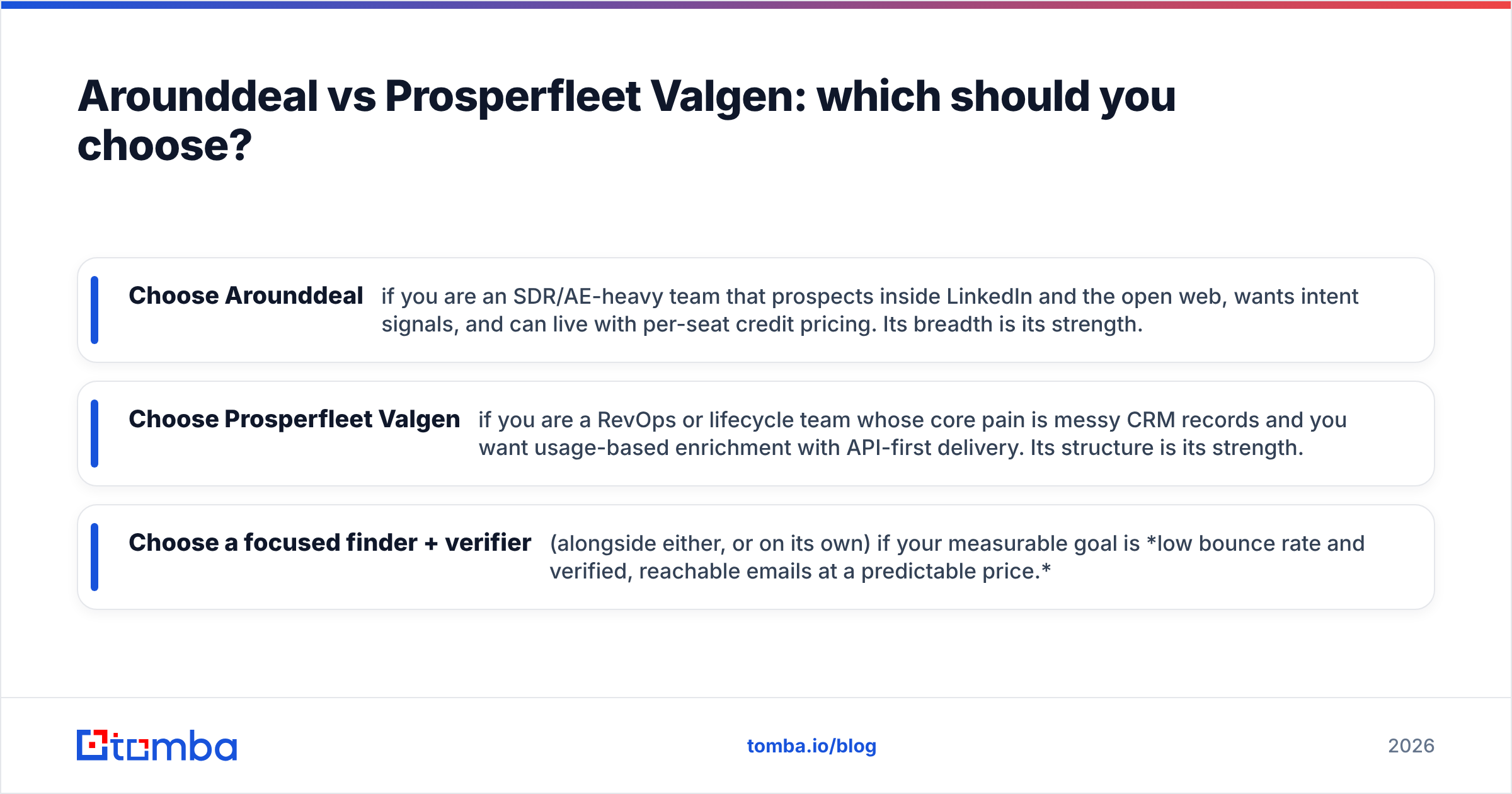
- Choose Arounddeal if you are an SDR/AE-heavy team that prospects inside LinkedIn and the open web, wants intent signals, and can live with per-seat credit pricing. Its breadth is its strength.
- Choose Prosperfleet Valgen if you are a RevOps or lifecycle team whose core pain is messy CRM records and you want usage-based enrichment with API-first delivery. Its structure is its strength.
- Choose a focused finder + verifier (alongside either, or on its own) if your measurable goal is low bounce rate and verified, reachable emails at a predictable price.
Most teams I've watched make this decision end up with a hybrid: a suite for discovery, a dedicated finder for the last-mile "is this email real and reachable" step. That second step is the one that protects email deliverability, and it's the one suites under-invest in. You can also sanity-check any single address for free with a free email checker before committing it to a sequence.
A final word on evaluation discipline: don't buy on database-size headlines. Run a blind accuracy test — pull 100 contacts from each tool for your exact ICP, send through verification, and compare valid-rate and bounce-rate. The winner on your data is the only benchmark that matters.

The bottom line#
Arounddeal vs Prosperfleet Valgen is really a question about your team's shape, not about which vendor is "best." Arounddeal wins on prospecting breadth and intent; Valgen wins on clean, usage-based enrichment; and neither is engineered to be the deepest email finder in your stack.
If your scorecard is deliverability and verified reach, start with the tool that treats finding-and-verifying as the main event, not a feature. The Tomba Email Finder finds professional emails by domain, name, or company, pairs natively with a verifier and catch-all detection, and prices transparently — Free (25 searches/mo), Starter $49/mo, Growth $99/mo. Run it against your ICP next to whichever suite you're testing, compare valid-rates side by side, and let the bounce numbers pick the winner.
// get started
Find, verify and enrich your first contacts today
Start on the free plan with 25 searches a month, then scale when your team is ready.
Free plan · No credit card required · GDPR & CCPA
// about the author